The Complete Enterprise Web Development Ecosystem: Web Apps, PWAs, and Scalable Architectures
In the modern hyper-connected digital economy, an organization’s web infrastructure is no longer just a digital storefront—it is the primary vehicle driving global revenue, operational automation, and customer lifecycle engagement. To remain competitive, enterprise architects and engineering leaders must strategically select the right application design patterns and technology stacks. Making the correct choice balances runtime performance, long-term development velocity, strict data security, and seamless user experiences across every device.
1. Architectural Paradigms: Traditional Web Applications vs. Progressive Web Apps (PWAs)
Choosing between a standard web application and a Progressive Web App dictates how your code interacts with client browsers, handles flaky network connections, and leverages physical device hardware.
Web Applications (Single-Page & Multi-Page Apps)
Modern web applications function as fully dynamic, interactive, and distributed software systems natively accessible via any internet browser. Unlike static websites of the past, web apps process multi-layered data streams, maintain complex user session states across distributed servers, and execute heavy computational logic on both the server side and the client browser engine.
High-scale enterprise architectures typically move away from monolithic builds in favor of decentralized microservices architectures. These individual, loosely coupled components handle distinct business capabilities and exchange structured data in real time via high-throughput RESTful APIs, highly tailored GraphQL endpoints, or low-latency gRPC protocols.
Progressive Web Apps (PWAs)
PWAs represent a massive evolutionary leap, bridging the gap between traditional web browsers and native mobile applications. Built entirely using open web standards (HTML5, CSS3, JavaScript/TypeScript) and bound together by a web app manifest file, PWAs provide an immersive, native-app feel directly inside desktop or mobile browsers—eliminating the need to download heavy binaries from third-party app stores.
The underlying magic of a PWA is driven by Service Workers. These event-driven background scripts run entirely separate from the main browser web page thread, acting as a programmable network proxy that intercepts requests, manages deep asset caching, and handles background tasks.
Resilient Offline Functionality: Service Workers establish aggressive, intelligent caching strategies (such as Cache-First or Stale-While-Revalidate). By caching critical UI assets, shell architectures, and dynamic API JSON responses locally, the application continues to run smoothly even during complete network dropouts or on low-bandwidth networks.
Contextual Push Notifications: Using the Web Push API and asynchronous service worker listeners, enterprises can broadcast real-time, personalized push alerts to a user’s device lock screen. This background communication channel drives user retention and re-engagement metrics that directly rival native iOS and Android installations.
Deeper Local Hardware Access: Modern web APIs allow PWAs to interact directly with native device hardware. Applications can securely query real-time GPS geolocation data, capture high-definition media streams via integrated camera and microphone arrays, trigger local biometric authentication (like TouchID/FaceID via WebAuthn), and manage local file systems.
Zero-Install Friction: PWAs use a lightweight browser installation framework. When a user meets specific engagement criteria, the browser surfaces a native “Add to Home Screen” prompt. The application instantly installs as a standalone window onto the device desktop or app drawer, completely bypassing app store distribution fees, continuous review delays, and download drop-off friction.
2. The Multi-Tiered Enterprise Technological Stack
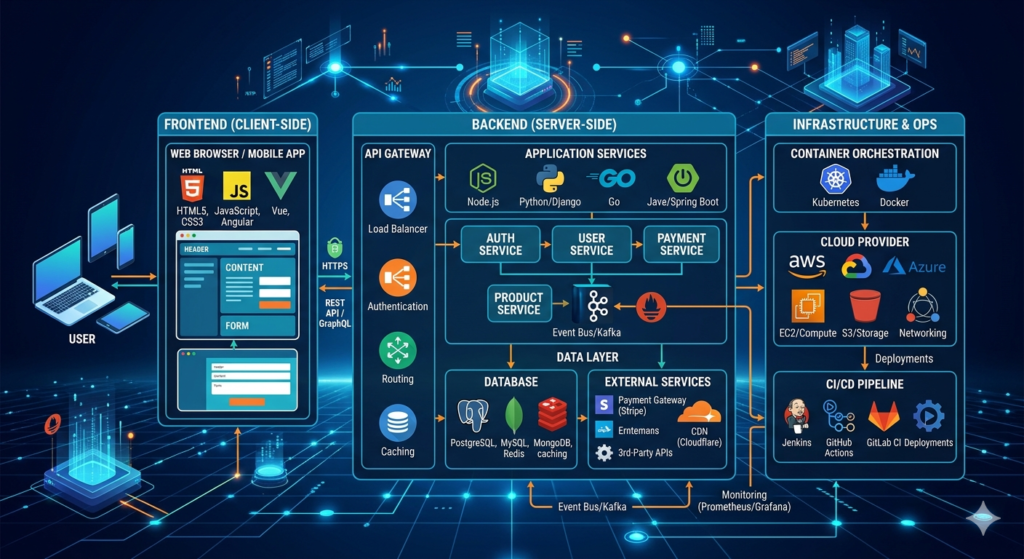
Building resilient, fault-tolerant enterprise web platforms requires assembling a complementary, highly specialized technology stack. Each layer must be carefully engineered to ensure horizontal scalability, low latency, and zero-trust security compliance.
A. The Frontend Ecosystem
The user interface layer is responsible for rendering data rapidly, managing local application states, and guaranteeing smooth interactive execution across variable device form factors.
Component-Driven Libraries (React.js, Vue.js, Angular): These structural frameworks isolate user interfaces into modular, reusable components. By utilizing a virtual Document Object Model (DOM) or fine-grained reactivity tracking, they recalculate and re-render only the exact UI elements that change, preventing costly browser layout recalculations.
Advanced Rendering Architectures (Next.js, Nuxt.js): To maximize Search Engine Optimization (SEO) rankings and drastically reduce the Time to First Byte (TTFB), production setups combine client-side rendering with Server-Side Rendering (SSR) and Static Site Generation (SSG). This pre-compiles pages into flat HTML on the server before dispatching them to the client browser.
Type-Safe Application Development (TypeScript): Replacing vanilla JavaScript with TypeScript introduces a powerful static type system. This catches structural bugs during compilation rather than at runtime, facilitates seamless refactoring across massive codebases, and provides clean code auto-completion for large engineering teams.
Modern Utility CSS Systems (Tailwind CSS, SASS): Utilizing utility-first styling frameworks ensures optimized, compiled style sheets. Tailwind CSS processes code to purge unused style classes, keeping final production asset packages incredibly light and fast to download.
B. Backend & API Frameworks
The backend service layer serves as the brains of the operation—handling enterprise business logic, enforcing database security parameters, and processing cross-service communication.
Event-Driven Concurrency (Node.js – Express & NestJS): Utilizing an asynchronous, non-blocking I/O event loop, Node.js excels at processing tens of thousands of concurrent network connections simultaneously, making it ideal for real-time applications and API aggregation layers.
High-Performance Computational Backends (Python – Django & FastAPI): FastAPI leverages asynchronous Python standards to deliver lightning-fast execution speeds alongside automatic OpenAPI documentation generation. Python backend ecosystems are highly favored when web apps need to interface directly with downstream AI models, machine learning microservices, or complex data science processing pipelines.
Enterprise Structural Stability (PHP – Laravel / Java – Spring Boot): Frameworks like Laravel provide a highly structured Model-View-Controller (MVC) architecture, built-in Object-Relational Mapping (ORM), robust background queue workers, and out-of-the-box security implementations that accelerate development velocity for transactional e-commerce platforms.
Compile-Time Speed and Scale (GoLang): Used for intensive core microservices, GoLang compiles directly to machine code, utilizing incredibly lightweight threads (Goroutines) to maximize hardware utilization and minimize memory usage.
C. Database Systems & Memory Storage
Data architecture must separate operational storage based on data structures, consistency guarantees, and access speeds.
ACID-Compliant Relational Databases (PostgreSQL, MySQL): Essential for critical transactional processes (such as payment ledgers, user authentication records, and core inventory management). These systems enforce strict relational schemas, foreign key constraints, and multi-version concurrency control (MVCC) to guarantee absolute data validity.
Dynamic Non-Relational Databases (MongoDB, DynamoDB): Designed for flexible, schema-less document objects. These NoSQL document stores scale out horizontally across distributed clusters, making them ideal for high-velocity logging data, flexible product catalogs, content management, and unstructured metadata.
In-Memory Caching & Session Stores (Redis): Operating entirely within system RAM, Redis reduces the burden on persistent databases by serving cached database queries, managing real-time API rate limits, and processing ephemeral user session variables in fractions of a millisecond.
D. DevOps & Cloud Infrastructure
Modern deployment frameworks move away from manual server configurations in favor of fully automated, immutable infrastructure pipelines.
Containerization (Docker): Packaging application code, runtimes, system tools, and dependencies into uniform Docker images isolates software from the underlying host environment. This guarantees that code executing perfectly on an engineer’s laptop runs identically in production cloud nodes.
Container Orchestration (Kubernetes): For complex distributed systems, Kubernetes (K8s) automates container deployment, scales container replicas up or down based on real-time CPU/Memory pressures, handles internal load balancing, and self-heals by instantly replacing crashed containers.
Continuous Integration & Continuous Deployment (CI/CD): Platforms like GitHub Actions or Jenkins automatically run automated linting, security vulnerability vulnerability scans, and comprehensive unit/integration test suites every time code is pushed. Once validated, the pipeline automatically deploys the updated code to production with zero downtime.
Hyperscale Cloud Infrastructure (AWS, Azure, GCP): Managing infrastructure using Cloud platforms provides immediate access to globally distributed datacenters, managed serverless compute clusters, durable block storage, and integrated security compliance layers—allowing application architectures to scale globally on demand.