The Convergence Paradigm: Accelerating Enterprise Velocity with Unified AI-IoT-ERP-CRM Architecture
In the modern industrial landscape, operational friction is a direct byproduct of systemic fragmentation. Traditional enterprises operate within a multi-tiered software deficit: ERP (Enterprise Resource Planning) systems act as passive historical ledgers; CRM (Customer Relationship Management) platforms function as disconnected engagement silos; and IoT (Internet of Things) networks generate massive streams of edge data that sit unutilized in isolated lakes.
By merging ERP, CRM, IoT, and AI into a single, closed-loop digital ecosystem, we have eliminated the operational latency inherent in disconnected tech stacks.
Here is a detailed breakdown of our architectural approach, our deployment methodology, and the unique capabilities of this powerful combination.
1. The Power of the Triad: Why This Integration is Unique
Most software architectures rely on middleware or asynchronous batch processing APIs to pass data between systems. This creates a severe time deficit. Our platform treats IoT telemetry, ERP asset states, and CRM customer profiles as a single, fluid data fabric.
The Unified Feedback Loop
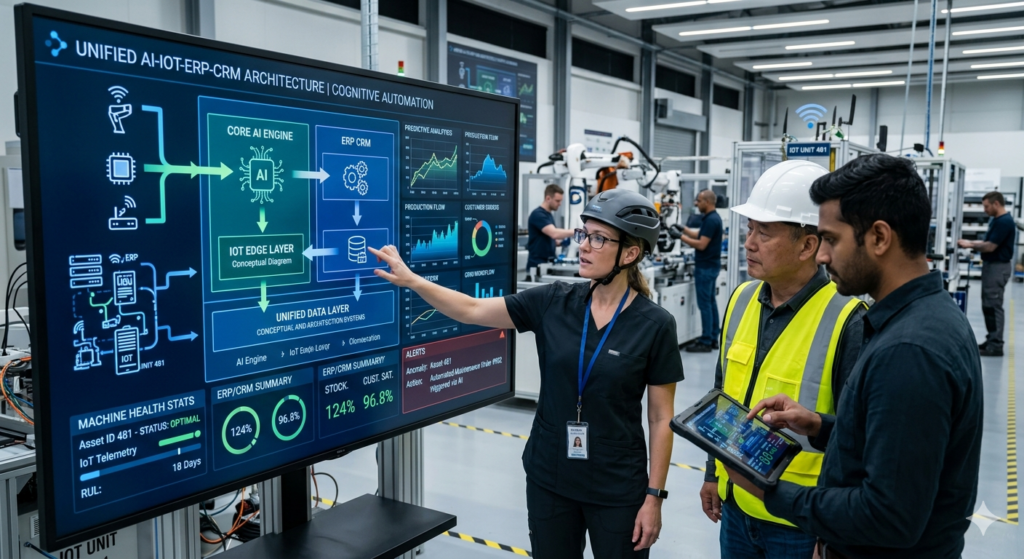
When an industrial asset or customer touchpoint generates data, it does not simply wait for a nightly sync. The architecture processes the event through a continuous three-way loop:
The IoT Edge Layer captures high-frequency physical telemetry (vibration, thermal dynamics, utilization rates, behavioral interactions).
The Unified ERP-CRM Data Layer immediately maps this telemetry against contractual agreements, inventory levels, financial depreciation schedules, and customer lifetime value metrics.
The Core AI Engine runs real-time inference on the combined dataset to execute autonomous operational workflows, trigger predictive customer dispatches, or modify supply chain queues without human intervention.
2. Technical Architecture & How We Do It
Our platform bypasses brittle third-party integrations by utilizing a native, highly available cloud-edge hybrid architecture engineered for low latency and infinite horizontal scalability.
A. Real-Time Ingestion & Streaming (The IoT Layer)
Protocol Aggregation: The edge layer ingests multi-protocol data streams—including MQTT, CoAP, OPC-UA, and Modbus TCP/IP—via localized edge gateways.
High-Velocity Data Pipeline: Telemetry is written directly to a distributed streaming broker (Apache Kafka), ensuring zero-loss ingestion even at a throughput of millions of events per second.
Time-Series Storage: Telemetry data is funneled into optimized time-series databases for instantaneous historical analysis and anomaly baseline comparisons.
B. Cognitive Processing (The AI Layer)
Real-Time Inference: Rather than processing data in batches, the system runs incoming IoT and transactional data through continuous inference models.
Anomaly & Pattern Recognition: Utilizing deep learning structures—including Long Short-Term Memory (LSTM) networks and Isolation Forests—the AI recognizes operational anomalies or subtle drops in customer engagement metrics with extreme precision.
Prescriptive Multi-Agent Systems: When a threshold is crossed, the AI does not just issue a static alert; it deploys specialized digital agents to orchestrate multi-system resolutions across your business operations.
C. The Central Ledger (The ERP/CRM Layer)
Single Source of Truth: Financial parameters, asset BOMs (Bill of Materials), service level agreements (SLAs), and customer accounts are co-located within a highly secure, relational database cluster.
Deterministic State Engine: Every operational adjustment triggered by AI-IoT observations translates directly into accounting entries, supply ledger modifications, or CRM pipeline updates via transactional state verification.
3. Our Strategic Approach: From Data Ingestion to Autonomous Action
We approach enterprise transformation through a structured, multi-phase methodology that ensures rapid deployment while maintaining system stability and compliance.
Phase 1: Edge Harmonization & Baseline Modeling
We deploy secure edge hardware or interface with your existing sensor arrays to capture structural data. During this phase, our AI ingests your historical enterprise data to establish clear baselines for operational performance, customer interaction dynamics, and financial cycles.
Phase 2: Structural Data Convergence
We consolidate your existing ERP registries and CRM databases into our unified data layer. This step eliminates duplicate profiles and maps every physical asset or service element directly to its corresponding financial owner, vendor contract, and customer account.
Phase 3: Activating Cognitive Automation
With the data pathways unified, we activate our prescriptive AI agents. We configure the system’s operational boundaries, allowing the software to transition safely from human-in-the-loop validation to completely autonomous decision-making and operational execution.
4. Cross-Functional Enterprise Capabilities
To understand the practical leverage of this architecture, consider how these four pillars intersect across your core business functions:
Operational Predictive Maintenance Connected directly to the CRM
Traditional predictive maintenance alerts an engineer that a machine is failing. Our system goes further:
IoT detects a bearing anomaly on an field-deployed medical device.
AI calculates the remaining useful life (RUL) and confirms a failure will occur within 48 hours.
ERP cross-references the factory parts inventory, reserves the required replacement component, and generates an internal logistics order.
CRM automatically reviews the customer’s SLA tier, selects an available field technician with the appropriate clearance, schedules an urgent on-site visit, and sends an automated notification to the client with the technician’s ETA—all within seconds of the initial sensor drop.
Smart Supply Chain Optimization Driven by Customer Demand
CRM records a sharp, regional spike in contract negotiations and custom product configurations.
AI runs predictive analysis on this customer pipeline and forecasts a 35% surge in specific raw material requirements over the next quarter.
IoT tracking on current transit fleets confirms transit delays due to regional weather patterns.
ERP automatically adjusts the safety stock thresholds, issues digital Purchase Orders to alternative, pre-vetted suppliers, and restructures factory production schedules to prevent bottlenecks before the pipeline deals are even signed.
Usage-Based, Dynamic Monetization
IoT tracks exact utilization metrics, power draws, or throughput configurations of an asset leased by a client.
AI analyzes the usage patterns to optimize performance variables and spot opportunities for efficiency upgrades.
CRM captures this optimization data to trigger contextual up-sell or cross-sell recommendations for account managers.
ERP processes the continuous usage data to generate micro-billing invoices on a dynamic, consumption-based subscription model.
5. Security, Resilience, and Compliance by Design
Operating at the intersection of physical infrastructure and financial records requires uncompromising security frameworks.
Zero-Trust Edge Security: Every IoT gateway utilizes hardware-root-of-trust authentication and asymmetric cryptographic keys to prevent spoofing or unauthorized access at the physical layer.
Comprehensive Data Privacy: Built natively around stringent global regulations, including GDPR, HIPAA, and SOC 2 Type II, the platform enforces granular, role-based access control (RBAC) over sensitive customer metrics and financial ledgers.
End-to-End Encryption: All data streams are fortified using AES-256 bit encryption at rest and TLS 1.3 encryption in transit, guaranteeing absolute confidentiality from edge to core.
Achieve Absolute Business Orchestration
By unifying ERP, CRM, IoT, and AI into a singular, cohesive digital architecture, your business transitions from a reactive posture to an autonomous operating model. We eliminate systemic blind spots, strip out manual inefficiencies, and unlock hidden revenue vectors across your entire value chain.
Partner with our enterprise architecture team today to design a tailored technical demonstration.