
A cold storage temperature monitoring system continuously records storage conditions, preserves readings during connectivity failures, and alerts named people when conditions cross product-specific limits. A reliable design also shows where sensors are placed, who acknowledged each alarm, which stock may have been exposed, and what action followed.

Why can a temperature log still fail to prevent product loss?
A spreadsheet, wall display or data logger can prove that somebody recorded a reading. It may still fail operationally if the reading arrives after the damage, if the probe represents only one easy location, or if an alarm has no accountable recipient. The business problem is the time between a condition changing and a competent person taking a documented action.
Start with three recent events: a power interruption, an unexpectedly long door opening and a refrigeration fault. Reconstruct when the condition began, when staff noticed it, who decided what to do and how the affected stock was identified. If any timestamp or owner is missing, the monitoring workflow has a gap even if the equipment produced a graph.
| What you observe | Likely workflow gap | First useful test |
|---|---|---|
| One stable sensor while products near the door warm | Placement does not represent the room | Map hot and cold points under normal loading |
| Many alerts but slow response | No ownership, escalation or alarm delay | Replay an alert and time acknowledgement |
| Blank graph during an outage | No local buffering or device-health alarm | Disconnect the gateway during a controlled test |
| Excursion recorded but affected stock unknown | Telemetry is not linked to zone, time and inventory movement | Trace one pallet through receipt, storage and dispatch |
What does a useful cold storage temperature monitoring system control?
A useful system controls evidence and response rather than refrigeration physics. It captures readings from approved locations, adds reliable timestamps, stores data through temporary outages, applies the correct limits, routes alarms, records acknowledgement and supports a decision about exposed stock. It should not silently decide that a product is safe.
The control boundary matters. A monitoring platform can signal that a threshold or rate-of-change rule was breached. Refrigeration technicians diagnose equipment. QA or the responsible business owner decides how product-specific evidence should be interpreted. Automatic control of compressors, defrost cycles or backup equipment belongs in a separately engineered control layer with appropriate safeguards.
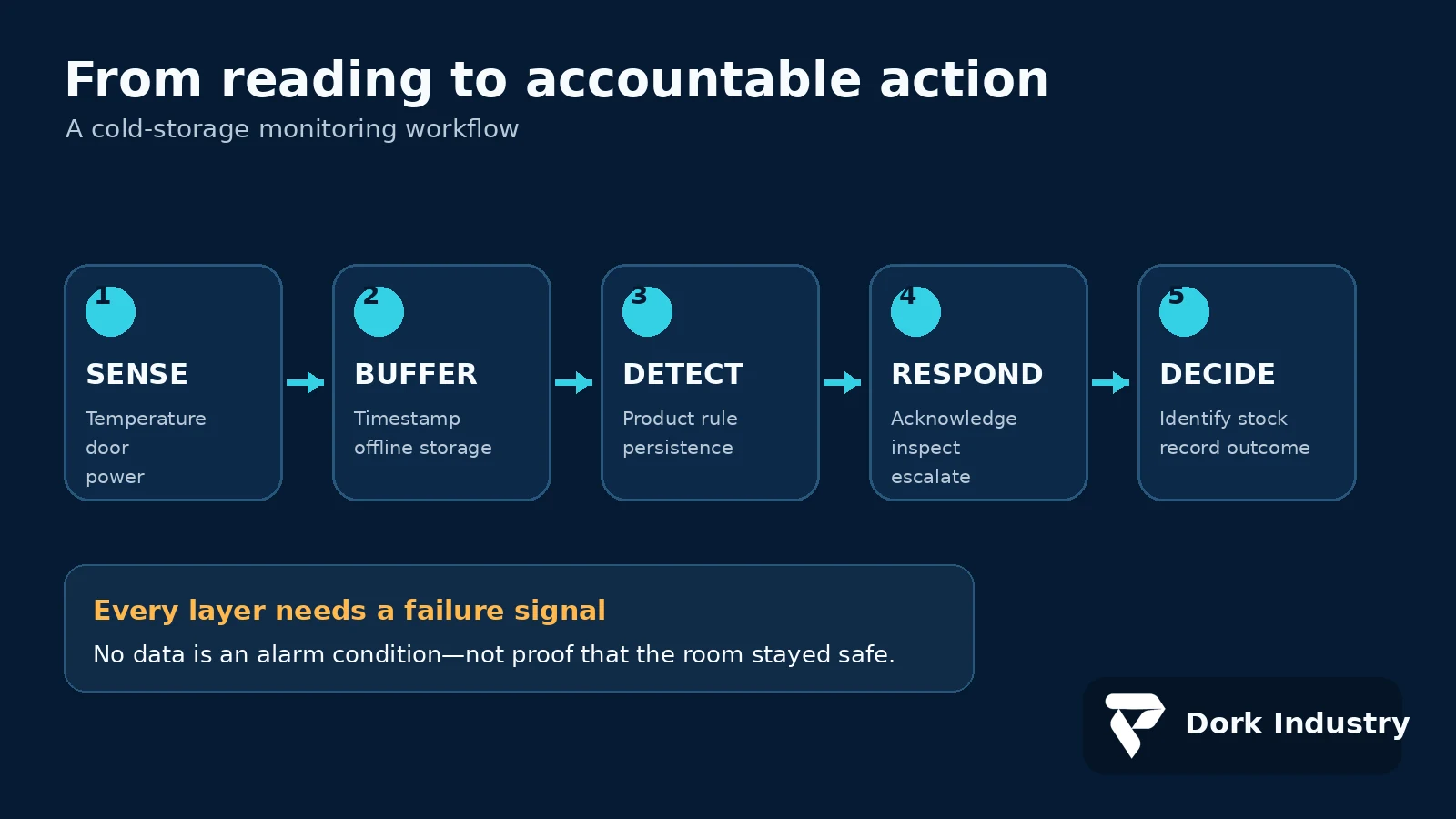
How should the cold storage temperature monitoring system architecture work?
Build the workflow in six layers: sensing, edge capture, connectivity, data storage, alert orchestration and human action. Each layer needs a failure signal. A dashboard that only shows temperature can look healthy while its gateway, clock, mobile notification service or backup power has already failed.
- Sensors measure temperature and, where relevant, humidity, door state, power status or equipment signals.
- An edge logger or gateway timestamps readings and retains them when the network is unavailable.
- Connectivity carries data by Ethernet, Wi-Fi, cellular or an appropriate low-power network; the choice follows the building and coverage test.
- A time-series store keeps readings, configuration changes, device health and audit events.
- An alert service applies product or zone rules, delays and escalation paths.
- People and operating procedures acknowledge the alarm, inspect the room, protect stock and record the outcome.
Separate a data gap from a safe reading. “No data for ten minutes” is not the same as “temperature remained within range for ten minutes.” Device heartbeat, battery status, last successful upload and clock synchronization should be visible beside the measurement.
Where should a cold storage temperature monitoring system place sensors?
Place sensors after mapping the real room under representative loading, airflow, door use and defrost conditions. One probe beside the refrigeration return or an easy wall can miss the area where products experience the greatest exposure. The number and locations depend on room geometry, racking, air movement, products and operating pattern.
FSSAI’s fish-sector guidance states that the temperature sensor should be located at the warmest place in cold storage. That is a useful principle, but the warmest point should be established through mapping rather than guessed. FSSAI’s broader storage and transportation training material also treats monitoring as part of the operating system around safe storage, distribution and transport.
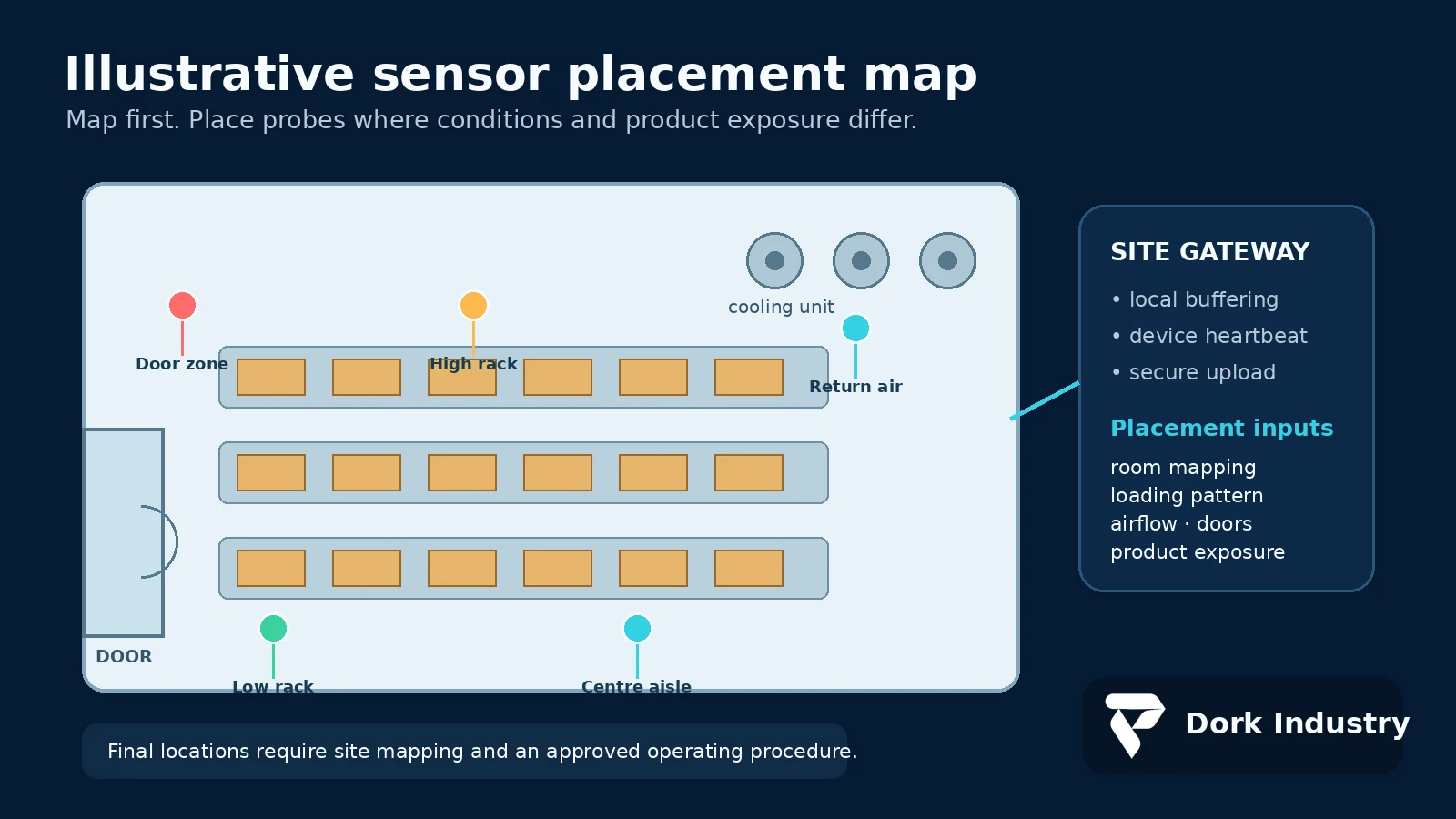
Record the sensor ID, physical location, height, zone, product served, installation date and calibration status. Photograph the position. When racking or airflow changes, review the map. Keep probes away from obvious local effects unless that location represents product exposure you need to measure.
How should cold storage temperature monitoring system alerts prompt action?
An alarm needs a threshold, persistence rule, recipient, acknowledgement time and escalation path. A short door opening may not require the same response as a refrigeration failure. Configure delays and hysteresis from the approved operating procedure so readings near a boundary do not create repeated on-off alerts.
| Alert element | Decision to document | Pilot evidence |
|---|---|---|
| Limit | Which product or zone rule applies? | Approved configuration and version |
| Persistence | How long must the condition continue? | Controlled excursion replay |
| Primary owner | Who is on duty and able to act? | Delivery and acknowledgement timestamp |
| Escalation | Who receives an unacknowledged alarm? | Timed escalation test |
| Resolution | What observation closes the event? | Reason, action, evidence and approver |
Send the recipient enough context to act: site, room, sensor, current reading, limit, duration, trend direction and a link to the response procedure. Protect alarm channels from casual changes. Record who changed a rule and when. Test notification delivery on every shift, including weekends and periods of weak connectivity.
What happens during a power or network failure?
The monitoring design should fail visibly. Provide appropriate backup power for the sensing and gateway layer, store readings locally and synchronize them when connectivity returns. Notify the team when the monitoring system itself becomes unavailable. A gateway that loses power with the refrigeration unit cannot report the developing condition unless its backup is independent.
Define the minimum local storage period from realistic outage scenarios. Test buffered upload order, duplicate handling and timestamp integrity. A reconnection should not overwrite earlier readings or create false continuity. If two network paths are justified, verify the failover at the site rather than assuming advertised coverage.
Offline resilience does not mean unlimited autonomy. A local buzzer or display may help nearby staff, but it does not replace escalation to the person responsible for stock. Manual checks can remain a contingency procedure; record when they begin, their frequency and how they reconcile with recovered electronic data.
How should an excursion be connected to affected stock?
A temperature graph alone cannot identify which pallets were present. Connect each room or zone to receipt, movement and dispatch timestamps. When an event occurs, the system should produce a candidate exposure list based on location and time. QA then reviews the product specification, evidence and applicable procedure before disposition.
Do not label stock “safe” because the temperature returned to normal. Preserve the original readings, event duration, device status, door and power events, actions taken and the identity of the decision maker. Isolate uncertain stock operationally while it is reviewed. The monitoring application can support this workflow without making a clinical, food-safety or commercial judgement.
For facilities in Narela or the Kundli–Sonipat belt, the useful integration may be small: a zone identifier in the WMS, a dispatch hold flag and a link from the incident to affected lots. Start with one direction of data exchange. Use stable event and lot IDs so a retry does not create duplicate holds or duplicate incident records.
What data, privacy and security controls are required?
Give each device a unique identity, restrict configuration changes by role and encrypt data in transit. Remove default credentials, document firmware ownership and decide how security updates will be delivered. Keep an inventory of sensors, gateways, SIMs, certificates and software versions. The US National Institute of Standards and Technology describes device identification, configuration, data protection, interface control and software update among the core cybersecurity capabilities for IoT devices.
Set retention periods from business and applicable regulatory needs. Separate operational telemetry from employee or customer data. If the dashboard shows staff acknowledgement or location, limit access to the people who need it and retain only what supports the process. Back up configuration and incident evidence, then test restoration.
Ask vendors who can access the data, where it is stored, how exports work, what happens when the subscription ends and whether alerts depend on a third-party service. Include device replacement and certificate renewal in operating cost. A low hardware price can hide the long-term work of calibration, connectivity, support and evidence retention.
Should you buy devices, configure a platform or build an integration?
Use the least complex option that passes the site tests. Standalone data loggers may fit a small room with a simple review process. A managed monitoring platform can suit multiple rooms and standard alerting. Custom software is justified when existing telemetry must connect to WMS, ERP, maintenance, batch disposition or multi-site operating rules that a standard product cannot represent.
| Option | Suitable when | Verify before buying |
|---|---|---|
| Standalone logger | Few locations, manual review is acceptable | Memory, export, calibration, clock and alarm method |
| Managed IoT platform | Standard monitoring across rooms or sites | Offline operation, alert escalation, ownership, export and support |
| Configure existing BMS/SCADA | Reliable building controls and technicians already exist | Sensor coverage, remote access, audit trail and business-user workflow |
| Custom integration | Events must affect inventory, QA, maintenance or customer reporting | APIs, identifiers, retry logic, validation, cybersecurity and maintenance |
Compare total ownership cost: sensors, calibration, gateways, SIM or network charges, cloud fees, SMS or messaging, installation, mapping, training, replacements and support. Ask each vendor to demonstrate a network outage, an unacknowledged alarm, a sensor failure and a historical export using your workflow.
Where should AI be used—and avoided?
AI can help rank abnormal patterns, identify recurring door-open events and flag equipment behaviour for maintenance review after enough trustworthy data exists. It can summarize an incident timeline for a person to verify. Start with rules for safety-critical limits and escalation because rules are visible, testable and easier to approve.
AI should not invent missing readings, silently change product limits or decide product disposition. A prediction is not a calibrated measurement. Keep model outputs labelled as recommendations, retain the underlying telemetry and provide a route for human review. Monitor false positives, missed events and data drift before expanding any predictive feature.
How can an operator pilot a cold storage temperature monitoring system for 30 days?
Choose one representative room and one product family. Agree the operating limits and response procedure before installation. Run the proposed system beside the current process so the team can compare evidence without making the pilot the only control.
- Days 1–5: map and baseline. Record room layout, loading, door pattern, existing probes, power and network behaviour. Map temperature before final placement.
- Days 6–10: install and verify. Register devices, calibration records, time settings, edge storage and user roles. Compare readings with an approved reference process.
- Days 11–20: replay exceptions. Test an approved door event, gateway disconnection, notification failure, unacknowledged alert and sensor outage without putting stock at risk.
- Days 21–27: test operations. Run shift handovers, escalation, incident notes, stock identification, exports and dashboard access.
- Days 28–30: decide. Review response times, data gaps, false alarms, unresolved events, staff workload and integration defects. Expand only after critical failures are closed.
What should the pilot worksheet contain?
| Field | Record |
|---|---|
| Room and sensor | Site, zone, device ID, location, calibration and last heartbeat |
| Rule | Product, limit, persistence, version and approver |
| Event | Start, first alert, acknowledgement, escalation and recovery |
| Response | Person, inspection, corrective action and evidence |
| Stock review | Candidate lots, hold status, reviewer and documented disposition |
| Technical outcome | Data completeness, delivery failure, duplicate, clock error or recovery result |
Track active work separately from elapsed time. A fast acknowledgement that produces no site action is not success. Set the go/no-go criteria before the pilot: acceptable data completeness, maximum alert delivery time, required acknowledgement rate, tolerable false alarms and zero unresolved critical security or duplication defects.
How can North India facilities adapt the plan?
Location matters when it changes power quality, network coverage, ambient conditions, service access or delivery operations. A Narela food-storage facility and a Kundli logistics operator may require different sensor density, escalation rosters and connectivity even when they use the same platform. A site survey should confirm those differences.
For multi-location operators, standardize the event fields and dashboard definitions while allowing product-specific limits and local recipients. Compare sites using response measures and data completeness rather than raw alarm counts. A site with fewer alarms may simply have a disconnected device or a wider threshold.
What should you bring to a monitoring assessment?
Bring a room layout, product categories, current temperature limits, existing devices, one month of available logs, three recent incidents and the contact path used after hours. Redact customer and supplier details. Dork Industry can assess the workflow, design a retrofit pilot, build cloud or mobile dashboards and integrate telemetry with inventory, QA or maintenance systems.
The assessment determines whether a standard device platform, configuration work or a custom IoT integration is appropriate. Scope, cost and timeline depend on the number of rooms, mapping work, hardware interfaces, connectivity and validation requirements.
Request a cold-storage monitoring assessment →
Email support@dorkindustry.com or start an enquiry on WhatsApp. Include your city, number of rooms, products stored and the monitoring problem you want to solve. Do not send passwords, production credentials or unredacted customer data.
Frequently asked questions
What is a cold storage temperature monitoring system?
It is a combination of sensors, local data capture, connectivity, software, alerts and operating procedures that records conditions and helps staff respond to temperature excursions. A complete system also monitors device health and preserves an audit trail.
Can sensors be added without replacing the refrigeration system?
Often, yes. Independent sensors and gateways can be retrofitted after a site survey. The design must confirm placement, power, connectivity, calibration and how staff will respond. Monitoring does not automatically control the refrigeration equipment.
How many temperature sensors does a cold room need?
There is no safe universal number. It depends on room size, geometry, airflow, loading, doors, products and the results of temperature mapping. Select locations from measured hot and cold points rather than a fixed rule of thumb.
Should alerts be sent through SMS, WhatsApp, email or an app?
Choose channels that reach the responsible shift and can be tested. Critical escalation may need more than one channel. The system should record delivery, acknowledgement and escalation; a sent notification alone does not prove action.
What happens when the internet is unavailable?
The edge device should retain readings, show its health locally and synchronize safely after reconnection. Staff also need an outage procedure. Test local storage, timestamps, duplicate handling and the separate notification for lost connectivity.
Can AI predict refrigeration failure?
It may flag patterns that deserve maintenance review when sufficient reliable data exists. It should not replace calibrated measurements, deterministic alarm limits or qualified decisions. Validate predictions against real maintenance outcomes before relying on them.
Can the system integrate with a WMS or ERP?
Yes, when the systems provide suitable APIs or controlled data exchange. Start with zone and lot identifiers, incident links and dispatch holds. Design idempotent retries so an outage cannot create duplicate inventory actions.
Does monitoring prove that exposed products are safe?
No. Monitoring provides evidence about conditions and timing. The responsible QA or business authority must review product requirements, exposure evidence and applicable procedures before deciding disposition.