
Direct answer: A web development company in Delhi should price the outcome and complete delivery scope—not only pages or coding hours. For a dependable 2026 budget, define whether you need a business website, ecommerce store, portal or custom web application, then document content, integrations, SEO migration, performance, security, ownership and post-launch support.

Delhi businesses rarely struggle to find web developers. The harder problem is comparing proposals for products that are not equivalent. One quote may cover a customised template; another may include research, original design, content migration, technical SEO, accessibility, analytics, testing and deployment. The cheaper figure can become the more expensive project after essential work is added.
This guide helps owners, founders, marketing leaders, ecommerce heads and product teams prepare a realistic brief before approaching a web development company in Delhi. It covers planning ranges, delivery phases, engagement models, content and SEO migration, hidden lifecycle costs, security evidence and milestone-based payments. The figures are planning assumptions—not a quotation—and should be validated against your requirements.
What Does a Web Development Company in Delhi Cost in 2026?
A credible estimate depends on scope, content, integrations, design originality and quality requirements. A five-page brochure website is not comparable to an ecommerce store, customer portal or custom web application. Use the following bands only for early planning and supplier conversations.
| Planning tier | Typical scope | Indicative 2026 budget | Indicative delivery window |
|---|---|---|---|
| Professional business website | Customised design system, 5–15 key pages, CMS, forms, analytics and on-page foundations | ₹40,000–₹1.5 lakh | 3–7 weeks |
| Ecommerce or content-rich website | Catalog, payments, accounts, search, integrations, migration and conversion measurement | ₹1.5 lakh–₹6 lakh | 6–14 weeks |
| Custom portal or web application | Multiple roles, dashboards, business workflows, APIs, data migration and cloud deployment | ₹6 lakh–₹30 lakh+ | 3–8 months, usually phased |

These bands assume professional discovery, information architecture, responsive design, development, QA and deployment. They exclude paid content production, photography, major licence fees, advertising, specialist audits and unusually difficult migration work. Treat them as a conversation starter. A responsible web development company in Delhi will refine the range after understanding goals, users, content, integrations and quality requirements.
Why can two proposals differ by 50% or more?
The scope may look similar while the definition of “complete” is different. Ask whether the price includes UX research, architecture, test automation, performance testing, cloud configuration, security review, data migration, documentation, training, warranty fixes and source-code handover. Proposal A and Proposal B are comparable only after those inclusions are normalised.
How Should You Estimate a Web Development Project?
Estimate the smallest valuable release before the complete roadmap. A first release should solve one measurable operational problem for a clearly defined user group. Everything else belongs in a later phase unless it is required for safety, compliance or adoption.
- Describe the current workflow. Record who starts the process, which information enters, where approval happens and what output closes the task.
- Define the measurable outcome. Examples include reducing order-entry time, preventing duplicate stock updates, shortening approval turnaround or creating a reliable audit trail.
- Separate essential and optional features. Use “must have for launch,” “needed next” and “future idea” instead of one undifferentiated feature list.
- List every external dependency. Include ERP, CRM, Tally, payment, WhatsApp, email, logistics, identity, IoT and reporting systems.
- Quantify migration. Note data sources, record volume, duplicates, missing fields, attachments and reconciliation rules.
- Define quality thresholds. State expected load, availability, device support, recovery objectives, accessibility and security requirements.
- Add ownership and transition. Specify repository access, cloud accounts, documentation, credentials, intellectual property and handover support.
This sequence gives a web development company in Delhi enough context to estimate outcomes instead of guessing at pages or screens. It also exposes assumptions early, when changes are cheaper.
Which requirements change the budget most?
The largest multipliers are usually original UX work, content volume, multilingual delivery, complex product catalogs, customer accounts, permissions, unreliable legacy data, real-time integrations, high traffic, SEO migration and AI features that require evaluation or human review. A polished interface matters, but content and system boundaries often consume more effort than the visible screens.
How Long Should a Web Development Project Take?
A focused business website can launch in roughly 3–7 weeks when content and approvals are ready. Ecommerce or content-rich sites often need 6–14 weeks. Custom portals and web applications should be divided into releases over 3–8 months instead of held back for one large launch.
| Phase | Typical duration | Evidence you should receive |
|---|---|---|
| Discovery and scope | 1–2 weeks | Goals, audience, sitemap, content inventory, assumptions and delivery plan |
| UX and technical design | 1–4 weeks | Wireframes, visual direction, component plan, SEO mapping and integration contracts |
| Build and content integration | 3–12+ weeks | Staging site, working demonstrations, source access and issue log |
| QA, performance and UAT | 1–4 weeks | Browser, device, accessibility, performance, security and acceptance results |
| Launch and hypercare | 1–3 weeks | Deployment record, monitoring, rollback plan, training and support route |
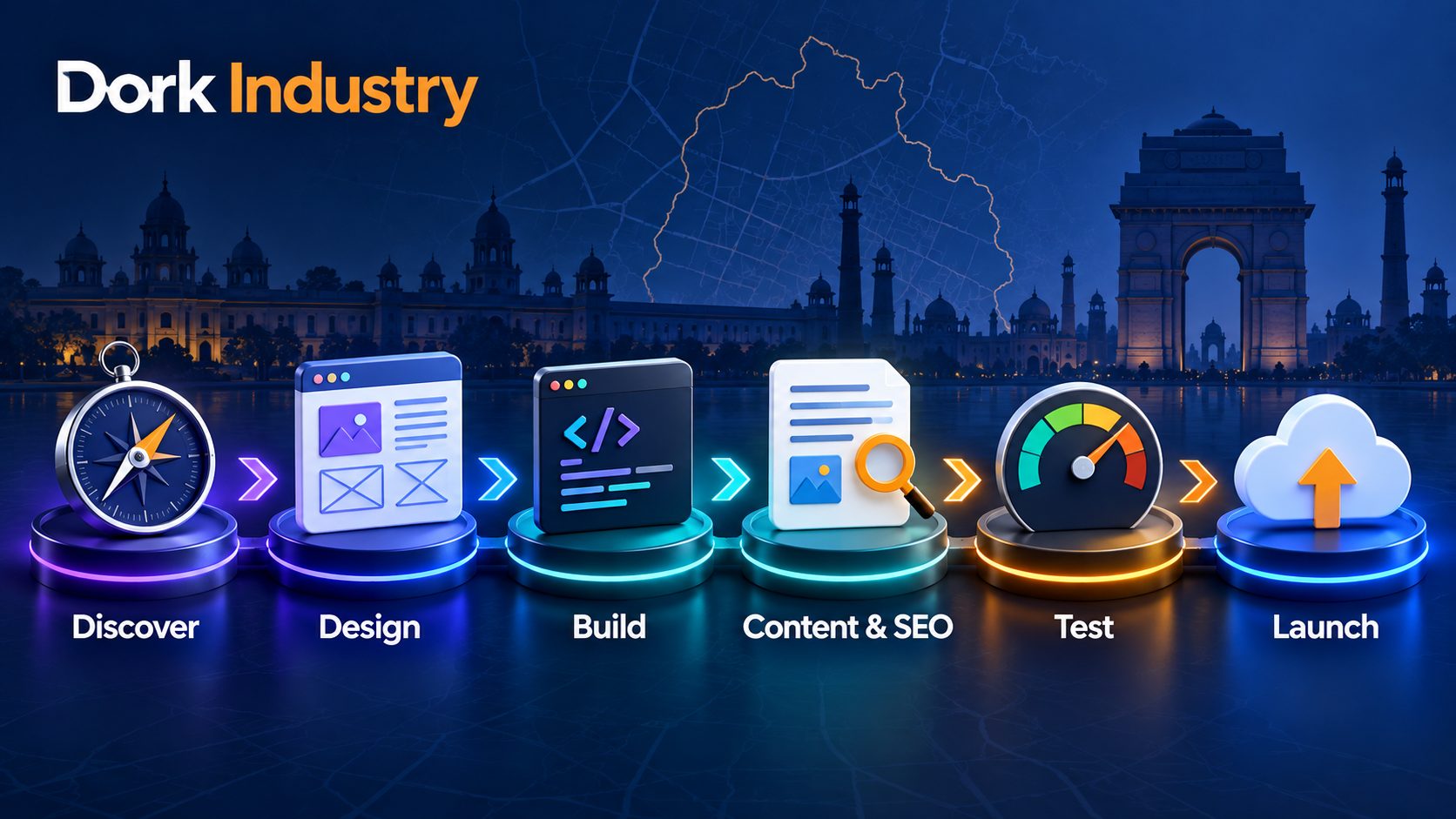
Some phases overlap. The warning sign is not overlap; it is invisible progress. A good delivery plan produces reviewable evidence every one or two weeks. If stakeholders cannot see working software until the end, schedule risk remains hidden.
How can you shorten delivery without cutting quality?
Reduce launch scope, not engineering discipline. Start with one location, one user group or one transaction path. Reuse trusted services for authentication, messaging or payments where appropriate. Freeze the first-release acceptance criteria, keep one empowered product owner available and make real users test each increment. Avoid compressing security, migration rehearsal or rollback planning.
Which Engagement Model Should You Choose?
| Model | Best when | Main risk | Control to request |
|---|---|---|---|
| Fixed scope and price | Requirements and acceptance tests are stable | Important detail is excluded or changes become expensive | Inclusion matrix, assumptions and change-control formula |
| Time and materials | Discovery continues and priorities may change | Spend rises without a strong product owner | Weekly burn report, sprint goals and budget ceiling |
| Dedicated team | You have a long roadmap and internal product leadership | Paying for capacity without sufficient decisions or backlog | Role plan, utilisation visibility and quarterly outcome review |
| Paid discovery, then build | Complex workflows or legacy systems make a quote premature | Discovery produces slides but no build-ready specification | Named deliverables, architecture decisions and transferable artefacts |
For uncertain projects, paid discovery followed by a phase-one build is often the most honest structure. It allows the web development company in Delhi to investigate content, migration and integration risk before committing to a number. The discovery output should belong to you and be usable by another team.
When is fixed price a poor choice?
Fixed price becomes fragile when workflows are undocumented, user feedback will change the product, APIs are untested or migration quality is unknown. The supplier must either price a large risk buffer or protect itself with exclusions. In those cases, cap discovery first and approve the build after evidence replaces assumptions.
Which Web Development Costs Are Commonly Missed?
The build price is only part of the first-year cost. Prepare a total-cost view that includes:
- cloud hosting, storage, backups, monitoring and bandwidth;
- email, SMS, WhatsApp, maps, payment and other usage-based APIs;
- third-party licences and per-user subscriptions;
- data cleaning, migration rehearsal and reconciliation;
- independent application security or specialist compliance review;
- training, documentation and change management;
- app-store, domain, certificate and account charges;
- warranty limits, support retainers and enhancement capacity;
- internal product-owner, reviewer and subject-matter-expert time; and
- a 10%–20% risk reserve for validated uncertainties—not uncontrolled scope.
Ask every web development company in Delhi for a first-year cost table and a steady-state annual estimate. Usage-sensitive services should show a unit assumption—for example, visitors, orders, messages, storage or transactions—so finance can model growth.
What Security and Compliance Evidence Should You Request?
Security statements are not evidence. Put testable requirements into the contract and acceptance plan. The NIST Secure Software Development Framework groups secure-development practices around preparing the organisation, protecting software, producing well-secured software and responding to vulnerabilities. The OWASP Application Security Verification Standard provides requirements that teams can use to verify web application controls.
For projects handling personal data in India, discuss consent, notices, purpose limitation, access controls, retention, breach response and processor responsibilities with qualified legal and security advisers. Use the Ministry of Electronics and Information Technology’s official Digital Personal Data Protection Rules, 2025 materials as the authoritative starting point.
Which security deliverables belong in the proposal?
- threat model or security-risk assessment for sensitive workflows;
- role and permission matrix;
- encryption, secret-management and backup approach;
- dependency scanning and patch policy;
- code review and automated test expectations;
- security test scope, severity rules and remediation window;
- logging, monitoring and incident-response responsibilities; and
- vulnerability disclosure and post-launch support process.
Do not accept “industry-standard security” as a complete requirement. Ask which standard, which controls, who tests them and what evidence marks them complete.
What Should a Strong Web Development Proposal Contain?
A useful proposal is a decision document. It should reveal what the supplier understood, what remains uncertain and how both sides will control delivery.
- Business outcome: the operational or commercial result the first release should create.
- Scope boundaries: included workflows, roles, platforms, integrations and explicit exclusions.
- Acceptance criteria: observable conditions used to approve each milestone.
- Team: named roles, seniority, allocation and replacement process.
- Architecture: major components, hosting ownership, environments and key trade-offs.
- Plan: phases, dependencies, client inputs, demos and release dates.
- Quality: testing levels, performance targets, security checks and defect thresholds.
- Commercials: fees, taxes, licences, payment milestones, change control and rate card.
- Ownership: source code, IP, repositories, accounts, credentials and documentation.
- After launch: warranty, service levels, monitoring, maintenance and exit assistance.
If your project is an online store, use Dork Industry’s Shopify development agency guide for Delhi for platform-specific checks. If it is primarily a mobile product, compare the release and device responsibilities in the mobile app development company guide. Those are different decisions from the web-budget planning problem covered here.
How should milestone payments be structured?
Tie payments to reviewable outputs, not calendar dates alone. A practical structure may include discovery approval, prototype and architecture approval, tested feature increments, user acceptance, production launch and final handover. Keep enough value attached to deployment, documentation and transition so they are treated as core deliverables.
What Original Data Supports This Delhi Web Development Guide?
Dork Industry original research snapshot, 15 October 2026: We analysed a direct dataset of 180 Google Ads keyword ideas generated from six service-aligned seeds and compared it with 23 GA4 Indian city rows plus five current organic competitor pages. Google Ads Keyword Planner reported 1,900 average monthly Delhi searches for “web development company in Delhi,” with 50% three-month growth, advertiser competition index 17, and modeled top-of-page bids from ₹43.48 to ₹159.20. The primary phrase showed 9.0 times the demand of the 210-search Delhi NCR variation and 11.2 times the demand of the 170-search “best” variation.
| Original research metric | Direct API result | Source and window |
|---|---|---|
| Primary keyword demand | 1,900 average monthly searches | Google Ads Keyword Planner, Delhi, last 12 months |
| Primary keyword momentum | +50% over three months | Google Ads Keyword Planner, retrieved 15 October 2026 |
| Advertiser competition | Low; index 17 | Google Ads Keyword Planner |
| Top-of-page bid range | ₹43.48–₹159.20 | Google Ads Keyword Planner |
| Delhi NCR variation | 210 average monthly searches; +88.9% | Google Ads Keyword Planner |
| “Best” variation | 170 average monthly searches; +90.9% | Google Ads Keyword Planner |
| Delhi + New Delhi visitors | 8 active users; 13 sessions; 22 page views | Dork Industry GA4, preceding 90 days |
| Keyword research dataset | 180 ideas from 6 commercial seeds | Dork Industry direct Keyword Planner analysis |
| Location dataset | 23 Indian city rows compared | Dork Industry direct GA4 analysis |
| SERP dataset | 5 current competitor pages analysed | Dork Industry organic results review |
Methodology and limitations: Dork Industry queried the Google Ads KeywordPlanIdeaService with Delhi as the explicit geographic target and English as the language, then retained service-aligned commercial phrases. Google defines average monthly searches as an estimate based on the selected month range, location and Search Network settings; it is not a guaranteed traffic forecast. The visitor comparison used GA4 city dimensions with active users, sessions and page views for a trailing 90-day window. Small samples can change quickly, so the snapshot is evidence for prioritisation, not a performance promise.
Dork Industry’s direct GA4 city query for the preceding 90 days recorded Delhi and New Delhi as the largest eligible location group from the approved target-area list: 8 active users, 13 sessions and 22 page views combined. These figures explain the keyword and location choice; they do not predict future rankings, leads or revenue. Keyword Planner and Analytics were queried directly rather than copied from plugin dashboard telemetry.
How Can You Prepare a One-Page Budget Worksheet?
Complete this worksheet before requesting proposals. It will make estimates faster and easier to compare.
| Field | Your planning answer |
|---|---|
| Problem and measurable outcome | What should improve, and by how much? |
| Launch users and roles | Who uses the first release, and what can each role do? |
| Must-have workflows | Which end-to-end transactions must work at launch? |
| Systems and integrations | Which APIs, devices, databases or vendors are involved? |
| Migration | What data moves, from where, at what volume and quality? |
| Quality and compliance | Availability, load, recovery, accessibility, security and legal needs |
| Target date and constraint | What event drives the date, and which scope can move? |
| Budget range | Approved range, contingency and first-year operating ceiling |
| Ownership | Required IP, repository, cloud-account and handover terms |
| Decision process | Approver, evaluator, user representatives and selection date |
Dork Industry can turn this worksheet into a discovery plan, sitemap, content and integration map, technical specification and phased estimate. Our web development work connects brand, user experience, performance, search foundations and reliable engineering to a measurable business goal.
Why Plan the Project With Dork Industry?
Dork Industry begins with the workflow, business outcome and evidence required for acceptance. That keeps architecture and features connected to revenue, control or operating efficiency. We can scope a focused first release, map dependencies, identify migration and security risks, and define what should wait for a later phase.
Whether you are rebuilding a slow company website, launching ecommerce, creating a customer portal, protecting rankings during a migration or building a custom web application, Dork Industry will provide a clear path from discovery to deployment. You retain visibility into milestones, assumptions and handover requirements throughout the engagement.
Need a Scope, Cost Range and Delivery Plan?
Share the workflow you want to improve, the systems it must connect and your target date. Dork Industry will help you define a buildable first release before you commit to a full development budget.
Frequently Asked Questions
How much does web development cost in Delhi?
For planning, a professional business website may cost ₹40,000–₹1.5 lakh, ecommerce or content-rich work ₹1.5–₹6 lakh, and a custom portal or web application ₹6–₹30 lakh or more. Actual cost depends on design, content, integrations, migration, performance, security and support.
How long does a web development company in Delhi need to launch?
A focused business website often needs 3–7 weeks, while ecommerce and content-rich sites commonly need 6–14 weeks. A custom web application may take 3–8 months in phases. Content delays, integrations, migration and approval cycles can extend any schedule.
Should I choose fixed price or time and materials?
Choose fixed price when scope and acceptance criteria are stable. Choose time and materials when priorities will evolve and you have active product ownership. For uncertain legacy or integration work, use a capped paid-discovery phase before choosing the build model.
Who should own the source code and cloud accounts?
Your contract should explicitly assign the agreed intellectual property and define access to source repositories, cloud accounts, domains, deployment pipelines, documentation and credentials. Arrange staged access during delivery instead of waiting for the final day.
What should I send to a web company before asking for a quote?
Send the business goal, target audience, sitemap or required workflows, content status, reference sites, integrations, migration sources, performance and SEO needs, target date, budget range and decision process. A precise brief produces a more reliable estimate than a vague page list.
Can Dork Industry modernise an existing application?
Yes. Dork Industry can assess an existing codebase, database, infrastructure and workflows; identify operational and security risk; then plan staged modernisation, integration or replacement. The recommended route depends on maintainability, business criticality, data constraints and the cost of disruption.
About the author: Nishant Singh writes about software strategy, automation, cloud engineering and practical digital transformation for Dork Industry. His work focuses on translating business workflows into testable technology requirements, helping decision-makers compare scope, delivery risk, ownership, security and lifecycle cost before investing in software. He advocates phased delivery, measurable outcomes and clear technical accountability.