

AI development services help a business turn a defined workflow into a governed AI application, integration or decision-support system. In India, the right buying decision is not “Which model is best?” It is “Which measurable process should improve, what data may be used, where must a person approve the output, and what will the system cost to operate?”
By Nishant Singh, Founder of Dork Industry · Reviewed 17 October 2026. Nishant reviews AI and software buyer guides for practical scope, integration, security, governance and commercial decision quality.
Quick answer
Choose AI development services only after defining one business metric, an approved data boundary, the systems that must be integrated, and a production acceptance test. Start with a 60–90 day pilot. Move to production only when the pilot improves the metric, passes security tests and has an affordable monthly operating cost.
What should AI buyers remember?
- Start with the workflow, not the model. A clear exception-heavy process is more valuable than a vague request to “add AI.”
- Separate build cost from run cost. Include model usage, cloud infrastructure, monitoring, support, retraining and human review.
- Buy before building when a standard product covers the workflow. Build only where proprietary data, integration or user experience creates meaningful advantage.
- Use decision gates. Discovery, data readiness, prototype security and production readiness should each have pass/fail evidence.
- Keep people in control of consequential actions. Payments, account changes, hiring, medical, legal and safety decisions need explicit approval and auditability.
Why are businesses buying AI development services now?
Businesses are moving beyond isolated chat experiments. Buyers increasingly want AI connected to document stores, CRMs, ERPs, ticketing systems, ecommerce platforms, production data and approval workflows. That creates a purchasing need for discovery, application engineering, data integration, security, evaluation and ongoing operations—not simply access to a language model.
Google Keyword Planner data collected for this research showed an estimated 4,940 monthly searches for “AI development services” across eight high-value markets. India accounted for approximately 2,900 searches, followed by the United States at 1,600. This is advertiser-demand data, not a promise of organic traffic or sales. It does, however, show that the phrase is used by a meaningful commercial audience.
Our analysis showed that, in this eight-market sample, India represented about 58.7% of estimated demand and the United States about 32.4%; the United Kingdom, United Arab Emirates, Australia, Canada, Germany and Singapore formed the remaining share. The competitor review covered 5 companies ranking for this buying intent. That concentration supports an India-led guide while keeping the framework relevant to global procurement teams.
| Market | Estimated monthly searches | Share of sample |
|---|---|---|
| India | 2,900 | 58.7% |
| United States | 1,600 | 32.4% |
| United Kingdom | 170 | 3.4% |
| United Arab Emirates | 140 | 2.8% |
| Australia | 70 | 1.4% |
| Canada | 30 | 0.6% |
| Germany | 20 | 0.4% |
| Singapore | 10 | 0.2% |
Source: Google Keyword Planner estimates collected 17 October 2026 for the exact keyword. Values are rounded planning estimates and may fluctuate.
The ranking pages reviewed for this article explain service catalogues, technologies and industries well. Their recurring weakness is the buyer’s decision journey: few connect business diagnosis, data readiness, cost governance, security acceptance tests, human approvals and a measurable go/no-go pilot in one practical framework. This guide focuses on that missing layer.
What do AI development services actually include?
AI development services are the professional activities required to identify, design, build, integrate, test, deploy and operate an AI-enabled system. The deliverable may be a small feature inside existing software, a private knowledge assistant, a computer-vision workflow, a predictive model or an agent that performs approved multi-step tasks.
| Service layer | What the buyer should receive | Acceptance evidence |
|---|---|---|
| Discovery | Workflow map, baseline, risk register and build/buy recommendation | Named owner, metric and approved scope |
| Data readiness | Source inventory, permission model, quality sample and retention rules | Representative data passes agreed quality checks |
| Application engineering | User interface, APIs, orchestration, business rules and approval flow | Priority user journeys work end to end |
| Model and retrieval | Model selection, prompts, retrieval, evaluation dataset and fallbacks | Accuracy and failure rates meet the agreed threshold |
| Integration | Connections to ERP, CRM, documents, databases or operational tools | Permissions, retries and rollback are tested |
| AI operations | Monitoring, usage-cost controls, incident response and improvement cycle | Owner can see quality, cost, latency and exceptions |
A vendor offering only a chatbot demonstration is not delivering the full lifecycle. Production AI requires the surrounding software, permissions, data contracts, tests, observability and support process.
Can your workflow benefit from AI? Use this five-minute diagnostic
Give one point for every “yes.” A score of four or five is a reasonable discovery candidate. A score below three usually means the process, data or ownership needs improvement before development begins.
- Does the workflow repeat frequently enough for improvement to matter?
- Can you measure today’s time, cost, error rate, backlog or conversion rate?
- Is there usable historical data, documentation or examples?
- Can a named employee approve exceptions or high-impact actions?
- Can the result be tested against a representative set of real cases?
Do not automate first when the underlying process changes weekly, the source data is unowned, success is subjective, or an incorrect output can cause material harm without human review. In those cases, process redesign or conventional software rules may deliver better value.
Have a workflow but no reliable AI scope?
Dork Industry can map the current process, identify the safest automation boundary and prepare a pilot brief with measurable acceptance criteria.
How much do AI development services cost in India?
There is no responsible fixed price without a workflow, data sample and integration map. Published provider estimates vary widely: some global vendors quote ranges from tens of thousands to several hundred thousand US dollars. Those ranges are not interchangeable because “AI application” may describe anything from one API feature to a regulated enterprise platform.
Instead of asking only for a total, ask every vendor to price the same work breakdown:
| Cost component | Questions that change the price | Common hidden cost |
|---|---|---|
| Discovery and UX | How many roles, workflows and approval paths? | Unresolved requirements creating rework |
| Data preparation | Is data digitised, labelled, permissioned and representative? | Manual cleaning and document conversion |
| Software and integration | Which APIs, databases, ERP/CRM modules and legacy systems? | Poor APIs, duplicate records and custom connectors |
| Model usage | API model, open model, fine-tuning or custom training? | Retries, long prompts, multimodal inputs and peak usage |
| Security and evaluation | What data classes, attack tests and compliance controls apply? | Red-team testing and remediation late in delivery |
| Operations | Who monitors quality, cost, latency and incidents? | No budget for monitoring, support or model changes |
How should you calculate first-year AI cost?
First-year AI budget = discovery + data preparation + application/integration build + security/evaluation + deployment + 12 months of model, cloud, monitoring and support cost.
Require vendors to show assumptions beside every line. For example: monthly users, requests per user, average input/output size, data volume, response-time target, availability target, human-review rate and support hours. A cheaper proposal with missing operating assumptions may become the most expensive option after launch.
Should you buy, configure or build an AI solution?
| Option | Choose it when | Watch for |
|---|---|---|
| Buy | The workflow is standard and a proven SaaS product covers most requirements. | Data export, lock-in, per-user charges and limited workflow control. |
| Configure | A platform covers the core need but requires integrations, prompts, rules and branded UX. | Connector limits, custom-code boundaries and upgrade compatibility. |
| Build | The workflow, data advantage, governance needs or customer experience is proprietary. | Longer validation, ownership burden and ongoing AI operations. |
A hybrid approach is common: buy the foundation model and cloud services, configure retrieval and controls, then build the workflow, integration and interface that differentiates the business. Dork Industry’s custom AI application development and AI agent development services can be scoped around that boundary.
What security, privacy and integration requirements belong in the proposal?
Security should be an acceptance criterion, not a paragraph promising “industry best practices.” NIST’s AI Risk Management Framework encourages organisations to govern, map, measure and manage AI risks. The OWASP Top 10 for LLM and generative AI applications highlights concrete risks including prompt injection, sensitive-information disclosure, supply-chain weaknesses, improper output handling, excessive agency and unbounded consumption.
For an Indian deployment processing personal data, involve qualified legal and privacy professionals to determine obligations under the Digital Personal Data Protection framework and any sector-specific rules. This article is a technical procurement guide, not legal advice.
Which minimum technical controls should you request?
- Data classification and an explicit list of sources the AI may access.
- Role-based access, least privilege and separation between tenants or departments.
- Encryption in transit and at rest, plus managed secrets and key rotation.
- Prompt-injection tests, output validation and restrictions on tool execution.
- Human approval before financial, account, customer, safety or compliance actions.
- Audit logs connecting the user, source data, model response, action and approval.
- Retention, deletion and incident-response procedures.
- Usage limits, rate limits and alerts for unexpected inference cost.
- Fallback behaviour when the model, vector store or dependent API is unavailable.
- A rollback path and a non-AI route for essential workflows.
Which integration questions do buyers often miss?
Ask which system remains the source of truth; whether writes are synchronous or queued; how duplicates and partial failures are handled; how permissions are inherited; how API changes are tested; and how the workflow behaves during an outage. These engineering details determine whether an impressive prototype becomes dependable software.
How should you compare AI development companies in India?
Use the same evidence-based scorecard for every proposal. A polished presentation should not outweigh delivery controls.
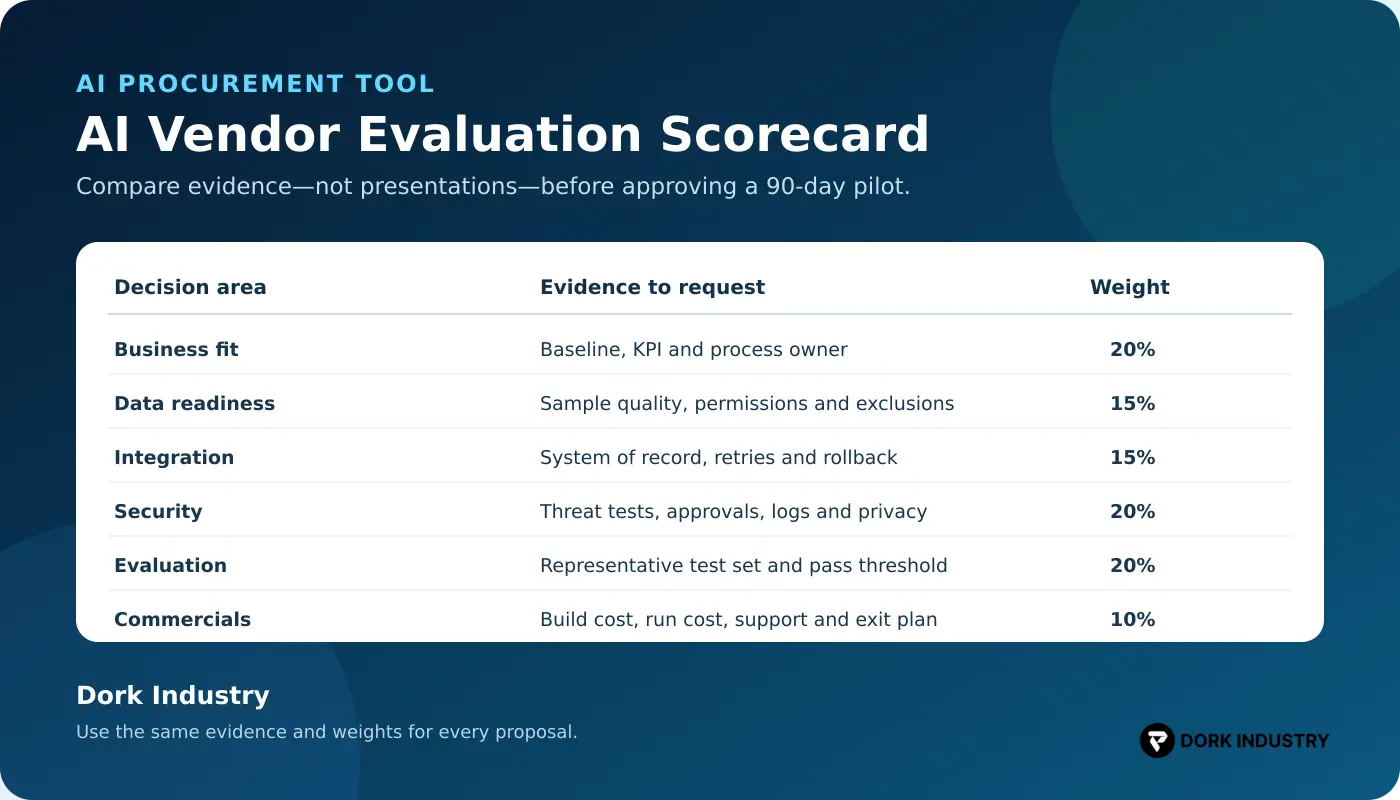
- Problem diagnosis: Did the vendor challenge the use case and quantify the current baseline?
- Relevant delivery evidence: Can it explain a comparable workflow, architecture and outcome without exposing client secrets?
- Data plan: Does the proposal name data sources, ownership, quality checks and exclusions?
- Architecture: Are the application, retrieval, model, integrations and approval points visible?
- Evaluation: Is there a representative test set and a pass/fail threshold?
- Security: Are threats, permissions, logs, privacy and incident handling specific?
- Human control: Which actions require review, and who can reverse them?
- Cost transparency: Are build and monthly run costs separated with assumptions?
- Ownership: Who owns code, prompts, evaluation data, documentation and deployment configuration?
- Operations: Who monitors model quality, latency, cost and failures after launch?
- Exit plan: Can the model or vendor be changed without rebuilding the whole application?
- Commercial milestone: Is payment tied to demonstrable acceptance evidence?
Red flags include a guaranteed accuracy claim without a test set, a fixed quote before data and integration discovery, unrestricted autonomous actions, no operating-cost model, or a proposal that treats a model API call as the entire system.
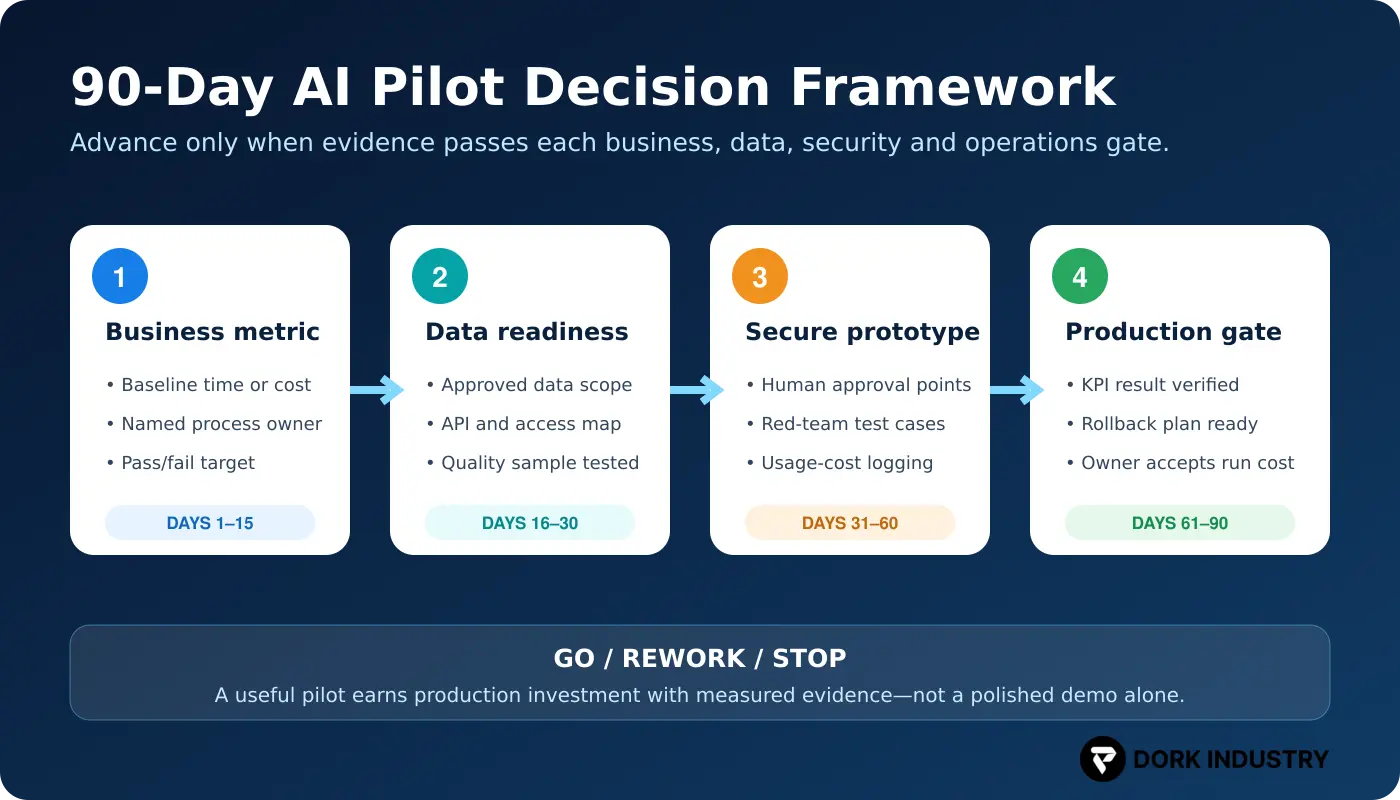
What should a 90-day AI pilot include?
What happens in days 1–15?
- Map the current workflow, exceptions and systems.
- Record the baseline and choose one primary KPI.
- Define what AI may recommend, draft or execute.
- Name the business owner and technical owner.
What happens in days 16–30?
- Approve data sources and access permissions.
- Test a representative sample for completeness and quality.
- Map APIs, authentication, retries and system-of-record rules.
- Create the evaluation set before tuning the solution.
What happens in days 31–60?
- Build the smallest end-to-end workflow with the real integration path.
- Add human approvals, logs, cost limits and failure handling.
- Test ordinary cases, edge cases and adversarial inputs.
- Track accuracy, latency, human correction and unit cost.
What happens in days 61–90?
- Use a limited user group and defined data boundary.
- Compare results with the original baseline.
- Document incidents, overrides and operating effort.
- Make a go, rework or stop decision using agreed evidence.
The production decision should answer four questions: Did the KPI improve? Did the system pass security and privacy tests? Can staff operate and supervise it? Is the monthly cost justified by the measured outcome?
Want to turn one workflow into a measurable AI pilot?
Share the process, current bottleneck, available data and systems. Dork Industry can prepare a scoped discovery, proof of concept, integration plan or dedicated AI development team.
Email: support@dorkindustry.com
WhatsApp: +91 8210792477
What should your AI project brief contain?
Complete this one-page brief before requesting proposals for AI development services:
- Workflow: What starts the process, what steps follow, and what ends it?
- Current pain: Time, cost, errors, backlog, missed revenue or compliance exposure?
- Baseline: What is the current measured value?
- Users: Which roles use, approve or supervise the system?
- Data: Which documents, records, images, events or sensor feeds are available?
- Systems: Which ERP, CRM, ecommerce, database, cloud or operational tools connect?
- Decision boundary: What may AI draft, recommend or execute?
- Risk: What is the consequence of a wrong, delayed or exposed output?
- Acceptance metric: What must improve, by how much and over what period?
- Budget model: What build budget and monthly operating limit are acceptable?
Attach anonymised examples where possible. Vendors can estimate more accurately when they can inspect the structure, variation and quality of representative inputs.
Frequently asked questions about AI development services
What are AI development services?
AI development services cover discovery, data preparation, application engineering, model or API integration, testing, deployment and ongoing monitoring. A production engagement should also define security controls, human approvals, evaluation criteria, monthly operating costs and support responsibilities.
How much does AI development cost in India?
Cost depends on workflow complexity, data readiness, integrations, model choice, security requirements and operating scale. Compare proposals using the same work breakdown and insist that vendors separate one-time implementation cost from recurring model, cloud, monitoring and support costs.
How long does an AI project take?
A tightly scoped pilot can often be evaluated in 60–90 days. Production deployment may take longer when data must be cleaned, multiple systems integrated, security controls tested or regulated decisions validated. The schedule should be tied to decision gates rather than a demonstration date alone.
Should a business build its own AI model?
Usually not at the beginning. Many businesses gain more value by using an existing model and building the proprietary workflow, integrations, retrieval, evaluation and controls around it. Custom training is justified only when evidence shows that available models cannot meet the requirement.
What information should be shared with an AI development company?
Share the workflow, baseline metric, user roles, representative anonymised data, system integrations, approval rules, security constraints and expected usage. Do not transfer sensitive production data before contractual, privacy and security controls are approved.
How do you prevent an AI pilot from failing after launch?
Define a production owner, monitoring dashboard, evaluation set, incident process, rollback route, usage-cost alerts and a recurring review cycle. Track business performance and model performance separately so the team can identify whether a problem comes from the workflow, data, model or integration.
Which sources and research method support this guide?
This article combines external demand research, a review of five ranking AI development service pages, current AI risk guidance and Dork Industry’s software-integration perspective. Search demand figures are rounded Google Keyword Planner estimates collected on 17 October 2026 and should be treated as directional planning data.
- NIST AI Risk Management Framework and Generative AI Profile
- OWASP Top 10 for LLM and Generative AI Applications (2025)
- Ministry of Electronics and Information Technology: Data Protection Framework
- Appinventiv: AI Development Services
- BairesDev: AI Development Services
- A3Logics: Artificial Intelligence Development
- Daffodil Software: AI Development Services
- Serviots: AI Development Services
Editorial responsibility: Dork Industry. This guide supports technology procurement decisions and does not replace legal, privacy, security or financial advice specific to your organisation.