
Computer vision development for hospital patient safety starts from a simple observation: your hospital already owns the cameras, but nobody is watching them. Yes — existing hospital CCTV can be turned into a patient-fall detection safety net without facial recognition, using skeleton-based pose tracking that sees body posture, not faces. A fall becomes a pattern — an upright body becoming horizontal faster than walking — that software can flag to a nurse’s phone within seconds, while the person themselves remains anonymous to the system.
This article examines whether a hospital can detect patient falls from its existing CCTV feed: what the expensive failure is, how the technology works without identifying anyone, what data you already have, what the system must never do alone, and how to pilot the idea in 30 days before committing to full deployment.

Why do patient falls cost hospitals so much?
Patient falls are not a rare edge case. According to the World Health Organization’s fact sheet on falls, falls are the second leading cause of unintentional injury deaths worldwide: an estimated 684,000 individuals die from falls each year, and 37.3 million falls are severe enough to require medical attention annually. Older patients carry the greatest risk — and hospitals and care facilities are exactly where the oldest, frailest patients concentrate.
What happens after a fall in a ward?
The clinical consequences are the ones everyone knows: hip fractures, head trauma, extended recovery. In the United States, 20–30% of older people who fall suffer moderate to severe injuries, per the WHO fact sheet. But the operational consequences are what quietly drain a hospital:
- Unwitnessed falls. Most ward falls happen when no one is looking — at night, in bathrooms, in corridors between rounds. The patient lies alone until the next round.
- Extended stays and liability. A fall injury extends the hospital stay, complicates the original treatment plan, and in many jurisdictions triggers incident reporting, internal review, and potential legal exposure.
- Lost trust. A family that learns their mother lay on a bathroom floor for two hours will not return — and will tell others.
- Staff burden. High fall-risk patients require more frequent checks, more documentation, and more anxiety for the nurses covering them.
Why can’t staff simply watch the CCTV?
Because CCTV in hospitals is forensic, not preventive. The cameras record; nobody watches live. A nurses’ station has no screen with a dedicated viewer — and no hospital can afford a person per corridor around the clock. So the most expensive surveillance infrastructure in the building only earns its value after an incident, when someone pulls the footage to see what happened. The question computer vision development answers is: what if that footage could be understood in real time?
How does computer vision development detect a fall without facial recognition?
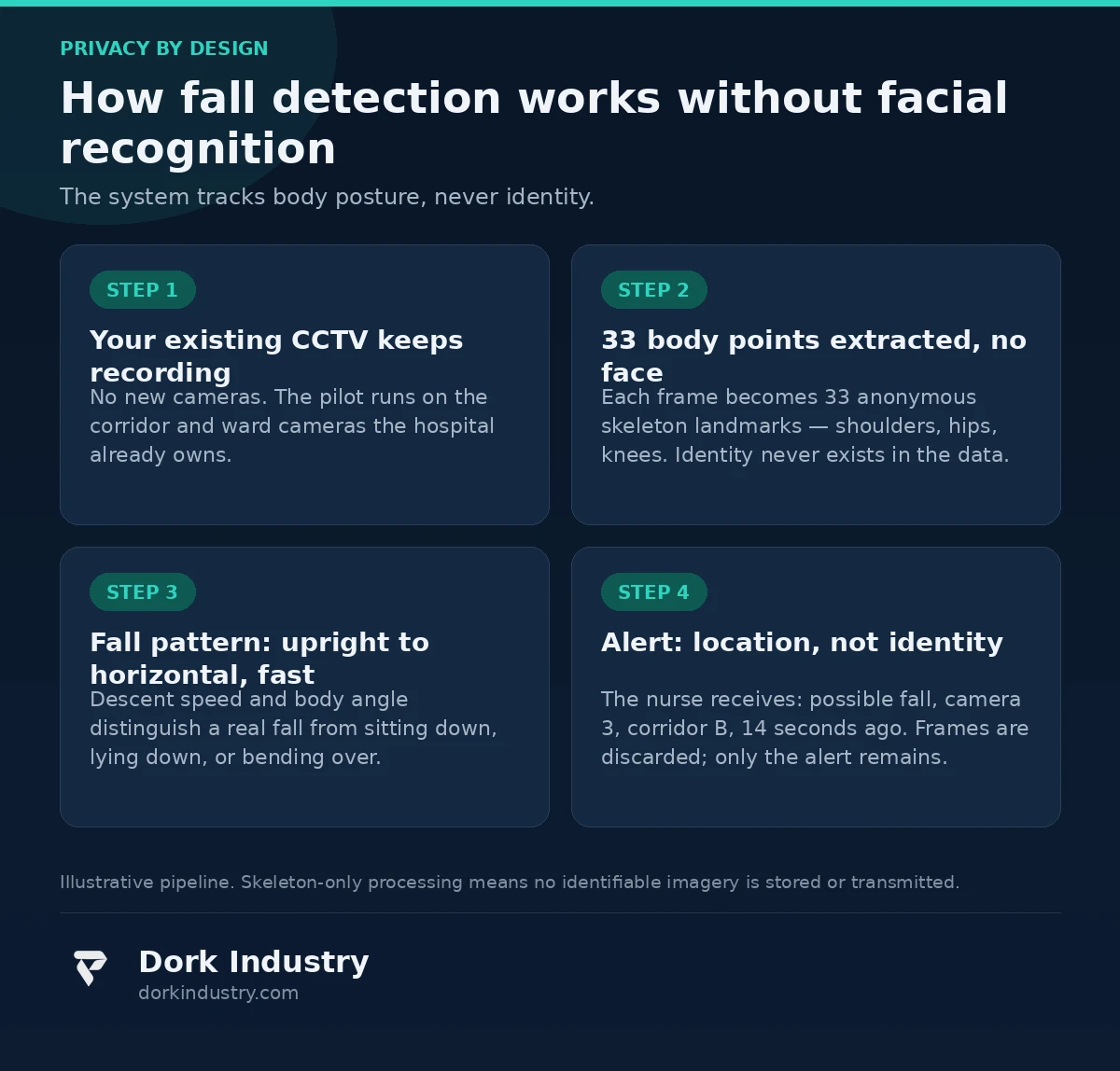
The key insight is that fall detection does not need to know who someone is. It needs to know what their body is doing. Modern computer vision development uses pose landmarking: from each video frame, a model extracts a body skeleton — shoulder, hip, knee, ankle positions — and tracks how those points move over time. According to Google’s AI Edge documentation for its Pose Landmarker, such a model estimates 33 three-dimensional body landmarks from an image or live video feed — no face identity involved.
What pattern does a fall actually make?
A fall has a recognizable physical signature that a skeleton model can measure:
- Vertical-to-horizontal transition: the body’s major axis rotates from upright to horizontal within a short time window.
- Speed of descent: hips and shoulders drop much faster than they would in any voluntary movement like sitting or lying down.
- Aspect-ratio change: the bounding box of the skeleton goes from tall-and-narrow to short-and-wide.
- Post-fall stillness: the skeleton remains in a low, horizontal posture — distinguishing a fall from someone who simply bent down and got up.
A person who walks to a bed and lies down produces a slow, controlled version of this pattern. A person who slips produces a fast, uncontrolled one. The system learns the difference from thousands of examples, tuned further on your own ward footage during the pilot.
Why is skeleton tracking more private than recording video?
Because what leaves the camera can be a set of 33 moving dots — not a face, not clothing, not a body image. The video frames can be processed on a local edge device next to the camera and discarded; only the anonymous skeleton coordinates and the alert event (camera location + timestamp) travel anywhere. There is nothing to rewind to a recognizable person, nothing to leak, nothing to misuse. This is the opposite of facial-recognition surveillance: the system is blind to identity by design, not by policy.
What does the alert look like for staff?
Not an alarm bell. A fall alert should arrive as a phone or dashboard notification: Possible fall — Corridor B camera 3 — 14 seconds ago. A nurse checks the live frame and walks over. The system’s job ends where the caregiver’s begins. False positives are a tuning problem, not a catastrophe: a glance at the live feed resolves them, and every one makes the next tuning round better.
What data does your hospital already have — and what is it missing?
Almost everything the system needs already exists in the building:
- CCTV feeds covering corridors, ward entrances, waiting areas, and stairwells — the exact places where unwitnessed falls happen.
- Network infrastructure that already carries those feeds to a server room or NVR.
- Incident records — every past fall report includes a time and a camera location, which is exactly the labeled data a pilot needs to validate detection accuracy.
What is missing is the interpretation layer between the camera and the nurse. Hospitals often worry they need to replace cameras first. They almost never do: most existing hospital CCTV — even older IP cameras — produces frames good enough for pose tracking, especially for corridors and ward doors where falls matter most. The pilot phase proves this on your actual cameras before any spending on hardware.
What does the math look like? An illustrative example
Consider a 200-bed hospital. The WHO fact sheet reports the average health-system cost per fall injury for people aged 65+ as US$1,049 in Australia (US$3,611 in Finland) — published reference figures. For illustration, assume the hospital’s wards see roughly 2 falls per month — 24 per year. Using the WHO’s published US$1,049-per-injury figure alone: 24 × US$1,049 ≈ US$25,000 per year in direct health-system costs, before extended stays, legal exposure, and the nursing time spent on high-risk surveillance rounds.
Now consider response time, which is free to improve once detection exists. A fall discovered on the next round — 30 to 90 minutes later — versus a fall alerted in 30 seconds: for hip fractures and head injuries, the clinical literature consistently treats time-on-the-floor as a risk multiplier. The expensive part of a fall is rarely the fall itself; it is everything that compounds while nobody knows it happened.
These are illustrative figures with stated assumptions, not industry benchmarks. A pilot measures your hospital’s actual numbers: fall count, average discovery time, and how both move when alerts arrive in seconds.
Should you build custom or buy? An honest breakdown
Not every hospital needs custom computer vision development. The honest options, in order of investment:
| Approach | Best for | Relative investment | Where it breaks |
|---|---|---|---|
| Manual surveillance rounds + bed alarms | Small wards with stable staffing | Minimal | Cannot scale; nurses cannot be everywhere |
| Off-the-shelf AI fall-detection cameras | Standard wards, no custom workflows | Low subscription/hardware | Fixed detection logic; privacy model is whatever the vendor chose |
| Custom computer vision on existing CCTV | Hospitals wanting privacy-by-design, existing cameras, ward-specific tuning | Medium | Overkill for a single small ward |
| Full clinical monitoring platform | ICU, post-surgical, high-acuity units | Highest | Regulatory complexity; not needed for general wards |
A credible technology partner should be willing to say “an off-the-shelf unit is enough for your ward” — and to tell you which vendors’ data flows to avoid.
What must the system never do alone?
Technology boundaries in computer vision development for healthcare matter more than in any other industry, because the stakes are clinical and the subjects are vulnerable.
- Never diagnose. The system detects a possible fall. It does not decide what happened to the patient, whether they are injured, or what care they need. A nurse’s eyes and a doctor’s assessment make those calls — always.
- Never replace human checks. Automated detection reduces the cost of missing a fall; it does not reduce the need for rounding, repositioning, or clinical observation. Hospitals that treat it as a staffing substitute are buying a lawsuit.
- Never identify patients. No facial recognition, no name matching, no re-identification of skeleton data against admission records. The moment the system can say who fell instead of where someone may have fallen, it has crossed from safety tool into surveillance system.
- Never store raw footage longer than policy allows. If the pipeline can work on skeleton coordinates, the identifiable frames should be transient — processed and discarded, per the hospital’s existing CCTV retention policy.
- Never alert families or insurers automatically. Detection events are clinical information. Who gets told, and when, is a care decision — not a webhook.
- Never let a missed alert hide. The system will miss some falls (occlusion, crowded frames). Audit the miss rate on your own footage monthly. A detection rate you measure is a tool; one you assume is a liability.
How do you test it in 30 days before full investment?
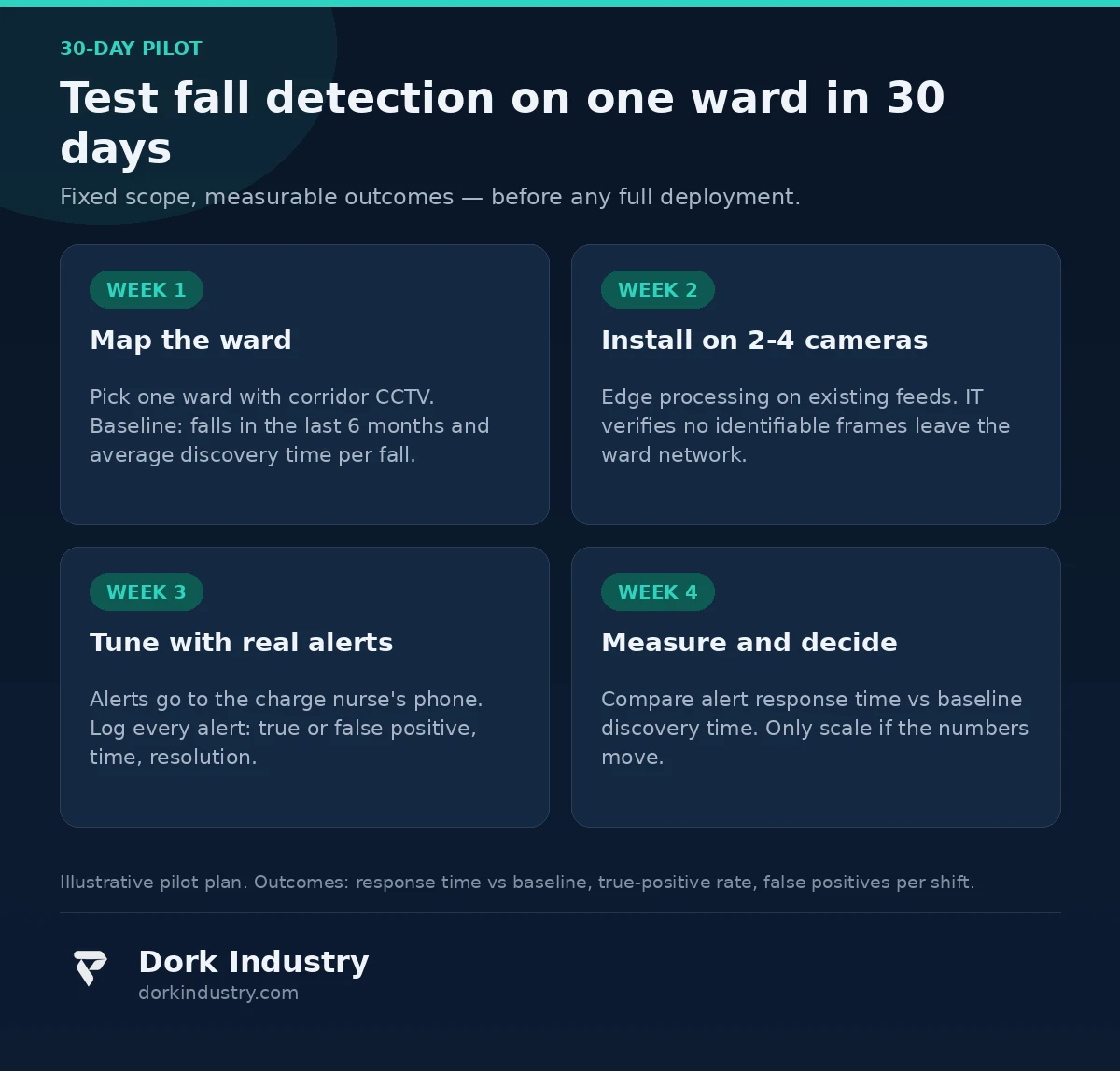
The lowest-risk path is a single-ward pilot with fixed scope and measurable outcomes:
- Week 1 — Map. Choose one ward with corridor CCTV and a documented fall history. Baseline: how many falls occurred there in the last 6 months, and how long (on average) before each was discovered.
- Week 2 — Install. Deploy edge processing on 2–4 existing cameras. Skeleton coordinates only; verify with IT that no identifiable frames leave the ward network.
- Week 3 — Tune. Run detection with alerts routed to a dedicated pilot phone carried by the charge nurse. Log every alert and every miss: time, camera, true/false positive, resolution action.
- Week 4 — Measure. Compare: alert response time vs baseline discovery time; true-positive rate; false positives per shift; nurse effort per alert.
If response time does not improve measurably in the pilot ward, a bigger computer vision development investment will not fix it either. The pilot validates the workflow — detection-to-nurse, not just detection. Dork Industry runs this assessment before quoting any computer vision project: map the current incident process, name the gaps, then decide what software earns its cost. Related reading on our pilot-first approach: how we pilot AI monitoring in a dairy plant.
What actually drives the cost of computer vision development for fall detection?
Fall-detection pricing varies widely because scope does. The real cost drivers are:
- Camera count and placement: 4 cameras in one ward vs 60 across a campus changes the edge-hardware footprint and the tuning effort significantly.
- Edge vs cloud processing: on-premise edge devices keep video local (privacy-friendly) but are hardware purchases; cloud processing is operational spend with bandwidth and data-residency questions.
- Privacy architecture: skeleton-only pipelines with transient frames cost more engineering than naive video-upload designs — the privacy is the engineering.
- Alert integration: a pilot phone is simple; routing into nurse-call systems, pagers, or the hospital’s existing alert infrastructure is integration work.
- Clinical validation effort: measuring true/false-positive rates on your own footage, tuning thresholds per camera, and documenting the miss rate for the hospital’s risk team.
- Retention and access controls: role-based alert access, audit logs of who viewed what, and compliance with local data-protection rules.
Anyone quoting a fixed price without asking how many cameras, where they point, what retention policy applies, and how alerts should reach staff is guessing.
Frequently asked questions
Can existing hospital CCTV detect patient falls without facial recognition?
Yes. Modern computer vision development uses pose landmarking — tracking 33 body-skeleton points from video frames — to detect the physical pattern of a fall (rapid vertical-to-horizontal transition followed by stillness). No face data is needed at any stage, and the video frames can be processed locally and discarded.
Do hospitals need new cameras for AI fall detection?
Usually not. Most existing hospital IP cameras produce frames good enough for pose tracking in corridors and ward areas. The 30-day pilot validates detection accuracy on your actual cameras before any hardware spending.
How accurate is computer-vision fall detection compared to nurse rounds?
It is a complement, not a comparison: software detects continuously but can miss occluded falls and produce false positives; nurses assess clinically but cannot watch every corridor. The honest metric is response time to real falls, measured in the pilot against your baseline discovery time.
Does fall-detection video processing comply with patient privacy laws?
It can, by design: skeleton-only processing with transient frames means no identifiable imagery is stored or transmitted. Compliance details depend on your jurisdiction and your hospital’s CCTV retention policy — the pilot verifies the data flow with your IT and legal teams before deployment.
What does a hospital fall-detection pilot cost?
A single-ward pilot on 2–4 existing cameras is a fraction of a campus-wide deployment. Its job is to prove measurable response-time improvement before larger investment. Request a privacy-first patient-safety computer-vision feasibility assessment for a concrete estimate.
About Dork Industry
Dork Industry (dorkindustry.com) is a custom software development company building mobile apps, AI automation, computer vision systems, and IoT for businesses across India. Our team designs privacy-first video analytics, workflow automation, and industrial IoT — from 30-day pilots to full enterprise rollouts.
The bottom line
The question is not whether a hospital needs computer vision development. It is whether a patient who falls at 3 a.m. in an empty corridor is discovered in seconds or in hours — and whether the discovery required identifying anyone on camera to happen. Your CCTV already sees every corridor. Teaching it to recognize the shape of a fall, while keeping it blind to identity, turns forensic footage into a safety net.
Start with one ward, pilot for 30 days on the cameras you already own, and let measured response times — not vendor demos — decide whether computer vision development earns its place in your patient-safety program.
Running a hospital or care facility and want to know what fall detection would change in your specific wards?
We map your current incident and discovery process, audit your camera coverage, and show you exactly what software would (and would not) fix, before any development is discussed.
Request a privacy-first patient-safety computer-vision feasibility assessment WhatsApp +91 8210792477