

Industrial IoT can keep a Chennai factory running through monsoon floods — yes — but not by stopping the water. A properly built industrial IoT flood network buys a plant two to six hours of warning before water reaches critical levels: water-level sensors on storm drains and approach roads, rain gauges, pump-status monitors, all feeding one dashboard that pages the plant head when thresholds cross. That warning window is the entire product — it turns a multi-lakh flood day into an orderly shutdown instead of a week of chaos. What it cannot do is substitute for drainage, and any vendor promising otherwise is selling fiction.
This article covers what just happened in Chennai on October 17–18, 2026; where a flooded industrial estate actually loses money; what an industrial IoT flood system concretely consists of; the honest arithmetic with stated assumptions; build-versus-buy; what the technology must never decide alone; and how to test it on one site for 30 days.
Key takeaways
- An industrial IoT flood network buys a Chennai plant 2–6 hours of warning — that window is the entire product.
- One flood day at a 200-worker unit puts roughly ₹48 lakh at risk (stated assumptions).
- The stack: battery-backed level sensors and rain gauges over LoRaWAN, one dashboard, staged amber/red alerts.
- The system must never auto-restart high-voltage equipment, depend on plant Wi-Fi, or be the only record.
- Pilot one building for 30 days through a heavy rain event before any estate-wide spend.
What just happened in Chennai — and why “flood” is trending
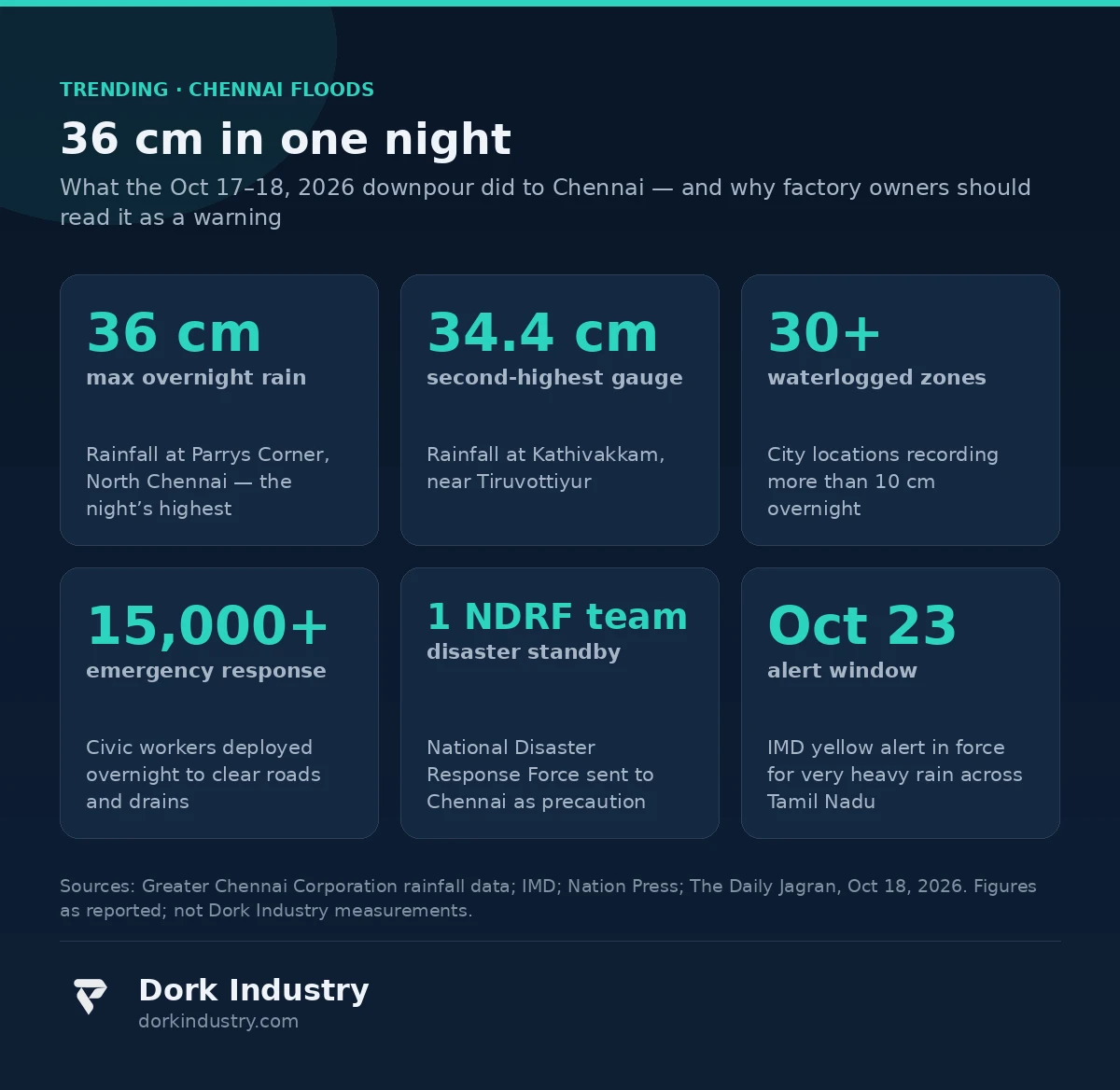
On the night of October 17–18, 2026, the northeast monsoon dumped extraordinary rain on Chennai: 36 cm at Parrys Corner, 34.4 cm at Kathivakkam, and 10+ cm across more than 30 locations. Roads became streams, knee-deep water stood outside the Tiruvottiyur maternity hospital, 15,000+ civic workers were deployed overnight, an NDRF team was sent as precaution, and Chief Minister Vijay recalled ministers to oversee response. The IMD’s yellow alert runs through October 23, with very heavy rain forecast across 17 Tamil Nadu districts.
The Tamil word for flood — வெள்ளம் — is trending on Google in India today, and industrial estates sit in the same low-lying basins as the flooded neighbourhoods; the 2015 floods shut Chennai plants for days. The question is not whether the water comes again — the IMD alert says it will, this week — but whether your plant sees it coming.
Reporting: Nation Press on the 36 cm Parrys reading and The Daily Jagran on the IMD alert through October 23.
Where does a flooded industrial estate actually lose money?
Flood losses are rarely one dramatic number — they are several medium ones arriving over the following month.
Why is the first damage always the electrical room?
LT panels, switchgear, and motor control centers usually sit at ground level — exactly where water arrives first. Flooded electricals need inspection, insulation testing, and often rewinding or replacement, with lead times that stretch into weeks when every plant in the estate is ordering the same parts. One flooded panel room can idle an otherwise dry factory.
Why does one night of rain idle the plant for a week — and move your orders to competitors?
The water recedes in a day; the restart takes a week: ruined low-racked work-in-progress, moisture-damaged material, machine cleanup, and power restoration that waits on inspection. Meanwhile the dispatch plan collapses. And OEM buyers dual-source for exactly this reason — a missed delivery window teaches them the second source is the reliable one. The shifted margin dwarfs the direct damage and never appears on any “flood loss” estimate.
Why does the night shift always discover the water first — and why does insurance never cover what you thought?
Nobody watches the drains at 2 a.m. The October 17–18 rain fell from Saturday evening to midnight — a skeleton weekend crew learns about flooding when water is already inside the gate. Every hour of delay is preventable damage. And flood endorsements carry exclusions — consequential losses like shifted orders are typically uncovered. A timestamped sensor log is the difference between a settled claim and a disputed one.
What does industrial IoT actually do during a flood?
A flood-monitoring industrial IoT deployment is four unglamorous layers, each doing one job:
How does the plant sense the water coming?
- Ultrasonic water-level sensors on storm drains, sump pits, and the approach road — estate drains fill before plant floors do, so they are the earliest tripwires
- Rain gauges on the admin block, giving rainfall intensity per 15-minute window instead of the city’s daily total
- Pump current monitors on dewatering pumps — a pump drawing no current during rain has failed silently
- Gate and shutter position sensors, so the dashboard knows whether the flood defences are actually deployed
How does the data survive the flood itself?
This is the layer most DIY setups get wrong. Sensor nodes should be battery-backed and communicate over LoRaWAN to a gateway on high ground — not over the plant’s Wi-Fi, which dies with the first power cut. The flood takes power and networks first; the monitoring must outlive both for at least 48 hours.
What does the plant head actually see?
One screen: water level by zone, pump status, rainfall intensity, IMD forecast overlay. Staged thresholds — green (normal), amber (drains rising, start the playbook), red (water at the gate, execute shutdown). Alerts escalate: dashboard, then SMS and WhatsApp to the plant head, maintenance lead, and security — because the person who needs the alert at 2 a.m. is asleep.
What happens automatically — and what stays human?
The system can start dewatering pumps, close shutters, and raise alarms on its own — pre-approved, reversible actions. It must not restart high-voltage equipment, override a lockout, or declare an area safe. The automation buys time; people make the calls that carry liability.
What does the math look like? Stated assumptions, honest arithmetic
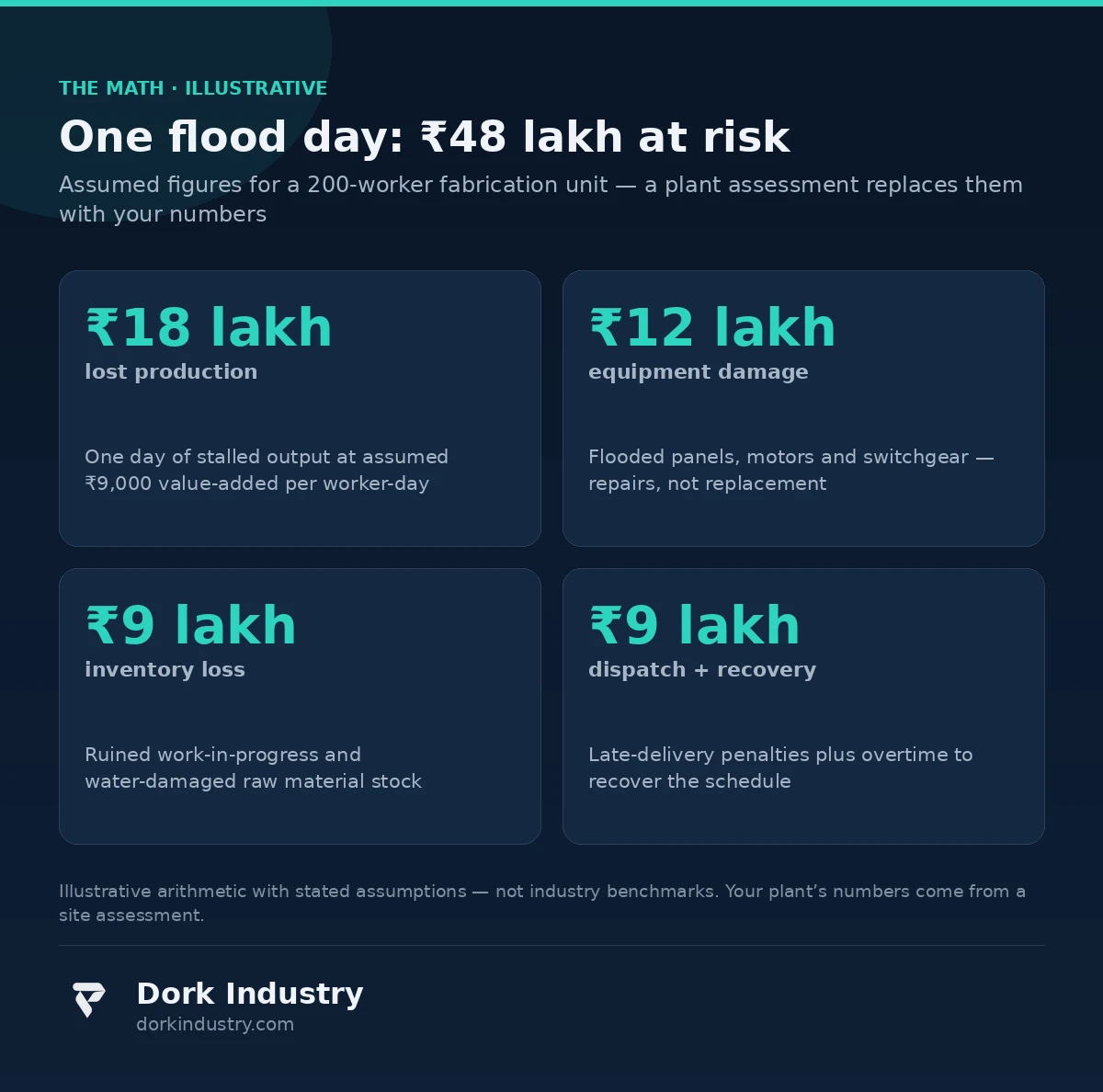
Consider a 200-worker fabrication unit in a Chennai industrial estate, one night of 20+ cm rain, water entering the shop floor. Figures below are stated assumptions, not benchmarks.
Assume ₹9,000 of value-added output per worker-day: one stalled day is ₹18 lakh. Flooded LT panels and motors needing repair: ₹12 lakh. Ruined low-racked work-in-progress and moisture-damaged material: ₹9 lakh. Late-delivery penalties plus overtime: ₹9 lakh. Total: roughly ₹48 lakh at risk from a single flood day — before shifted purchase orders, which are real but unquantifiable.
Against that, a 12-to-20 node industrial IoT flood grid — sensors, one LoRaWAN gateway, dashboard, alerting — typically lands in the ₹6–9 lakh capex range (stated assumption) with modest annual maintenance. If the warning window converts even one ₹48-lakh flood day into an orderly ₹8-lakh shutdown over five years, the system has paid for itself several times over. It does not need to prevent floods. It needs to prevent surprises.
Should you build, buy, or subscribe? An honest breakdown
Not every plant needs a custom industrial IoT deployment. The honest options:
| Approach | Best for | Relative investment | Where it breaks |
|---|---|---|---|
| Off-the-shelf flood sensor kit | A single small unit | Low | Generic thresholds, no pump/playbook integration, support ends at the manual |
| Industrial IoT platform (subscription) | Multi-site, standard protocols | Medium + hardware | Recurring cost forever; customization limited to the platform’s options |
| Custom industrial IoT build | Mixed estates, ERP/SCADA integration | Higher upfront | Overkill for one building; needs a competent integrator |
| DIY Arduino/LoRa hobby rig | Tinkering | Minimal | No support, no calibration discipline — dies in year two, when the flood comes |
At Dork Industry, we regularly advise plants against custom builds when an off-the-shelf kit plus a written playbook covers the risk.
What must industrial IoT never do in a flood?
Technology boundaries matter most when water is involved.
- Never auto-restart high-voltage equipment after water recedes. The system can report “water below threshold”; only a qualified electrician re-energizes. Software must not decide a panel is dry.
- Never silence an amber alert because “it was wrong last time.” False alarms are a threshold-tuning problem. Fix the sensitivity; do not shoot the messenger.
- Never let the dashboard be the only record. Stream sensor logs to an independent store — your insurer will ask for them. A history that lives only on a flooded server is a story, not evidence.
- Never depend on the plant’s main power and Wi-Fi. If the monitoring dies with the lights, it was decoration.
- AI should forecast and prioritize, not command people. “Drain 3 is rising 4 cm/hour — at this rate the gate road floods by 11 p.m.” is useful. Automated evacuation orders are not the software’s call.
How do you test it in 30 days without disrupting production?
The lowest-risk path is a single-building pilot, timed to catch the next heavy rain — the IMD alert runs through October 23. One building, 6–10 sensors on the storm drain, sump pit, approach road, and electrical room; one LoRaWAN gateway on high ground; dashboard plus SMS/WhatsApp alerts to three people. Write the playbook first — who does what at amber, who decides at red — then measure warning lead time versus actual water arrival, false-alarm rate, and whether the night team acted.
If the pilot cannot demonstrate a reliable warning lead time on your own drains, a bigger industrial IoT investment will not fix it either. The pilot validates the sensing and the response workflow, not just the hardware.
Frequently asked questions
Can industrial IoT really predict flooding at our specific plant?
It does not predict the monsoon — the IMD does that. It measures your plant’s reality: water rising in your drains, rain on your roof, pumps running or not. Hyperlocal sensing answers the only question that matters — how long before water reaches your gate. It cannot fix bad drainage; beware any vendor who implies otherwise.
What does a flood-monitoring pilot cost in Chennai?
A single-building pilot — 6 to 10 sensors, one gateway, dashboard, alerting — typically falls in the low single-digit lakhs (a site survey sets the real figure). The honest way to price it is against one flood day’s losses at your plant. Request a flood-readiness assessment for a concrete estimate.
Will the system work when power and internet go down?
That is the entire design constraint: battery-backed nodes, LoRaWAN to a gateway on high ground, 4G uplink, SMS as the last-mile alert. If any link depends on the plant’s mains power or office Wi-Fi, the design is wrong.
Can’t we just rely on IMD alerts?
IMD alerts are city-scale and invaluable days ahead — but they cannot tell you your estate’s drain is backing up at 9:40 p.m. You need both: the IMD for the week-ahead picture, your own sensors for the tonight-at-your-gate picture.
Does it integrate with our existing SCADA or ERP?
Yes — sensor data feeds SCADA historians via OPC or MQTT, and maintenance tickets can flow into ERP/CMMS automatically. But keep the flood-safety alerting path independent: the 2 a.m. page to the plant head must not depend on the ERP being up.
About Dork Industry
Dork Industry (dorkindustry.com) builds mobile apps, AI automation, and IoT systems for businesses across India — including industrial IoT sensor networks, command dashboards, and alerting for factories and estates, from 30-day pilots to multi-site rollouts.
The bottom line
The question is not whether Chennai will flood again this monsoon — the IMD’s alert through October 23 says the water is already on its way. The question is whether your plant learns about it from a sensor at 9 p.m. or from a guard wading through the gate at midnight.
Running a plant in a flood-prone estate?
We walk your site, map the water’s path, quantify one flood day at your plant, and show what sensing would (and would not) fix, before any hardware is discussed.
Request an industrial IoT flood-readiness assessment WhatsApp +91 8210792477