
AI development is becoming the dairy plant’s most practical quality tool. Yes — an AI agent watching collection, chilling, and pasteurization data can warn your dairy plant hours before a milk-quality batch fails, flagging the batches and suppliers most likely to fail lab tests while there is still time to hold, re-test, or divert them. A plant manager’s worst morning is a 5,000-litre batch failing its quality test after pasteurization: the energy is spent, and the batch must be dumped or downgraded at a steep loss. That failure was usually predictable from data the plant already had — it just arrived too late to act on.
This article covers the failure economics, the causes, the data you already collect, how the AI agent works, human boundaries, and a 30-day pilot plan.
How much does a single failed milk batch actually cost?
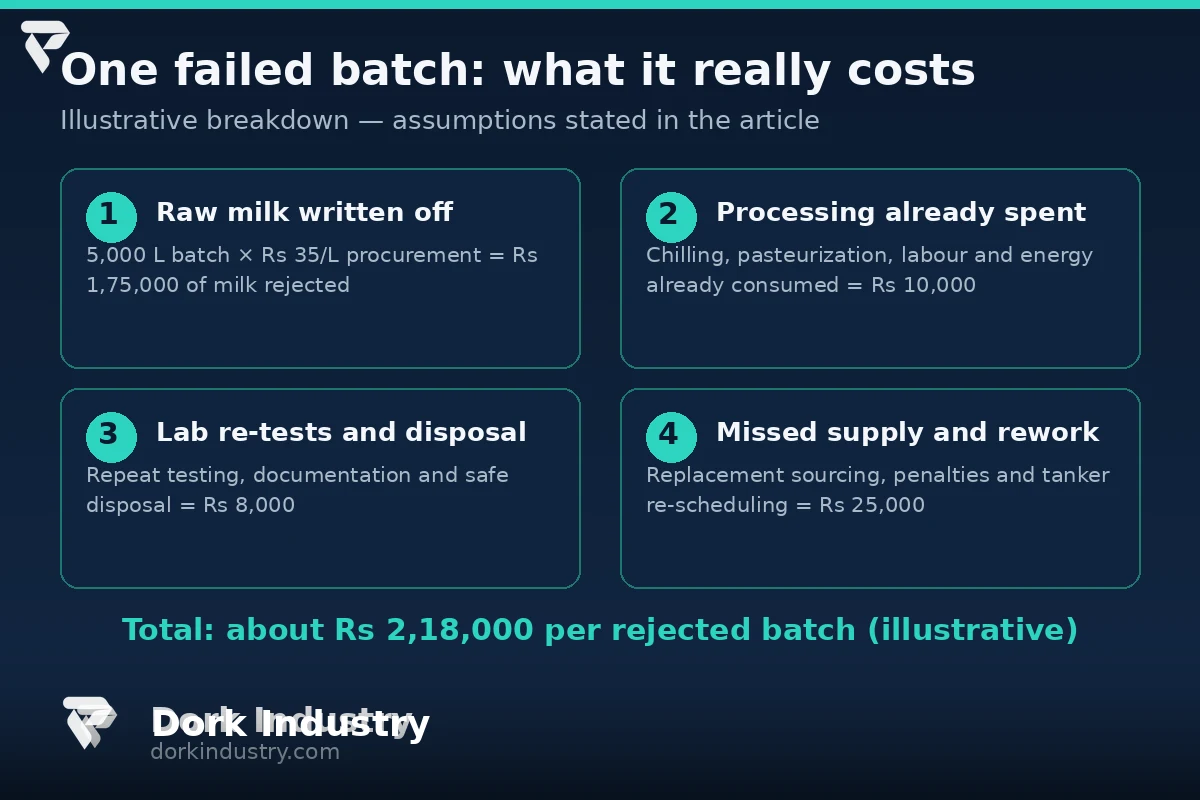
Before discussing technology, price the failure precisely. A rejected batch costs far more than the milk: by the time it fails its quality test, the plant has paid for it several times over.
What is lost when a batch is rejected after processing?
The raw milk is the first loss — procurement cost on thousands of litres that cannot be sold as intended. Then sunk processing: chilling energy, pasteurization fuel, labour, and water for a batch that produced nothing. Then secondary costs: repeat lab testing, disposal, tanker re-scheduling, and emergency replacement sourcing. Repeated incidents also erode institutional buyers’ trust.
Why do failed batches hurt more than the milk price?
According to the Food Safety and Standards Authority of India (FSSAI), milk sold in India must meet prescribed standards for fat, solids-not-fat, and microbial limits. A failed batch is not merely off-spec product; it is a compliance event that must be documented, investigated, and kept from consumers — overhead that makes each failure expensive well beyond the milk’s price.
Why do milk-quality batch failures happen?
Most failures are the predictable result of variation nobody was watching in real time.
Why does incoming milk quality vary so much?
Milk arrives from hundreds of village collection points with different animal health, feed, hygiene, and handling. Sub-clinical mastitis raises somatic cell counts; poor hygiene raises microbial load; adulteration depresses SNF; seasons shift fat and SNF naturally. Manageable in isolation — combined across hundreds of suppliers changing daily, a quality lottery at the plant gate.
Why is the cold chain the silent culprit?
Milk is a race against bacteria, and temperature is the clock. Delays between milking and chilling, chiller breakdowns, and warm tanker transit all accelerate microbial growth. According to the UN Food and Agriculture Organization’s dairy resources (FAO), quality management must span the chain from farm to plant — yet most plants cannot see what happened to their milk before it reached the gate.
Why do lab results arrive too late?
Testing is reactive by design. Samples are drawn, sent to the lab, and results return hours later — often after the batch has moved through pasteurization. The lab tells you with certainty what went wrong, but after the money is spent. This timing gap is the core problem an early-warning system exists to solve.
Why does pasteurization not save a bad batch?
Pasteurization kills pathogens; it does not repair quality. High microbial load can still fail post-pasteurization tests, and heat-stable toxins from poor raw milk survive the process. Composition failures — low fat, low SNF, added water — are unaffected by heat treatment. Relying on the pasteurizer to fix upstream problems means paying to process milk you will reject.

What data does your dairy plant already collect?
Most dairy plants already generate the raw material for early warning. The data exists in separate registers, devices, and memories — never combined into one view of risk.
What lives in your collection records?
Village collection centers record fat, SNF, and CLR per can or tanker, twice daily. A supplier whose SNF drifts downward over two weeks is signaling trouble long before any reading crosses a rejection threshold — if anyone watches the trend.
What do your chilling and tanker logs show?
Bulk milk coolers log temperatures; tankers carry time-stamped dispatch and arrival records. Even paper logbooks reveal which routes run warm and which centers chill late. Temperature abuse is the most predictive signal for microbial failure — and it is usually already being written down.
What does your pasteurizer already record?
Modern pasteurizers log time-temperature curves for every run — slow ramps, temperature dips, holding-time shortfalls. Reviewed across weeks, those curves reveal which lines and shifts produce the most marginal runs.
What is your lab history quietly telling you?
Every lab result the plant has ever recorded is a labelled training example: this batch, with these collection readings and this temperature history, failed — or passed. Months of lab history paired with collection and process data is exactly what a predictive model needs. The most valuable dataset is usually sitting in filing cabinets and spreadsheets.
How does AI development turn that data into an early warning?
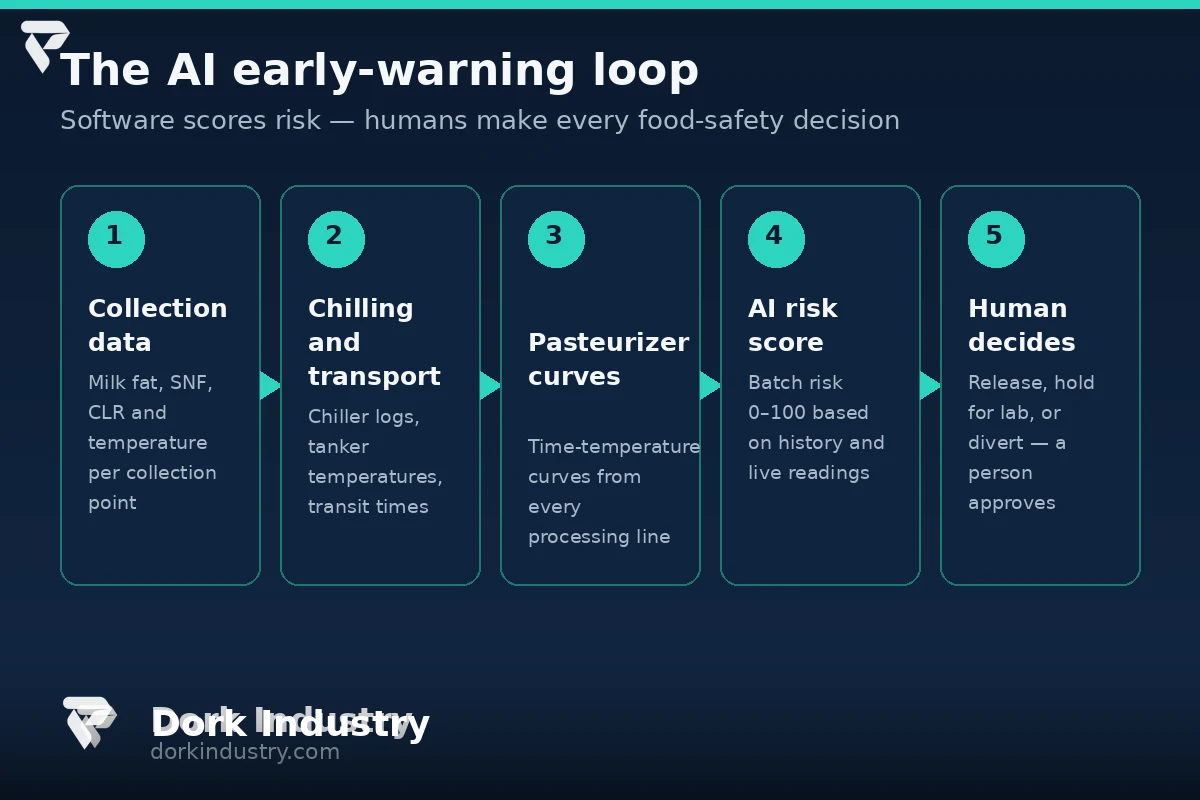
An AI agent for dairy quality is not a chatbot and not a black box. It fuses the plant’s existing data streams, scores every incoming batch for failure risk, and routes the risky ones to human attention before processing commits the cost.
How is the batch risk score calculated?
The agent combines four signal families: supplier composition trends (fat, SNF, CLR drift), cold-chain integrity (chilling delays, tanker temperatures, transit times), process readiness (the target line’s recent deviation history), and lab history correlation (how similar batches fared before). Each batch gets a risk score from 0 to 100. A score above threshold routes the batch to the quality manager with reasons listed: “Supplier X’s SNF trending down 6 days; tanker arrived 2.1°C above target; similar profile failed 3 of last 8 batches.”
How early can the warning come?
The earliest signal arrives at the plant gate — often 4 to 8 hours before that milk reaches the pasteurizer. That window is the entire economic value of the system: time to hold the batch for priority lab testing, divert it to a lower-risk product line, or process the suspect batch last. Warnings issued after processing are just autopsies.
How does the agent improve over time?
Every lab result feeds back into the model — flagged batches that pass, and unflagged batches that fail, become new training data. The system also learns plant-specific patterns no generic software could know: a route’s summer profile, a chiller that drifts every monsoon, a supplier whose milk changes after feed switches. This local learning compounds in value.
What must the AI agent never do on its own?
Where food safety, livelihoods, and regulation intersect, boundaries matter most. An AI agent in a dairy plant must be an advisor with excellent recall — never an autonomous decision-maker.
- Never auto-reject supplier milk. Rejecting a farmer’s milk affects livelihoods and triggers disputes. The agent flags risk; a human quality officer makes the call and owns the relationship.
- Never change pasteurization setpoints. Time-temperature parameters are critical control points under food safety plans. No software should adjust them without a qualified person’s explicit sign-off.
- Never substitute for lab testing. A risk score prioritizes; it is not a test result. Compliance and release decisions rest on accredited lab analysis, not model output.
- Never file regulatory reports unsupervised. Compliance documentation must be reviewed and signed by a responsible person. The agent can draft; it cannot attest.
- Never penalize suppliers automatically. Deductions and scorecards based on model output alone invite disputes. Human review of the underlying data must precede any commercial consequence.
- Always show its reasons. A flag without an explanation is a black box nobody will trust. Every alert must list the specific signals that triggered it, in terms a shift supervisor can verify.
Should you build a custom AI system or buy dairy software?
Not every dairy plant needs custom AI development. The honest options, in order of investment:
| Approach | Best for | Relative investment | Where it breaks |
|---|---|---|---|
| Registers + spreadsheets | Small plants under ~5,000 litres/day | Minimal | No trend visibility; quality depends on individual memory |
| Off-the-shelf dairy ERP | Digitizing collection, billing, and dispatch records | Low subscription | Records data but does not predict; no early warning |
| SCADA / automation add-ons | Plants with modern pasteurizers and chillers | Medium | Process visibility only — blind to supplier and cold-chain history |
| Custom AI development | Plants with digitized records and recurring batch failures | Highest | Overkill without data volume or a defined failure problem |
At Dork Industry, we regularly advise dairy businesses against custom builds when records are not yet digitized — an AI agent trained on incomplete data is an expensive guess. If collection readings still live in paper registers, the right first investment is digitization, not AI. You can explore our solution areas to see where custom development typically earns its cost.
What does the math look like? An illustrative example
The figures below are illustrative, built on stated assumptions — not industry benchmarks. They show how to size the problem for your own plant by substituting your numbers.
Assume a plant processing 50,000 litres per day, 300 days a year, procuring at ₹35 per litre. If 1% of volume ends rejected or downgraded — 500 litres a day — the milk alone costs ₹17,500 a day, about ₹52.5 lakh a year. Sunk processing of ~₹2/litre adds ₹3 lakh a year. Lab re-testing, disposal, and replacement sourcing at ₹8,000–₹25,000 per major event, twice a month, adds ₹2–₹6 lakh. All-in illustrative cost of a 1% rejection rate: roughly ₹58–₹62 lakh a year.
If an early-warning agent catches half the at-risk batches in time — cutting rejections from 1% to 0.5% — the illustrative saving is ₹29–₹31 lakh a year, before avoided compliance incidents and preserved buyer trust. The pilot below replaces these assumptions with your plant’s measured numbers.
How do you pilot this in 30 days?
The lowest-risk path is a single-line pilot with fixed scope and measurable outcomes:
- Week 1 — Data assembly. Pick one collection route and one pasteurization line. Digitize 90 days of collection readings, tanker logs, pasteurizer curves, and lab results for that route and line. This unglamorous work is what the project stands on.
- Week 2 — Baseline model. Build the first risk-scoring model on the historical data and back-test it: of the batches that failed in the last 90 days, how many would it have flagged? That gives a measured catch rate before any live alert fires.
- Week 3 — Live shadow mode. Run the agent alongside normal operations. It scores every batch and logs flags; the quality team works as before but records what they would have done with each flag. No process changes yet.
- Week 4 — Decision review. Compare flags against lab outcomes: catch rate, false-flag rate, and the lead time each correct flag would have provided. If the numbers justify it, scope the full build; if not, 30 days bought you a definitive answer.
If the back-test cannot beat the quality team’s existing instincts on historical data, a bigger AI development investment will not fix it. The pilot validates the signal, not just the software — the same assessment Dork Industry runs before quoting any dairy project.
What actually drives the cost of AI development for dairy quality?
The real cost drivers:
- Data integration: connecting collection software, chiller controllers, pasteurizer logs, and lab records into one pipeline — the single biggest variable
- Sensor gaps: filling blind spots (tanker temperature probes, automated collection-center readings) where data does not exist yet
- Model development and validation: building the risk model and correlating it against lab outcomes over real batches
- Alert and workflow design: getting flags to the right person in a form they will act on, inside their existing routine
- Change management: training staff to trust, verify, and challenge the system’s flags — adoption is a cost line, not an afterthought
- Ongoing retraining: seasonal shifts, new suppliers, and new product lines require the model to keep learning
Anyone quoting a fixed price without asking about your collection software, pasteurizer make, and lab record format is guessing.
Frequently asked questions
Can AI really predict a milk-quality failure before lab tests confirm it?
It does not replace the lab — it prioritizes. Combining supplier trends, cold-chain records, and process history, the agent flags batches statistically likely to fail, hours before processing. The lab still confirms.
How much historical data does a dairy plant need for this to work?
A practical minimum is 60–90 days of paired data: collection readings, temperature logs, and lab results for the same batches. Longer digitized histories build better models, but the pilot validates whether even limited data carries enough signal before larger investment.
Will this work if our collection records are still on paper?
Partially — but not well enough to justify AI development yet. Paper records can be digitized for the pilot (one route, 90 days), and that exercise is valuable in itself. A production system needs ongoing digital feeds, so the honest first step is usually digitizing collection and lab records first.
Does the AI agent need to control our pasteurizer or chillers?
No — and it should not. The agent is read-only on process equipment: it observes data and issues advisories. It never adjusts setpoints, overrides interlocks, or touches safety systems. This boundary is non-negotiable.
What does a 30-day dairy AI pilot cost?
A single-route, single-line pilot — data assembly, baseline model, shadow-mode evaluation — costs a fraction of a full plant-wide build. Its job is to produce a measured catch rate and false-flag rate from your own data first. Request a dairy quality-monitoring and AI-agent feasibility assessment for a concrete estimate.
About Dork Industry
Dork Industry (dorkindustry.com) builds AI automation, mobile apps, and IoT systems for businesses across India — including AI agents for quality monitoring, predictive maintenance, and process optimization, from 30-day data pilots to full production deployments for manufacturing, dairy, and food processing.
The bottom line
The question is not whether a dairy plant needs AI development. It is whether the quality team can see — hours before processing — which incoming batches carry the highest failure risk and which cold-chain links are weakening. If the answer is no, the plant pays for certainty (lab tests) only after spending the money the failure wastes.
Start with the data you already collect, pilot the early-warning loop on one route and one line for 30 days, and let measured catch rates — not vendor promises — decide whether to build further.
Running a dairy plant and losing batches to quality failures discovered only after processing?
We assemble your collection, chilling, and lab data, measure whether an early-warning signal exists in it, and show you exactly what an AI agent would (and would not) change before any development is discussed.
Request a dairy quality-monitoring and AI-agent feasibility assessment WhatsApp +91 8210792477