
AI development turns funding into a shipped product when it buys one thing first: a working product in real users’ hands, not a better demo. For India’s newly funded AI startups, that means a scoped MVP, a boring reliable stack, and production discipline from week one.
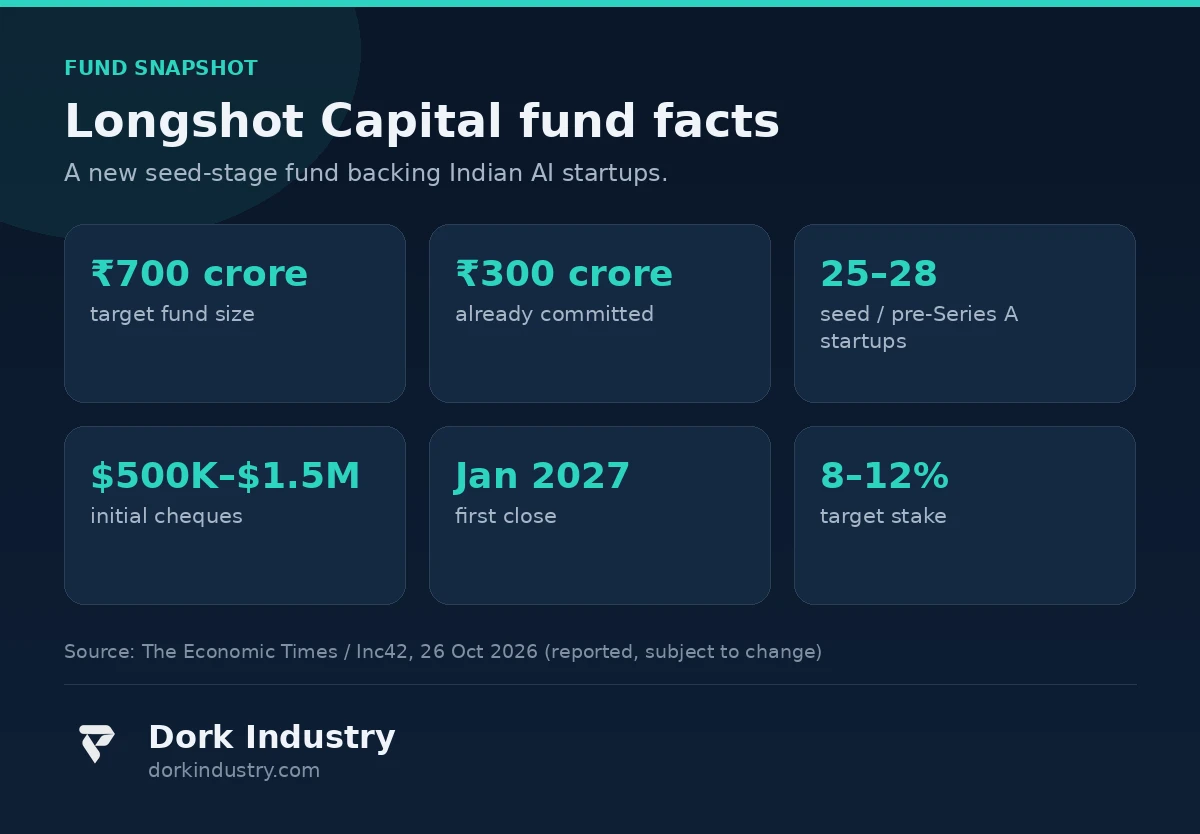
That is the gap facing founders today. According to The Economic Times, Unacademy founders Gaurav Munjal and Roman Saini are raising Longshot Capital, a ₹700-crore fund for AI and deep-tech startups, with about ₹300 crore already committed and a first close targeted for January 2027. The fund plans to back 25–28 seed and pre-Series A startups. For those founders, the money is real — but money alone has never shipped a product. What ships it is AI development done as product engineering.
In brief: Longshot Capital targets ₹700 crore for 25–28 AI and deep-tech startups, with cheques of $500,000 to $1.5 million. Funded AI startups most often fail not on the AI itself but on the road from prototype to production. A 4–6 week MVP sprint on one workflow, built with APIs rather than custom models, is the smallest safe pilot.

The fund that changed the math for AI founders
Longshot Capital is an operator-led fund, and that detail matters more than the headline number. Munjal and Saini built Unacademy from 2015, and have made more than 200 angel investments deploying over ₹25 crore. Saini will run the fund full-time while Munjal stays involved part-time alongside heading Unacademy. The fund will deploy over three years across AI, manufacturing, space, defence and robotics. According to Inc42, the fund targets an 8–12% ownership stake per company. The move follows upGrad’s all-stock takeover of Unacademy, completed on 1 September 2026 at about ₹1,955 crore — roughly 94% below the company’s 2021 peak value of about $3.44 billion.
The bigger picture: capital is now chasing AI builders specifically, and Longshot follows operator funds like those of Snapdeal’s founders. For a funded AI founder, this changes the bottleneck: raising money is no longer the hardest part — shipping a product that survives contact with real users is. With a first close in January 2027, backed startups will be expected to show working products, not pitch decks, within months. That is a product-engineering problem, and exactly what AI development is for.
Why funded AI startups still fail to ship
Most AI projects fail before reaching production for reasons that have little to do with the model. Practitioner guidance puts it bluntly: scope creep, solving the wrong problem, building models before validating workflows, and never collecting real user feedback. The AI itself is rarely the bottleneck — the product decisions around it are. A team that spends its first two months fine-tuning a custom model before any user has touched the workflow has spent its most precious resource — runway — on the part users never see.
The second failure mode is the prototype-to-production gap. AI coding tools are excellent at generating the first version of a product: layouts, boilerplate, basic integrations, all in minutes. The real challenge starts when the product moves toward production — deployment problems, authentication, API errors, scaling, performance bottlenecks, and long-term maintenance. That final stretch is where real engineering begins, and it is where vibe-coded prototypes and demo-driven teams stall. One vendor’s framing puts it sharply: 70% of AI-built apps never ship, because the tools were built for speed, not for the discipline, coordination and governance production demands.
The cost of that stall is measurable. According to internal research published by AI product firm Ailoitte, most startups waste between 40% and 60% of their initial product budget on inefficiencies caused by team ramp-up time, redundant meetings, and rework cycles. The same research calls a 120-day development cycle a competitive liability. These are vendor figures, not independently verified — but the mechanism is familiar to anyone who has watched a funded team spend a quarter hiring before writing production code.
What AI development actually buys a funded startup
Done right, AI development buys three things: a validated workflow, a reliable stack, and production discipline. In that order.
First, the workflow. Ship a working workflow first — even without AI — and add intelligence incrementally based on real usage data. If the workflow has no users, the model has nothing to learn from. A funded team should describe its MVP in one sentence: one user, one job, one measurable outcome. Everything else is scope creep wearing a roadmap costume.
Second, the boring stack. For a first version, use LLM APIs instead of training custom models; fine-tune later only if the use case justifies it. When retrieval is needed, use a vector database rather than building a search pipeline. Run models on cloud GPU on demand — do not buy hardware for an MVP. Save innovation for what differentiates the product: workflow design, user experience, domain logic. Not infrastructure.
Third, production discipline. Architecture decisions recorded and remembered, so each step builds on the last. Review gates on every change. Monitoring, cost controls, and data pipelines from the start — not retrofitted after the first outage or surprise bill. That is the difference between a demo and a product that survives its first thousand users.
| Dimension | Prototype | Production product |
|---|---|---|
| Goal | Impress in a demo | Serve real users daily |
| Stack | Whatever generated fastest | Boring, reliable, observable |
| Users | Founders and friends | Paying customers with edge cases |
| What breaks first | Nothing — nobody uses it | Auth, scale, costs, data quality |
| What proves it works | A video | Retention and unit economics |
What technology must never do alone
AI development fails when technology is asked to do the whole job by itself. Four lines that must never be crossed: AI without a validated workflow underneath it; a demo without real users testing it; generated code without review, architecture, and persistent memory of past decisions; and funding without a shipping cadence. A model can write code, but it cannot decide what is worth building, cannot tell you whether users want it, and cannot own the consequences when it breaks in production. That ownership is the engineering team’s job, and it is the part no tool purchase replaces.
This is also why the cheapest-looking path is often the most expensive: three months generating a free prototype, then three more rewriting it for production, costs more than building it properly in six weeks. The rewrite is the tax on skipping discipline.
Build in-house, hire an agency, or buy a dedicated team?
Funded founders have three honest options, and each has a real cost. Building in-house means hiring senior AI engineers in a market where talent shortages make that slow; every month spent hiring is a month of runway burned before the product exists. Traditional agencies bring experience but often bill hourly, which rewards slow delivery, and fragmented workflows produce projects that run over budget and miss product-market-fit windows.
The third option is a dedicated product team with outcome accountability: a brief that becomes a working MVP in weeks, not quarters. One vendor claims 38 days from brief to working MVP, 68% faster than the traditional agency average — a vendor claim, not an independent benchmark, but the direction is right: delivery should be a working product on a date, not hours billed. For most funded AI startups, the right first engagement is an assessment followed by a pilot: a fixed-scope MVP sprint proving the team, stack, and workflow before larger commitments. That is how custom software development should be bought when the money is real and the clock is running.
The smallest safe pilot: a 4–6 week MVP sprint
Practitioner guidance puts a functional AI MVP at 4–6 weeks. If it takes longer, the scope is wrong, not the team:
Week 1 — scope one workflow. One user, one job, one success metric, agreed in writing. Everything else goes on a later list, not into the sprint.
Weeks 2–3 — build with APIs, not custom models. One model provider, one data source, one integration surface. Authentication, deployment, and basic monitoring are part of the build, not follow-ups.
Week 4 — real users and a decision. Ship to a small group of real users, measure the one metric, and decide: scale, fix, or stop. A pilot without a kill criterion is a project that never ends.
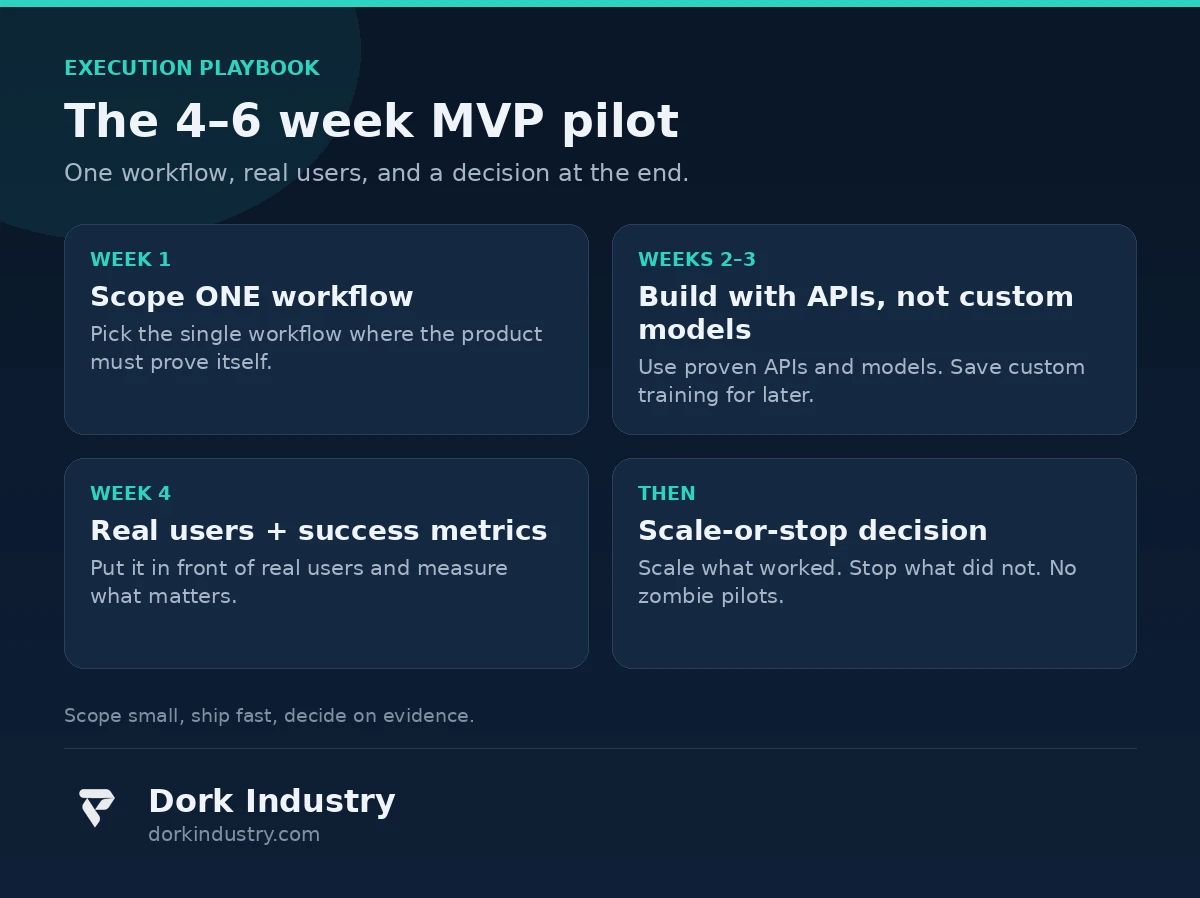
Guardrails matter as much as the schedule: fixed scope, a fixed budget band, success criteria agreed before building starts. If the metric moves, the startup has evidence for its next round. If not, it has learned cheaply — still a better use of funding than a polished demo nobody uses.
The numbers behind this article
Fund figures (₹700 crore target, about ₹300 crore committed, 25–28 startups, $500,000–$1.5 million cheques, first close January 2027) are as reported by The Economic Times and Inc42 on 26 October 2026; fundraising is ongoing, so targets may change. The 4–6 week MVP timeline is practitioner guidance from an AI product guide, not a guarantee for any specific product. The 40–60% budget-waste range and the 120-day-cycle claim come from one vendor’s internal research and are not independently verified. The 70% never-ship framing is a vendor’s claim about the prototype-to-production gap; the underlying mechanism — missing review gates and architecture memory — is the useful, verifiable part.
Frequently asked questions
Why do most AI projects fail before reaching production?
Scope creep, solving the wrong problem, building models before validating workflows, and never collecting real user feedback. The AI itself is rarely the bottleneck — the product decisions around it are.
How long should it take to build an AI MVP?
Four to six weeks for a functional MVP. If it is taking longer, the scope is too big. Ship a working workflow first — even without AI — and add intelligence incrementally based on real usage data.
Why do 70% of AI-built apps never ship?
Because AI coding tools optimise for generating code fast, not for production engineering. The gap is closed by governed delivery: architecture planning, review gates, persistent knowledge of past decisions, and security and quality enforced on every change rather than applied retroactively.
Which AI automation company in India should a funded startup hire?
Shortlist on production evidence, not pitch decks: deployed AI systems handling real production load, hands-on LLM and RAG work beyond wrappers, data engineering readiness, and post-deployment support including monitoring and retraining. Ask for a working product they shipped in weeks, and for the metric it moved. A firm that can show both is worth a pilot; a firm that can only show demos is not.
The bottom line: Longshot Capital’s ₹700 crore is a bet that Indian AI founders can turn capital into products. The founders who win that bet will be the ones who treat funding as a deadline, not a cushion: one workflow, one MVP in 4–6 weeks, real users, and a scale-or-stop decision. Everything else is commentary.
Raised a round and need the product to show for it?
Get a free AI product assessment: we scope your MVP to one workflow, one metric, and a 4–6 week pilot plan — so your funding turns into a shipped product, not another demo.
Request a free AI product assessment WhatsApp +91 8210792477
About Dork Industry: Dork Industry builds custom web, mobile, AI and IoT systems for businesses across India. Our editors and engineers write from production experience — every assessment, pilot framework and cost breakdown here reflects how real AI projects are scoped, tested, and handed over to the teams that run them. See our IT services for the full range.
Sources: According to The Economic Times, Longshot Capital targets ₹700 crore with about ₹300 crore committed and a first close in January 2027. According to Inc42, the fund plans 25–28 investments with an 8–12% target stake. MVP timeline and failure-mode guidance from Fairdevs.