
AI automation can end the warehouse-vs-ERP inventory mismatch — not by replacing your warehouse team, but by reconciling what was scanned against what your ERP expects, every single day. Yes: a reconciliation layer that ingests scan events, compares them against ERP records continuously, prioritizes cycle counts by variance risk, and drafts adjustment journals with evidence attached turns the annual audit surprise into a daily non-event. This article examines exactly how that works: what the mismatch costs, why it keeps happening, what data you already own, what AI automation must never do unsupervised, and how to prove the economics in a 30-day pilot before committing to anything bigger.

What does a warehouse-vs-ERP inventory mismatch actually cost?
Every warehouse has two inventories: the one on the shelves and the one in the ERP. When they disagree — and they almost always do — the cost shows up in five places at once: stockouts on items the system says are available, overstocks on items the system says are low, emergency purchases at premium prices, write-offs at audit time, and planning decisions made on numbers nobody trusts.
Why do auditors keep finding the same gap?
Because the gap is structural, not episodic. An annual physical count measures the mismatch; it does not remove its causes. The day after the count, putaway errors resume, transfers go unscanned, and duplicate entries pile up again. By the next audit, the variance has grown back to the same size. Auditors flag it every year because the underlying process never changed — only the numbers were re-baselined.
How does the mismatch create stockouts you cannot explain?
When ERP shows 400 units and the bin holds 60, the system happily accepts sales orders it cannot fulfil. The stockout is discovered at picking time, when the customer is already waiting. The reverse is equally expensive: ERP shows zero while 300 units sit in a mislabelled bin, so you rush-order from the supplier and pay air freight for stock you already own. Both failures have the same root — records that drifted from reality.
Why does your warehouse never match ERP?
The mismatch is rarely one big failure. It is six small ones, repeating daily.
Why do putaway errors happen?
Received goods get stored in the wrong bin because the operator was rushed, the label was ambiguous, or the directed-putaway instruction was ignored. The ERP thinks the stock is in bin A; it is physically in bin B. From that moment, every pick of that SKU risks a variance.
Where do pick-and-pack mistakes hide?
Partial picks, substitution of a similar SKU, and quantity keying errors — typing 100 instead of 10 — create variances that surface weeks later. These are the hardest to trace because the person who made the error has no idea it happened, and the transaction looked correct at the time.
How do duplicate system entries appear?
A goods receipt entered twice, a transfer posted in both WMS and ERP, an adjustment keyed against the wrong plant code. Every manual keystroke is a chance to create a phantom quantity. ERP systems rarely complain: they post what they are told.
Why do bin-to-bin transfers go unrecorded?
Operators move stock to a more convenient bin to keep picking fast, and never record the move. The bin map in the system becomes fiction within weeks. This is the single most common cause of “the system says it’s there but we can’t find it” — the stock exists, the location is wrong.
What happens to damaged and expired stock?
Damaged cartons get quarantined physically but stay on the books as available. Expired batches get set aside but never written off. The system counts what the floor has already mentally discarded, and the variance waits for the audit to be discovered.
Why does bad master data poison everything?
Duplicate SKUs, units of measure that do not match between purchasing and warehousing, barcodes that do not scan — master-data defects multiply every downstream error. No reconciliation system can fix data that was wrong before it arrived. Master-data cleanup is the unglamorous prerequisite.
What data do you already have — and what is missing?
Most warehouses already generate the raw material for reconciliation: goods receipts in the ERP, issue and transfer transactions, handheld scanner logs, cycle-count sheets (even paper ones), supplier invoices, and customer returns. What is missing is linkage. The scan event lives in one system, the journal entry in another, and nobody connects them until the audit.
According to SAP’s documentation on cycle counting in Extended Warehouse Management, cycle counting means carrying out a physical inventory of stocks at regular intervals during a fiscal year, with products allocated to classes so that fast-moving products are inventoried more frequently than slow-moving ones. The discipline already exists in most ERPs — what fails is the follow-through: counts get scheduled, performed late, and the variances they find get posted without investigation.
We have written about the same identification discipline in a different setting — how manufacturing software development can track production, quality and material on the shop floor (manufacturing traceability article). The principle is identical: every physical movement needs a scan, and every scan needs a system record. Warehouses differ only in volume and speed.
How does AI automation reconcile inventory without replacing your team?
The intervention is a reconciliation engine, not a robot. It sits between your WMS (or scanner app) and your ERP and does three things continuously: compare, prioritize, and document.
How does continuous reconciliation work?
Every scan event — receipt, putaway, pick, transfer, count — is matched against the ERP’s expected quantity for that SKU and bin within minutes, not at month-end. When the numbers agree, nothing happens. When they disagree beyond a tolerance, the system opens a variance case automatically: what moved, who scanned it, what the system expected, and what changed since. Small, explainable variances (a damaged carton, a known substitution) are auto-resolved with rules. Everything else goes to a human queue with the evidence pre-assembled.
What does variance-risk prioritization change about cycle counting?
Traditional cycle counting is blind: count A-items monthly, B-items quarterly, C-items yearly, regardless of what is actually going wrong. A reconciliation engine scores every SKU-bin by variance risk — recent discrepancies, transaction velocity, value at risk, days since last verified count — and directs counters to the bins most likely to be wrong. The same counting hours find three to five times more real variance, because the counts go where the errors are. The blind schedule becomes a backstop, not the plan.
How are adjustment journals created?
This is where most automation proposals fail the trust test. The engine never posts adjustments by itself. Instead it drafts the adjustment journal — SKU, bin, book quantity, counted quantity, variance, root-cause hypothesis, linked scan evidence — and routes it to a manager for one-tap approval. The audit trail is the point: every adjustment carries its evidence, which is exactly what auditors ask for and almost never get. We have applied the same evidence-first automation pattern to fintech data entry, where KYC and compliance evidence must survive automation — warehouses need the same discipline for stock adjustments.
What does the identification layer look like?
Reconciliation is only as good as identification. According to GS1 US, GS1 identification standards — GTINs for products, SSCCs for logistic units, GLNs for locations — give trading partners a common language to uniquely identify products, locations, and assets, which is the foundation of accurate inventory data capture. Practically, this means: one barcode standard across receiving, putaway, and dispatch; bin labels that actually scan; and no SKU that exists in two systems under two codes.
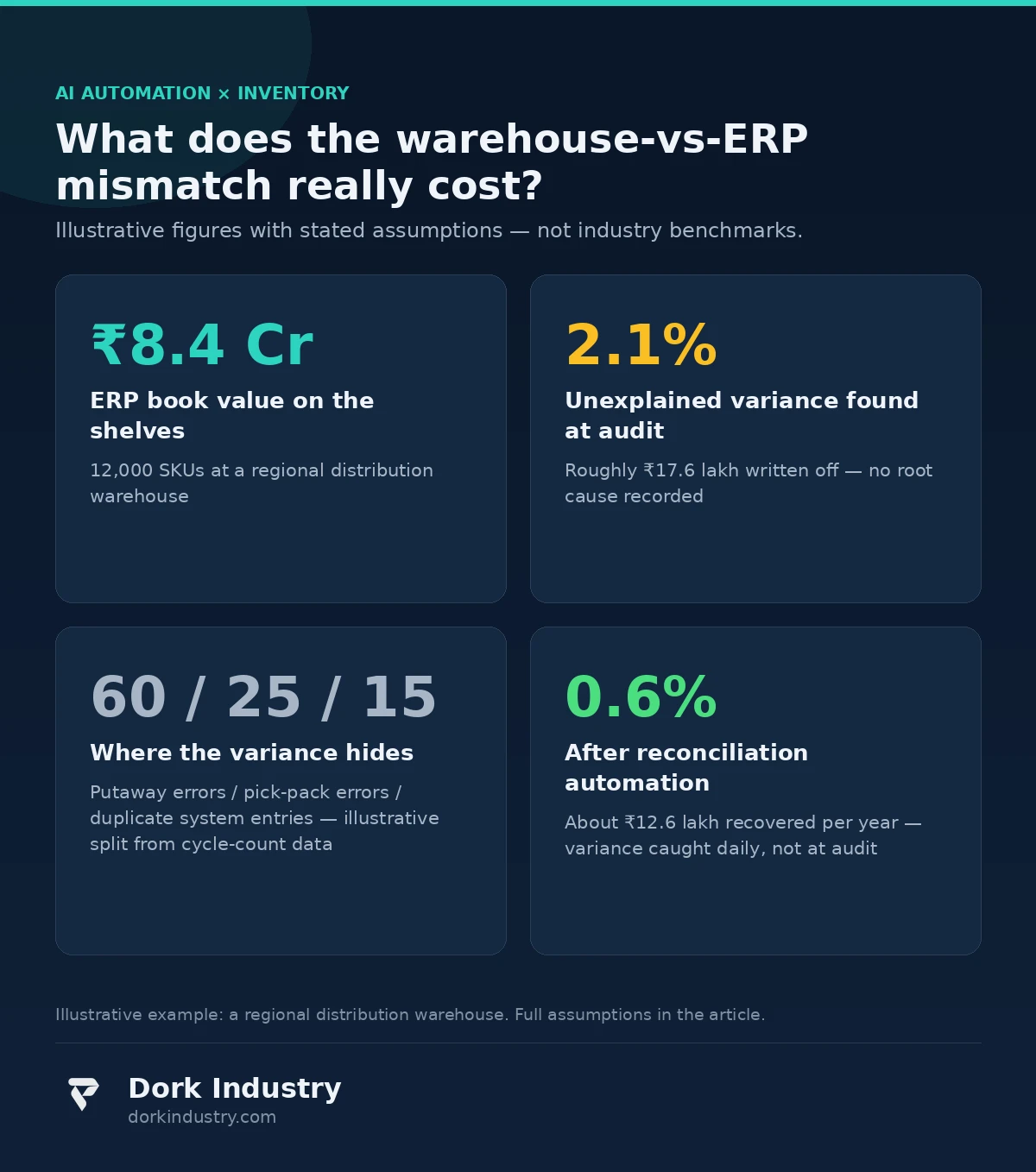
What does the reconciliation math look like? An illustrative example
The following is an illustrative example with stated assumptions — not an industry benchmark. Consider a regional distribution warehouse: 12,000 SKUs, ERP book value ₹8.4 crore (roughly ₹700 per unit). The last annual audit found 2.1% unexplained variance — about ₹17.6 lakh written off, with no root cause recorded for any of it.
Cycle-count data from the first month of scan discipline suggested an illustrative root-cause split: roughly 60% putaway errors, 25% pick-and-pack mistakes, 15% duplicate or misposted system entries. With continuous reconciliation in place — daily variance detection, risk-prioritized cycle counts, evidence-backed adjustments — the residual variance settles around 0.6% of book value. The recovered 1.5 percentage points equal roughly ₹12.6 lakh per year.
The counting workload math: classify 1,200 A-SKUs for monthly counts, 3,000 B-SKUs quarterly, and 7,800 C-SKUs twice a year. That is about 42,000 count lines a year — roughly 170 per working day across 250 working days, comfortably handled by two dedicated counters with handheld scanners. The automation does not reduce counting; it aims the counting.
Should you build or buy? An honest breakdown
Not every warehouse needs custom AI automation. The honest options, in order of investment:
| Approach | Best for | Relative investment | Where it breaks |
|---|---|---|---|
| Spreadsheets + annual audit | One small warehouse, under 2,000 SKUs | Minimal | Variance grows silently between audits |
| WMS cycle-counting module | Warehouses already running a WMS with scanner discipline | License + process change | Counts stay blind; variances posted without investigation |
| ERP-native reconciliation | SAP/Oracle shops with strong in-house teams | Medium (consulting) | Generic rules; weak evidence handling |
| Custom AI automation reconciliation | Multi-site, high-SKU, audit-sensitive operations | Highest | Overkill if your ERP module already fits |
At Dork Industry, we regularly advise warehouses against custom builds when their ERP’s native cycle-counting and reconciliation modules fit. A credible technology partner should be willing to tell you that you do not need custom AI automation. If every consultation ends with a quotation for a custom system, get a second opinion.
What must AI automation never do alone in your warehouse?
Automation boundaries matter as much as features — especially where AI touches financial records.
- Never post inventory adjustments to the general ledger unsupervised. Every adjustment needs a human approver and attached evidence. Software proposes; people dispose.
- Never auto-write-off high-value variances. A ₹5 lakh variance on one SKU is an investigation, not a journal entry. Thresholds must escalate to senior management, not bypass them.
- Never change master data. Merging SKUs, editing units of measure, or reassigning bins must stay human decisions — master-data errors compound silently.
- Never hide its reasoning. “Variance flagged by AI” is not an audit explanation. Every flag must show the matched events, the tolerance rule, and the root-cause hypothesis in plain language.
- Never punish counters for finding variance. If staff learn that reporting discrepancies triggers blame, the data dries up. Reward accurate counting; investigate the process, not the person.
- AI should prioritize counts, not certify stock. “These 40 bins carry the highest variance risk — count them first” is useful. Declaring inventory accurate without a physical count is not.
How do you test it in 30 days before full investment?
The lowest-risk path is a single-zone pilot with fixed scope and measurable outcomes. Week one connects systems read-only and audits the bin map — no live changes. Week two establishes baseline scan discipline with cycle counts on the top-200 variance SKUs. Week three switches on the automation rules: tolerance thresholds, exception queues, drafted adjustment journals awaiting manager approval. Week four measures: variance trend, root-cause split, and an audit evidence pack the finance team can actually review.
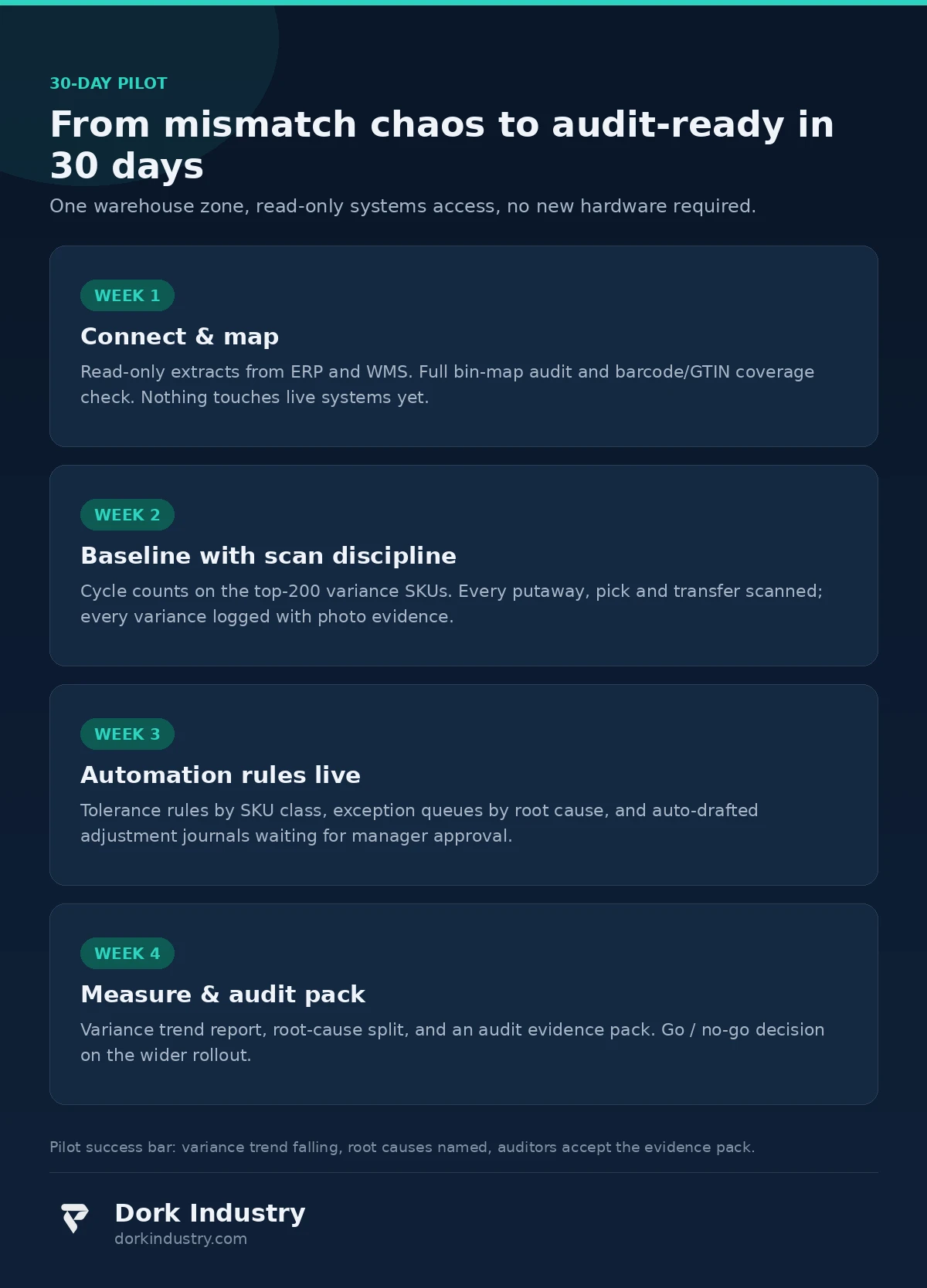
Success criteria are agreed upfront: variance trending down in the pilot zone, root causes named for at least 80% of variances, and auditors accepting the evidence pack format. If those hold, the rollout decision is easy. If they do not, you have spent a month learning — not a year building. The same pattern applies when orders leak between systems: we have examined how orders leak between checkout, OMS and dispatch in ecommerce, and the fix is identical — reconcile continuously, investigate variances, never let the systems drift apart silently.
What drives the cost of a reconciliation automation system?
Five cost drivers, in order of impact: integration surface — how many ERPs, WMSs, and scanner apps must connect, and whether they expose clean APIs or need file-based extracts; master-data cleanup — deduplicating SKUs and fixing units of measure, usually a separate workstream; hardware readiness — handheld scanners and bin labels that scan reliably; rule complexity — tolerance rules by SKU class and approval workflows tailored to your operation; rollout scope — one zone versus twelve sites changes the program cost far more than the software itself.
Frequently asked questions
Can AI automation really fix warehouse-ERP mismatch, or just report it faster?
It fixes the cycle, not just the reporting. Continuous comparison catches variance within hours instead of at audit time, risk-prioritized counting finds the actual errors, and evidence-backed adjustments close each case with a root cause. The mismatch shrinks because causes get eliminated — not because numbers get re-baselined.
Do we need new scanners or a new WMS to start?
Usually not. The pilot runs on your existing scanners and ERP with read-only extracts. The first investments are bin labels that scan reliably and a master-data cleanup pass — both cheaper than hardware. New devices come later, only if the pilot proves the scanning volume justifies them.
How is this different from the cycle counting our ERP already does?
ERP cycle counting schedules counts blindly by ABC class. Reconciliation automation scores every SKU-bin by live variance risk and aims the counts where errors are actually occurring, then investigates every variance instead of just posting it. Same counting hours, far more real variance found.
Will auditors accept AI-assisted adjustments?
Auditors accept adjustments with evidence — who counted, what the scan logs show, what the tolerance rule was, who approved. They reject adjustments that cannot be explained. The system is designed to produce exactly the evidence pack auditors ask for; “AI flagged it” alone would never pass, and the system never relies on that.
What happens to our warehouse staff’s jobs?
Same counting hours, far more real variance found. The tedious parts of the job get automated; accountability moves to evidence instead of blame.
About Dork Industry
Dork Industry is a software development company that builds custom applications, AI automation systems, and integrations for businesses. The Dork Industry Editorial Team writes from real implementation experience — each article examines operational problems we have encountered and technology we have actually built. Our standing position is honesty about build-vs-buy: when off-the-shelf software or your ERP’s native modules fit better than custom development, we say so, because a system you do not need is the most expensive system of all. Our work spans AI systems that warn plants before quality failures, automation with compliance-grade evidence trails, and shop-floor and warehouse integrations.
Request a reconciliation automation assessment
We will map your ERP-to-warehouse data flow, run a variance-pattern analysis on one zone, and tell you honestly whether custom AI automation pays back — or whether your existing systems just need better discipline.