
Real estate lead routing automation should capture every enquiry, match it to an existing person or requirement, preserve consent, assign one accountable owner and record each hand-off in the CRM. It should not allow multiple agents to contact the same buyer independently or let incomplete enquiries disappear. The implementation problem is reliable identity and ownership—not simply sending faster messages.
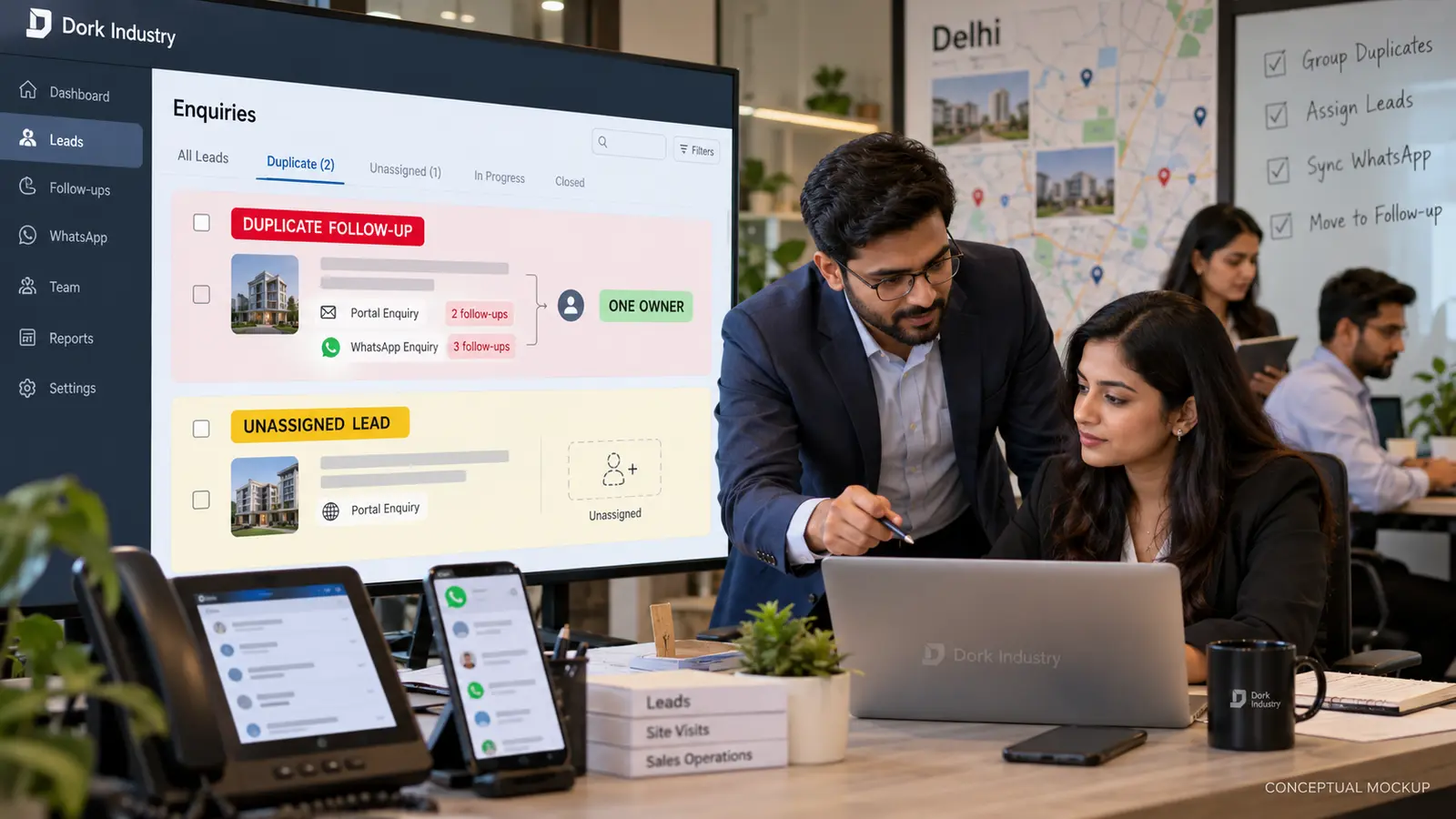
Delhi NCR real-estate teams may receive the same buyer through a project website, property portal, phone call, referral and WhatsApp conversation. When each source creates a fresh row, sales managers cannot distinguish new demand from repeat activity. Buyers receive inconsistent calls, agents dispute ownership and reporting overstates the pipeline.
What problem should real estate lead routing automation solve?
The useful outcome is one trustworthy lead timeline. A new enquiry should either create a contact or attach to an existing buyer based on approved match rules. The system should then select an eligible owner using project, locality, language, budget, source, working hours and current availability. Ambiguous cases should enter an exception queue instead of being guessed.
According to Microsoft’s CRM guidance, CRM automation can capture leads, route requests, log interactions and update records. Salesforce’s CRM overview similarly describes CRM as a system for pipeline visibility and automated lead management. Those capabilities validate the workflow category; they do not prove which product or model fits a specific brokerage.
What business rules should be documented before development?
- Identity: decide which normalized phone, email, source ID or account fields can match an existing buyer.
- Requirement: separate the person from individual property requirements so a returning buyer can enquire about another location.
- Ownership: define whether the original agent, project team or new locality specialist keeps the lead.
- Availability: specify leave, shift, capacity and reassignment rules.
- Consent: store channel-specific consent and opt-out state before promotional follow-up.
- Exceptions: name a human owner for conflicts, missing fields, suspected spam and VIP/referral cases.
Locality can support routing, but it should not be inferred from a Delhi phone number. A buyer considering Dwarka, Rohini, Noida and Gurugram is one person with multiple requirements, not four unrelated leads. Project and locality preferences should remain editable business data.
How should an automated real-estate lead-routing workflow operate?
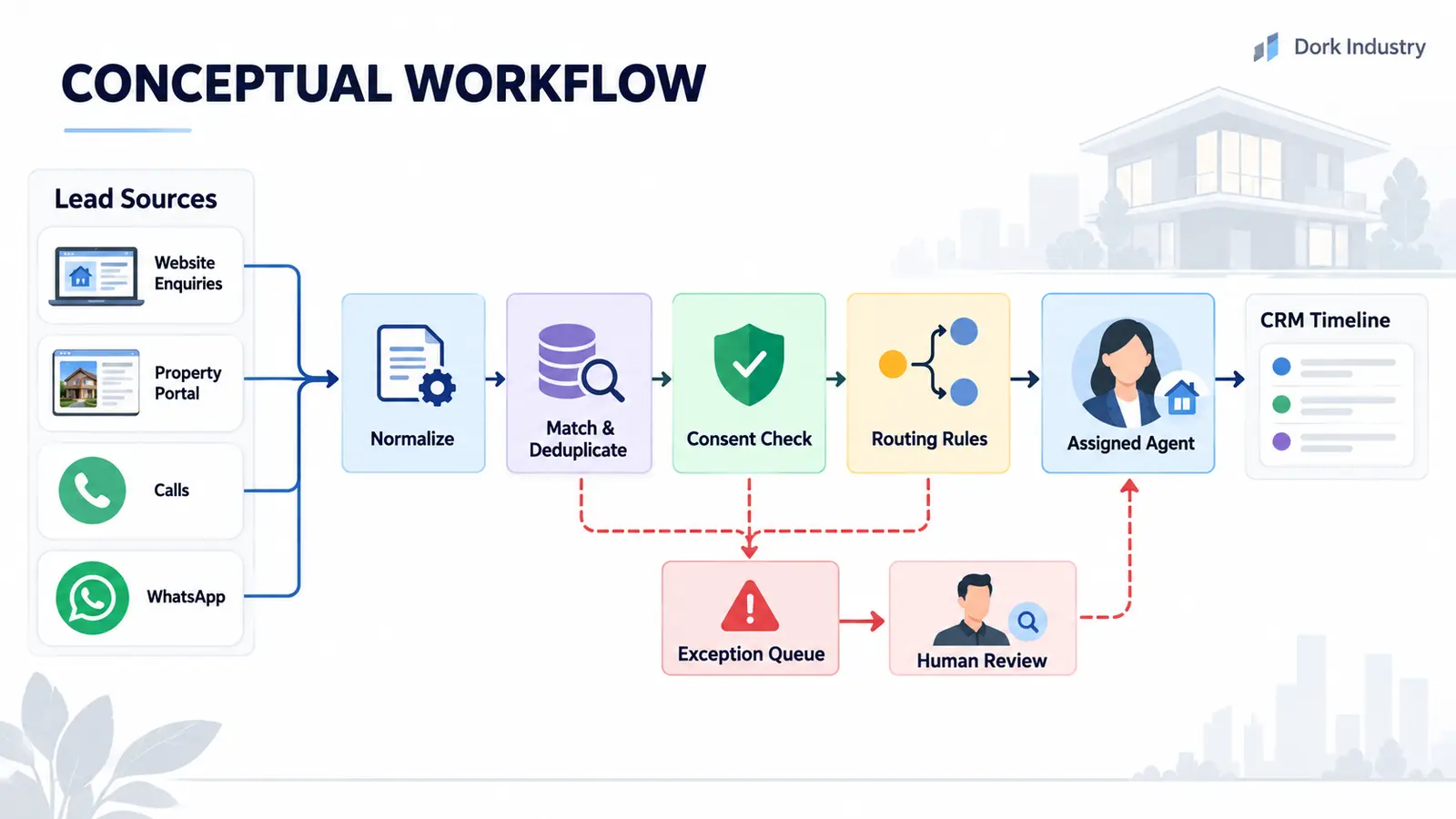
| Stage | Control | Failure handling |
|---|---|---|
| Capture | Keep source ID, timestamp and campaign/project context | Retry without creating duplicate records |
| Normalize | Standardize phone, email and locality fields | Preserve the original submitted value |
| Match | Apply deterministic identity rules first | Send uncertain matches to review |
| Consent | Separate service response from marketing permission | Restrict outreach when consent is missing |
| Route | Use published project, territory and availability rules | Assign a queue when no agent qualifies |
| Follow-up | Record owner, task, channel and outcome | Escalate missed service levels without duplicating outreach |
Every inbound connector should be idempotent: retrying the same event must not create another lead or task. Webhook providers can retry deliveries, and a slow endpoint can receive the same event again. Store source-event identifiers and make record creation safe to repeat.
Where should AI—and human review—be used?
AI can help classify free-text requirements, extract locality and budget, summarize a conversation or suggest priority. It should not silently merge two people, invent consent, promise property availability or reassign a disputed lead without a traceable rule. High-impact decisions need thresholds and a visible review path.
A sensible proof of concept uses historical CRM fields only after duplicates, missing outcomes and inconsistent status labels are understood. Dork Industry’s verified AI/ML implementation service can support classification or prioritization, while deterministic CRM logic handles identity, permissions and ownership.
Should the company configure a CRM, integrate tools or build custom software?
- Configure: appropriate when one CRM receives all sources and its native assignment rules cover the sales structure.
- Integrate: appropriate when portals, calling, WhatsApp, websites and existing CRM must share identity and activity reliably.
- Build custom: justified when the business has complex project ownership, channel rules, lead exchanges or exception processes unsupported by standard automation.
Dork Industry can deliver the workflow through custom software development, connect portals and operational systems, or provide implementation capacity through developer staff augmentation. For a broader CRM-selection pattern, see the related guide to testing multi-location admissions CRM workflows; its routing and ownership principles are transferable even though the industry rules differ.
How should real estate lead routing automation be acceptance-tested?
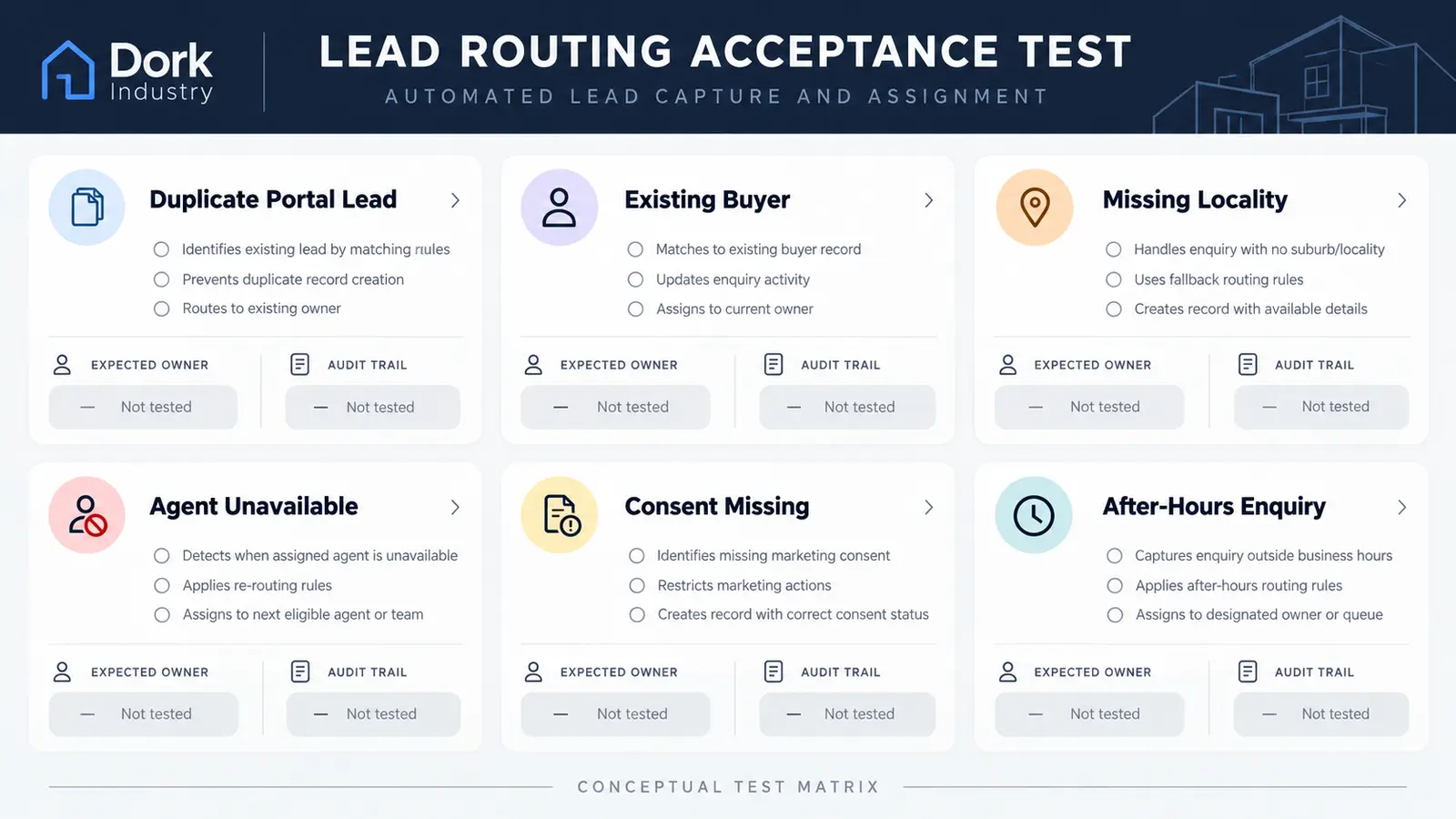
| Scenario | Expected decision | Audit evidence |
|---|---|---|
| Duplicate portal enquiry | Attach activity to existing buyer/requirement | Source IDs and match reason |
| Existing buyer, new locality | Create a new requirement without duplicating person | One contact, linked requirements |
| Missing locality | Route to qualification queue | Missing-field reason and owner |
| Agent unavailable | Use approved backup/capacity rule | Reassignment reason and timestamp |
| Consent missing | Permit necessary response but restrict marketing | Consent source and status |
| After-hours enquiry | Acknowledge and assign without pretending a human replied | Automation label and next task |
Test with synthetic records, not real buyer data, until access controls and deletion rules are proven. Compare the CRM timeline, agent notification, reporting attribution and exception queue for every scenario. A passing happy path does not validate duplicates, consent or reassignment.
Need a lead-routing assessment?
Share the lead sources, current CRM, project/locality ownership rules, agent structure and examples of duplicate or unassigned cases—without personal buyer data. Dork Industry can map the workflow, build a proof of concept, integrate existing systems or provide a developer resource.
Frequently asked questions
Can AI decide which property agent receives every lead?
AI can suggest classification or priority, but ownership should follow approved, auditable rules. Ambiguous identity, consent and agent disputes need human review.
How should duplicate leads be matched?
Use normalized, approved identifiers such as phone, email and source IDs. Preserve original values and require review when matches are uncertain.
Should each property enquiry create a new CRM contact?
No. One person may have several requirements. Maintain one contact and link separate projects, localities or budgets as distinct requirements.
Can WhatsApp and portal leads use the same routing rules?
They can share ownership logic, but each channel needs its own source identifiers, consent state, delivery evidence and failure handling.
What should a proof of concept include?
Use two or three real lead sources, synthetic test records, documented match and routing rules, an exception queue, CRM audit history and an agreed acceptance matrix.
What information should I send a software team?
Provide source systems, CRM, required fields, ownership rules, consent model, operating hours, reassignment cases and sanitized examples. Do not send live buyer records through an ordinary enquiry.