
An equipment rental asset tracking system should answer six questions for every serialized item: what it is, where it was last verified, who accepted custody, when it is due back, what condition it is in and whether it can be rented again. GPS alone cannot provide that chain. Rental businesses need verified hand-offs, QR/RFID or device events, return inspection, overdue exceptions and one availability state shared by operations and billing.

Contents
Why does rental equipment become “missing” even when a spreadsheet exists?
A spreadsheet records the intended location, not necessarily the last verified hand-off. An item may be dispatched under a product name instead of a serial number, transferred between sites without a scan, returned with part of a kit missing, held for repair while still shown as available, or moved after a GPS device stops reporting. The commercial consequences include double booking, avoidable replacement purchases, disputed responsibility and delayed invoicing—but the system should not claim a loss or customer fault without evidence.
Current rental-software pages repeatedly address check-in/out, serialized items, due dates, condition evidence, maintenance and multi-location availability. Indian pages also specifically target construction machinery moving between sites and yards. This validates buyer intent without proving search volume or that every company needs custom software. One Indian market example covers asset-heavy rental businesses, while an international equipment-hire example combines QR, GPS, dispatch and inspection.
Which nine controls should an equipment rental asset tracking system include?
| Control | Business question | Proof before launch |
|---|---|---|
| 1. Asset identity | Is this the exact serialized item? | unique ID and label test |
| 2. Availability state | Can it be promised for new work? | agreed status map |
| 3. Custody hand-off | Who accepted it, where and when? | scan, signature and timestamp |
| 4. Location evidence | Is the location live, scanned or last seen? | freshness indicator |
| 5. Kit hierarchy | Did every component return? | parent-child checklist |
| 6. Due and overdue | Who owns follow-up? | timer and exception queue |
| 7. Condition | Is damage documented consistently? | photos and inspection fields |
| 8. Transfer | Can branches see assets in transit? | send/receive reconciliation |
| 9. Audit integration | Do operations and billing agree? | event history and export |
1. How should each physical asset be identified?
Create one record per serialized item, not only one record per product type. Store the serial number, owner, model, photos, label ID, attachments, service requirements and current lifecycle state. Replace damaged labels through a controlled process so two physical items never share the same code.
2. Which availability states are actually needed?
Define available, reserved, dispatched, on hire, due back, overdue, in transit, inspection, maintenance, damaged, lost and retired. Each transition needs an authorised actor and timestamp. “At customer” is too vague when the business operates across branches, projects or countries.
3. What makes a custody hand-off verifiable?
Scan the exact item or kit, identify the receiving person or organisation, record the site, due date and condition, and capture acknowledgement. An operator may correct a mistake, but the correction should create a new event instead of overwriting history.
4. How should the system describe location evidence?
Show whether the location came from a counter scan, mobile GPS, installed tracker, geofence event or manual correction—and when it was captured. A last-seen position must not be presented as live. AWS documents architectures that combine IoT device events, location resolution, trackers, geofences and alerts; the suitable hardware depends on power, coverage, asset value and update frequency. Review AWS asset-tracking guidance.
5. How can kits and accessories be tracked?
Model the generator, cable set, case and accessories as a parent-child kit. Allow dispatch only after the required children are scanned. At return, raise a component exception instead of marking the complete kit available.
Do staff still phone several branches to locate one rental asset?
Share an anonymised asset register, current dispatch note, branch structure, typical hand-offs, overdue rules and existing accounting or rental software. Dork Industry can map a focused asset-custody proof of concept.
6. What should happen when an item becomes overdue?
Create an exception with the customer, contract, last verified custody, due date, contact history and owner. Automate reminders according to policy, but keep disputed extensions, damage and cross-border recovery under human review.
7. How should damage and maintenance affect availability?
Capture return photos, meter readings, accessories, observed damage and the inspector. Block the item from new reservations until the approved inspection or maintenance path closes. Never infer customer liability solely from a sensor or image without review.
8. How should transfers between branches work?
Use a two-sided transfer: the sending branch dispatches exact assets, the receiving branch scans them in, and transit remains a visible state. Partial delivery, wrong serial number and damaged-in-transit cases belong in an exception queue.
9. Which systems need integration?
Common connections include the booking website, CRM, rental contracts, invoicing, payment or deposit records, workshop maintenance, telematics and customer notifications. Choose one source of truth for asset identity and availability, then use idempotent events so retries do not duplicate dispatches or returns.
Should the business use QR codes, RFID, GPS or IoT trackers?
| Technology | Useful for | Limitation |
|---|---|---|
| QR/barcode | low-cost deliberate hand-offs | requires a person to scan |
| RFID | faster yard or doorway reads | tag, reader and missed-read design |
| GPS/cellular tracker | mobile high-value powered assets | power, coverage and subscription |
| BLE/LoRaWAN/IoT | site presence and low-power telemetry | gateway and radio planning |
| Hybrid | custody plus location evidence | integration and exception complexity |
Start from the decision the business must make. A QR scan may be enough for a camera case handed across a counter. A generator travelling between projects may justify a tracker. A passive tag does not automatically create trustworthy custody; the process still needs assignment, confirmation and exception handling.
What does a complete rental custody workflow look like?
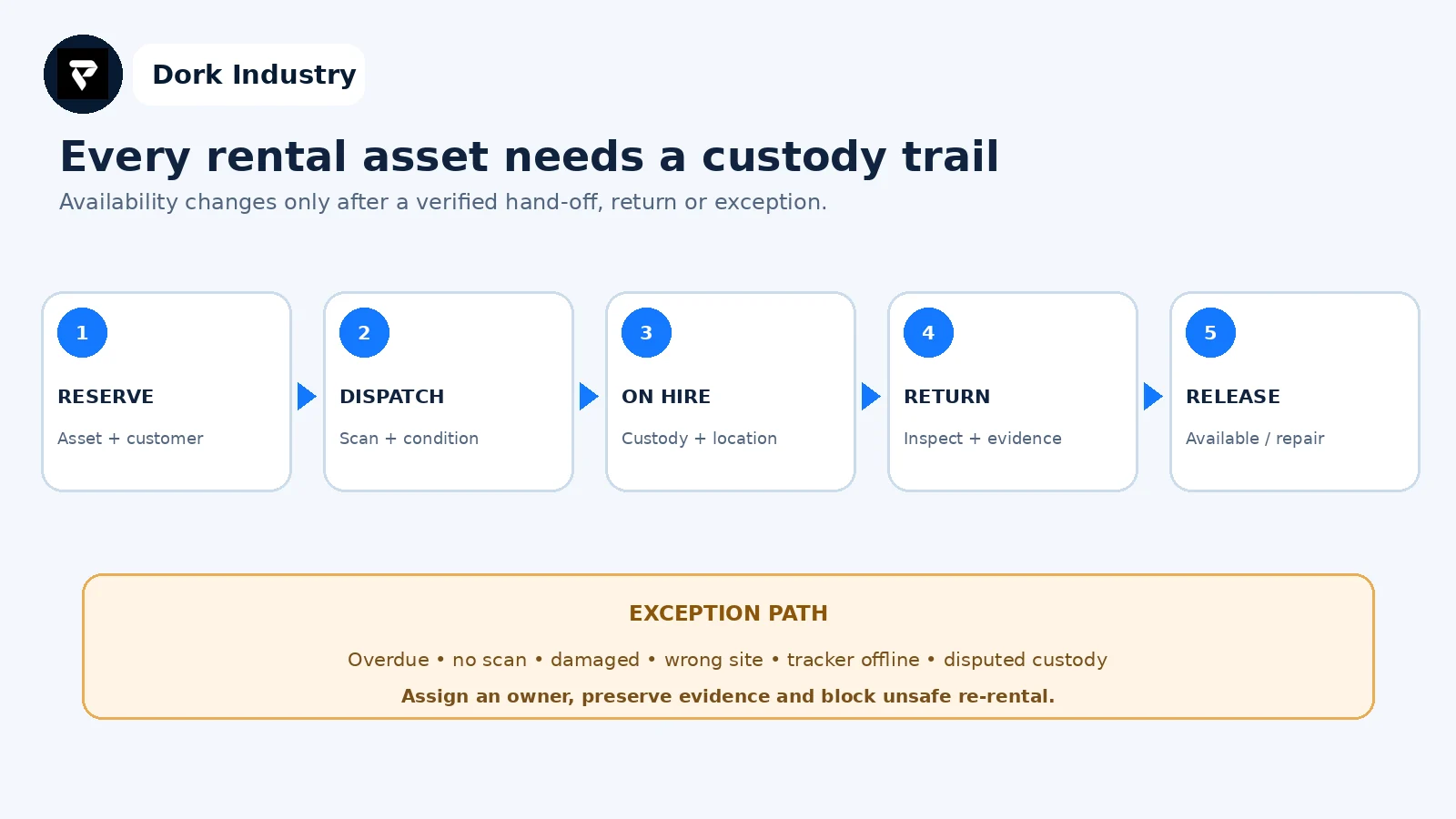
The system can automate availability checks, due reminders, geofence alerts, inspection tasks and reconciliation reports. It should not automatically accuse a customer, declare an asset stolen, charge for damage or imply a stale tracker position is live.
How should a rental business test the system?
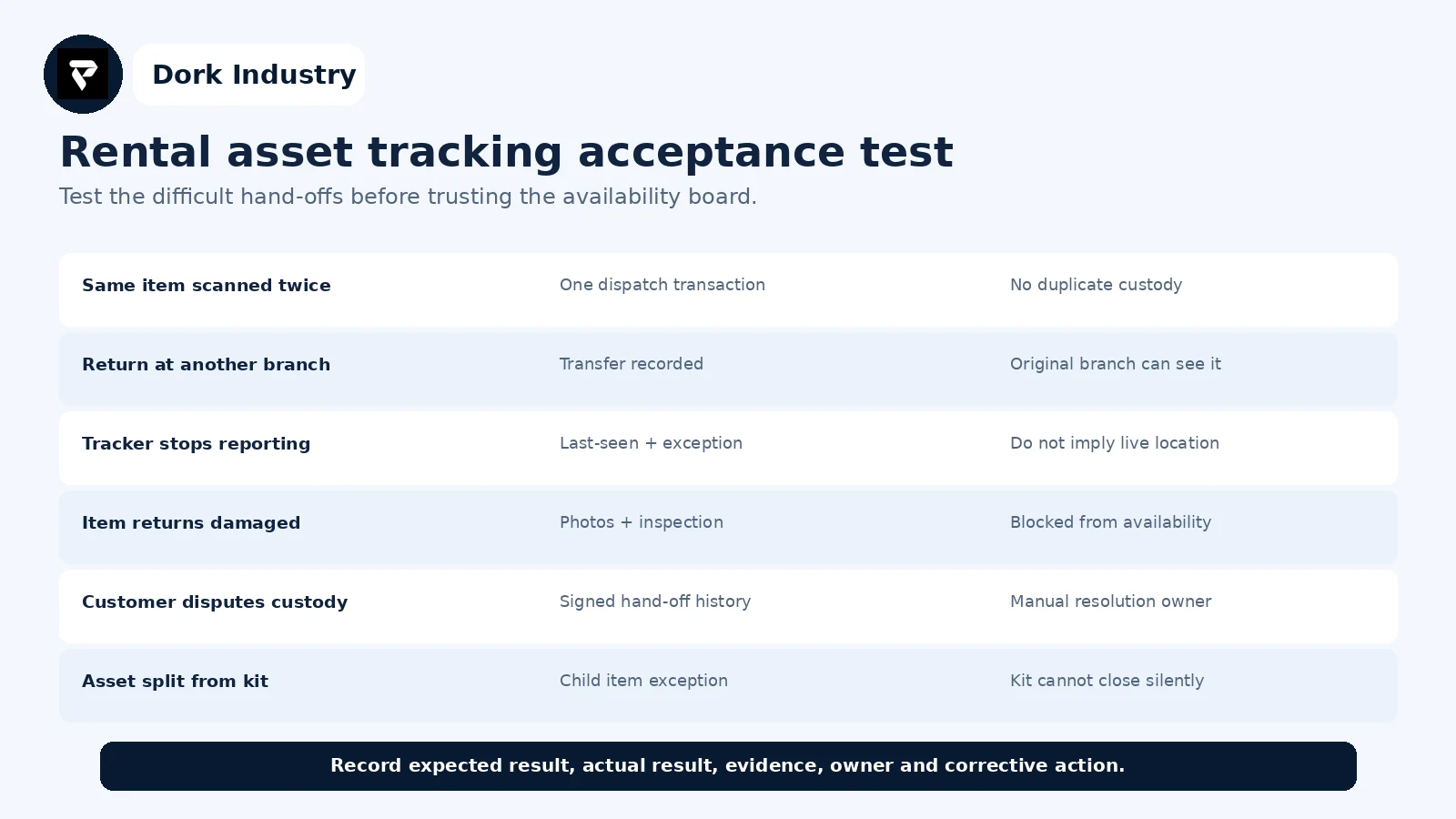
Run each case with test assets before rollout. Record the expected result, actual result, evidence, owner and corrective action. Repeat after changes to labels, mobile apps, tracker firmware, booking rules or billing integrations.
What can Dork Industry build or integrate?
Dork Industry can map the rental workflow, build a mobile scanning app and operations dashboard, integrate existing rental or accounting software, connect supported IoT/GPS devices, create exception queues and deliver a phased proof of concept. The stack—Flutter, web technologies, cloud services, databases or device protocols—should follow the workflow and environment.
Review Dork Industry’s automation solutions, application development, industries served and IoT monitoring workflow guide.
Turn “where is this asset?” into a verifiable workflow
Send a sample asset register, branch flow, rental states, current labels or trackers and required integrations. Dork Industry can propose an integration repair, scanning proof of concept or custom rental operations system.
Frequently asked questions
Is GPS enough for rental asset tracking?
No. GPS can provide location evidence, but the business still needs identity, customer custody, due dates, condition, kit completeness and an authorised return process. The dashboard should distinguish a live update from a last-seen position.
Should every rental item receive a GPS tracker?
No. Match the technology to asset value, mobility, power, coverage, update frequency and operating risk. QR or RFID may be more practical for smaller tools, while a hybrid approach may suit powered mobile equipment.
Can the system work across several branches?
Yes, if it treats transfers as send-and-receive transactions, keeps assets visible while in transit and exposes partial or incorrect receipts as exceptions. All branches must share the same asset identity and availability rules.
What belongs in a proof of concept?
Include serialized registration, reservation, dispatch, one cross-site transfer, overdue handling, return inspection, damaged-item blocking, an offline or stale tracker and reconciliation with one billing or booking system.