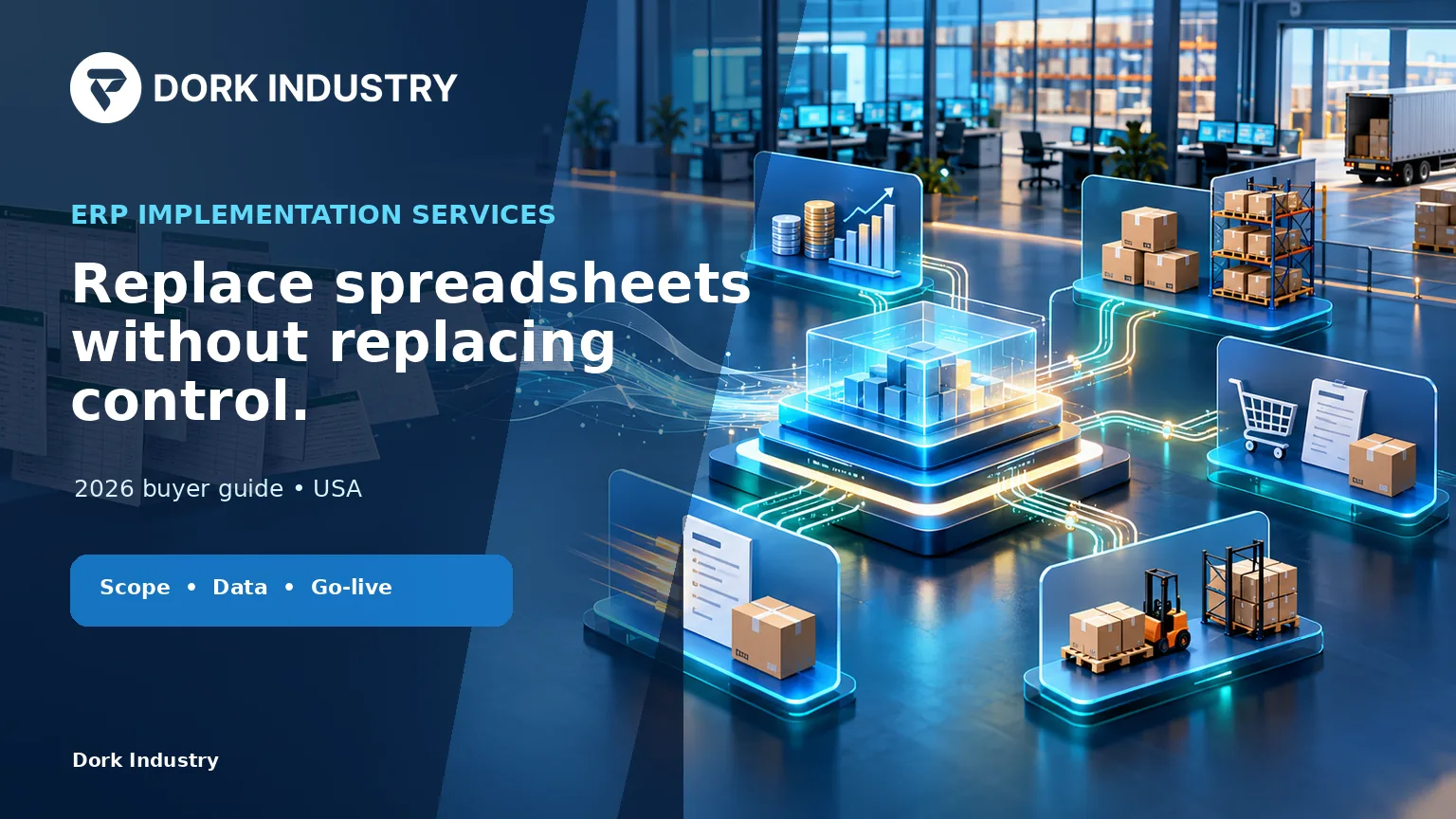
ERP implementation services are the structured activities used to map processes, configure or extend an ERP platform, migrate data, connect systems, test operations and prepare users for a controlled go-live. They should replace uncontrolled spreadsheet workflows with governed processes—not simply move the same confusion into a new interface.
By Nishant Singh, Founder of Dork Industry · Reviewed 17 October 2026. Nishant reviews enterprise-software buyer guides for workflow clarity, data migration, integration risk, security, user adoption, implementation governance and commercial decision quality.
Direct answer
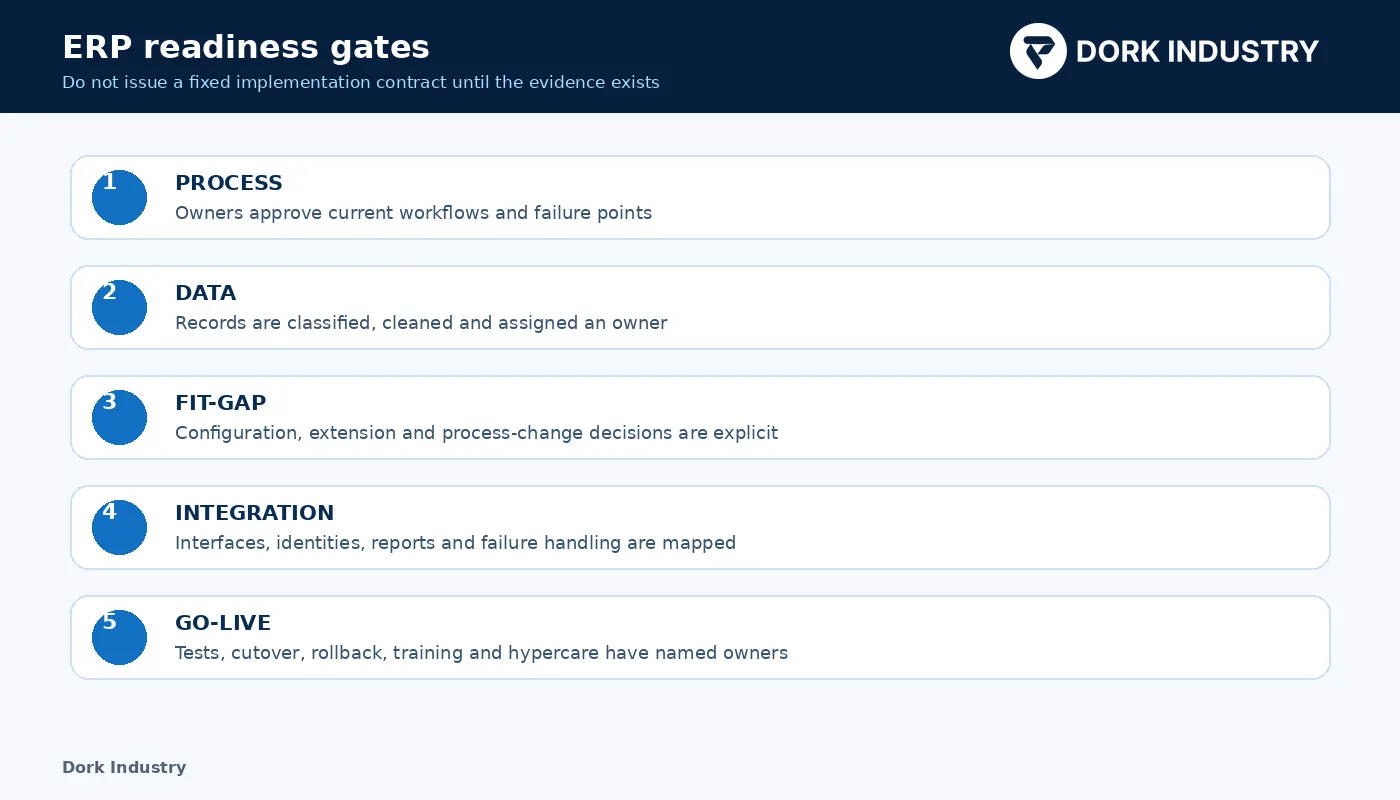
ERP implementation services should include process discovery, requirements prioritization, platform fit-gap analysis, configuration, controlled customization, data cleansing and migration, integrations, security roles, end-to-end testing, training, cutover, rollback, hypercare and operational handover. Buy the engagement in evidence-based stages, with business owners approving each gate before the next commitment.
What should an ERP buyer remember first?
- Do not automate an undocumented process. Establish the current workflow, exceptions, owners and failure points first.
- Data migration starts with ownership. A tool cannot decide which duplicate customer, item or supplier record is authoritative.
- Configure before customizing. Build only where a workflow creates defensible business value and cannot be supported safely by configuration.
- Test business outcomes, not screens. Rehearse complete transactions across finance, sales, purchasing, inventory and reporting.
- Make adoption measurable. Training attendance is not adoption; completed transactions, exception rates and reconciliation effort are stronger evidence.
Why target ERP implementation services in the USA?
External demand was evaluated before selecting this workflow or industry. Google Keyword Planner estimates collected on 17 October 2026 showed approximately 1,310 monthly searches for the exact phrase across eight researched markets. Our analysis showed the United States contributed about 45.0% of the sample and recorded approximately 84.4% three-month momentum. India followed with about 36.6% of measured demand.
| Market | Estimated monthly searches | Share of sample |
|---|---|---|
| United States | 590 | 45.0% |
| India | 480 | 36.6% |
| Singapore | 90 | 6.9% |
| Canada | 70 | 5.3% |
| Australia | 40 | 3.1% |
| United Kingdom | 20 | 1.5% |
| United Arab Emirates | 10 | 0.8% |
| Germany | 10 | 0.8% |
Keyword Planner figures are rounded advertising estimates, not guaranteed organic traffic, rankings or enquiries. The USA was selected from measured external demand rather than current Dork Industry traffic.
What do five ranking ERP implementation competitors cover—and miss?
The review examined 5 companies appearing for this service intent. NexInfo presents process design, SaaS implementation and managed services. RubinBrown emphasizes independent advice, project management and change management. Index InfoTech focuses on consulting and training. Itransition provides the deepest implementation lifecycle, platform options and case-study evidence. Intwo describes selection, process mapping, customization, migration and phased rollout.
The shared gap is not a missing list of ERP stages. Buyers still need one procurement framework that begins with spreadsheet failure evidence and connects workflow scope, data ownership, build-versus-configure decisions, acceptance tests, cutover authority, adoption measures and vendor-exit protection.
| Ranking page | Useful coverage | Buyer question still requiring evidence |
|---|---|---|
| NexInfo | Process design, SaaS and managed services | Which spreadsheet controls and exceptions become acceptance tests? |
| RubinBrown | Vendor independence, project and change management | What must be owned by the client before configuration begins? |
| Index InfoTech | Consulting, training and implementation expertise | How are data quality, reconciliation and rollback accepted? |
| Itransition | Full lifecycle, platforms, cases and service options | How should a smaller buyer stage commercial commitments? |
| Intwo | Selection, migration, training and phased rollout | Which outcomes prove that spreadsheets can be retired? |
When have spreadsheets become an operational risk?
Spreadsheet use is not automatically a failure. A controlled workbook can remain appropriate for bounded analysis. The risk appears when spreadsheets become an unofficial transaction system shared across departments without reliable ownership, validation, permissions or audit history.
Can your teams pass this five-minute diagnostic?
Give one point for every “yes.” A result of five or more supports a structured ERP readiness assessment; it does not automatically justify buying a platform.
- Do finance and operations reconcile the same inventory, order or project data every reporting period?
- Can more than one person alter a critical record without an approval trail?
- Do customer, supplier or item names exist in conflicting versions?
- Does management wait for manual consolidation before seeing performance?
- Are purchase, sales or stock commitments made before current availability is confirmed?
- Do macros, formulas or reports depend on one employee who cannot be replaced easily?
- Are exceptions resolved through email or chat without returning the decision to the system of record?
- Would a damaged file or access mistake interrupt a core business workflow?
Are spreadsheets hiding the real ERP scope?
Dork Industry can map the workflow, identify master-data owners, define the first implementation phase and produce an evidence-based scope before you shortlist or contract a platform partner.
Book an ERP readiness assessment Discuss the workflow on WhatsApp
What should ERP implementation services include?
A complete service should turn business decisions into testable deliverables. The scope must distinguish client responsibilities, implementation-partner responsibilities and software-vendor responsibilities. If every activity is described as “consulting” or “configuration,” price and accountability become difficult to compare.
| Workstream | Required deliverable | Acceptance evidence |
|---|---|---|
| Process discovery | Current and target workflows, owners, exceptions and controls | Department owners approve the maps and unresolved decisions |
| Requirements | Prioritized outcomes, mandatory rules and deferred scope | Every requirement has an owner, priority and test |
| Fit-gap | Configure, change process, extend, integrate or exclude | Impact on cost, upgrades and ownership is documented |
| Data | Source inventory, cleansing rules, mappings and reconciliation | Counts, totals and critical records reconcile after rehearsal |
| Integration | Interface contracts, frequency, error queues and ownership | Failures are visible, recoverable and traceable |
| Security | Roles, approvals, segregation, logging and privileged access | Positive and negative access tests pass |
| Testing | Functional, integration, migration, performance, security and UAT plans | Business scenarios pass with representative data |
| Deployment | Cutover, rollback, communications, hypercare and handover | Named approvers sign the go-live and stabilization gates |
When should you buy, configure or build?
This is not one decision for the whole ERP program. Make it per workflow. Standard finance posting may justify adopting a platform convention. A distinctive pricing, scheduling or service process may justify configuration. A workflow that creates real competitive value—but cannot be configured safely—may justify a governed extension or custom ERP module.
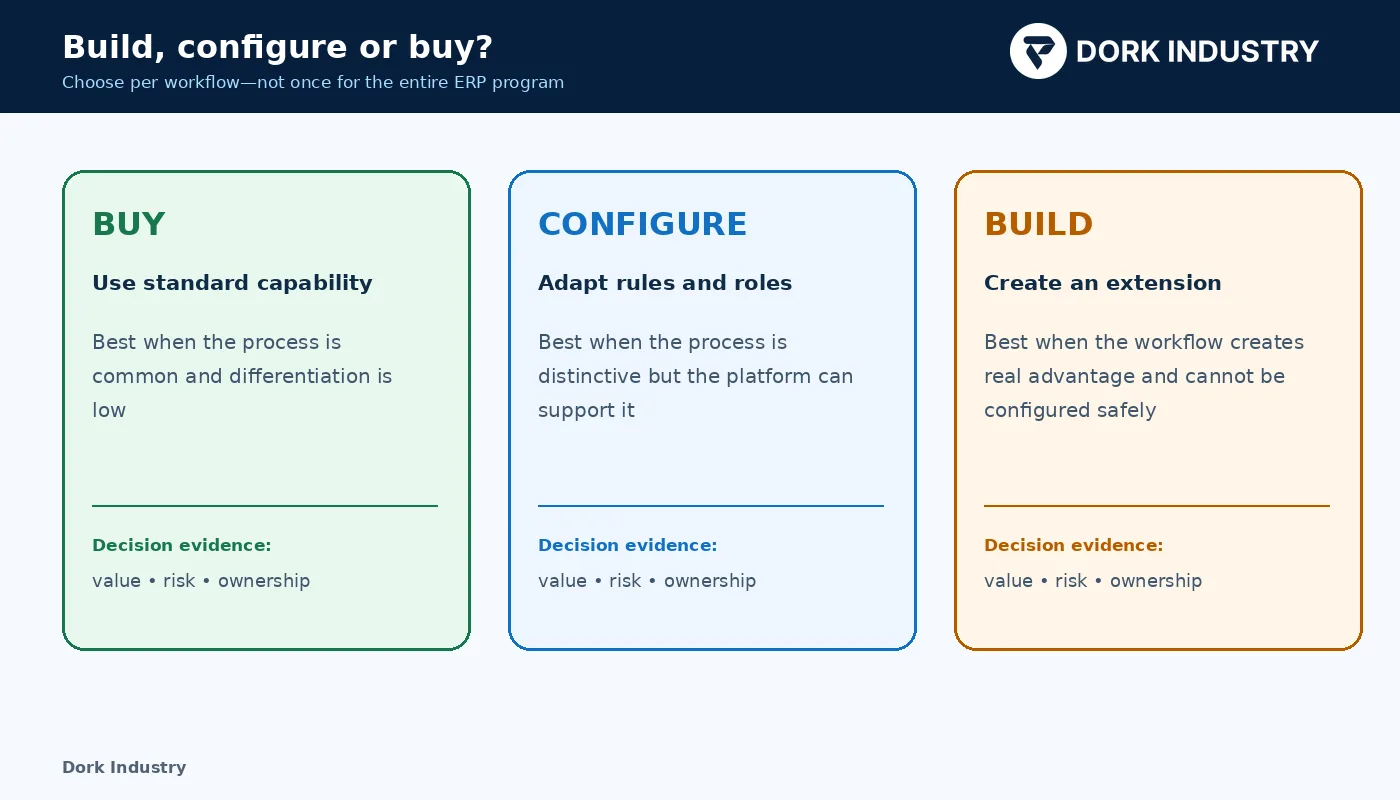
Which questions control the decision?
- Does changing the process remove waste, or remove an advantage?
- Can configuration meet the rule without fragile workarounds?
- Who will test and maintain an extension after upgrades?
- Is the requirement legally mandatory, operationally important or merely familiar?
- Can the same outcome be achieved through reporting, integration or role design?
Dork Industry supports platform-led options such as Odoo ERP implementation and Microsoft Dynamics 365 services, as well as custom business applications when the operating model justifies them.
How should data, integrations and security be controlled?
Who owns ERP data decisions?
Business owners—not the implementation vendor alone—must decide which records are authoritative, which history is necessary, which fields are mandatory and which duplicates can be merged. The partner should profile sources, expose anomalies, implement approved transformations and produce reconciliation evidence for every rehearsal.
What must an integration contract define?
Each interface should specify the system of record, data direction, frequency, identity method, validation, idempotency, timeout, retry, error queue, monitoring, reconciliation and support owner. “Connect ERP to ecommerce” is not a sufficient requirement because it does not explain what happens when a price, payment, stock reservation or fulfilment update fails.
Which security controls belong in the scope?
ERP security should include role design, least privilege, segregation of duties, approval limits, privileged-access controls, strong authentication, encryption, audit logging, retention, backup, recovery and incident ownership. NIST CSF 2.0 treats digital risk as enterprise risk; therefore, finance and operations leaders should participate in governance rather than leaving the decision entirely to IT.
How should ERP testing, cutover and adoption work?
Microsoft’s Success by Design guidance recommends testing early and across functionality, performance, security, usability, integration and data migration. It describes each test cycle as a mini go-live. That principle is useful even when the selected ERP is not Dynamics 365: rehearse the real business day, not isolated screens.
Which end-to-end scenarios should be tested?
- Quote or order through fulfilment, invoicing, payment and accounting.
- Purchase request through approval, receipt, quality decision and supplier payment.
- Inventory transfer, adjustment, reservation, return and reconciliation.
- Period close with taxes, exchange differences, accruals and management reporting.
- Access denial, approval escalation, integration failure and recovery.
What should trigger a rollback?
Define thresholds before cutover: unreconciled balances, unavailable critical integrations, unacceptable transaction latency, missing access controls, failed backup or unresolved severity-one defects. The go-live authority, rollback authority and decision deadline must be named. A rollback statement without rehearsed steps, data restoration and business communication is not a rollback plan.
How should adoption be measured?
Measure completion of target transactions, exception volume, error correction, approval time, support demand, manual exports and continued spreadsheet dependence. Training completion is a leading indicator only. The business has adopted the ERP when critical work occurs reliably in the governed process and managers trust the resulting data.
How should ERP implementation services be contracted?
Separate discovery from implementation when the current workflow, data or integration landscape is uncertain. A bounded readiness phase should produce assets that remain useful even if the business changes vendor: process maps, prioritized requirements, data inventory, integration register, security model, phased roadmap, assumptions, estimate basis and acceptance criteria.
What belongs in the commercial comparison?
- Software licenses, environments and third-party tools.
- Discovery, configuration, customization and integration effort.
- Data profiling, cleansing support, migration rehearsals and archival.
- Testing support, business-user time and defect correction boundaries.
- Training, documentation, cutover, hypercare and ongoing support.
- Change-request rates, travel, taxes, infrastructure and contingency.
- Source-code, configuration, documentation, account and data ownership.
Which contract protections reduce dependency?
Require access to environments, configuration exports, source repositories, interface specifications, release notes, test evidence and administrative accounts. Define service levels, knowledge transfer, security incident notification, subcontractor transparency, termination assistance and a usable data-export path. These controls protect continuity without assuming the relationship will fail.
What should a 30-day ERP readiness worksheet contain?
- Days 1–5: identify the trigger. Record the business consequence, affected teams, deadline and decision owner.
- Days 6–10: map two critical workflows. Capture inputs, decisions, exceptions, approvals, outputs and current spreadsheet dependencies.
- Days 11–15: profile representative data. Measure duplicate, missing, inconsistent and unowned records.
- Days 16–20: inventory integrations and controls. Include identity, ecommerce, banking, payroll, warehouse, reporting and external partners.
- Days 21–25: run fit-gap workshops. Decide what to buy, configure, change, integrate, build or defer.
- Days 26–30: issue a phased scope. Define the pilot, test scenarios, acceptance evidence, commercial assumptions and go-live gates.
| Decision | Owner | Evidence required | Approval date |
|---|---|---|---|
| Process scope | COO / process owners | Maps, exceptions and target outcomes | _____ |
| Data readiness | Business data owners | Profiles, cleansing rules and reconciliation | _____ |
| Security model | Risk / IT / finance | Roles, approvals and access tests | _____ |
| Go-live | Executive sponsor | Passed tests, cutover and rollback evidence | _____ |
Turn spreadsheet pain into a testable ERP scope
Dork Industry can diagnose the workflow, compare platform and custom options, prepare the implementation scope, build required integrations and support delivery with measurable acceptance gates.
Email: support@dorkindustry.com · WhatsApp: +91 8210792477
What do buyers ask about ERP implementation services?
What are ERP implementation services?
ERP implementation services convert business requirements into a configured or customized enterprise system. They normally include process discovery, solution design, data migration, integrations, security, testing, training, deployment, hypercare and support. A reliable engagement assigns deliverables, owners and acceptance evidence to each stage.
Should a business replace every spreadsheet?
No. Replace spreadsheets that act as uncontrolled systems of record, create duplicate entry or hide critical decisions. Retain governed analytical workbooks when they have a bounded purpose, reliable source data and appropriate access control. The goal is controlled operations, not eliminating a useful tool.
Should ERP selection happen before process mapping?
Not completely. A buyer needs enough process and outcome clarity to evaluate platforms without recreating every historical habit. Detailed target-process design can continue after selection, but critical rules, integrations, data constraints and non-negotiable requirements must be understood before a commitment.
How long does an ERP implementation take?
Timeline depends on scope, modules, users, data quality, integrations, customization, decision speed, testing and change readiness. Ask vendors for a phase plan with assumptions and exit criteria rather than accepting a generic duration. Discovery should reduce uncertainty before a fixed schedule is approved.
How much do ERP implementation services cost?
Cost depends on software, environments, process scope, migration complexity, integrations, extensions, testing, training, cutover and support. Compare the assumptions and included evidence behind each proposal. A lower quote can become more expensive if data work, business-user effort, change requests or post-launch support are excluded.
Can Dork Industry implement Odoo, Dynamics 365 or a custom ERP?
Dork Industry can assess the workflow and recommend a suitable route across Odoo, Dynamics 365, integrations and custom ERP/CRM development. The recommendation follows process fit, ownership, data, integration and commercial requirements.
Which sources support this ERP implementation guide?
This guide combines live external demand research, inspection of five current service competitors, primary implementation guidance and Dork Industry’s workflow-first service model. It does not promise a particular cost, timeline, saving, compliance result or business outcome without an organization-specific assessment.
- Microsoft Dynamics 365 implementation guide overview
- Microsoft guidance for implementation test planning
- Microsoft go-live checklist
- Microsoft project-governance guidance
- NIST CSF 2.0
- CISA vendor and supplier assessment guidance
- Oracle migration guidance for test and production environments
- NexInfo ERP implementation services
- RubinBrown ERP implementation services
- Index InfoTech ERP implementation services
- Itransition ERP implementation services
- Intwo ERP implementation services
Editorial responsibility: Dork Industry. This guide supports software procurement and implementation planning; it does not replace legal, regulatory, information-security, accounting or financial advice specific to your organization.
If you are shortlisting a partner for this kind of system, see our comparison of best AI automation companies in India, which covers eight providers on delivery, integrations and governance.
Evaluating software for this?
Book a free consultation — we map your workflow, compare the options, and recommend the smallest safe first step.