
AI development can identify an underperforming solar inverter weeks before the damage becomes a line item in a monthly settlement. Yes: by streaming inverter, irradiance, and grid-meter data through an anomaly-detection model that compares actual output against an expected-yield model per inverter and per string, a solar plant owner can get flagged losses within days — while the fix still recovers generation. The alternative is what most plants do today: discover the underperformance in the monthly generation report, when the lost units are gone forever and the warranty clock on the faulty inverter has quietly ticked down.
This article examines what AI development changes about solar plant monitoring: where plants actually lose generation, why inverters underperform silently for months, what data the AI needs, what it must never do on its own, and how to test it on one inverter block in 30 days before committing to a plant-wide rollout.
Where does a solar plant actually lose generation?
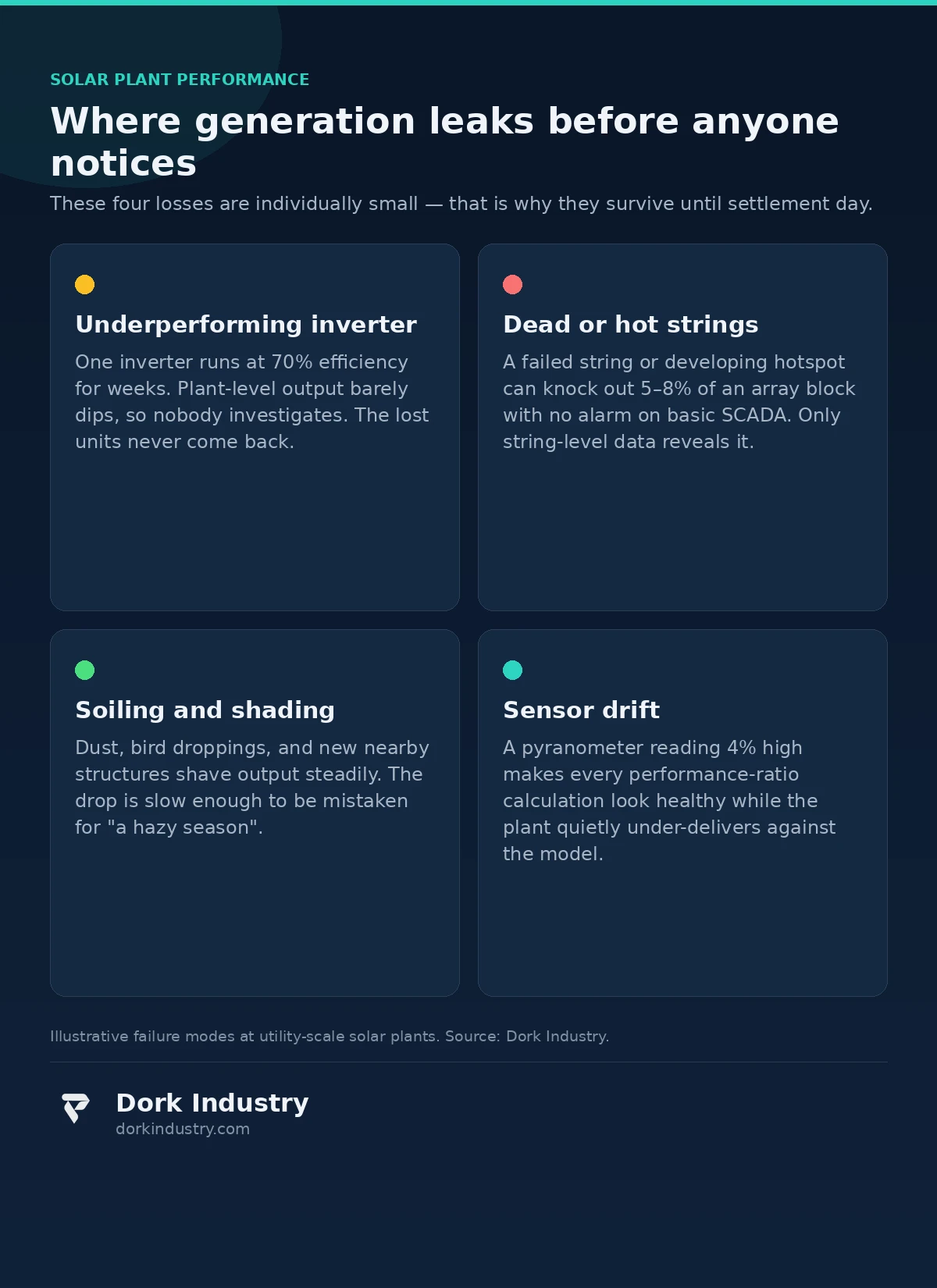
Before discussing technology, it is worth naming the specific leaks. In our experience working with industrial and commercial solar assets, the expensive problems are rarely about broken modules or cloudy seasons. They are about small, steady losses that never trigger an alarm.
Why do underperforming inverters go unnoticed for months?
Plant-level SCADA dashboards show total generation, and an inverter running at 70% of expected output only nudges that total down slightly — especially when the other inverters are performing normally. Nobody walks into the control room and sees a crisis. The loss surfaces weeks or months later, usually when the monthly generation report lands on the owner’s desk and someone compares it against the projected yield. By then, the lost units cannot be recovered.
How do dead or hot strings escape basic monitoring?
A failed string or a developing hotspot can knock out 5–8% of an array block. Basic inverter-level monitoring shows a gentle dip that looks like weather. Only string-level current data — or an AI model that flags the specific pattern of a string dropping while its neighbors hold steady — reveals what happened. Some plants do not discover dead strings until an annual maintenance inspection, which means a full year of partial output.
Why do soiling and shading look like “just a bad season”?
Dust, bird droppings, agricultural residue drifting from nearby fields, and new structures built beside the plant all shave output gradually. Because the decline is slow and the weather varies anyway, the O&M team attributes it to haze or seasonality. Soiling losses are among the most recoverable losses in solar — a cleaning schedule change can fix them in days — but only if someone can see them.
How does sensor drift poison every calculation?
Performance ratio (PR) is the standard health metric for a solar plant: actual yield divided against expected yield from measured irradiance. According to the National Renewable Energy Laboratory’s photovoltaic reliability research, accurate system monitoring is essential for catching underperformance in PV systems. But the PR calculation is only as honest as its sensors. A pyranometer reading 4% high makes every inverter look healthier than it is. The plant quietly under-delivers while the dashboard shows green.
What data does your plant already produce — and what is it missing?
Most utility-scale and commercial solar plants already generate the raw material an AI needs: inverter SCADA streams (DC voltage, DC current, AC power, temperatures), pyranometer and weather-station readings, grid-meter export data, and maintenance logs. What is missing is not data but attention: the streams are checked against fixed thresholds, not against what the plant should be producing right now given the actual sunlight and temperature.
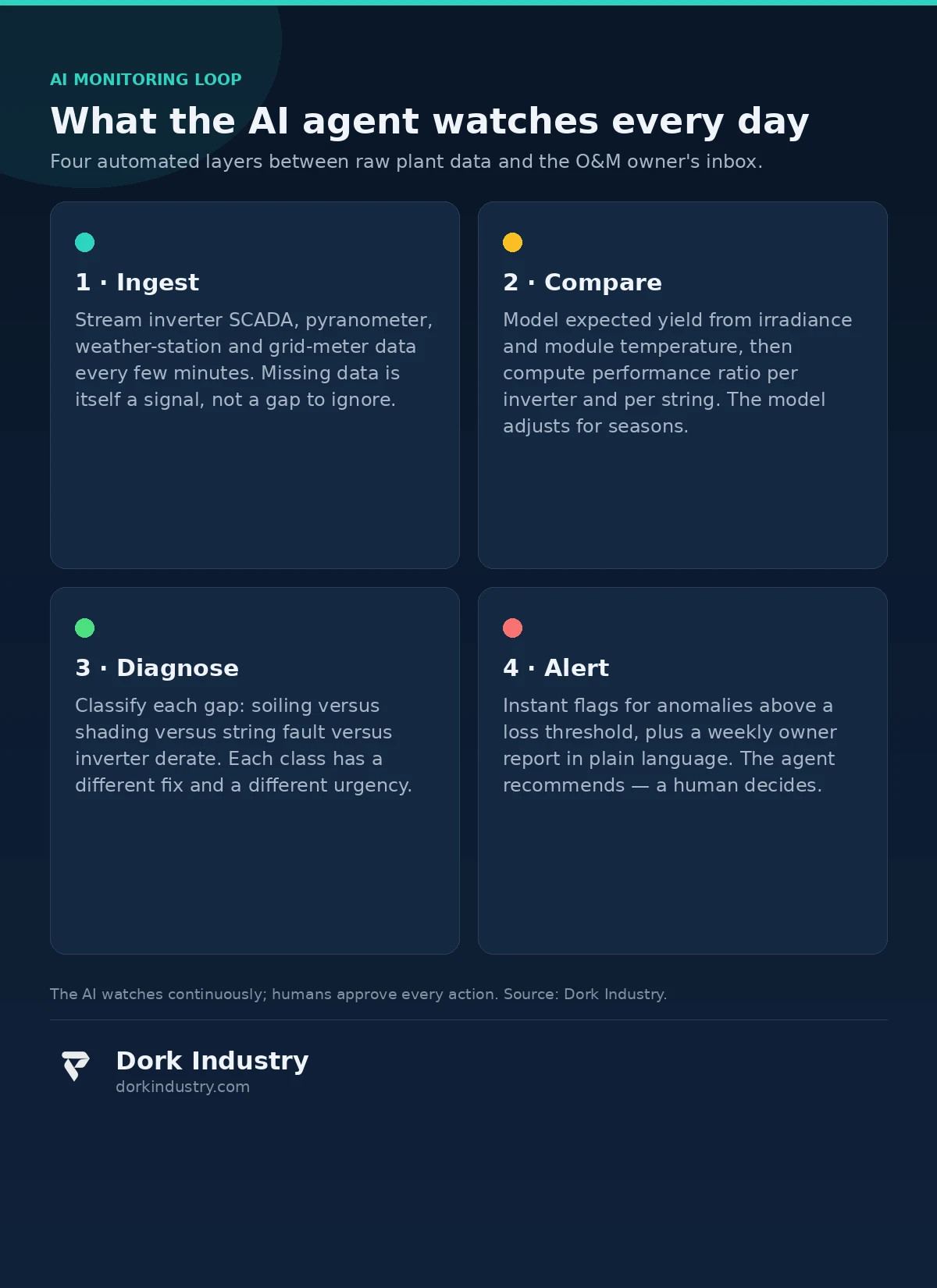
An expected-yield model does exactly that comparison. It takes plane-of-array irradiance and module temperature, applies the plant’s nameplate characteristics, and produces an expected output for every inverter and string. The gap between expected and actual is the loss — and that gap, tracked continuously, is what AI development turns into early warning. According to the Ministry of New and Renewable Energy, India crossed 100 GW of installed solar capacity in early 2025, which means an enormous fleet of plants now faces exactly this monitoring gap as assets age.
What does AI development do that basic SCADA monitoring cannot?
Threshold alarms are binary: power crosses a fixed line, an alert fires. The trouble is that every loss mode described above stays inside the lines. AI development adds four capabilities on top of the same SCADA hardware.
How does anomaly detection work on solar data?
Instead of fixed thresholds, a model learns each inverter’s normal relationship between sunlight, temperature, and output — including how that relationship shifts with seasons. When one inverter starts deviating from its own learned baseline while its peers behave normally, the system flags it. This catches degradation patterns that no static threshold would, such as an inverter slowly losing efficiency over six weeks.
How does the AI classify the cause, not just the symptom?
A drop in output has many possible causes, and each demands a different fix. Soiling produces a slow, uniform decline across many strings. Shading produces a pattern tied to time of day. A string fault produces a sudden localized drop. Inverter clipping produces a flat-topped generation curve at peak sun. A classification model distinguishes these signatures so the O&M ticket says “string fault in block C” instead of “plant underperforming — please investigate.”
Can AI development predict failures before they happen?
Some faults announce themselves: rising inverter cabinet temperatures, increasing DC ripple, cooling-fan cycling anomalies, and arc-fault detector pre-events. A predictive model tracking these leading indicators can flag an inverter for inspection before it fails outright — converting an unplanned outage with a service-team emergency visit into a scheduled maintenance slot.
What does the math look like? An illustrative example
Consider a 5 MW commercial solar plant with a power purchase agreement at ₹3.20 per kWh. Assume a 19% capacity utilization factor, which is typical for a well-sited Indian plant. Annual generation is roughly 5 MW × 8,760 hours × 0.19 = 8,322 MWh, or about ₹2.66 crore in annual revenue. These are illustrative figures with stated assumptions, not benchmarks — your numbers will differ with location, tariff, and plant design.
Now assume one of the plant’s ten inverters runs 25% below its expected output for four months before anyone notices. The lost generation is 0.25 × (8,322 ÷ 10) × (4 ÷ 12) ≈ 69 MWh — about ₹2.2 lakh, gone permanently. Add one dead string block (3% of plant capacity) persisting for six months: 0.03 × 8,322 × 0.5 ≈ 125 MWh, another ₹4 lakh. Together that is roughly ₹6.2 lakh a year lost to two fault classes that an AI agent would flag within days.
The point is leverage: monitoring does not create new generation. It converts recoverable losses into O&M tickets early enough to act on. A single avoided four-month inverter slump often pays for a year of monitoring.
Should you build or buy? An honest breakdown
Not every plant needs custom AI development. The honest options, in order of investment:
| Approach | Best for | Relative investment | Where it breaks |
|---|---|---|---|
| SCADA vendor’s built-in analytics | Single-brand inverters, basic alerting | Bundled with existing SCADA | Fixed thresholds; no cross-brand correlation or loss classification |
| Third-party monitoring SaaS | Standard fleet monitoring with dashboards | Per-MW subscription | You inherit their alert logic; data stays on their platform |
| Custom AI agent over existing SCADA | Multi-brand fleets, mixed plant sizes, owner-specific alerting | Project cost + modest running cost | Overkill for a single small rooftop with one inverter brand |
| In-house data science team | Large IPPs with many plants and proprietary needs | Highest ongoing cost | Expensive to sustain for one or two plants |
At Dork Industry, we regularly advise plant owners against custom builds when a monitoring subscription fits. We built a similar early-warning pattern for a dairy plant — AI development that warns before a milk-quality batch fails — and the same honesty applies: if packaged monitoring covers your fleet, buy it. Custom AI development earns its cost when you run multiple inverter brands, mixed plant sizes, or want the alert logic and the data to belong to you.
What must an AI agent never do alone?
Technology boundaries in AI development matter as much as features — especially on a plant that carries hundreds of volts of DC and feeds a grid connection.
- Never auto-disconnect or reconnect equipment. Isolation of inverters and strings is a high-voltage operation. The AI flags; a certified electrician with lockout-tagout procedures performs.
- Never auto-derate or curtail output. Reducing plant output affects grid scheduling commitments and PPA obligations. Derating is a commercial decision, not an algorithmic one.
- Never authorize warranty claims. An AI flag is not a root-cause report. Inverter OEM warranties require manufacturer diagnostics; sending claims on AI inference alone creates disputes.
- Never skip inspection on safety-critical flags. Arc-fault precursors and hotspot signatures are fire risks. The AI escalates immediately and loudly — a human must physically verify, even if the last ten flags turned out to be dust.
- Never retrain its model on unlabeled anomalies. If the model absorbs every unusual reading as “normal,” its baseline drifts and detection decays. A human reviews anomalies and labels them before retraining.
- AI should prioritize tickets, not override the O&M plan. “Inverter 7 in block C is 18% below expected — inspect string combiner boxes this week” is useful. Reordering the entire maintenance schedule automatically is not.
How do you test it in 30 days before full investment?
The lowest-risk path is a pilot on one inverter block with a fixed scope and measurable outcomes:
- One inverter block (typically 1–5 MW), with string-level data enabled
- Connect the existing SCADA stream — no new hardware in most cases
- Expected-yield model calibrated against two weeks of history
- Run for 30 days with a daily anomaly feed and a weekly plain-language report to the owner
- Measure: losses flagged vs actual findings, detection lag vs the old monthly-review process, and any MWh recovered through early tickets
If the pilot cannot name specific, verifiable losses in 30 days — a soiling pattern, a string fault, a sensor drift — a bigger AI development investment will not fix it either. The pilot validates the detection, not just the dashboards. This is the assessment Dork Industry runs before quoting any solar project: map the data you already produce, name the losses, then decide what software earns its cost.
What actually drives the cost of AI development for solar monitoring?
Solar AI pricing varies widely because scope does. The real cost drivers are:
- Capacity and inverter brands: a 2 MW single-brand plant and a 50 MW multi-brand fleet are different projects — each brand’s SCADA protocol needs integration work
- Data granularity: inverter-level only vs string-level vs combiner-box level changes the model complexity significantly
- Sensor quality: plants with calibrated pyranometers and clean weather-station data calibrate faster; sensor upgrades may be needed first
- Alerting and integration: WhatsApp/SMS/email alerting, O&M ticket-system integration, and owner dashboards
- Reporting needs: investor-grade generation reports and grid-code compliance formats vs internal dashboards only
- Model hosting: cloud vs on-premise at the plant, and who owns the data
Anyone quoting a fixed price without asking about inverter brands, data granularity, and alerting workflows is guessing.
Frequently asked questions
How does AI development detect an underperforming solar inverter?
It compares each inverter’s actual output against an expected-yield model built from live irradiance and module-temperature data. When an inverter deviates from its own learned baseline while its peers behave normally, the system flags the gap — typically within days, not at month-end settlement. The flag includes a likely cause class (soiling, shading, string fault, or derate) so the O&M ticket is specific.
What data does the AI need from my plant?
In most cases, only what you already produce: inverter SCADA streams (DC/AC values, temperatures), pyranometer and weather-station readings, and grid-meter export data. String-level current data unlocks the most valuable fault classes, so plants without it may consider enabling it. No new hardware is usually needed for the pilot.
Can AI development replace my O&M team’s site visits?
No — and any vendor claiming otherwise should be questioned. The AI tells the O&M team where to look and what to bring; it never replaces physical inspection, especially for safety-critical issues like arc-fault precursors or hotspot signatures. Think of it as a triage system for site visits, not a substitute.
How long before the monitoring pays for itself?
In the illustrative 5 MW example above, one avoided four-month inverter slump (~₹2.2 lakh) covers a large share of a year’s monitoring cost. Actual payback depends on your plant’s fault history, which the 30-day pilot is designed to reveal. Plants with aging fleets or multi-brand inverters tend to find more recoverable losses, faster.
Will it work with my existing SCADA and multiple inverter brands?
Yes — that is precisely where a custom AI agent beats bundled vendor analytics. The agent integrates with each inverter brand’s SCADA protocol or data export and normalizes the data into one monitoring model. Multi-brand fleets, which most bundled tools handle poorly, are a strong reason to go custom. Request a solar performance assessment to map your specific setup.
About Dork Industry
Dork Industry (dorkindustry.com) is a custom software development company building mobile apps, AI automation, and IoT systems for businesses across India. Our team designs solar performance monitoring, dairy quality AI agents, and industrial IoT — from 30-day pilots to full fleet rollouts.
The bottom line
The question is not whether a solar plant needs AI development. It is whether the owner finds out about an underperforming inverter in days or in the monthly settlement report. Every week of delay converts recoverable generation into a permanent loss and burns warranty time on the faulty equipment.
Start with the data you already produce, pilot on one inverter block for 30 days, and let measured detection lag and recovered generation — not feature lists — decide whether to scale the AI development.
Own or operate a solar plant and want to know what your inverters are quietly losing?
We map your current monitoring, SCADA data, and O&M process, and show you exactly what an AI agent would (and would not) catch, before any development is discussed.
Request a solar performance assessment WhatsApp +91 8210792477