
IoT development can automatically control a mushroom farm’s humidity, CO2 and ventilation — but only if the system understands that a grow room needs four different climates, not one. Yes: sensors, a stage-aware controller and the right actuators can hold each growth stage inside its recipe around the clock, reacting in minutes where a grower’s walk-through reacts in hours. A mushroom room is one of the most climate-sensitive production environments in agriculture: the same room must run sealed and humid during spawn run, then drop temperature and flood with fresh air for pinning, then hold steady for fruiting. Get the transition wrong by a few degrees or a few hundred ppm of CO2 and an entire flush is downgraded — long stems, small caps, bacterial blotch — weeks of substrate, labour and energy investment sold at a fraction of its value, or not sold at all.
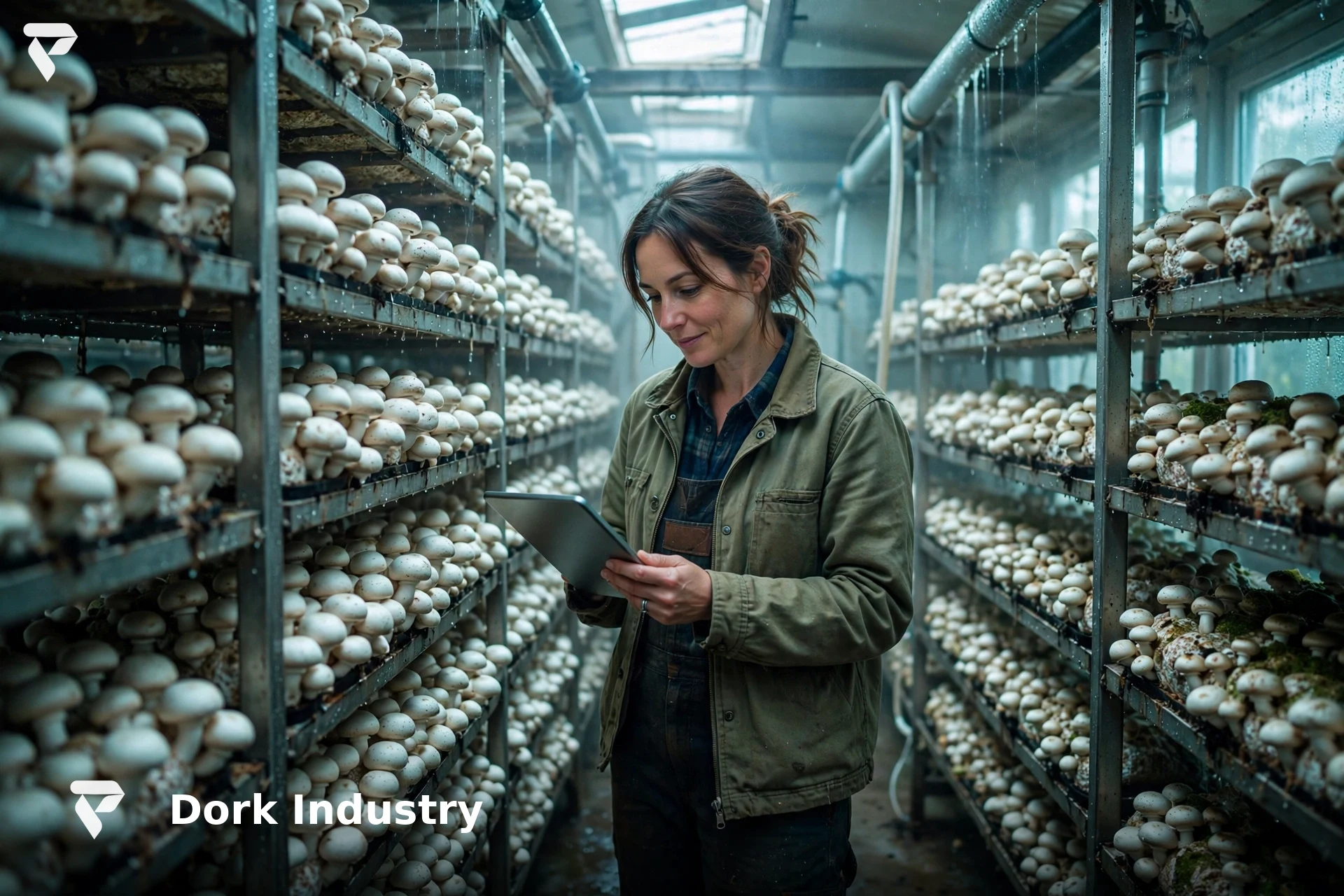
How does a wrong climate actually destroy a mushroom crop?
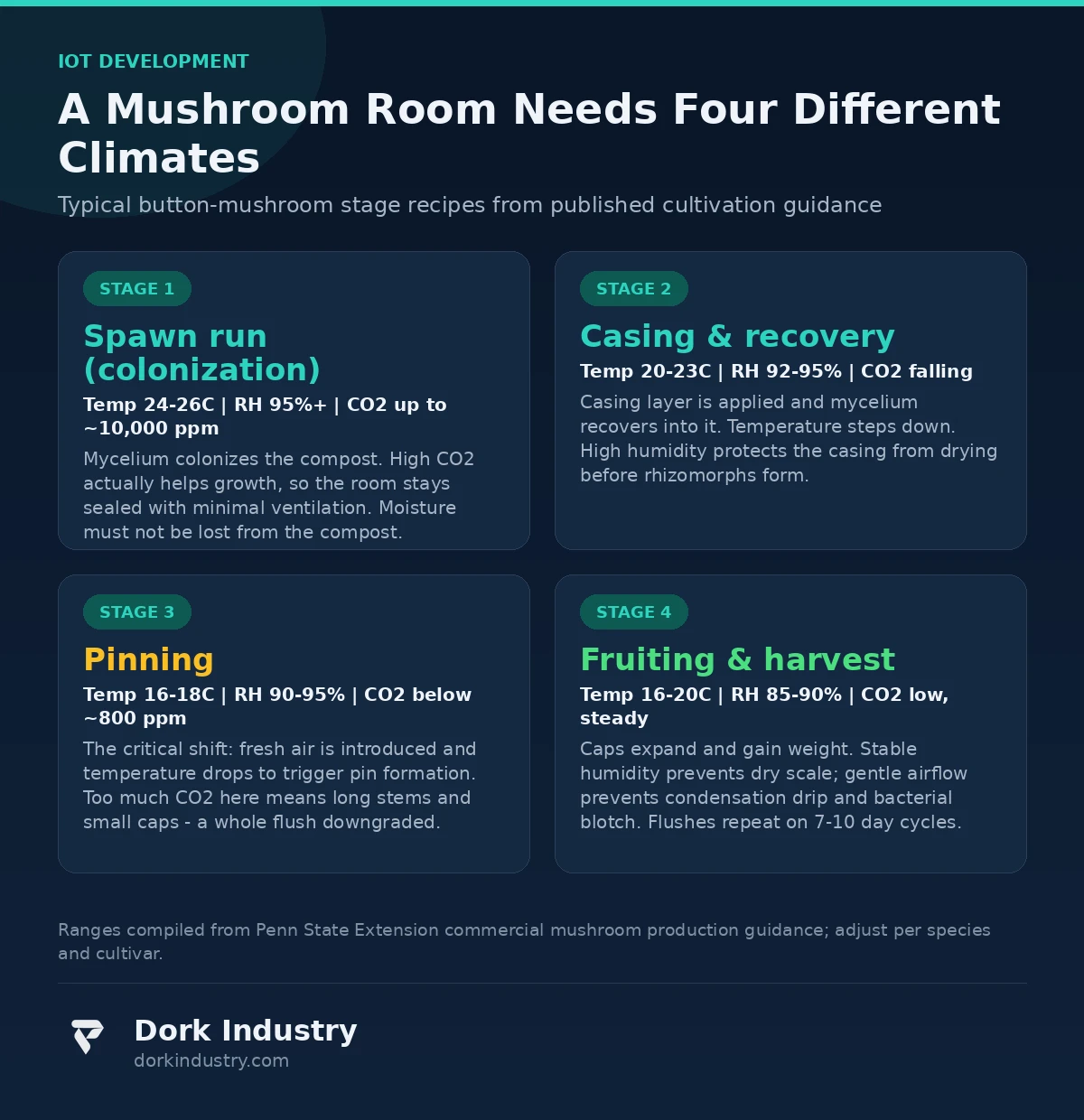
Mushrooms are roughly 90% water and absorb moisture from the air, not through roots — that single fact makes climate control the crop. A mushroom flush that develops under the wrong conditions cannot be fixed later. According to Penn State Extension’s commercial mushroom production guidance, humidity during spawn growth should be held at 95% relative humidity or higher, while pinning needs fresh air with CO2 at 0.08% (800 ppm) or lower. The room must move between those extremes on schedule, every cycle.
Why is the pinning transition so fragile?
Pinning is the moment mycelium commits to forming mushrooms, and it is triggered by a coordinated shift: temperature drops, fresh air arrives, CO2 falls. If ventilation lags or the temperature drop is too shallow, pins form weakly or unevenly. If CO2 stays elevated, the crop stretches — long thin stems with tiny caps that buyers reject. A pinning window missed by half a day does not delay the flush; it degrades it.
What happens when humidity drifts just a few percent?
A 3–5% humidity drift sounds trivial until you see what it does at canopy height. Too dry and caps develop dry scale, abort, or deform. Too wet and condensation drips onto the crop, inviting bacterial blotch — brown lesions that spread across a flush and can take the whole room down. According to the cultivation guidance at Eurosubstrat, fruiting typically needs relative humidity above 85%, often around 90–95%, while excess condensation encourages bacterial disease — the band between “healthy” and “diseased” is narrow and moves with temperature.
Why does a climate failure cost a whole cycle, not just a day?
A grow room runs on a 7–10 day flush cycle, and the substrate, energy and labour invested are sunk before the first mushroom is picked. A ruined flush means the room is turned over and restarted — weeks of lost production plus the wasted substrate. The product has no recovery path.
Why can’t an experienced grower manage this manually?
A single grower cannot be in four rooms at once, and rooms do not wait for the morning walk.
- Rooms change state between checks. A fogger nozzle clogs at 2 AM; humidity collapses; by the 7 AM walk the casing has dried and pinning is compromised. The grower sees the consequence, never the event.
- Equipment fights itself silently. Heating and humidification, or cooling and fresh-air intake, can work against each other for days — the room “looks fine” on a thermometer while energy burns and condensation forms.
- Manual logs have gaps exactly when things go wrong. Paper or spreadsheet logs record a few points a day. A CO2 spike between readings leaves no trace, so the same failure repeats every cycle.
- Stage transitions depend on memory and timing. Switching a room from spawn-run conditions to pinning conditions is a multi-step sequence. Done late or out of order, it costs a flush — and there is no log of what was actually done.
The grower’s knowledge is the most valuable asset on the farm. IoT development extends it — the grower’s judgment, executed every minute instead of twice a day.
What must IoT development deliver for a mushroom farm?
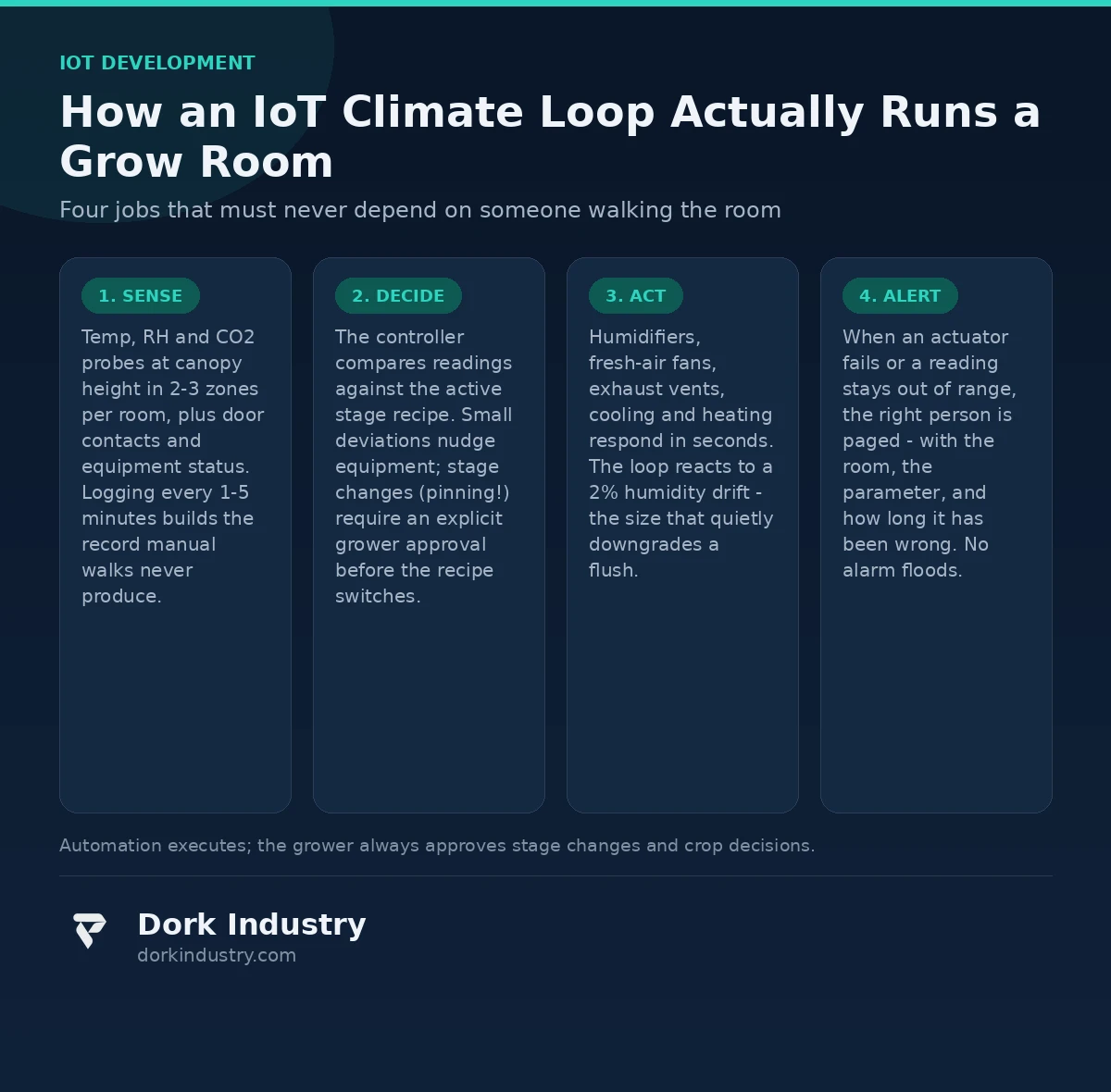
A useful mushroom climate system does four jobs continuously — sensing, deciding, acting, alerting. Each is simple; the value is that they run together, all day, with a record.
What should sensors measure, and where?
Temperature, humidity and CO2 must be measured at canopy height — conditions at the ceiling tell you nothing about what the crop experiences. A practical layout: 2–3 sensing zones per room (near the door, mid-room, far corner), each with temperature, humidity and a true NDIR CO2 probe, plus door contacts and equipment status. Logging every few minutes builds the record manual walks never produce — and that record turns the next crop failure into a diagnosis instead of a mystery.
How does the control loop decide what to do?
The controller holds one active stage recipe — the temperature, humidity and CO2 band for the current growth stage — and compares live readings against it. Small deviations nudge equipment: a 2% humidity drift starts the fogger; rising CO2 opens the fresh-air damper. The critical design point is stage transitions: moving from spawn run to pinning is a crop decision. The system proposes the switch, the grower approves it, and the approval is logged.
What does the grower see and approve?
- A live dashboard per room: current readings vs the active stage recipe, with trend graphs
- Stage-transition proposals (“Room 3 ready for pinning recipe — approve?”) with one-tap approval
- Alerts that name the room, the parameter, and how long it has been wrong — routed to the shift lead, not a group chat
- A per-cycle climate record: every reading, every equipment action, every approval, exportable for audits and buyer quality programs
What data does your mushroom farm already have — and what is it missing?
Most mushroom farms already generate useful raw material: manual climate logs, harvest weights per room per flush, energy bills, notes about which rooms underperformed. What is missing is correlation: nobody can connect a weak flush to the CO2 readings of three weeks earlier, because those readings were never captured.
The principle that should guide any IoT development for mushroom farming: capture what the farm already does — walks, readings, equipment runs, harvests — in a form the grower can query. The most common failure is a beautiful dashboard that nobody checks because alerts go to the wrong person. If the shift lead does not get the alert on their phone within minutes, the data might as well not exist.
What does the math look like? An illustrative example
Illustrative example with stated assumptions — not industry benchmarks. Consider a mid-size button mushroom farm with 4 growing rooms, each producing one flush per 8-day cycle. Assume each room yields 400 kg per flush at a wholesale price of ₹120 per kg — ₹48,000 of revenue per room per flush, or roughly ₹2.2 lakh per room per year across 45 cycles.
Now assume climate drift downgrades one flush in four: caps with dry scale or blotch sell at half price, and one flush in twelve is lost entirely. That is roughly ₹3 lakh in lost revenue per room per year — ₹12 lakh across the farm — before counting the wasted substrate, labour and energy in the failed cycles. A climate system that halves the downgrade rate pays for its hardware many times over; the software earns its cost by making the failure visible before the flush is graded, when a correction still helps.
The second lever is energy: heating, cooling and humidification working against each other is pure waste, and farms that log equipment duty cycles against climate readings routinely find a large share of climate energy is avoidable. These are illustrative figures; your farm’s numbers come from one instrumented room, which is exactly what the pilot below produces.
Should you build or buy? An honest breakdown
Not every mushroom farm needs custom IoT development. The honest options, in order of investment:
| Approach | Best for | Relative investment | Where it breaks |
|---|---|---|---|
| Manual walks + thermostats | One or two rooms, owner always on site | Minimal | No night coverage, no records, no correlation |
| Packaged climate computer | Standard rooms with standard equipment | Medium | Locked data, rigid recipes, alerts to a wall panel nobody watches |
| Sensors + off-the-shelf IoT platform | Monitoring and alerting without custom logic | Medium | Cannot model stage recipes or approval-gated transitions |
| Custom IoT development | Multiple rooms, multiple species, buyer audit requirements | Highest | Overkill for a single standard room with a resident grower |
At Dork Industry, we regularly advise farms against custom builds when a packaged climate computer plus a data-export layer would do. If every consultation ends with a quotation for a custom platform, get a second opinion. Our own IoT work — from cold-store temperature monitoring to farm irrigation control — follows the same rule: start with the cheapest intervention that produces evidence.
What must the system never do alone?
Climate automation in mushroom farming has hard boundaries. Crossing them does not save labour — it risks the crop.
- Never switch stage recipes without grower approval. Moving a room to pinning conditions is a crop decision. The system proposes, shows the readings that justify it, and waits. An automated transition on a misreading can destroy a flush.
- Never let CO2 control ignore worker safety. Spawn-run rooms legitimately run CO2 levels far above normal indoor air. The system must interlock: if CO2 approaches occupational exposure limits, ventilation takes priority over the recipe and workers are warned before entering.
- Never run misting on a blind timer. Water on the crop without humidity feedback is how bacterial blotch starts. Every misting action must be tied to a live humidity reading and a maximum wetness budget per cycle.
- Never hide the raw data behind a “health score.” A single green/yellow/red indicator teaches the grower nothing. Show the actual temperature, humidity and CO2 curves — the grower’s eye on real data is the most powerful diagnostic on the farm.
- Never make harvest or labour decisions. Climate data can inform, but picking schedules, staffing and buyer commitments stay human. Software that auto-commits a harvest date to a buyer is a liability machine.
How do you test it in 30 days before full investment?
The lowest-risk path is a single-room pilot with a fixed scope and measurable outcomes. According to Penn State Extension’s production and harvesting guidance, flush timing is managed through water, CO2 and temperature control — which makes a pilot the right way to learn a room’s actual behavior before scaling:
- One growing room, one full crop cycle — spawn run through at least one flush
- Three sensing zones (temp, humidity, CO2 at canopy height), door contact, equipment status
- Controller running the room’s stage recipes with grower-approved transitions
- Alerts to the shift lead’s phone; dashboard in the packing area
- Measure: excursions caught vs the previous cycle, response time, flush grades, energy per kg
If the pilot room does not show fewer excursions and a cleaner flush grade than its uninstrumented twin, a bigger investment will not fix it either. The pilot validates the workflow — sensing, deciding, acting, alerting — not just the hardware.
What actually drives the cost of mushroom farm IoT development?
Pricing varies because scope does. The real cost drivers are:
- Rooms and zones: one room with three zones vs ten rooms with per-rack sensing changes the hardware and data model completely
- Sensor grade: true NDIR CO2 probes and industrial humidity sensors cost more than hobby modules — and in 95% humidity, cheap sensors die within months
- Existing equipment: modern foggers and VFD fans with control inputs integrate cleanly; relay-switching old contactors needs electrical work and safety review
- Connectivity: growing sheds are often metal boxes with poor signal — a local gateway with store-and-forward vs farm-wide network
Anyone quoting a fixed price without asking how many rooms, what equipment is already installed, and which species you grow is guessing.
Frequently asked questions
Can IoT sensors survive inside a humid mushroom growing room?
Yes, if specified correctly. Industrial temperature/humidity probes and true NDIR CO2 sensors are built for condensing environments, but they need protective housings, periodic calibration checks, and placement away from direct fogger spray. Consumer-grade sensors corrode and drift within months at 95% humidity — sensor replacement is a line item, not an afterthought.
How many sensors does one growing room need?
A practical minimum is three sensing zones per room — near the door, mid-room, and the far corner — each measuring temperature, humidity and CO2 at canopy height, plus a door contact and equipment status. Fewer zones miss the gradients that damage crops; more zones add precision for large or oddly-shaped rooms.
Will automation replace the grower’s judgment?
No — and it should not try. The system executes the grower’s recipes around the clock and flags deviations, but stage transitions, recipe adjustments and all crop decisions stay with the grower.
What happens when the internet goes down?
The controller must run locally. Climate control cannot depend on a cloud connection — a well-designed system keeps sensing, deciding and acting on a local gateway with store-and-forward, so a network outage means delayed dashboards, not a dead room. Ask any vendor how their system behaves with the cable unplugged.
How long until an IoT climate system pays for itself?
It depends on your current loss rate, which the pilot measures. Farms losing one flush in four to climate drift typically see payback inside a few crop cycles, because a single saved flush is worth far more than one room’s hardware. The honest answer: instrument one room for 30 days and let measured numbers decide. Request a mushroom climate-control assessment for a concrete estimate.
About Dork Industry
Dork Industry (dorkindustry.com) is a custom software development company building mobile apps, AI automation, and IoT systems for businesses across India. Our team designs industrial monitoring platforms, farm automation, and cold-chain systems — from 30-day single-room pilots to full multi-site rollouts.
The bottom line
The question is not whether a mushroom farm needs IoT development. It is whether the grower can see — from one screen, at 2 AM — which room is drifting out of its stage recipe, by how much, and for how long. If not, every flush is a bet that nothing went wrong between walks.
Start with the stage recipes, instrument one room for 30 days, and let measured excursion counts and flush grades — not feature lists — decide.
Running a mushroom farm and wondering what automated climate control would change in your specific operation?
We map your current rooms, equipment and stage practices, and show you exactly what IoT would (and would not) fix, before any development is discussed.
Request a mushroom climate-control assessment WhatsApp +91 8210792477