
AI automation can build an insurance claim file before an adjuster reviews it — in the concrete sense that it can gather every document, classify them, extract the key data, flag inconsistencies, draft a reserve estimate, and assemble an audit-ready file within minutes of first notice of loss. Yes: a well-designed system hands the adjuster a complete, evidence-packaged file instead of a raw pile of PDFs, cutting file-preparation time from days to under an hour. What AI automation must never do is decide the claim. Approval, rejection, settlement, fraud referral, and coverage interpretation remain human decisions, with every machine step traceable for the regulator. This article examines what claim-file automation must actually deliver, where the technology must stop, and how to test it in 30 days before any large investment.
This article walks through the expensive failure first — the manual claim file — then the data you already have, the concrete intervention, the boundaries, the honest build-vs-buy math, and a 30-day pilot. It is written for claims operations heads, not for engineers.

Where do insurance claim files actually lose time and money?
Before discussing technology, it is worth naming the specific leaks. In our experience with document-heavy operations, the expensive problems in claims are rarely about adjuster skill. They are about what happens before the adjuster opens the file.
Why does claim intake eat whole days?
First notice of loss arrives as a messy bundle: a call recording, a mobile-app form, photos of damage, a garage estimate, a hospital bill, a police report, and three follow-up emails with attachments nobody named properly. Someone — usually a junior operations executive — must read all of it, rename it, sort it into the right claim, and key the data into the core system. At volume, this is not a task; it is a department. And every hour the file sits unsorted is an hour off the settlement clock.
Why do adjusters rework the same file twice?
The adjuster opens the file, discovers the garage estimate is missing the labour breakup, the photos are undated, or the hospital bill lacks the diagnosis code — and sends the file back to intake or to the customer. The file then waits in a different queue until the missing piece arrives. According to the Insurance Information Institute’s guide to filing an insurance claim, claimants are expected to keep thorough, organized records of everything related to the claim — but in practice, incomplete submissions are the norm, and the rework loop is where cycle time goes to die.
What evidence goes missing — and when?
The missing evidence is rarely exotic. It is the timestamp on photos, the odometer reading, the FIR number, the itemized invoice, the pre-loss photo of the insured asset. Each missing item triggers a callback, and callbacks stretch the file across weeks. Worse, evidence gathered late is weaker evidence: a photo taken three weeks after a motor accident settles nothing.
Why are initial reserves usually wrong?
Reserves are set from an incomplete picture because the complete picture does not exist yet. The adjuster sets a cautious number from two documents, the file grows, and the reserve gets revised — sometimes twice. Inaccurate reserves distort loss ratios, reinsurance reporting, and management decisions. The root cause is not bad judgment; it is that the file was never complete when the decision was made.
What must AI automation deliver for a claim file?
A generic “AI chatbot for claims” is not the answer. Claim-file automation that earns its cost must cover five operational areas — each concrete, each measurable.
What should the adjuster see every morning?
- Every new file, fully assembled: documents classified, data extracted, gaps listed
- Files ranked by readiness — which can be decided today, which are blocked and why
- Reserve drafts with the assumptions behind each number, open for correction
- Fraud-score notes as advisory flags, never as verdicts
- Audit trail per file: what the system did, when, with what confidence
- SLA countdown per file against the regulatory settlement window
How does document intake actually work?
Documents arrive through every channel — email, WhatsApp, the customer portal, the surveyor’s app — and the system classifies each one (estimate, invoice, photo set, police report, medical bill), extracts the fields that matter (dates, amounts, registration numbers, diagnosis codes), and validates them against each other. A hospital bill dated before the accident date is flagged. A photo set with no timestamps is flagged. According to HDFC Ergo’s summary of IRDAI’s claim-settlement rules, an insurer must ordinarily settle or reject a claim within 30 to 45 days of receiving all documents, paying interest at 2% above the bank rate on delays. Intake automation exists to stop burning half that window before the adjuster acts.
- Multi-channel capture with automatic claim matching
- Document classification with confidence scores on every item
- Field extraction mapped to your core system’s claim schema
- Cross-document consistency checks (dates, amounts, identities)
- Low-confidence items routed to a human — never silently accepted
How is the claim file assembled?
The system builds the file chronologically: first notice, evidence in the order it arrived, extraction results, gap analysis (“missing: labour breakup on garage estimate”), the reserve draft, and the fraud advisory note. The adjuster opens one view and sees the whole story. This is the same evidence-packaging discipline we describe for regulated document workflows in our fintech KYC automation article — timestamps, hashes, and a complete chain of custody, because a claim file that cannot survive a regulator’s questions is a liability, not an asset.
How are fraud signals handled without accusing customers?
Fraud models score patterns — duplicate photos across claims, inflated labour lines, staged-document markers — and present them as questions, not conclusions: “this estimate’s labour line is 3.2x the network average for this repair; verify with the surveyor.” The human decides whether it is fraud, a data error, or a legitimate outlier. The system must never auto-deny, auto-escalate to investigation, or label a customer in any visible record.
What keeps reserves honest as the file evolves?
The reserve draft updates as new evidence arrives, and every revision records what changed and why. The adjuster sees the trajectory — initial draft, revised after the surveyor report, revised after the final invoice — instead of one mysterious number. Management gets reserve accuracy as a trackable metric rather than a quarterly surprise.
What data does your claims operation already have — and what is it missing?
Most insurers already generate the raw material: FNOL recordings, claim forms, surveyor reports, garage and hospital networks with estimate formats, historical settlement data, and reinsurance bordereaux. What is missing is structure and connection. Documents are not linked to the right claim, extraction is not timestamped, and nobody can reconstruct six months later exactly what the adjuster saw when they decided.
Claim-file AI automation does not create new work for adjusters, and that principle should guide any AI automation for insurance: it captures the work the operation already does — intake, sorting, checking, assembling — in a form the adjuster can act on immediately. The most common implementation failure is designing for the claims dashboard while making exception-handling painful for the operations team. If the people clearing flagged items do not benefit from the system, the flags will rot in a queue and the automation will be blamed.
What does the math look like? An illustrative example
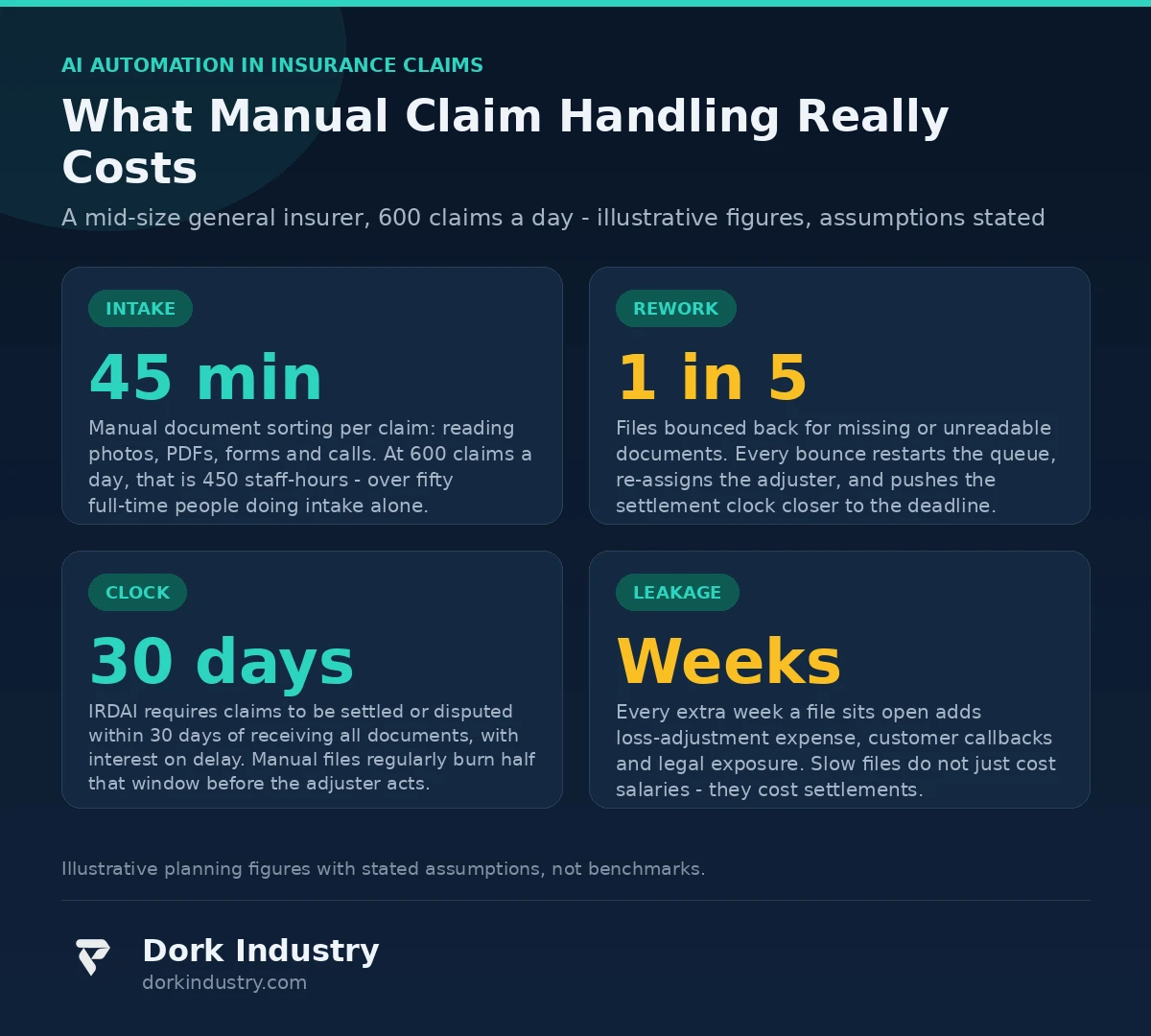
Consider a mid-size general insurer handling 600 claims a day across motor and health lines. Manual intake — reading, renaming, sorting, and keying each claim’s documents — takes about 45 minutes per claim. That is 450 staff-hours a day, the equivalent of over fifty full-time people doing nothing but intake. These are illustrative figures with stated assumptions, not industry benchmarks.
Now the rework loop: if one file in five bounces back for a missing document, 120 files a day re-enter the queue. Each bounce adds an average of three days of waiting plus 20 minutes of re-handling — 40 staff-hours a day and 360 claim-days of delay daily. Against a 30-to-45-day regulatory settlement window, that rework alone can push a meaningful share of files into interest-on-delay territory. A system that assembles complete files before the adjuster opens them attacks both numbers at once: intake time collapses, and bounces fall because gaps are caught at submission, not at decision.
Should you build or buy? An honest breakdown
Not every insurer needs custom AI automation for claims. The honest options, in order of investment:
| Approach | Best for | Relative investment | Where it breaks |
|---|---|---|---|
| Manual intake + spreadsheets | Under 50 claims a day, simple products | Minimal | Breaks the moment volume or document variety grows |
| Core-system workflow rules | Standard routing and SLA timers in your existing policy admin system | Low | Cannot read documents or extract meaning from them |
| Off-the-shelf claims AI suite | Standard document types, standard claim workflows | Medium subscription | You inherit their document models and their roadmap |
| Custom AI automation | High volume, unusual documents, tight regulatory scrutiny, own-data advantage | Highest | Overkill if your claims are simple and low-volume |

At Dork Industry, we regularly advise insurers against custom builds when a packaged claims suite fits. A credible technology partner should be willing to tell you that your volumes do not justify custom AI automation. If every consultation ends with a quotation for a custom system, get a second opinion.
What should AI automation never do alone?
Technology boundaries in AI automation matter as much as features — especially in insurance, where every decision carries regulatory and legal weight.
- Never approve or reject a claim. The system prepares the file; a licensed human makes the decision. No exceptions, no “low-value auto-approve” carve-outs without explicit, documented, regulator-aware policy.
- Never communicate a decision to the policyholder. Denial letters, settlement offers, and fraud intimations go out under a human’s name, reviewed by a human.
- Never auto-refer a customer for fraud investigation. Advisory flags only. An investigation referral is a human decision with legal consequences.
- Never set the final reserve. Drafts and revisions are the machine’s job; the booked reserve is the adjuster’s signature.
- Never learn from one claim to decide another without oversight. Model updates need governance — a model that quietly shifts its own thresholds is an audit finding waiting to happen.
How do you test it in 30 days before full investment?
The lowest-risk path is a single-line pilot with a fixed scope and measurable outcomes:
- One claim line (e.g. motor own-damage), one intake channel, 200–300 live claims
- Scope: document classification, field extraction, gap analysis, file assembly, audit trail
- Run for 30 days alongside the existing manual process (shadow mode, then assisted mode)
- Measure: intake minutes per claim, bounce-back rate, adjuster time-to-first-decision, extraction accuracy on a sampled audit
If intake time and bounce-backs do not measurably improve in the pilot, a larger AI automation investment will not fix it either. The pilot validates the document workflow, not just the software. This mirrors the assessment discipline we apply to other operations-heavy AI automation work, such as warehouse-vs-ERP reconciliation: map the current process, name the leaks, then decide what software earns its cost.
What actually drives the cost of claim-file AI automation?
Claim automation pricing varies widely because scope does. The real cost drivers are:
- Document variety: five standard document types vs forty, including handwritten surveyor notes and regional-language forms
- Claim lines: motor only vs motor + health + property, each with different evidence norms
- Core-system integration: pushing extracted data into your policy admin and claims core, with reconciliation
- Audit and retention: immutable audit trails, document retention rules, and regulator-ready reporting
- Languages: English only vs multi-language extraction for customer-submitted documents
- Governance: model monitoring, drift detection, and the human-review workflow design — the unglamorous half of the system
Anyone quoting a fixed price without asking about document types, claim lines, and your core system is guessing.
Frequently asked questions
Can AI automation really assemble a claim file before an adjuster sees it?
Yes — for the preparation layer. Classification, extraction, gap analysis, and chronological assembly run in minutes. The adjuster still reviews the assembled file and makes every decision. Think of it as the world’s fastest, most thorough file clerk, not a replacement adjuster.
Will the regulator accept machine-prepared claim files?
Regulators accept files with complete, timestamped audit trails showing what was done by whom — or by what system, at what confidence. What they do not accept is an unexplained decision. Keep the machine in preparation and the human in decision, and the file is defensible.
How accurate is document extraction for insurance claims?
On clean, standard documents (typed estimates, itemized bills), extraction accuracy is high. On damaged photos, handwritten notes, and regional-language forms, it drops — which is why low-confidence routing to humans is a design requirement, not a fallback. Measure accuracy on your own documents in the pilot, not on a vendor’s demo set.
What does a claim-file automation pilot cost?
A single-line, single-channel pilot with classification, extraction, and file assembly is a fraction of a full build. The pilot’s job is to prove measurable improvement in intake time and bounce-backs before larger investment. Request a pilot scoping call for a concrete estimate.
Does this replace claims adjusters?
No. It replaces the hours adjusters spend waiting for complete files and re-checking documents. Adjusters do more of what only they can do: coverage judgment, negotiation, fraud discernment, and customer communication. Operations that frame this as headcount reduction usually get resistance; operations that frame it as file quality get adoption.
About Dork Industry
Dork Industry (dorkindustry.com) is a custom software development company building AI automation, mobile apps, and IoT systems for businesses across India. Our team designs document-intelligence systems, claims and KYC automation, and operations dashboards — from 30-day pilots to full production rollouts.
The bottom line
The question is not whether an insurer needs AI automation for claims. It is whether the adjuster can open a file and see — in one view — every document, every extracted fact, every gap, and every assumption behind the reserve, before the regulatory clock forces a rushed decision. If the answer is no, the technology decision is really an operations decision wearing a software costume.
Start with the document workflow, pilot it on one claim line for 30 days, and only then scale the AI automation — and let measured intake time and bounce-back rates, not feature lists, decide whether to build further.
Running a claims operation where files wait days for assembly and the settlement clock keeps ticking?
We map your current intake, document, and decision process and show you exactly what AI automation would (and would not) fix, before any development is discussed.
Request a claim-file automation assessment WhatsApp +91 8210792477