
AI automation can extract tender requirements and build a compliance checklist — yes, reliably — but only when it is deployed as a pre-qualification assistant, not as a decision-maker. The short answer: parsing RFP documents, extracting eligibility criteria, cross-checking your company’s qualifications, and tracking amendments and deadlines are exactly the repetitive, error-prone jobs AI automation handles well. Judging whether to bid, setting pricing strategy, and signing off the final submission must stay human. If your team loses bids to disqualification, missed amendments, or chasing tenders it was never going to win, the fix is a structured extraction-and-checklist workflow, piloted on one tender stream for 30 days before any wider investment.
This article walks through where tender response actually loses money, what AI automation does concretely inside a bid workflow, what the numbers look like on an illustrative bid pipeline, what the system must never do on its own, and how to test the idea cheaply before committing to a build.

Where does tender response actually lose money?
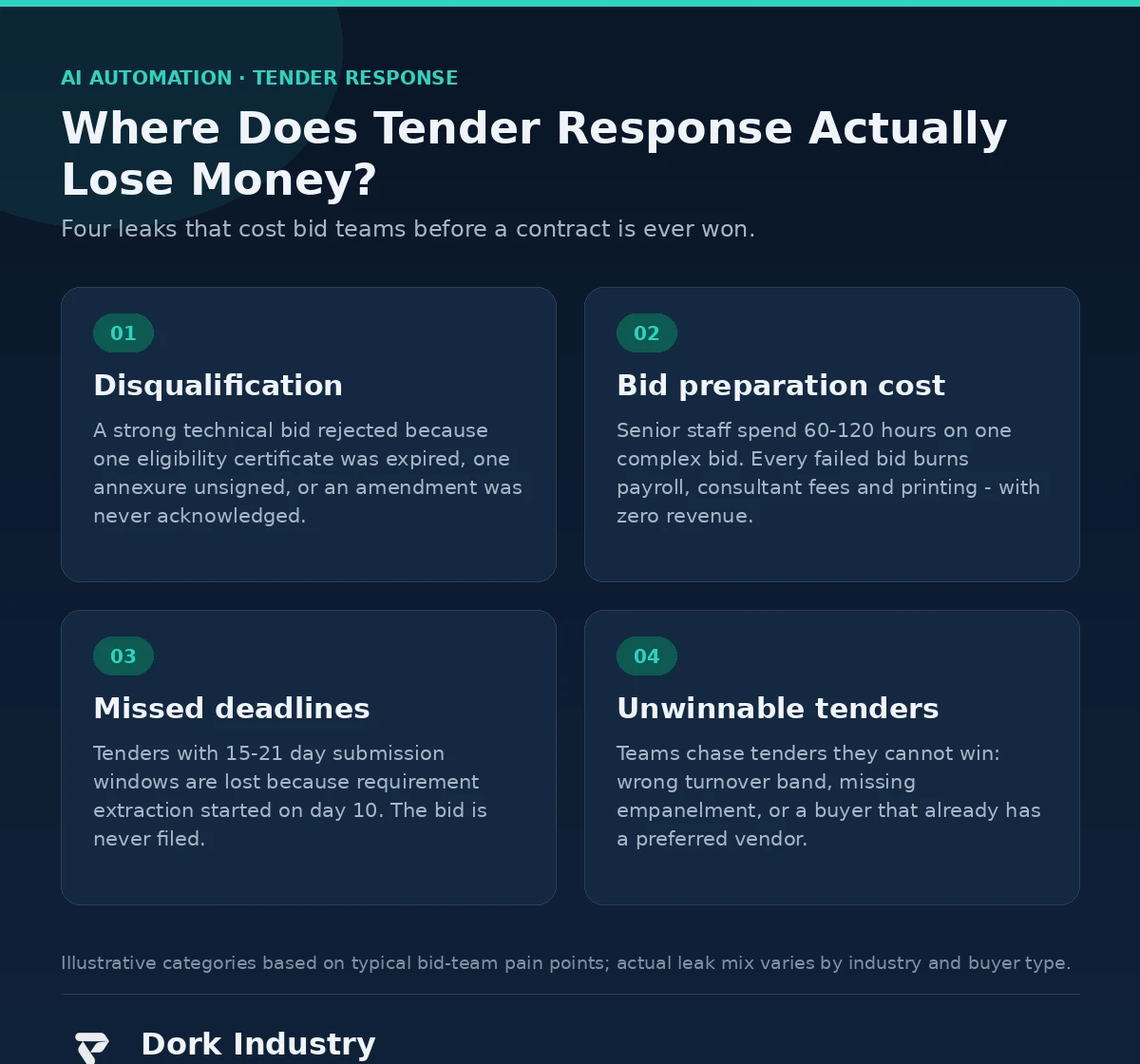
Tenders are rarely lost at the negotiation table. They are lost in the office, weeks earlier — in documents nobody fully read, certificates nobody checked, and deadlines nobody owned. Four patterns repeat across industries.
Why are strong bids disqualified?
Disqualification is the cruellest leak because the bid itself may be excellent. An expired eligibility certificate, one unsigned annexure, a missed corrigendum, a turnover figure that falls short of the threshold by a fraction — any of these ends the bid before technical evaluation begins. According to the U.S. Government Accountability Office, bids have been rejected as nonresponsive over a single defective pricing entry, with the bid’s technical quality never entering the picture (GAO bid-protest decision). The lesson is blunt: compliance is binary. You are either fully responsive or you are out, and no amount of technical excellence compensates.
Procurement discipline also has a paper trail. According to the World Bank’s Procurement Regulations for IPF Borrowers, borrowers must retain procurement documents and records — which means the evidence behind your bid has to be organized, complete, and retrievable long after submission.
Why does bid preparation cost so much before anything is won?
A complex tender easily consumes 60–120 hours of senior staff time: engineers writing the technical proposal, finance assembling cost schedules, managers coordinating documents and signatures. Add consultant fees, bid bonds, and printing, and a single serious bid costs real money — all of it sunk before the outcome is known. Teams that bid on twenty tenders a year to win three are funding seventeen failures out of operating cash flow. When extraction and checklist work is manual, every one of those bids also carries disqualification risk on top of its sunk cost.
Why do teams chase tenders they cannot win?
Optimism is expensive. Teams bid below their turnover band, without the required empanelment, or against a buyer that clearly has a preferred vendor — because nobody applied a cold eligibility filter early. According to the NC State Supply Chain Resource Cooperative, one large supplier reported failing to respond to almost 50% of the RFPs that came its way, precisely because chasing everything means responding to nothing properly. A disciplined go/no-go decision, made in hours rather than days, is one of the highest-value outputs an automated tender workflow can produce.
What data is already sitting in your tender documents?
Most bid teams already hold the raw material: past RFPs and bid submissions, corrigenda and amendment notices, eligibility certificates, audited financials, past-performance records, and clarification Q&A logs. What is missing is structure. Requirements live as paragraphs inside hundred-page PDFs, amendment lineage is tracked in someone’s memory, and the eligibility check happens late — after the technical work has already started. An automation workflow does not create new work for the bid team. It captures the work they already do — reading, extracting, checking — in a form that can be verified line by line.
What does AI automation actually do in a tender workflow?
Strip away the buzzwords and the workflow is five concrete steps, each with a human checkpoint:
- Ingest: the system watches tender portals and alert emails, downloads the RFP document set, and versions every file — including corrigenda and amendments — so nothing is read from an outdated copy.
- Extract: it parses the documents into structured requirements: eligibility criteria, technical specifications, mandatory documents, commercial terms, evaluation methodology, and every deadline. The same document-extraction discipline applies in other compliance-heavy work — we described the pattern for legal document review in our article on AI automation for law-firm documents.
- Cross-check: eligibility criteria are compared against your company profile — turnover, certifications, years of experience, past project values — producing a red/amber/green fit score before anyone opens the technical template.
- Build the checklist: every requirement becomes a checklist item with an owner, the source document and page reference, and a due date. Nothing is a vague “prepare documents” task; each item is verifiable.
- Track: amendments re-trigger extraction automatically, changed items are flagged for human re-review, and deadline countdowns run against the checklist — not against someone’s calendar memory.
Note what is deliberately absent from this list: writing the technical proposal, setting the price, and deciding to bid. Those stay human. The automation’s job is to make sure the humans work from a complete, current, verified picture.
What does the math look like? An illustrative example
Consider a mid-size contractor responding to 24 tenders a year. Assume an average bid preparation cost of ₹1.5 lakh per tender (staff time, consultant fees, bid bonds and charges), a win rate of 1 in 6, and one disqualification per year on a genuinely winnable tender carrying an 8% margin on an ₹80 lakh contract. These are illustrative figures with stated assumptions, not industry benchmarks.
Annual bid spend: 24 × ₹1.5 lakh = ₹36 lakh, to win roughly 4 contracts. If the eligibility filter stops the team from chasing just 2 unwinnable tenders a year, that is ₹3 lakh of sunk cost avoided. If the checklist prevents the single annual disqualification, the expected recovered value is 8% of ₹80 lakh — ₹6.4 lakh of margin that would otherwise have been thrown away on a technicality. The automation does not need to win more tenders to pay for itself; it needs to stop the team from losing money on the ones it should never have touched or should never have fumbled.
What must AI automation never do alone?
Boundaries matter more in tender automation than in most workflows, because a bad automated action can disqualify you or commit you legally.
- Never submit a bid or sign anything. Submission, digital signatures, and bid-bond instruments stay with authorized humans, always.
- Never make the go/no-go decision. The system scores eligibility and flags risks; the bid manager decides. An automated “no-bid” on a strategic tender would be as costly as a bad bid.
- Never invent a requirement. Every checklist item must link to its source page in the RFP. If the extraction cannot cite a source, the item goes to a human rather than into the checklist.
- Never absorb amendments silently. Every corrigendum re-runs extraction and flags exactly what changed for human re-review — a quiet document swap is how deadlines get missed.
- Never touch pricing strategy. Cost schedules can be assembled from templates, but margins, discounts, and risk pricing are commercial judgments, not extraction tasks.
The compliance-evidence discipline here mirrors what we built for fintech document automation, where every extracted field keeps its audit trail (AI automation for fintech compliance evidence).
Should you build it, buy it, or do nothing?
Not every bid team needs custom AI automation. The honest options, in order of investment:
| Approach | Best for | Relative investment | Where it breaks |
|---|---|---|---|
| Manual + spreadsheets | Fewer than ~10 tenders a year, simple documents | Minimal | Breaks on document volume, amendments, and staff turnover |
| Off-the-shelf bid management software | Deadline tracking and document storage | Low subscription | Cannot extract requirements or check eligibility |
| Tender alert + RFP tools | Finding tenders and basic parsing | Low–medium | Generic extraction, no company-profile cross-check |
| Custom AI automation | High tender volume, complex documents, strict compliance | Highest | Overkill for a low-volume, simple-document bid team |
At Dork Industry, we regularly advise bid teams against custom builds when a disciplined manual process or packaged software fits. If your disqualification rate is near zero and you respond to a handful of familiar tenders a year, you do not need AI automation — you need a better checklist template. A credible technology partner should be willing to say that. Similar document-assembly honesty applies in insurance, where we showed what claim-file automation should and should not touch (AI automation for insurance claim files).
What does a 30-day pilot look like?
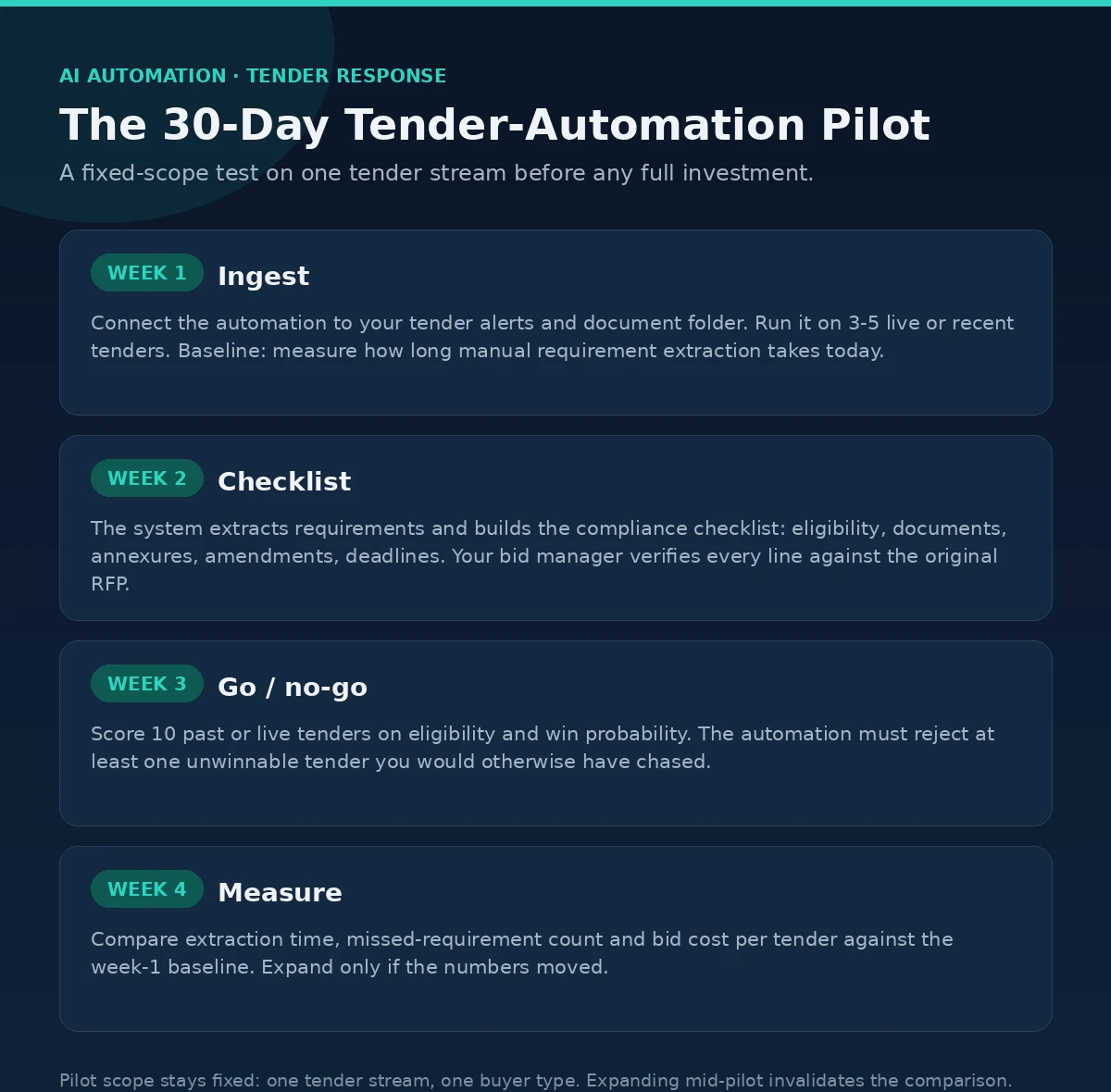
The lowest-risk path is a fixed-scope pilot on one tender stream:
- Week 1 — Ingest: connect the automation to your tender alerts and document folder; run it on 3–5 live or recent tenders; baseline how long manual requirement extraction takes today.
- Week 2 — Checklist: the system extracts requirements and builds the compliance checklist; your bid manager verifies every line against the original RFP.
- Week 3 — Go/no-go: score 10 past or live tenders on eligibility and win probability; the automation must reject at least one unwinnable tender you would otherwise have chased.
- Week 4 — Measure: compare extraction time, missed-requirement count, and bid cost per tender against the week-1 baseline; expand only if the numbers moved.
If extraction time and missed requirements do not measurably improve in the pilot, a larger AI automation investment will not fix it either. The pilot validates the workflow — extraction quality and checklist discipline — not just the software. This is the assessment Dork Industry runs before quoting any tender-automation project: map the current bid process, name the leaks, then decide what software earns its cost.
What drives the cost of tender AI automation?
- Document volume and variety: 10 tenders a month of similar RFPs is a different system from 50 a month across five buyer types with different formats.
- Scanned vs digital documents: OCR pipelines, handwriting, and low-quality scans add a preprocessing layer and confidence-flagging logic.
- Eligibility logic depth: simple threshold checks vs multi-criteria scoring against financials, certifications, and past-performance records.
- Portal integrations: automated tender discovery across portals vs manual upload of RFP documents.
- Amendment handling: diffing corrigenda and re-running extraction is a real subsystem, not a checkbox.
- Security posture: on-premise or VPC processing, audit logging, and data-retention controls for confidential bid documents.
Anyone quoting a fixed price without asking about tender volume, document formats, and amendment frequency is guessing.
Frequently asked questions
Can AI automation read scanned RFP documents?
Yes, through an OCR preprocessing stage — but scan quality decides accuracy. Clean digital PDFs extract cleanly; skewed, low-resolution scans need confidence flagging, with uncertain pages routed to a human reviewer. The pilot’s week-2 verification step exists precisely to measure extraction quality on your real document mix before anything goes live.
How accurate is requirement extraction?
There is no honest single number — it depends on document quality and how standard your buyers’ RFP formats are. What matters is the measurable miss rate: in the pilot, the bid manager verifies every extracted line against the original RFP and counts what was missed or misread. Proceed only if that count beats your manual baseline.
Will this replace our bid manager?
No. It removes the extraction drudgery — reading 200 pages to build a checklist — so the bid manager spends their time on judgment: go/no-go calls, technical strategy, and pricing. Teams that automate extraction typically find their bid manager becomes the bottleneck worth protecting, not a cost to remove.
What about confidential tender documents and data security?
Bid documents are commercially sensitive, so processing location matters: the system should run in your VPC or on-premise, with audit logs of who accessed what, and a contractual commitment that your documents are never used to train models. If a vendor cannot say exactly where your documents are processed and how long they are retained, walk away.
How long until we see results?
A fixed-scope pilot runs 30 days and tells you whether extraction quality and checklist discipline improve. A production rollout on one tender stream typically follows in 6–10 weeks. Full multi-buyer coverage takes longer — but you should not commit to it until the pilot numbers justify it.
About Dork Industry
Dork Industry (dorkindustry.com) is a custom software development company building AI automation, mobile apps, and IoT systems for businesses across India. Our team designs document-intensive automation — tender response, legal workflows, fintech compliance, and insurance claim processing — from 30-day pilots to production rollouts.
The bottom line
The question is not whether AI automation can read tender documents. It can. The question is whether your bid process has the discipline to use what it extracts: a complete checklist, verified against the source RFP, owned by named humans, with go/no-go decisions made early and amendments tracked loudly. Teams that have that discipline win more and waste less. Teams that do not will automate their chaos.
Start with the workflow, pilot it on one tender stream for 30 days, and let measured extraction accuracy and avoided bid costs — not feature lists — decide whether to build further.
Responding to tenders regularly and want to know what automation would change in your specific bid process?
We map your current tender discovery, extraction, and compliance process and show you exactly what AI automation would (and would not) fix, before any development is discussed.
Request a tender-response automation assessment WhatsApp +91 8210792477