
Custom software development can rescue a half-built application after your developer vanishes — yes, in most cases the stranded project is saveable. But the rescue does not start with more coding. It starts with a forensic audit: securing every account and credential, verifying what the code actually does, and separating what works from what only looks finished. Business owners who skip that step usually pay twice — once for the abandoned build, and again for a rescue that repeats the original mistakes.
This article walks through exactly how to rescue a half-built application: what to secure in the first 48 hours, how to audit the code you inherited, what the rescue should never do, when rebuilding is honestly cheaper, and how to test a rescue team in 30 days before committing serious money.

Why do developers vanish mid-project?
Before the rescue, it helps to understand the abandonment — because the cause shapes what you will find in the code.
Was it a payment dispute or a cash-flow collapse?
The most common cause is money. A freelancer took on three projects, one client paid late, and your project absorbed the shortfall. In these cases the code is usually healthiest: the developer was working in good faith until the economics broke, and may cooperate with a handover if approached calmly.
Was the developer in over their head?
The second most common cause is technical: the project hit a wall the developer could not climb — a payment integration that kept failing, a database design that corrupted under load. In these codebases expect the newest commits to be the messiest: frantic workarounds, disabled features, and TODO comments where the hard problems were left unsolved.
Was it a solo freelancer with no backup?
A one-person project has a single point of failure — the person. Illness, a better offer, or a lost laptop can end the project overnight. The rescue lesson is the same regardless: your project’s continuity should never depend on one person’s availability.
What does “70% done” actually mean?
Almost every abandoned project arrives with a completion percentage attached — usually the developer’s last estimate, or the number that justified the last invoice. Treat it as fiction. “70% done” almost always means 70% of the visible screens exist. The remaining 30% is where the actual software lives: error handling, security, data migration, performance under load, and admin tooling. The missing 30% was the hard part.
What do you already own — and what must you secure first?
Your legal and practical ownership of the project lives in accounts and credentials, not in the code. Before any technical evaluation, spend the first 48 hours collecting these six asset groups. According to GitHub’s documentation on transferring repository ownership, a repository transfer moves the code — but it does not move the deploy keys, secrets, or third-party integrations tied to the developer’s personal accounts, which is why the credential inventory below matters as much as the code itself.
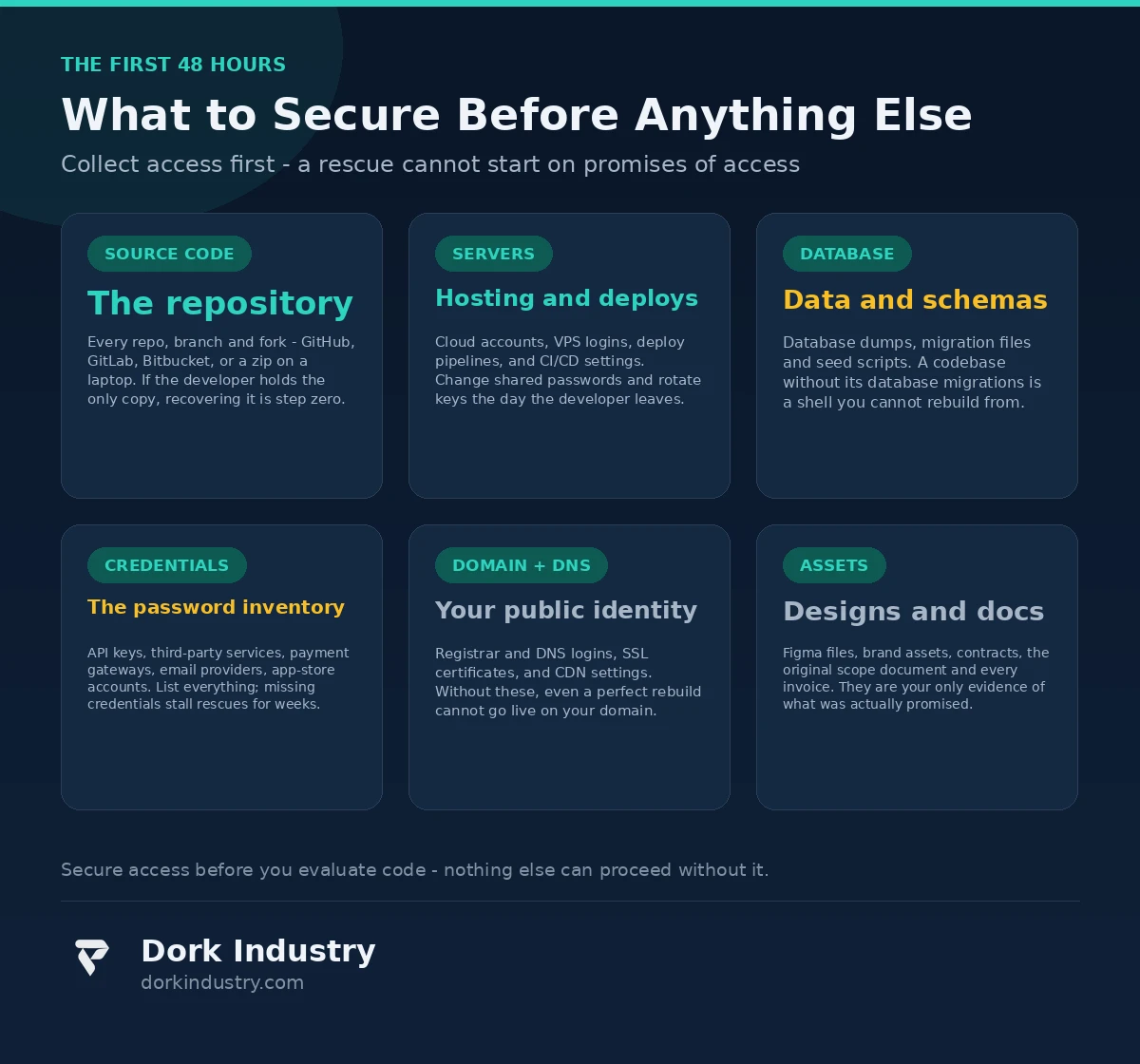
Two moves prevent most rescue disasters. First, rotate every shared secret and revoke the departed developer’s access on day one — not after the audit. Second, freeze any production environment: no deploys, no database changes, until the audit is complete. A rescue team that inherits a moving target is guessing.
What does a rescue audit actually examine?
A forensic code audit is the core of any serious custom software development rescue — not a style review, but a due-diligence investigation answering one question: what did you actually buy? It examines seven things:
- Does it build and run? The most basic test, and it fails more often than owners expect. Missing environment files, hardcoded local paths, and undocumented setup steps mean “it worked on the developer’s laptop” was the entire deployment strategy.
- What is real vs. stubbed? Auditors click every button and call every API. Screens that look finished but show mock data, payment flows that never charge a card, admin panels that edit nothing — all of it gets catalogued.
- How is authentication and authorization handled? Passwords stored in plain text, admin routes with no access checks, and JWT secrets committed to the repository are instant red flags. According to the OWASP Top 10, broken access control remains the most common serious web application risk — and abandoned projects are where it hides.
- Where do secrets live? API keys and credentials belong in environment configuration, never in source code. The twelve-factor methodology’s config principle is the standard here: anything that varies between deploys must live in the environment. Secrets in git history must be treated as compromised and rotated.
- Are dependencies current and licensed? Abandoned projects often pin libraries two or three years old, some with known vulnerabilities, some with licenses that do not permit commercial use. The audit lists every dependency with its age, known CVEs, and license terms.
- Is there a database migration story? Schema changes tracked as versioned migrations mean the database can be rebuilt and evolved safely. A single “final_dump.sql” from six months ago means the data model is archaeology.
- What does the test coverage look like? Zero tests does not disqualify a rescue, but it changes the price: every change the rescue team makes must be verified manually, and that cost is real.
The audit’s output is a written report with three lists: what works, what is broken or missing, and what is unknowable without further investigation. That report — not the developer’s old percentage — becomes the basis for every budget and timeline conversation that follows.
What does the math look like? An illustrative example
Consider a business that paid ₹8 lakh for a custom web application, of which ₹5 lakh was released before the developer disappeared. An audit (typically 1–2 developer-weeks) finds the application genuinely 55% complete: the core workflows function, but payments, admin tooling, and security hardening are missing or stubbed. These are illustrative figures with stated assumptions, not industry benchmarks.
The ₹5 lakh already spent is sunk — it buys whatever working code the audit verified, nothing more. Finishing the verified core into a production-ready application typically costs another ₹4–6 lakh: the missing scope plus the overhead of learning someone else’s code, which rescue teams price at roughly a 20–30% premium over fresh development. Total cost lands around ₹9–11 lakh — roughly half a from-scratch rebuild, because the working half of the codebase is genuinely reused.
The math flips when the audit finds the foundations untrustworthy — no working core, broken security, or a tech stack that cannot scale. Then the ₹5 lakh is not an investment to protect; it is tuition. Spending ₹6 lakh more nursing bad foundations to “save” ₹5 lakh already spent is the sunk-cost trap, and it is the most expensive mistake in rescue work.
Should you rescue, rebuild, or buy? An honest breakdown
Not every stranded project deserves a rescue. The honest options:
| Approach | Best for | Relative investment | Where it breaks |
|---|---|---|---|
| Rescue the codebase | Code compiles, core features genuinely work, architecture is sound | 30–50% below a rebuild | Breaks when the audit was skipped and the foundations are rotten |
| Rebuild from scratch | Tangled prototype, broken security, wrong tech stack | Highest | Breaks when pride demands reusing code that should be discarded |
| Buy packaged software | Standard needs — CRM, booking, store, basic ERP | Low subscription | Breaks when unique workflows are forced into a generic product |
| Rescue-then-rebuild | Working core now, planned rewrite later | Medium, phased | Breaks when the “temporary” rescue becomes permanent by neglect |
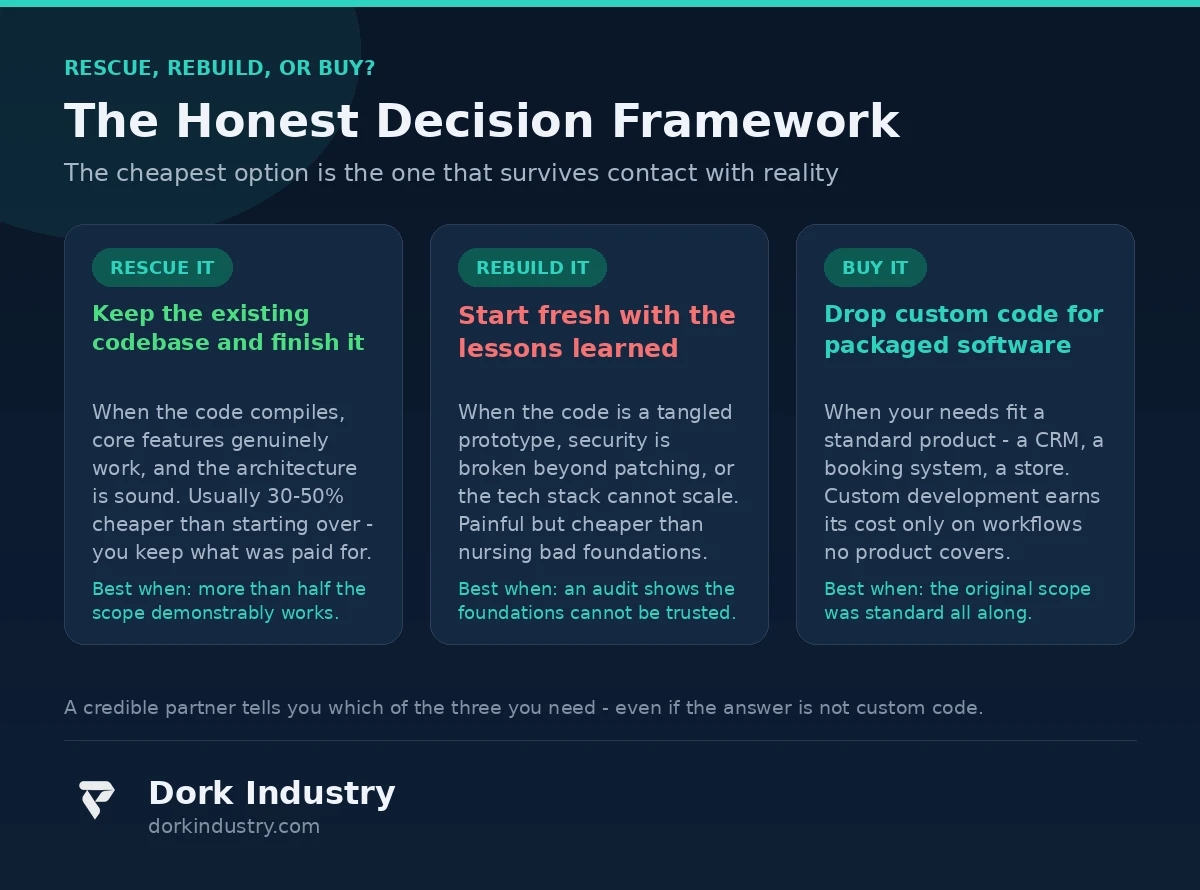
At Dork Industry, we regularly advise clients against rescuing when a rebuild or a packaged product fits better. A credible custom software development partner should be willing to tell you that your half-built application is not worth saving. If every consultation ends with a quotation to continue your exact codebase, get a second opinion.
What must a rescue team never do?
Rescue work has sharper boundaries than fresh development, because the project arrives with unknown risks baked in.
- Never deploy to production from the inherited codebase without a full backup and a rollback plan. The first deploy is the most dangerous moment of a rescue. Snapshot everything — code, database, configuration — before it.
- Never pay the departed developer a “release fee” for your own code without legal advice. If your contract assigns IP to you on payment, a ransom demand is a legal matter, not a technical one. Paying it sets the precedent that your project is hostage to individuals.
- Never let a new team start rewriting before the audit is finished. Rewriting feels like progress, but rewriting without the audit’s map means re-learning every lesson the hard way — including the ones the original developer already solved.
- Never accept the old timeline. “Two more weeks” was the estimate that preceded the disappearance. The rescue timeline comes from the audit, and it will be longer than you want. A team that promises the old deadline without reading the code is the next developer who will vanish.
- Never run the business on the half-built system during the rescue. If any part of the abandoned application is already live — taking orders, storing customer data — isolate it, back it up daily, and treat it as legacy from day one. Business continuity and rescue work are separate tracks.
How do you test a rescue team in 30 days?
Do not hand a stranger the full rescue on day one. A 30-day pilot with a fixed scope proves whether the team can actually work with inherited code:
- Days 1–10: the audit. Deliverable is the written report — what works, what is broken, what is unknowable. If the report is vague, the team cannot rescue your project. This alone is worth paying for.
- Days 11–20: stabilization. The team gets the application building reliably from a clean checkout, secrets moved to environment configuration, and one small but real bug fixed end-to-end. You are testing their discipline, not their speed.
- Days 21–30: one vertical slice. One complete user-facing feature — finished, tested, and deployed to a staging environment. This proves they can ship inside your inherited architecture instead of around it.
If the audit is sharp and the vertical slice ships cleanly, you have a rescue team. If either fails, you have spent one month and learned it cheaply — instead of learning it six months in. This staged discipline is the same assessment Dork Industry applies before quoting any rescue: read the code, stabilize, prove one slice, then commit.
What actually drives the cost of a rescue?
Rescue pricing varies because inherited code varies. The real cost drivers are:
- Audit findings: a clean, working core vs. a tangled prototype changes the quote more than any other factor — this is why the audit comes before the estimate, never after
- Missing assets: every credential, migration, or design file you could not recover in the first 48 hours becomes paid reconstruction work
- Tech stack age: two-year-old dependencies with known vulnerabilities must be upgraded before new features, and upgrades on abandoned code break things
- Test coverage: zero tests means every change is verified by hand — the rescue team prices that labor honestly or not at all
- Live-data risk: if the half-built system already holds real customer data, migration and continuity planning add a careful, unskippable workstream
- Scope honesty: “finish what was promised” vs. “finish what was promised plus the features we thought of since” — rescues that absorb new scope repeat the original failure
Anyone quoting a fixed rescue price without reading the code first is guessing — and guessing is what stranded the project in the first place.
Frequently asked questions
Can a half-built app be rescued if I only have a zip file of the code?
Sometimes. A complete, recent zip of the source is a workable starting point. What kills rescues is not the zip format but missing pieces: no database migrations, no environment configuration, no credentials. Secure those first.
Who owns the code if the developer disappeared before final payment?
It depends on your contract — most development agreements assign IP on payment, which makes the unpaid balance a genuine legal question, not a technical one. Get legal advice before paying any “release fee,” and never let a payment dispute stop you from securing your accounts and backups in the meantime.
How long does a typical project rescue take?
The audit takes 1–2 weeks. A rescue of a genuinely half-complete application typically runs 2–4 months of focused work after that. Timelines shorter than the audit suggests should be treated as marketing, not engineering.
Is it cheaper to just hire another freelancer to finish it?
It can be, if the audit shows clean, working code and the scope is small. But a second solo freelancer reintroduces the exact single-point-of-failure risk that stranded the project. For anything business-critical, a team with shared code ownership and documented handover practices is the structural fix.
What should I do differently so this never happens again?
Four structural fixes: code lives in a repository you own from day one, with the team committing daily; credentials and hosting are in your accounts, never the developer’s personal ones; payments are tied to verifiable milestones, not percentages of time; and progress is demonstrated on a staging environment you can access — not screenshots. These are standard practices in professional web development, and any team that resists them is telling you something.
The bottom line
The question is not whether custom software development can rescue your half-built application — in most cases, it can. The question is whether you know what you actually own. A developer who vanishes leaves behind two things: code of uncertain quality, and a set of accounts and credentials that are entirely in your control to secure. Handle the second in 48 hours, investigate the first with a proper audit, and let the audit — not sunk cost, not pride, not the old percentage — decide between rescue, rebuild, and buy.
Start with the audit, pilot the team for 30 days on a fixed scope, and only then commit. That discipline is what separates a rescue from a second abandonment.
Free Abandoned-Project Rescue Assessment
Send us what you have — the repository, the last build, even just a zip file and a list of logins. We audit the inherited code, verify what actually works, and give you a written rescue-vs-rebuild verdict with honest cost ranges. You walk away with a clear map of your project whether or not we write a single line of code for you.
Request your free project rescue assessment WhatsApp +91 8210792477
About Dork Industry
Dork Industry (dorkindustry.com) is a custom software development company building mobile apps, AI automation, and IoT systems for businesses across India. Our team takes on stranded and half-built software projects — from forensic code audits and stabilization to full rescue delivery — alongside greenfield web and mobile development.