

AI automation can fix a messy retail product catalog — but only if you understand that the catalog mess is an operations problem wearing a data costume. Yes: an AI system can find duplicate listings, write consistent product titles and attributes, match supplier data to your store’s vocabulary, and keep prices aligned across your website, marketplace, and physical store. The expensive part is not the AI; it is deciding who is allowed to approve changes before they go live, and building the source trail that proves every merge was correct.
A retailer with 20,000 SKUs usually has three catalogs that disagree with each other: the POS system the staff use, the website the customers see, and the supplier spreadsheets nobody owns. Nobody deliberately broke the catalog. It decayed one listing at a time — a duplicate added during a festival rush, a price updated on the website but not in the store, a discontinued variant that was never removed. This article examines what AI automation can realistically do about that decay, what it must never do alone, and how to test it on a 500-SKU slice before committing.

Where does a messy catalog actually cost retailers money?
Catalog problems look like a data-quality complaint. They are really a revenue leak. Shoppers who cannot find a product do not complain about your taxonomy — they buy from someone else.
Why do duplicate listings kill search?
When the same product exists as three separate listings — different titles, different codes, slightly different photos — your own search engine splits the demand. Click-through data fragments, reviews scatter across the duplicates, and the “best match” ranking has nothing good to work with. The retailer thinks the product is underperforming. It is not underperforming — it is invisible, split into three shadows of itself.
How do missing attributes quietly filter products out?
Faceted search and marketplace filters work on attributes: size, material, wattage, compatibility, color family. Listings with empty attribute fields simply vanish from filtered searches. A product can be in stock, correctly priced, and still unreachable by every shopper who filters instead of typing free text. According to Google’s product data specification for Merchant Center, structured product attributes are what make listings eligible and discoverable across Google surfaces — the same principle applies inside your own store search.
What do price mismatches cost beyond the discount?
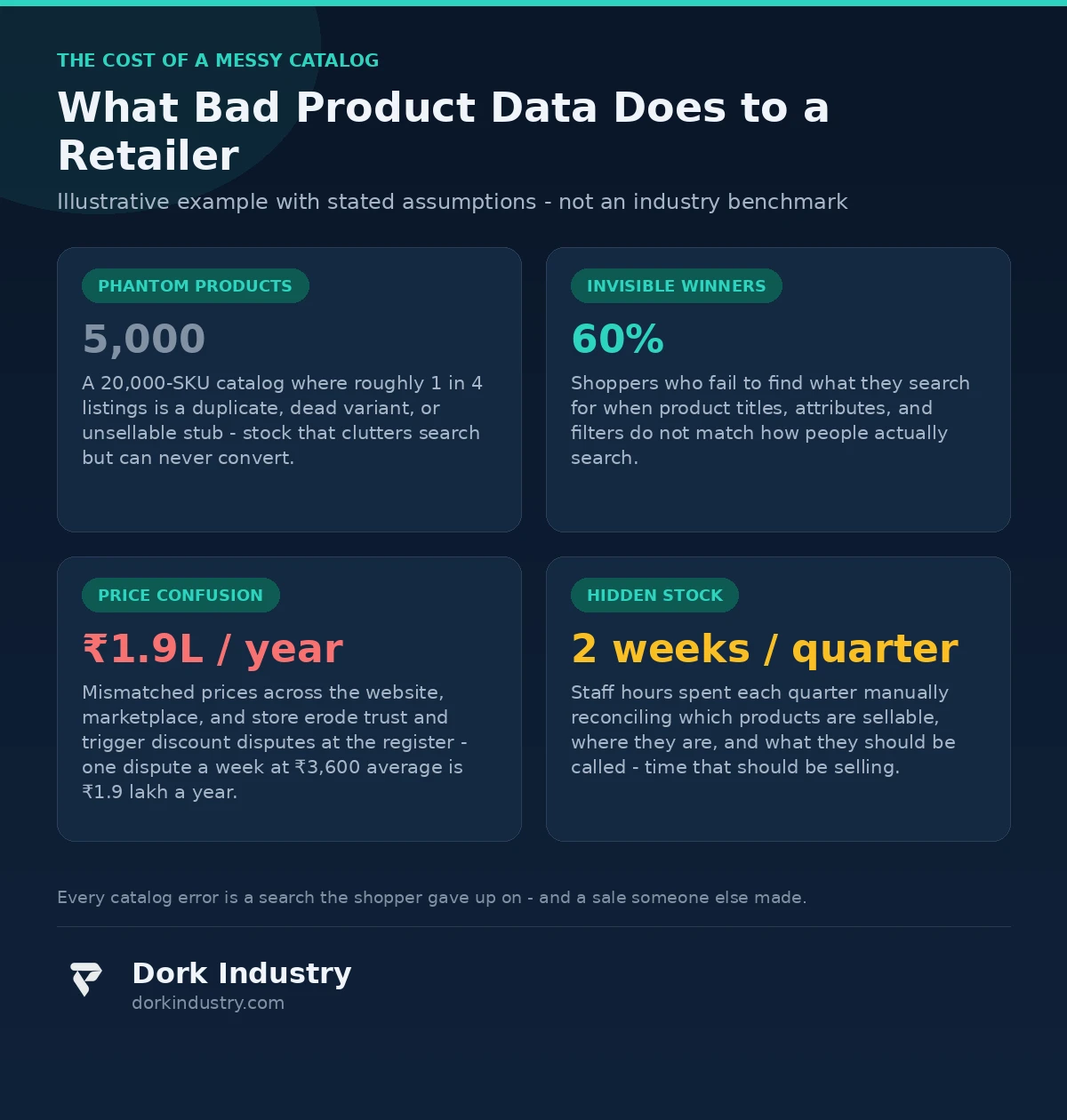
A price that differs between the website and the register does more than force an awkward conversation at checkout. Each dispute trains staff to distrust the system, each override trains shoppers to expect a discount, and each wrong-price sale that cannot be honored turns into a complaint on a review site. One mismatch per week, resolved with an average ₹3,600 concession, is roughly ₹1.9 lakh a year of pure friction — before counting the shoppers who silently left when the price felt unreliable.
Why does channel inconsistency erode the brand?
The same product with different names, photos, and descriptions on your website, your Amazon storefront, and your physical shelf tags reads as three different sellers. Price-comparison shoppers assume the cheaper listing is the real one and the expensive one is the markup. Marketplaces also penalize inconsistent data: listings that fail validation get suppressed without warning, and nobody on the team notices until weekly sales are already down.
Why do catalogs get messy in the first place?
Catalog decay is not a technology failure. It is the predictable output of five organizational habits.
- Supplier data arrives in chaos. Five suppliers send the same product data in five formats — one spreadsheet, one PDF price list, one email with photos, one WhatsApp message, one portal export. Nobody normalizes it; everyone copies it differently.
- Listings are created under pressure. Festival season, a new brand launch, a clearance push — staff create listings fast, skip attributes, and promise to “fix it later.” Later never comes.
- Ownership is diffuse. Marketing writes the descriptions, the store team sets prices, the warehouse knows the real stock, and nobody owns the listing itself. A listing with four partial owners has zero actual owners.
- Deletions are feared. Nobody deletes a duplicate or dead variant because nobody is sure it is dead. The catalog only grows, never shrinks.
- Corrections have no audit trail. When a listing is “fixed,” there is no record of what changed, who changed it, or why. The same error returns within a quarter because the correction was never verified against a source.
Any AI automation layered on top of these habits without fixing ownership will produce a cleaner-looking mess — consistently formatted errors instead of inconsistently formatted ones.
What data does your business already have — and what is it missing?
Most retailers already hold the raw material: POS transaction records with SKUs, supplier price lists and catalogs, product photos from brand partners, website search logs showing failed queries, and staff who know which listings are wrong but have no way to fix them at scale.
What is missing is structure. The same product has different codes in the POS and the website. Attributes live in descriptions instead of fields. Search logs record what shoppers typed but nobody reads them. Photos are named IMG_4521.jpg. The supplier feed has the correct technical specifications but they never made it into the listing.
An AI catalog system does not need new data so much as it needs permission to reconcile the data that already exists — and a human who signs off when it merges two listings, because a merge is a business decision about which record of truth survives.
What can AI automation actually do with product catalogs?
Strip away the marketing language and catalog AI automation does four concrete jobs.
Can it find and merge duplicates without deleting real products?
Yes, with the right guardrails. Similarity matching — titles, specs, photos, barcodes — clusters candidate duplicates, and confidence thresholds decide what happens next. High-confidence matches with matching barcodes can merge automatically; everything else goes to a human review queue with the evidence side by side. According to Shopify’s product API documentation, products carry variant structures, SKUs, and barcodes that make deterministic matching possible — the API surface exists; the judgment about edge cases does not automate itself.
Can it write better product titles and attributes?
This is where language models earn their cost. Given supplier specifications, existing listings, and the retailer’s naming conventions, AI can generate consistent titles, populate missing attributes, and produce search-friendly terms — in the retailer’s voice, not the supplier’s jargon. The output is always a draft: the value is that a catalog manager reviews 200 generated listings in an afternoon instead of writing 20 in a week.
Can it keep prices and availability consistent across channels?
Yes — this is the most deterministic of the four jobs. A rules engine plus a reconciliation feed compares POS, website, and marketplace listings continuously and flags or fixes mismatches: a price changed in the POS that never reached the website, stock marked available that the warehouse shows as zero, a marketplace listing still live for a discontinued variant. Most of this needs no AI at all; it needs a single source of truth and the discipline to push from it.
Can it learn from failed searches?
Website search logs are a catalog-quality report written by your shoppers. AI can cluster failed queries, map them to the products that should have matched, and propose new search terms, synonyms, and attribute values. This closes the loop: the catalog improves based on what shoppers actually typed, not what the catalog team guessed they would type.
What does the math look like?
Consider a mid-size retailer with 20,000 SKUs across a website, two marketplaces, and three physical stores. Suppose a quarter of the catalog — 5,000 listings — is duplicates, dead variants, or unsellable stubs. Those 5,000 listings consume search real estate, confuse filters, and cost staff time every quarter.
Now the price-dispute math from the infographic above: one concession a week at an average of ₹3,600 is ₹1.9 lakh a year. Add the search side: if even 5% of the retailer’s monthly search sessions fail because of missing attributes or split listings, and the store converts failed-search sessions at half the normal rate once fixed, the recovered revenue typically dwarfs the dispute money. These are illustrative figures with stated assumptions, not industry benchmarks. But they show why catalog work should be measured in search-to-purchase conversion and staff hours recovered, not in “listings cleaned.”
The honest framing: a catalog cleanup is not a cost-saving project. It is a revenue-recovery project whose returns compound — every fixed listing keeps working after the project ends, unlike a one-month marketing campaign.
Should you build or buy?
Not every retailer needs custom AI automation for their catalog. The honest options, in order of investment:
| Approach | Best for | Relative investment | Where it breaks |
|---|---|---|---|
| Spreadsheets + discipline | Under 1,000 SKUs, one channel | Minimal | Collapses the moment you add a marketplace or a second supplier format |
| PIM software (Akeneo, Pimcore) | Multi-channel catalogs with structured attribute needs | Low subscription or self-hosted | You still have to do the enrichment work — the PIM organizes, it does not write |
| Marketplace listing tools | Sellers whose mess lives mostly on marketplaces | Low subscription | Fixes the marketplace copy, not the source catalog or the website |
| Custom AI automation | Large catalogs, messy supplier data, multi-channel price/stock reconciliation | Highest | Overkill for a clean catalog under 2,000 SKUs with one supplier format |
A good rule: if a configured PIM plus two weeks of a catalog manager’s cleanup time solves 80% of your problem, do that first. Custom AI automation earns its cost when supplier data is genuinely chaotic — multiple formats, thousands of SKUs, frequent price changes — or when reconciliation has to run continuously across channels, not once. At Dork Industry, we regularly tell retailers their catalog needs a process owner before it needs AI. Our custom software development practice starts with the workflow audit, not the model selection.
What should AI automation never do with your catalog alone?
Because a wrong automated change is published to every shopper instantly, catalog boundaries matter as much as catalog capabilities.
- Never merge listings without a human on ambiguous matches. Auto-merge is safe for barcode-identical records. For title-similar products — is the 55-inch and 65-inch TV a variant or two products? — a human decides. A wrong merge destroys reviews and breaks order history.
- Never push price changes to live channels without a review window. An automated feed that publishes a supplier’s typo as your selling price is a one-way ticket to honoring losses. Changes stage in a holding area; a human approves or a rule with a tight tolerance auto-approves.
- Never rewrite brand-controlled copy without permission. Many brands dictate product copy, images, and MAP pricing. Automation that rewrites a brand’s registered listing can violate distribution agreements.
- Never delete listings — archive them. A “deleted” duplicate that turns out to be the only record with the correct barcode is a disaster. Archive with a reason, keep the trail, let nothing vanish.
- AI should propose enrichments, not publish truths. “This listing is missing wattage; the supplier spec says 1500W — apply?” is useful. Silently writing specs into listings from a guessed source is how catalogs develop confident, wrong facts.
How do you test it in 30 days before full investment?
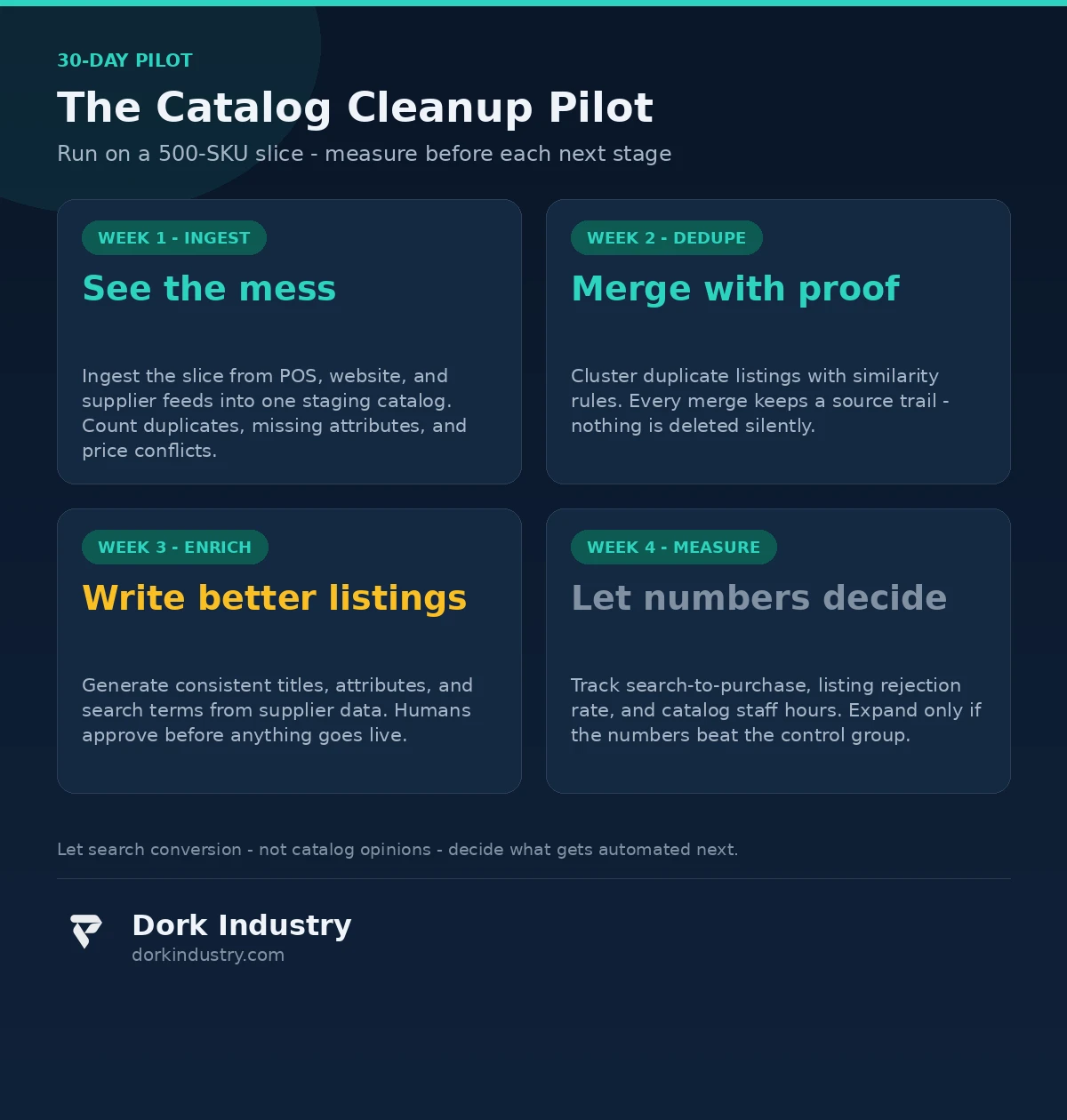
The lowest-risk path is a 500-SKU slice with a fixed scope and measurable outcomes:
- One category, one supplier, 500 SKUs — messy enough to be real, small enough to review by hand
- Ingest from POS, website, and supplier feed into a staging catalog (nothing touches the live store)
- Dedupe with similarity rules; every merge keeps a source trail
- Generate titles, attributes, and search terms; humans approve before anything goes live
- Run for 30 days
- Measure: duplicate rate in the slice, search-to-purchase conversion for the slice vs a control category, listing rejection rate on marketplaces, catalog staff hours per week
If the pilot slice does not measurably beat the control category, a bigger AI automation investment will not fix the catalog either. The pilot validates the workflow and the ownership model, not just the software. This approach mirrors the method in our published guide on how to test AI document automation before buying: fixed slice, measured outcomes, human approval gates.
What actually drives the cost of catalog AI automation?
Catalog automation pricing varies because the mess varies. The real cost drivers are:
- SKU count and supplier formats: 2,000 SKUs from one clean feed vs 50,000 SKUs from twelve chaotic formats are different projects
- Channel count: website only vs website + two marketplaces + POS + shelf labels — every channel doubles the reconciliation surface
- Photo and content needs: attribute enrichment only, vs generating titles, descriptions, and search terms in multiple languages
- Approval workflow depth: one catalog manager approving batches vs multi-role approvals with brand compliance checks
- Integration reality: modern APIs vs a POS system that exports CSV once a day
- Continuous vs one-time: a cleanup project has an end; a live reconciliation feed needs ongoing operation
Anyone quoting a fixed price without asking about supplier formats, channel count, and who approves merges is guessing.
Frequently asked questions
Can AI automation clean up a product catalog without human review?
Partially. Deterministic work — barcode-identical duplicates, missing standard attributes, price mismatches against the POS — can run with rules and tight tolerances. Anything ambiguous, like merging similar-but-possibly-different products or rewriting brand copy, needs a human approval gate. Fully unsupervised catalog automation is how listings get confidently wrong.
How long does a catalog cleanup project take?
A 500-SKU pilot slice takes about 30 days including human review cycles. A full catalog of 20,000+ SKUs with messy supplier data typically runs 2–4 months for the first pass, then moves to continuous reconciliation. Timelines depend more on how fast your team approves changes than on the technology.
Will AI-generated product descriptions hurt our search rankings?
Not if they are accurate, structured, and reviewed. Search engines penalize thin, duplicated, or misleading content — which is exactly what a messy catalog already has. Consistent, attribute-rich, human-approved descriptions are an improvement over the status quo, not a risk to it.
What is the first step if our supplier data is a mess?
Normalize before you enrich. Get every supplier’s data into one staging format with consistent columns, barcodes matched, and units standardized. AI enrichment on top of un-normalized data produces beautifully formatted errors. The pilot’s first two weeks are usually 80% data plumbing and 20% AI.
How do we measure whether catalog automation worked?
Track search-to-purchase conversion for the cleaned category against a control category, marketplace listing rejection rates, price-dispute frequency at the register, and catalog staff hours per week. If those four numbers do not move, the automation did not earn its cost — regardless of how clean the data looks in a dashboard.
The bottom line
The question is not whether AI automation can clean a messy retail catalog. It can — deduplication, enrichment, and reconciliation are solved problems with known guardrails. The question is whether the retailer will give the project what it actually needs: a single owner for the catalog, an approval workflow for ambiguous merges, and 30 days on a 500-SKU slice with measured outcomes. Technology without ownership produces a prettier mess. Ownership with the right automation produces a catalog that keeps selling.
Free Retail Catalog Automation Assessment
We map your current catalog across POS, website, and marketplaces, count the duplicates and price mismatches, and show you exactly which 500 SKUs to pilot first — with the approval workflow your team can actually run. You walk away with a measured cleanup plan and an honest verdict on whether AI automation earns its cost for your catalog, before any development is discussed.
Request your free catalog assessment WhatsApp +91 8210792477
About Dork Industry
Dork Industry (dorkindustry.com) is a custom software development company building AI automation, mobile apps, and IoT systems for businesses across India. Our team designs catalog reconciliation pipelines, document automation, and multi-channel retail systems — from 30-day pilots to full production rollouts.