IoT development for diagnostic labs can track every sample from the moment it is collected to the moment its report is released — yes, provided every handoff is scanned, every transport box reports its temperature, and every exception reaches a named person within minutes, not at the end of the day. A diagnostic lab rarely loses a sample in one dramatic moment. It loses it in the gaps: a tube handed to a courier without a scan, a manifest that does not match the box, a fridge delay nobody records, and a report held back because nobody can prove which sample produced which result.
This article examines how IoT development restores that chain of custody: where samples actually go missing, what data a lab already has, what a tracking system must concretely do, what it must never do alone, and how to test it on one collection route in 30 days before rolling it out.
Why was this topic selected? The focus keyword, iot development, carries verified Planner demand (210 searches a month in the US with top-page bids near USD 1,914 — advertisers paying that much signals buyer intent), and the questions below come from real published lab-tracking guides: how to track a patient specimen from collection to result, what four questions a sample record must answer, and what happens when a specimen goes missing. Search Console’s latest top-25 query pull returned no diagnostic-sample questions for dorkindustry.com, so the question base here is published practitioner sources, not invented queries.
Where do diagnostic samples actually go missing?
Before discussing sensors and software, it is worth naming the specific gaps. In our experience working with operations-heavy businesses, the expensive failures are rarely about the laboratory test itself. They are about custody that nobody recorded.
Why does the collection-to-lab handoff fail?
A phlebotomist collects the sample, labels it by hand or from a printed list, and places it in a transport box. If the label does not match the order, or the box leaves without a scan, the lab’s first record of the sample is its arrival — or its absence. By then, the collection team has moved on to the next site, and reconstructing what happened means phone calls, not data.
Why do manifests and boxes disagree?
The paper or spreadsheet manifest says twelve samples; the box contains eleven. Or it contains twelve, but one belongs to a different route. Nobody discovers the mismatch until accessioning, hours later, when the courier is already on another run. The missing sample is not necessarily lost — it is unaccounted for, which for a patient waiting on a diagnosis amounts to the same thing.
Why does temperature become a silent failure?
Many samples are only valid inside a temperature range and a time window. A box left in a hot vehicle, or a fridge door opened repeatedly during a power cut, can degrade a sample without any visible sign. The lab then reports a result from a compromised sample, or rejects it and orders a recollection — both outcomes are worse than catching the excursion during transport.
Why does a missing sample surface so late?
Because most labs discover a gap at report time: the result is due, the sample is not in the system, and the search begins backwards through registers and memory. According to NovoPath’s specimen-tracking guide, a lost specimen is not a paperwork problem but a patient problem — a misplaced sample means a delayed diagnosis and a chain of custody that cannot be defended in an audit. The cost of that delay is paid by the patient first and the lab second.
How do you track a patient specimen from collection to result?
This is the question every lab-tracking guide answers first, and the answer is a sequence of recorded events, not a single device. According to the LIMS IQ specimen-tracking buyer’s guide, tracking software should keep the physical specimen connected to the patient and the order across the full pre-analytical, analytical and post-analytical path: order and identity, collection, transport, receiving and accessioning, preparation and testing, result status and release, and storage or disposition.
What happens at collection?
The collector verifies the patient, scans or prints the specimen barcode, and the system records the collector, the time, the site and the test ordered. According to CrelioHealth’s barcode-tracking guide, this is the step that catches transposed samples and identity mismatches at the source: if the label being scanned does not match an open order for the patient in the room, the system flags it before the draw is completed, not after the fact.
What should happen at every handoff?
Every time a specimen changes hands — collection site to courier, courier to lab reception, reception to the testing bench — it is scanned, and the scan logs who, when and where. A properly implemented barcode system connected to a laboratory information system does not just record where a specimen is; it enforces what should happen at every step and creates an automatic, timestamped record of everything that did happen. That record is the chain of custody.
What four questions must a sample record answer?
LabKey’s clinical sample-management guide frames it as four questions staff should be able to answer for every sample: What? When? How? and Who? What was collected, when each event happened, how it was handled and stored, and who handled it at each step. If a tracking system cannot answer all four for any sample on demand, it is a register with a nicer screen, not a chain of custody.
How does barcode sample tracking reduce pre-analytical errors?
Most of the errors that ruin samples happen before analysis: mislabelling, wrong tube, delayed transport, broken cold chain. Barcodes remove transcription — nobody retypes a patient ID from a paper requisition into the system — and scans at each step turn “somewhere between collection and the lab” into a named handoff with a timestamp. The errors do not disappear, but they surface at the bench where they happened, while correction is still possible.
What does IoT development add beyond barcodes and a LIMS?
Barcodes and a laboratory information system are the foundation — a lab that lacks them should build those first. IoT development adds what barcodes cannot see: continuous location, continuous condition, and automatic exception detection between scans.
- Transport-box sensors: small temperature and humidity loggers in the box report excursions during transit, not at receipt. A box that spent two hours above range is flagged before its samples are tested.
- Location between scans: a cellular tracker on the transport box shows where the box is right now, so an overdue arrival is visible while the courier can still be reached — not when the route ends.
- Refrigerator and storage monitoring: sensors on lab fridges and freezers log temperature continuously and alert on door-open events and power failures, protecting samples already in storage.
- Automatic exception rules: overdue arrival, manifest mismatch, temperature excursion and un-scanned handoff each raise an alert to a named person, with the sample’s last known scan attached.
- One record per sample: scans, sensor readings, handoffs and report status merge into a single timeline the lab can show a patient, a doctor or an auditor without assembling it from five systems.
The honest boundary matters: IoT development does not replace the LIMS, and it does not replace laboratory judgement. It feeds both. The LIMS remains the system of record for orders and results; the IoT layer is the evidence of what physically happened to the sample in between.
What does the math look like? An illustrative example
Consider a diagnostic lab receiving 200 samples a day across 26 working days a month — 5,200 samples a month. If just 2% of those samples are lost or delayed beyond their stability window, that is about 104 samples a month needing a repeat collection, a delayed report, or both. At an illustrative ₹450 per recollection (courier revisit, consumables and handling), the direct cost is roughly ₹46,800 a month, before counting delayed diagnoses, repeat patient visits, or audit findings. Add roughly 45 minutes of staff time a working day spent tracing missing samples — about 18 hours a month — and the real cost is a team that spends its mornings searching instead of testing. These are illustrative figures with stated assumptions, not industry benchmarks. They show why the first problem worth fixing is usually the handoff gap, not the analyser: flagging an overdue sample within 30 minutes converts most “lost” samples into “found late” ones.

Should you build or buy? An honest breakdown
Not every lab needs custom IoT development. The honest options, in order of investment:
| Approach | Best for | Relative investment | Where it breaks |
|---|---|---|---|
| Barcodes + spreadsheets | A single small collection centre with low daily volume | Minimal | Breaks the moment you add routes, couriers or a second lab |
| Off-the-shelf LIMS tracking | Standard accessioning, bench workflows and reporting | Low subscription | Cannot see transport conditions or location between scans |
| Packaged IoT trackers | Temperature and location visibility on transport boxes | Medium | Data lives in the vendor’s dashboard, disconnected from orders |
| Custom IoT development | Multi-route networks, cold-chain rules and audit-grade custody | Highest | Overkill for a single lab with one daily route |
At Dork Industry, we regularly advise labs against custom builds when a configured LIMS and packaged loggers already cover their routes. A credible technology partner should be willing to tell you that you do not need custom IoT development. If every consultation ends with a quotation for a custom system, get a second opinion.
What should the system never do alone?
Technology boundaries in IoT development matter as much as features — especially where patient samples and clinical decisions are involved.
- Never auto-reject or auto-release a result based on a sensor reading alone. A temperature excursion flags the sample for human review; a qualified person decides whether it is tested, recollected or reported with a caveat.
- Never auto-notify a patient that a sample is lost or a result is delayed. The lab’s clinical team owns that conversation, with the facts from the tracking record behind it.
- Never let an alert auto-close. An overdue-arrival alert stays open until a human records what was found, or the sample is formally declared lost and the recollection process starts.
- Never expose patient-identifiable sample data on courier or driver devices beyond what the handoff needs. The courier sees a box and a manifest count, not patient names and test details.
- AI should prioritise searches, not judge samples. “These 6 samples are overdue on route 3 — check the courier’s last scan first” is useful. Scoring samples as “probably lost” in a visible record is not.
How do you test it in 30 days before full investment?
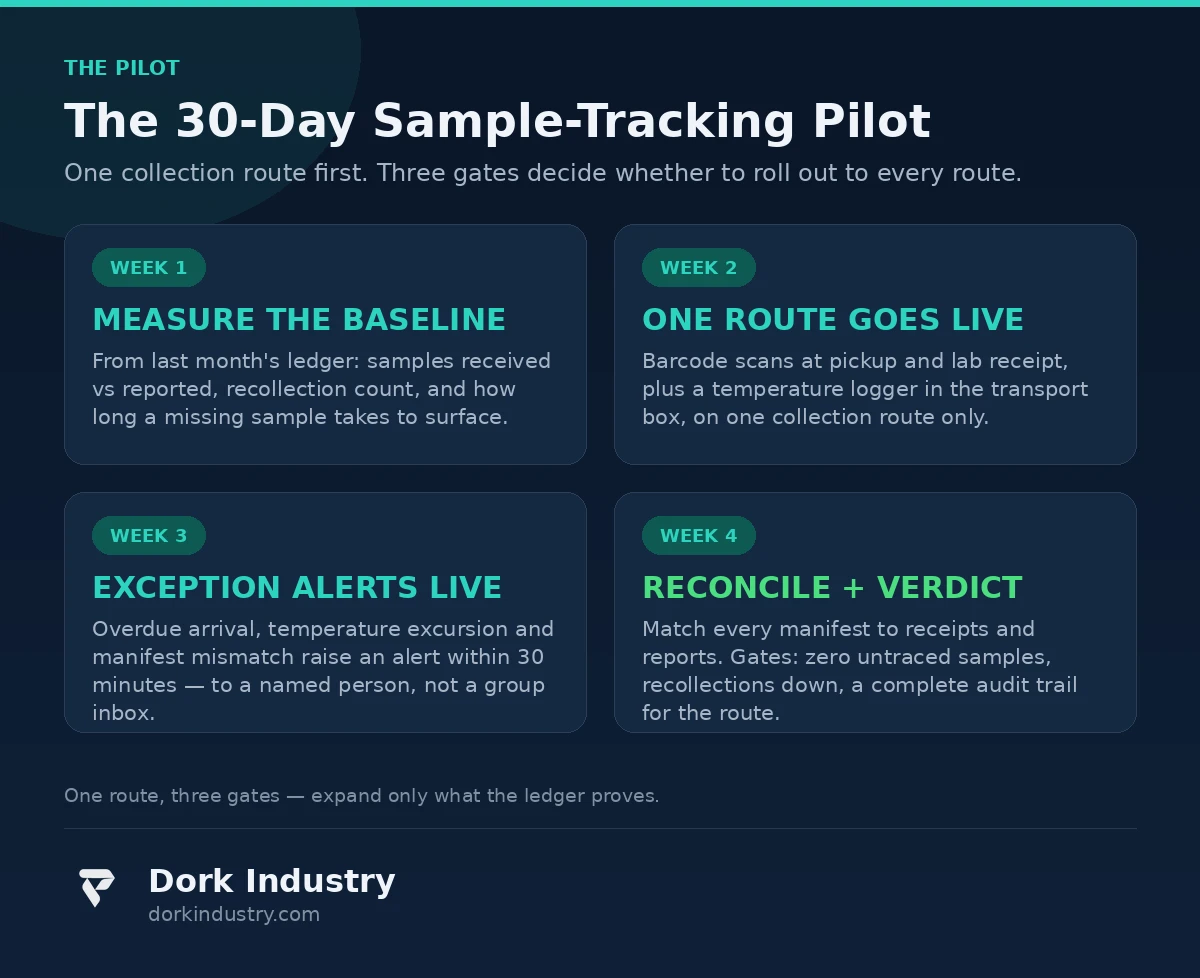
The lowest-risk path is a single-route pilot with a fixed scope and measurable outcomes:
- One collection route, its regular courier, and its usual daily volume
- Barcode scans at pickup and lab receipt, a temperature logger in the transport box, and exception alerts to one named coordinator
- Run for 30 days
- Measure: samples received vs reported, recollection count, time from “expected” to “found” for overdue samples, and whether the audit trail for the route is complete
If overdue samples do not surface faster and recollections do not fall on the pilot route, a bigger IoT development investment will not fix it either. The pilot validates handoff discipline, not just sensors — the same assessment Dork Industry runs before quoting any lab project.
What actually drives the cost of sample-tracking IoT development?
Sample-tracking pricing varies widely because scope does. The real cost drivers are:
- Routes and handoffs: one route with two handoffs vs a network of collection centres, couriers and reference labs changes the data model significantly
- Sensor types: temperature-only loggers vs temperature, humidity, shock and live cellular location — and how often each reports
- LIMS and order integration: whether the tracking timeline must merge with an existing LIMS, an EMR, or a doctor portal, and how clean those interfaces are
- Connectivity on the route: cellular coverage, offline scan queues for low-signal areas, and how scans sync when the courier returns to coverage
- Compliance depth: audit trails, role-based access and retention rules your accreditation actually requires, not a generic checklist
- Alerting discipline: who gets which alert, escalation when nobody acts, and a log proving the alert was seen — the part most pilots underestimate
Anyone quoting a fixed price without asking about routes, handoff counts, your current LIMS and your accreditation requirements is guessing.
Frequently asked questions
How do you track a patient specimen from collection to result?
Give the specimen one barcode identity at collection, scan it at every handoff — pickup, lab receipt, bench, storage — and keep the scans, transport conditions and report status on a single timeline tied to the patient order. The practical test is simple: scan any barcode and reconstruct the sample’s current status and recorded history without switching between unrelated systems.
What four questions must a sample record answer?
What was collected, when each event happened, how it was handled and stored, and who handled it at each step. If your record cannot answer all four for any sample on demand, an auditor — or a doctor asking about a delayed report — will find the gap before you do.
What happens when a specimen goes missing?
First, the search starts from the last recorded scan, not from memory: who last held it, where, and when. If it cannot be found within the sample’s stability window, the lab orders a recollection and informs the referring doctor through its clinical team. A tracking system shortens the search from hours to minutes, but the decision to recollect always stays with qualified lab staff.
How does barcode sample tracking reduce pre-analytical errors?
It removes transcription — no one retypes patient details from a paper requisition — and it catches identity mismatches at collection, before the draw is completed. Scans at each handoff then turn vague gaps between sites into named events with timestamps, so errors surface where they happened while correction is still possible.
What should happen at every handoff?
The sample is scanned, and the scan records who received it, when, where, and in what condition. A manifest mismatch, a missing scan or a temperature excursion at that moment raises an exception immediately. A handoff without a scan is not a completed handoff — it is the start of the next gap.
The bottom line
The question is not whether a lab needs IoT development. It is whether the lab can answer, for any sample, at any moment: where is it, who last held it, what condition it travelled in, and what happens next. If the answer requires phone calls and registers, the technology decision is really a custody decision wearing a software costume.
Start with one route, scan every handoff for 30 days, and let the ledger — overdue samples found faster, recollections down, a complete audit trail — decide whether to build further.
Losing track of diagnostic samples between collection and report?
Dork Industry maps your current chain of custody — routes, handoffs, cold chain and LIMS — and scopes a one-route tracking pilot that proves, from your own ledger, whether IoT tracking cuts recollections before you commit to a full rollout.
Request a free sample-tracking assessment WhatsApp +91 8210792477
About Dork Industry
Dork Industry (dorkindustry.com) is a custom software development company building mobile apps, AI automation, and IoT systems for businesses across India. Our team designs field-tracking, cold-chain and operations platforms — from 30-day pilots to full multi-site rollouts — including IoT automation and custom software development for healthcare and laboratory operations.