
Web development can close your overdue dental recall list — by giving every patient a risk-based recall date at checkout, pre-booking the next hygiene visit before they leave, and turning the patients who still slip through into a daily worked queue with a named owner. The direct answer is yes, but only when recall stops being a reminder to send and becomes a list to work: every patient due, every patient overdue, every attempt logged, no name ageing past its date unnoticed.
Every dental practice knows the symptom. The hygiene diary looks healthy three weeks out, then a gap opens next Tuesday, then another the week after. The front desk insists the recall list was called — but nobody can show how many patients became due last month, how many booked, and how many are now six months past their last cleaning with no date at all. That last number is the practice’s real recall problem, and it grows in silence.
Why do patients skip their six-month recall in the first place?
Because nothing happened at the moment they were most likely to return. The patient leaves after a cleaning feeling fine, the hygienist says “see you in six months,” and the next appointment is never made. Six months is long enough for a phone number to change, a job to move, a child to start school, and a healthy mouth to feel like no reason to return. By the time anyone notices, the patient is not “late” — they are gone, and winning them back costs far more effort than keeping them ever did.
The published recall guides describe the same failure from the practice side. According to Rework’s dental recall and recare guide, most practices manage recall reactively: hygiene has openings next week, the front desk pulls a list of patients due for recall, staff make calls, some patients respond, and the schedule gets partially filled. That works well enough to survive. It does not work well enough to keep a diary full, because it depends on someone remembering to pull the list, on a week when the desk is already busy.
How often should dental patients actually be recalled?
Not all on the same six-month clock. According to Rework’s guide, a risk-stratified schedule fits the interval to the patient: low-risk patients on a six-month or annual interval, moderate-risk patients on a four-month interval, and high-risk or active periodontal-maintenance patients on a three-month interval. A 60-second checklist at checkout sets the right interval and documents it. A system that books everyone at six months underserves the patients who need three-month care and wastes hygiene time on patients who could safely wait longer.
What is a good dental recall rate, and what counts as overdue?
According to Rework’s guide, the industry average recall rate is 60–70%, while top-performing practices reach 80–88%, and practices above 80% generate 25–35% more revenue per patient over five years than those below 65%. Those figures are benchmarks, not promises — but they frame the question a practice should ask itself: what share of your active patients have a next recall date, and what share have passed theirs with no booking? A patient becomes overdue the day after their recall date passes without an appointment. A patient with no recall date at all is overdue from the start, because nobody will ever chase a date that was never set.
Why does a reminder alone not fix recall?
Because a reminder protects a booking that already exists; it does not create one. A patient with no recall date receives nothing. A patient whose number changed receives a message that never arrives, yet the system marks the job done. Recall fails in the gaps between messages, and only a worked list closes those gaps.
What data does your practice already hold that could fix this?
Almost all of it. The practice system already knows each patient’s last hygiene visit, their recall interval, their contact details, and whether they have a next appointment. What is missing is not data; it is a single view that turns those facts into work: this patient, this recall date, this many days overdue, this owner, this next step. The honest first question is simpler: show us your overdue list, and count how many names have no owner and no next attempt scheduled.
That distinction matters for cost. Connecting the booking page, the recall list, and the messaging record is weeks of work; replacing the whole practice system is months — during which the overdue list keeps growing.
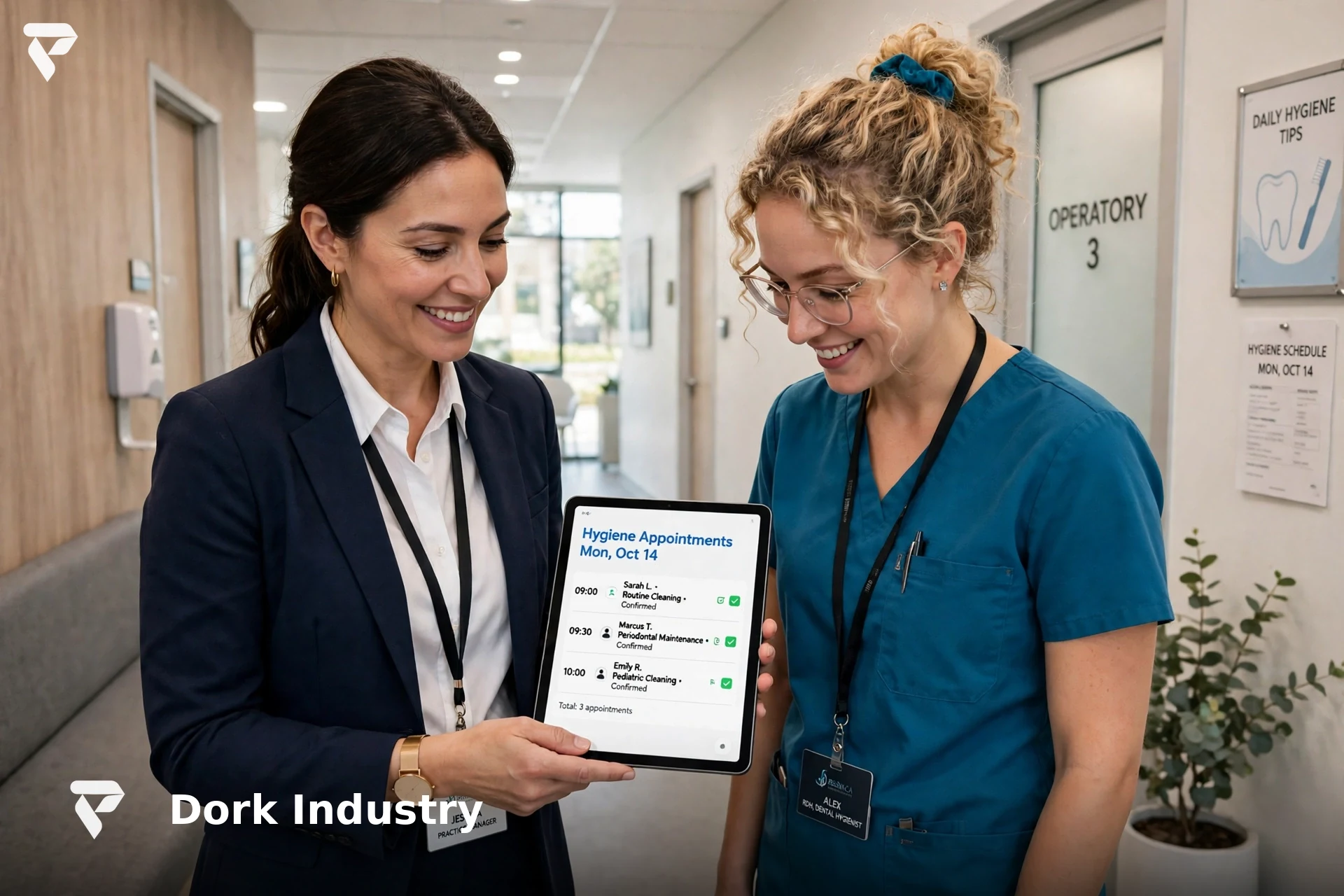
How does web development turn a recall list into a full hygiene diary?
The technology is deliberately unglamorous, and that is a compliment. At its centre is a recall engine: at checkout, the hygienist’s interval becomes a recall date automatically; the next hygiene visit is pre-booked before the patient leaves, or, if they cannot commit, the patient enters the due queue with a date and an owner. When the recall date approaches, a staged reminder sequence runs on the patient’s preferred channel. When the date passes without a booking, the patient moves to the overdue queue — visible to a named person, with a due time for the next attempt. Nothing here requires artificial intelligence — only a website and a workflow that refuse to let a patient go silent unnoticed.
According to DenTrends’ practical guide to dental patient recall, the steps that reduce overdue patients are exactly this shape: offer to schedule the next visit before checkout, review due-patient reports regularly, assign recall-list ownership, keep contact information accurate, and contact patients through their preferred method. Its guide also asks the right follow-up question: can recall follow-up be automated? Some administrative steps can, it says — but staff must monitor responses, verify messages are appropriate, protect patient information, and escalate clinically important concerns. Automation finds the work; people do the caring.
Concretely, a working recall system has five parts. First, interval capture at checkout: the recall date is set from risk, not from a default six months. Second, pre-booking: the next visit is booked before the patient leaves, because according to Rework’s guide, practices that consistently pre-schedule at checkout run recall rates 15–20 percentage points higher than those relying on call-to-schedule. Third, a staged reminder sequence on the patient’s preferred channel, with a clear confirm-or-reschedule action. Fourth, an overdue queue with owners and attempt limits: newest overdue first, because a patient a few weeks past due is the easiest to book. Fifth, a weekly recall report — due, contacted, booked, overdue — so the practice knows its real recall rate instead of guessing it.
According to Emitrr’s dental recall guide, the reminder cadence that protects bookings is a courtesy reminder a week before, a follow-up one to two days before, and a same-day reminder for afternoon appointments. A practice that only builds reminders has built half a recall system.
What does the math look like? An illustrative example
Illustrative example — stated assumptions, not statistics. Replace every number below with your own recall list before making a decision. Consider a practice with 1,200 active patients on six-month recall, where 30% of patients leave checkout without a next appointment booked, where half of those unbooked patients drift past their recall date without contact, and where the average hygiene visit is worth ₹2,500.
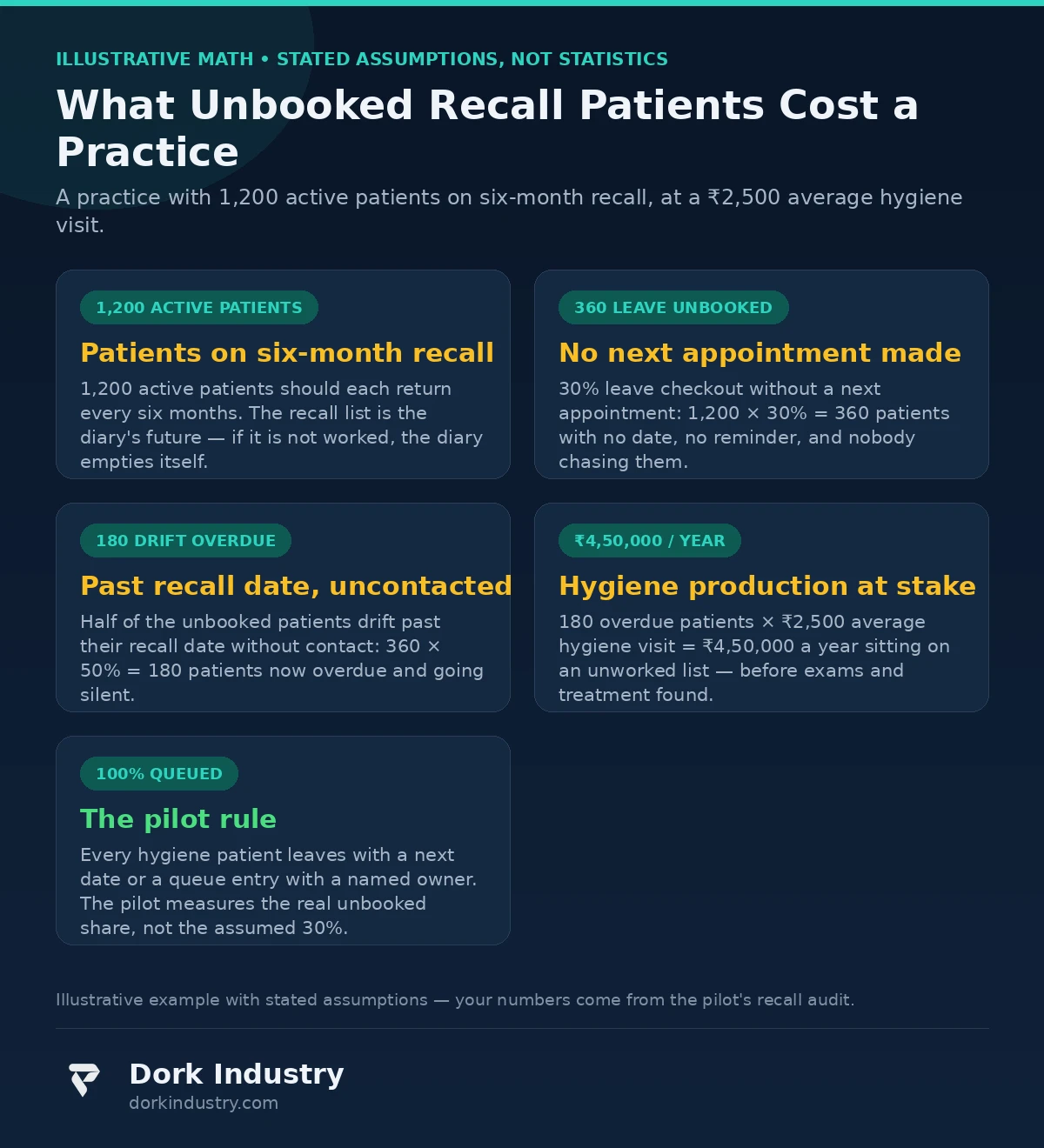
Three hundred and sixty patients leave without a booking; 180 of them drift overdue; at ₹2,500 each, that is ₹4,50,000 of hygiene production a year sitting on an unworked list — before the examinations, X-rays, and treatment those visits would have found. None of this proves what your practice loses, but it shows where to look: count last month’s hygiene patients, count how many left with a next date, and multiply the gap by your hygiene fee. That single count is the business case for the pilot below.
Should you build, buy, or use your existing practice software?
There are three honest routes, and the right one depends on how much of your recall workflow your current software already covers.
| Route | Recall reliability | Overdue visibility | Best for |
|---|---|---|---|
| Printouts and memory | Depends on who is on shift | None — the list is pulled when remembered | Very small practices with one receptionist |
| Practice software reminders | Staged reminders, if configured | Due reports, if someone reads them | Practices happy inside one vendor’s workflow |
| Custom web recall system | Queue with owners and due times | Overdue list worked daily, reported weekly | Practices with a real overdue list to clear |
| Full custom practice platform | Full — your intervals, your queues | Full — your reports, your channels | Multi-chair or multi-branch practices |
Build custom only when bought tools cannot model your recall intervals, your channels, or your queue ownership. Do not build custom because a recall dashboard sounds strategic; the strategic part is the queue and the weekly report, and a bought tool delivers both for most practices. Conversely, do not buy a tool whose reminders cannot follow the patient’s preferred channel, or whose reports cannot show the overdue list by days past due — a reminder system nobody works is a more expensive printout. For practices whose wider operations also need custom work, custom software development is the route when bought options genuinely fall short, and web development is where the booking page, recall queue, and report get built.
What should the system never do alone?
Recall automation must never pretend to be a clinician, pressure a patient, or expose health information. Five boundaries are non-negotiable. First, no message may claim a slot is reserved, a condition has worsened, or a treatment is urgent unless a clinician has said so — manufactured urgency destroys the trust a cleaning just built. Second, no message may include clinical details beyond what is needed to book; appointment reminders carry the practice name, a callback number, and an invitation to schedule. Third, no fee, discount, or treatment is offered automatically; a clinician or practice manager approves every commercial offer. Fourth, no automated message answers a patient’s clinical question — pain, swelling, bleeding, or a treatment query routes to a clinician the same day. Fifth, every automated message identifies itself as from the practice, respects the patient’s recorded channel and consent, and offers a human reply path — and after an agreed number of attempts, the patient moves to low-frequency review instead of being chased indefinitely.
These boundaries are not inefficiency. They are why patients trust a practice with their health and their contact details — and a vendor who proposes removing them to save minutes is selling speed at the price of that reputation.
How do you test it in 30 days before full investment?
Run one hygienist’s diary, one reception team, four weeks — judged on the list, not enthusiasm. Week one audits it: count active patients, patients with a next date, patients overdue, and patients with no recall date. Week two puts pre-booking live: every hygiene patient leaves with a next date or enters the due queue with an owner. Week three switches on the overdue queue: newest overdue first, one owner per name, every attempt logged, no name without a next attempt. Week four re-counts the list and renders a verdict on three gates: 100% of hygiene patients leaving with a date or a queue entry, overdue share down, and hygiene diary utilisation up.
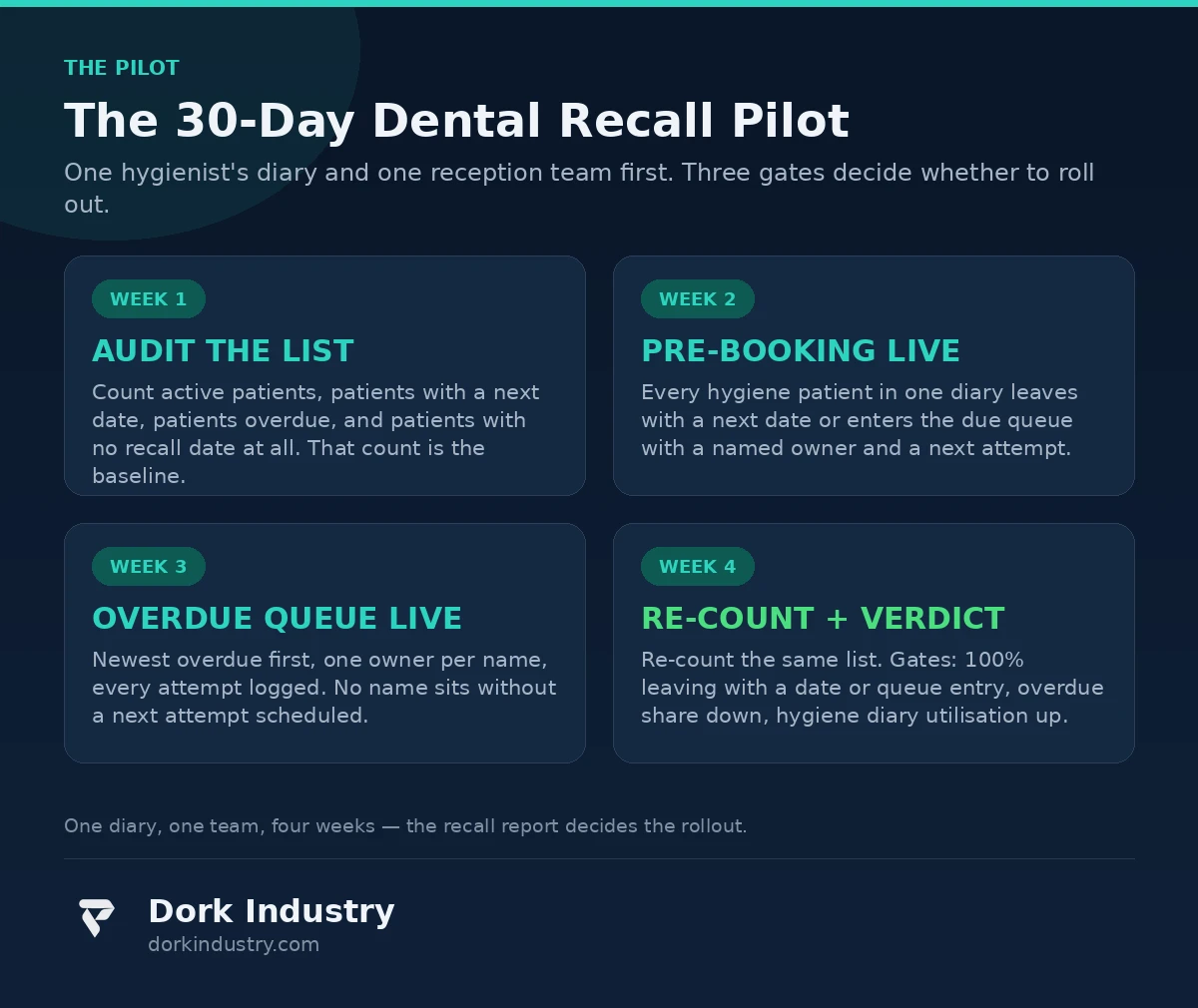
If any gate fails, you have learned something cheap: recall dates were never captured properly, the queue needs a different owner, or the overdue list points to a real problem — wrong intervals, wrong channels, or unverified contact details — that no software can paper over. If all three gates pass, rollout is a scheduling decision, not a leap of faith.
What actually drives the cost of a dental recall system?
Four drivers dominate. First, patient volume and interval complexity: risk-based three-, four-, and six-month intervals across chairs and branches cost more than one interval for everyone. Second, integration depth: a booking page alone is cheap; one connected to the practice system, reminders, and online booking costs more and is the version worth buying. Third, reporting depth: a recall report by hygienist, interval, channel, and days overdue costs more than a due list. Fourth, change management: reception teams used to printouts need training and a manager who reads the overdue queue daily. A quotation that ignores any of the four is guessing.
Frequently asked questions
How often should dental patients be recalled?
By risk, not by default. Low-risk patients fit a six-month or annual interval, moderate-risk patients a four-month interval, and high-risk or periodontal-maintenance patients a three-month interval. Your hygienist sets the interval at checkout from caries risk, periodontal status, and compliance history, and the system books from that date.
What is a good dental recall rate?
According to Rework’s guide, the industry average is 60–70% and top-performing practices reach 80–88%. Treat those as benchmarks to measure against, not targets to claim: count your own active patients with a next recall date, your overdue share, and your reactivation rate, and judge improvement against your own baseline.
Can recall follow-up be automated?
The administrative steps can: interval capture, pre-booking prompts, staged reminders, overdue queueing, and reporting. The conversations cannot: clinical questions route to a clinician, commercial offers need human approval, and unresponsive patients move to low-frequency review after an agreed number of attempts rather than being chased forever.
What should happen when a patient does not respond to reminders?
Change the channel, then change the approach. Try the patient’s preferred channel, then a personal call for recently overdue patients and written outreach for long-overdue ones. Log every attempt, set the next attempt, and after the agreed sequence, move the patient to annual reactivation review instead of burning staff time on repeated calls.
How do you reactivate lapsed dental patients?
Segment by how long they have been gone. Recently lapsed patients, 12–18 months since their last visit, respond best to a warm personal call; long-lapsed patients respond better to written outreach first. Lead with care, not guilt, offer a real appointment time, and measure what share of each segment books.
The bottom line
Patients do not skip their six-month recall because they stopped caring about their teeth. They skip it because nobody set a date, nobody worked the list, and nobody noticed when the date passed. Web development closes that gap only when every patient has a recall date, an owner, a next attempt, and a weekly report — and a human keeps every decision that touches health, money, or trust. Start with the overdue count, prove it on one diary, and let the recall report decide.
Is your hygiene diary developing gaps while past patients go silent?
Dork Industry audits your dental recall list — due, overdue, and never-booked patients — and builds the booking page, recall queue, and weekly report that bring recall patients back on time.
Request a free patient-recall assessment WhatsApp +91 8210792477
About Dork Industry
Dork Industry (dorkindustry.com) is a custom software development company building mobile apps, AI automation, and IoT systems for businesses across India — including custom software development and web development such as the dental recall system in this article. Talk to us through our contact page.
Outbound sources: According to Rework’s dental recall and recare guide, risk-based intervals, pre-scheduling at checkout, and a systematic recall rate of 80–88% for top practices keep hygiene schedules full. According to DenTrends’ practical guide to dental patient recall, reducing overdue patients takes pre-checkout scheduling, regular due-patient reports, assigned ownership, and accurate contact information. According to Emitrr’s dental recall guide, reminder cadence runs a week before, one to two days before, and same-day for high no-show practices. According to the Indian Dental Association’s continuous care guidance, a recall appointment should be recommended in six months or when suitable for the patient’s oral status, with contact details verified and a reminder sent.