AI automation can reorder a hotel’s housekeeping queue so the rooms guests actually need first get cleaned first — by ranking every dirty room against today’s arrivals, early check-ins, VIP bookings, and special requests, instead of letting attendants work down the hallway in order. The direct answer is yes, but only when the queue is a live, supervisor-approved order, not a black box that moves staff around without telling anyone why.
In brief: Rank rooms by check-in time, not hallway order. Keep one live status board with one supervisor owning the “ready” call. Hold maintenance-blocked rooms out of the queue, re-sequence at noon when arrivals change, and never release a room without inspection.
Every hotel manager knows the 3 pm scene: guests in the lobby with luggage, the front desk apologising, and somewhere down a corridor, clean rooms nobody has released yet — while the rooms those guests were promised are still dirty, behind rooms nobody needs until tomorrow. The hotel is not short of clean rooms. It is short of the right clean rooms, at the right hour.
Why are rooms ready in the wrong order when the hotel is fully staffed?
Because the queue was built for the building, not for the arrivals. The traditional housekeeping list runs floor by floor, room by room, in hallway order — the order that is easiest to walk, not the order guests arrive in. The attendant who starts at room 101 and works toward room 120 cleans beautifully and steadily, and finishes the rooms for tonight’s 8 pm arrivals before the rooms for the 2 pm family who are already in the lobby. Nobody made a mistake. The list itself was wrong.
The second failure is status lag. A room can be cleaned, inspected, and ready while the front desk still shows it dirty, because the update travels by walkie-talkie or paper slip. The desk cannot sell a room it believes is dirty, so guests wait for rooms that are, in fact, ready. And a room can be shown as ready when inspection never happened, because someone ticked the box on the way past. The room’s status lives in three places — the attendant’s head, the supervisor’s sheet, and the desk’s screen — and they disagree.
How do hotels decide which rooms to clean first?
Published housekeeping guides say the good hotels already decide by arrivals, not by hallway. According to Little Hotelier’s small-hotel housekeeping guide, prioritisation means tackling rooms based on guest arrivals, early check-in requests, and length of stay, rather than just working down a hallway — if one guest arrives at 1 pm and the others at 4 pm, the schedule should be built entirely around that first arrival.
According to Kiyo’s hotel housekeeping SOP guide, the working day follows the same logic at larger scale: pull check-outs, arrivals, and stayovers from the booking system, brief the team on early arrivals and rooms needing a cot or twin beds, then work check-out rooms in an agreed order — early arrivals first, then special requests, then the rest — with each finished room inspected and released through one channel only. One person owns the “ready” call.
The window those guides describe is brutally narrow. Most hotels enforce an 11 am check-out and a 3 pm check-in, leaving four hours to turn every vacated room, and a standard room attendant is typically allotted between 30 and 45 minutes per room. In a 60-room hotel with 45 check-outs, that is 22.5 attendant-hours inside a 4-hour window — six attendants working flat out, with no slack for a maintenance fault or a late check-out. When the queue order is wrong, there is no time left to fix it.
Why is my room not ready at check-in time?
According to a guide to hotel check-in waits, hotels set check-in times — often 3 pm — to give housekeeping time to strip beds, clean bathrooms, vacuum, replenish linens and toiletries, and run maintenance inspections after the standard 11 am check-out. That narrow window maximises occupancy while leaving no gap for a slow turnover.
According to a guide to rooms not ready at check-in, when a designated room is not fully prepared by the official check-in time, the front desk falls back on courtesy protocols: luggage held securely, a notification the minute housekeeping clears the room, and depending on the delay and the property tier, vouchers, amenity access, or an upgrade if another room is open. Notice what that means: the hotel’s recovery plan starts after the failure. Nothing in the courtesy protocol prevents the next guest from waiting tomorrow, because nothing changed the order rooms were cleaned in.
The deeper reason is that “ready” is a chain, not a moment: cleaned, inspected, restocked, and released to the desk, each step with its own delay. A room cleaned at 1 pm but inspected at 2.30 pm is a 2.30 pm room. Automation earns its keep by shrinking the gaps between those links, not by asking attendants to clean faster.
What data does your hotel already have that could order the queue?
Almost everything the queue needs already exists, scattered across systems nobody joins up. The property management system holds today’s arrivals with times, early check-in requests, VIP flags, and special requests. The housekeeping board holds each room’s status: vacant dirty, in progress, cleaned, inspected, released, or out of order. The maintenance log holds rooms that cannot be sold until a fault is fixed. The front desk holds the live truth about who is standing in the lobby right now.
Put those four together and the correct order writes itself: earliest arrivals first; special-request rooms early enough for their extra setup time; stayovers fitted around arrivals, not ahead of them; maintenance-held rooms excluded entirely. A hotel that has never logged ready-times cannot prove which rooms were late or why, which is why the pilot below starts with a week of counting.
How can AI automation reorder the housekeeping queue?
The intervention has four parts. First, an arrival-first ranking: every morning, and again at noon, the system ranks all dirty rooms by the check-in time of the guest assigned to that room type, then by early check-in requests, VIP status, and special-request setup time. A room for a 1 pm arrival outranks a room for an 8 pm arrival even if it is three floors away.
Second, a live status board with one owner. Attendants update room status from a phone as they work, and the supervisor alone releases a room after inspection. The front desk sees the same board, so a released room is sellable the minute it is released, and a cleaned-but-uninspected room is never sold by mistake. Third, maintenance handoffs: a fault found mid-clean automatically holds the room, notifies maintenance, and pulls the next arrival-first room into the queue.
Fourth, a noon re-sequence. Arrivals change — flights land late, guests extend, a group checks out early — and a queue fixed at 8 am is stale by noon. At noon the system re-ranks the remaining dirty rooms against updated arrivals and proposes the new order to the supervisor, who approves or changes it in minutes. The supervisor stops rebuilding a list by hand, and spends the morning inspecting rooms instead.

What must the system never do alone?
This is where hotel automation fails when it is bought as a black box. The system must never do six things without a human decision. First, it must never mark a room ready without an inspection — a cleaned room and a ready room are different things, and selling an uninspected room trades a lobby wait for a complaint inside the room. Second, it must never assign an occupied room, a do-not-disturb room, or a room with a guest’s belongings still inside; occupancy status comes from the property system and the attendant’s eyes, not from a schedule’s guess.
Third, it must never override a maintenance hold or reassign a room under repair to an arriving guest. Fourth, it must never promise a guest a ready time the queue cannot keep; a promised 2 pm room ready at 3 pm is worse than an honest “we will message you the minute it is ready.” Fifth, it must never pull attendants off safety work — a blocked fire exit, a flooded bathroom, a broken lock — to chase the queue. Sixth, it must never expose guest details beyond what the attendant needs: room number, room type, setup request, and timing.
Those boundaries are not a limitation. They are why guests trust the room they are finally given. A queue that quietly marks rooms ready to hit a target moves the complaint from the lobby — where an upgrade can fix it — into the room, where it becomes a review.
Should you build custom software, buy housekeeping software, or start with a whiteboard?
Start with the whiteboard if you have under 30 rooms, one floor, and a supervisor who already re-orders the day by hand. Four columns — room, guest arrival time, status, released — plus a rule that nobody cleans out of arrival order without the supervisor’s initials will fix most of the problem on its own, because the failure is usually the rule, not the tool. Buy off-the-shelf housekeeping software when you want standard room-status boards, attendant apps, and inspection checklists without building anything, and your property system already talks to it.
Build custom when standard tools stop fitting: multiple properties sharing one housekeeping pool, your own room types and setup rules a generic board cannot express, guest notifications the minute a room is released, or group bookings where fifty arrivals land within one hour. Do not build custom to replace a whiteboard nobody updates. Fix the status discipline first.
| Approach | Best for | What it gives you | Where it falls short |
|---|---|---|---|
| Whiteboard + arrival rule | Under 30 rooms, one floor | Arrival-first order and one release owner in a day | No live updates; relies on someone rewriting it |
| Off-the-shelf housekeeping software | Standard rooms, one property | Status board, attendant app, inspection checklists | Generic ranking; may not talk to your property system |
| AI automation, custom-built | Multi-property, group arrivals, guest messaging | Arrival-first ranking, noon re-sequence, live release, guest notification | Needs clean arrival and status data; higher upfront cost |
What does the 30-day pilot look like?
Run it on one floor and the 3 pm arrivals first, not the whole hotel. Week 1 is counting only: log every room’s vacated, cleaned, inspected, and ready times, plus every late check-in with its reason. Week 2 switches on the live queue board, with the supervisor approving every re-order. Week 3 switches on auto-sequencing, proposed each morning and at noon. Week 4 adds the verdict.
The pilot passes only if all three gates hold: rooms ready by check-in time rise and late check-ins fall, without the inspection pass rate falling; no room is released without inspection, and no guest is promised a time the queue missed; and the supervisor approves the day’s queue in under fifteen minutes. If inspection failures rise, the queue is too aggressive — slow the ranking, not the inspection.
What drives the cost?
Three things. First, data cleanup: joining property-system arrivals, housekeeping status, and maintenance holds into one status all three agree on. Second, integration: whether a phone update reaches the front desk screen instantly, or staff must re-key it. Third, scale — one floor is a pilot; five properties with group arrivals is a rollout with training. The software is rarely the expensive part; the expensive part is the week of watching real 3 pm lobbies and fixing rules that do not survive a wedding group arriving two hours early.
Illustrative data: what late rooms cost (stated assumptions, not statistics)
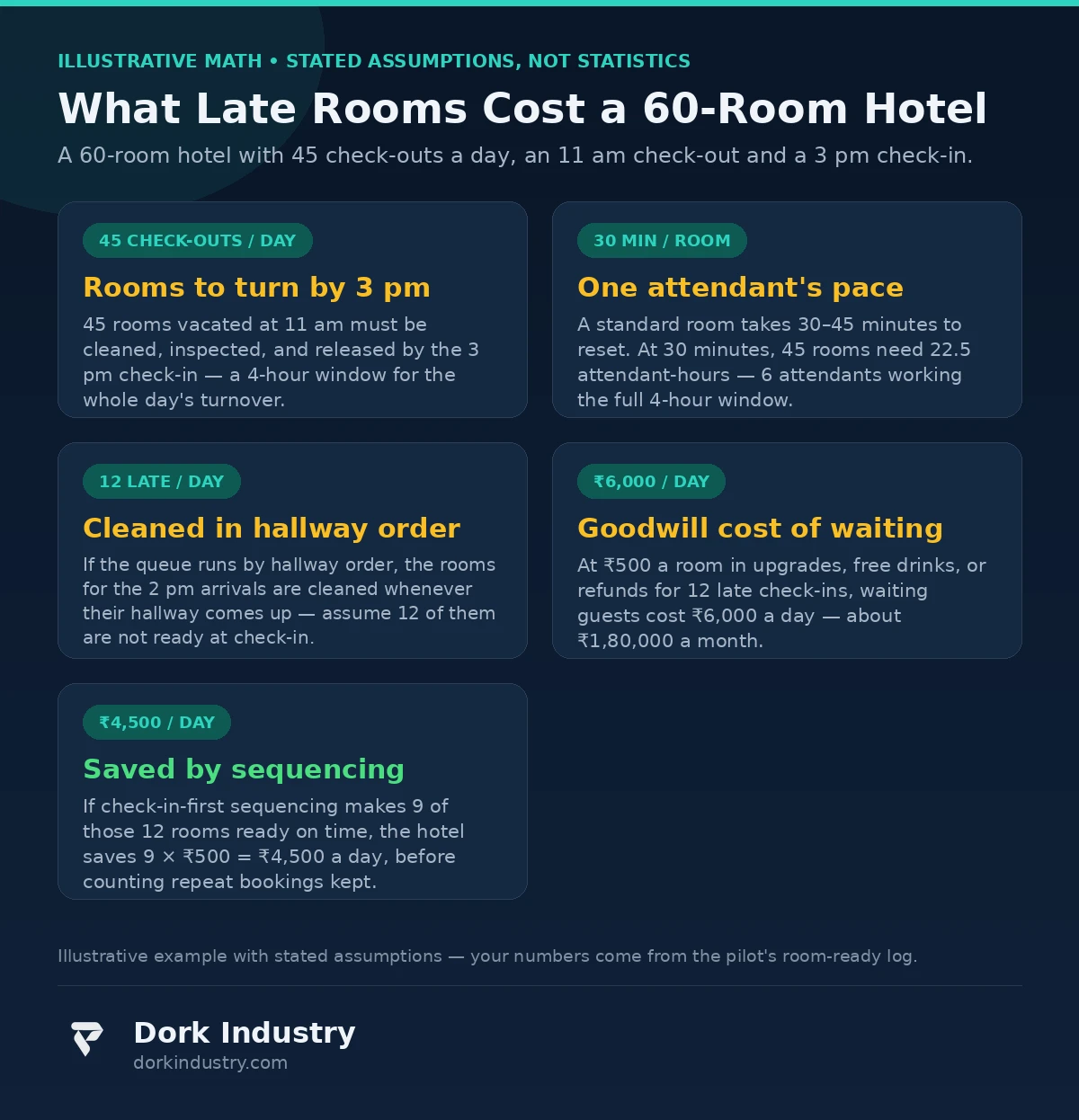
This section is an illustration with stated assumptions, not a statistic about hotels in general. Assume a 60-room hotel with 45 check-outs a day, an 11 am check-out, and a 3 pm check-in. At 30 minutes per room — the faster end of the published 30–45 minute range — turning 45 rooms needs 22.5 attendant-hours inside a 4-hour window, or six attendants with no slack.
Now assume the queue runs in hallway order, and 12 rooms for afternoon arrivals are not ready when their guests arrive. At ₹500 per late check-in in upgrades, free drinks, or refunds, that is 12 × ₹500 = ₹6,000 a day, or about ₹1,80,000 a month — before counting guests who do not complain but do not return. If check-in-first sequencing makes 9 of those 12 rooms ready on time, the hotel saves 9 × ₹500 = ₹4,500 a day, or about ₹1,35,000 a month. And the cheapest saving is free: a room cleaned at 1 pm but released at 2.45 pm because nobody told the desk is a 105-minute wait no extra attendant would have fixed.

Frequently asked questions
How do hotels decide which rooms to clean first?
By guest arrivals, not by hallway. Published housekeeping guides say to prioritise rooms by arrival time, early check-in requests, VIP status, and special requests such as a cot or twin beds — early arrivals first, then special requests, then the rest. A room for a 1 pm guest outranks a room for an 8 pm guest even if it is on another floor.
Why is my hotel room not ready at check-in time?
Usually because the turnover window is only four hours — 11 am check-out to 3 pm check-in — and the room’s place in the cleaning queue did not match your arrival time. A room can also be cleaned but not yet inspected or released to the front desk, so the desk cannot honestly sell it yet. Both are queue problems, not cleaning-speed problems.
How long does it take housekeeping to clean a hotel room?
A standard guest room typically takes 30 to 45 minutes to completely reset: strip and remake the bed, clean and sanitise the bathroom, vacuum, replenish linens and amenities, and check the room’s condition. Suites, trashed rooms, and rooms needing maintenance take longer, which is why the queue must leave slack for them instead of assuming every room takes the same time.
Can software reorder housekeeping without causing chaos on the floor?
Yes, if the supervisor approves every order and the system never moves staff silently. The working pattern from published SOPs is one live board, one person owning the “ready” call, and a re-sequence at noon when arrivals change. Attendants see why their next room changed — a 1 pm arrival, a VIP, a maintenance hold — so the new order reads as a decision, not a disruption.
What happens if I arrive early and no room is ready?
The front desk will usually hold your luggage securely, take your mobile number, and notify you the minute housekeeping clears a room. Depending on the delay and the property, you may be offered a drink voucher, pool or fitness access, or an upgrade if another room is open. Asking for a realistic ready time — and a message when it is met — beats waiting beside the desk.
The bottom line
Guests do not wait in lobbies because housekeepers are slow. They wait because the queue was built for the hallway, the room’s status lived in three places that disagreed, and nobody re-ranked the afternoon when arrivals changed. AI automation earns its keep when it ranks rooms by check-in time, keeps one live status board with one release owner, pulls maintenance-held rooms out of the queue, and re-sequences at noon — while the supervisor keeps every decision about inspection, safety, and what the desk promises a guest. Count room-ready times for one week, pilot one floor, and let the late check-in log decide.
Guests waiting in your lobby while rooms sit dirty down the hall?
Dork Industry audits one floor’s room-ready data, then builds the arrival-first queue, live status board, and guest-ready notification that get rooms released by check-in time — with inspection and safety holds the system can never override.
Request a free housekeeping sequencing assessment WhatsApp +91 8210792477
About Dork Industry
Dork Industry (dorkindustry.com) is a custom software development company building mobile apps, AI automation, and IoT systems for businesses across India — including custom software development and web development such as the housekeeping queue system in this article. Talk to us through our contact page.
Outbound sources: According to Little Hotelier’s small-hotel housekeeping guide, rooms should be prioritised by guest arrivals, early check-in requests, and length of stay rather than hallway order. According to Kiyo’s hotel housekeeping SOP guide, check-out rooms are worked early arrivals first, then special requests, then the rest, with one person owning the “ready” call. According to a guide to hotel check-in waits, the 11 am check-out to 3 pm check-in window exists to give housekeeping time for a full reset and inspection. According to a guide to rooms not ready at check-in, the front desk falls back on luggage holding, ready notifications, and courtesy vouchers when a room misses check-in time.