

Nano GCC setup in India means a company in the UK, the US or Dubai building a small, company-owned team of 5 to 50 specialists in India — engineering, AI, product or operations — without the cost, headcount or timeline of a traditional 1,000-person capability centre, and without needing a contact in India first. If you have no team, no office and no trusted contact in India yet, the fastest path is this: pick one function that moves revenue, let an on-ground partner in Delhi NCR hire and run the first team for you, choose EOR, BOT or your own entity by speed and control, and prove the first team ships before you scale it.
Key highlights:
- A nano GCC is 5–50 specialists, not a vendor team — you own the talent, the IP and the culture, even though you are based in the UK, the US or Dubai.
- You do not need an India contact to start. Dork Industry in Delhi NCR can be that contact: hiring, workspace, cloud and governance, with one point of accountability back to your HQ.
- India now hosts 2,117 GCCs with 2.36 million professionals and about $98.4 billion in revenue (Zinnov–NASSCOM FY26).
- HCLTech and AWS launched an AI-powered nano GCC model on 28 October 2026 — the clearest signal yet that small is now a formal model, not a workaround.
- A 50-person nano centre in Bengaluru is quoted at $500K–$800K upfront and $1.5–2M a year to run, against $20–50M for a traditional setup — ranges, not a Dork quote.
- Most new centres do not fail at incorporation. They fail at hire number seven, because the country head was hired late and no recruiting engine existed.
| Model | Speed to first team | Who is the legal employer? | Best when |
|---|---|---|---|
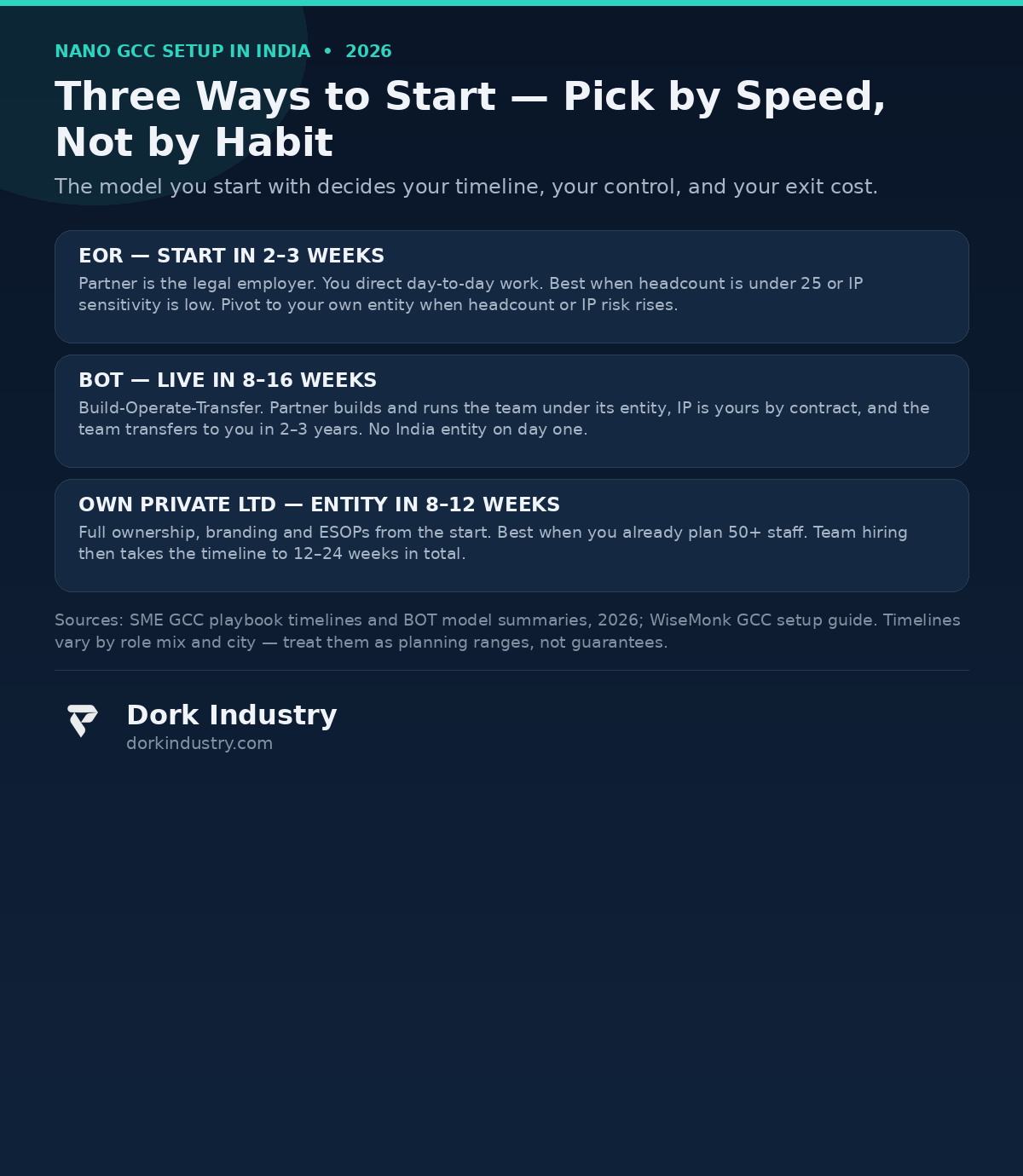
| EOR | 2–3 weeks | Partner | Under 25 staff, or testing India, with no India contact yet |
| BOT | 8–16 weeks | Partner, then you on transfer | You want a team without an entity on day one |
| Own Private Ltd | Entity 8–12 weeks; team 12–24 weeks | You | You already plan 50+ staff |
What is a nano GCC, in one paragraph?
A nano GCC is a small Global Capability Centre: a wholly owned India team that works for its parent company abroad, focused on one product or function rather than on volume operations. Karnataka’s GCC Policy 2024–2029 — India’s first dedicated state GCC policy — formally codified nano GCCs at 5–50 employees, while other guides describe the band as 5–100 specialists. The difference matters less than the idea: a nano GCC is built for strategic experimentation, specialised capability and speed, not for running a 3,000-seat operation. It is the opposite of traditional outsourcing, where a vendor owns the talent and the IP. In a nano GCC, you own both, and the team works to your roadmap, not to a vendor’s SLA — even when your HQ is in London, New York or Dubai and your India team is 3,500 miles away.
Why is nano GCC setup in India trending now?
Three things changed at once. First, the market is no longer only Fortune 500 companies: 480+ mid-market GCCs already employ 210,000+ professionals in India, and 120+ new mid-market centres were expected by 2026. Second, state policy caught up — Karnataka’s nano category, plus payroll and location incentives in several Tier-2 states, made a small centre a policy-backed choice rather than a grey area. Third, on 28 October 2026, HCLTech launched an AI-powered nano GCC offering with AWS, inside its GCC 360 suite, built around compact, product-centric teams and AI-native engineering, autonomous IT operations, advanced data and analytics, and intelligent business operations. HCLTech has not disclosed pricing or named customers for that model, so treat it as a market signal, not as a price benchmark. The signal is this: the big vendors now sell small, because mid-market demand for small is real — including demand from companies outside India that have never operated in India before.
You are in the UK, the US or Dubai — who is your India contact?
This is the question most foreign companies get stuck on, and it is the one this post is written to answer. You cannot hire well in a country where you have no one to interview, onboard, pay and manage a team, and you cannot fly in every fortnight to fix a hiring delay. A nano GCC works for a foreign HQ only when there is one accountable contact on the ground in India: someone who owns hiring, workspace, payroll compliance, cloud setup and weekly delivery, and who reports to your HQ in your working hours. Delhi NCR helps here on time zones alone — about 4.5–5.5 hours ahead of the UK, 1.5 hours ahead of Dubai, and with a workable overlap window to the US East Coast for a product team that plans its day around a morning review with HQ. That contact is not a recruiter who hands you CVs and disappears. It is the team that stays when the first hire resigns, when a compliance filing is due, and when the parent asks, honestly, “what did this team ship this week?” If you do not have that contact, do not start by incorporating. Start by appointing one.
Who should NOT set up a nano GCC?
Do not set one up if you need 500 engineers in six months, if your work cannot be split into a single ownable function, or if you are not willing to put a senior leader in India with a real mandate. A nano GCC also fails when it is really a cost-cutting exercise with no product owner: the team will drift into ticket-taking, attrition will rise, and the parent will conclude “India didn’t work” when the model, not the talent, was wrong. If you only need two contractors for three months, hire contractors. If you need a team you will still own in three years, a nano GCC is the right shape.
Which operating model should you pick: EOR, BOT, or your own entity?
Pick by speed, control and exit cost, in that order — and for a foreign company with no India contact yet, speed and a managed start usually matter more than full ownership on day one. An Employer of Record (EOR) lets you hire in 2–3 weeks without an India entity: the partner is the legal employer and handles payroll and compliance, while you direct day-to-day work. Pivot to your own entity once headcount passes about 25 or IP sensitivity rises. Build-Operate-Transfer (BOT) is the middle path: a partner builds and runs the team under its entity, IP belongs to you by contract from day one, and the team, processes and operations transfer to your own India entity after 2–3 years, in 4–8 weeks. A wholly owned Private Limited company is the destination: full P&L, branding and ESOPs, with entity setup in 8–12 weeks (SPICe+ filing, DIN, DSC, PAN, TAN, GST and bank account) and a first team in 12–16 weeks when workstreams run in parallel. Most foreign SMEs start with EOR or BOT, gather data, and migrate — that sequence is cheaper than incorporating first, from abroad, and discovering your hiring plan was wrong.
What does nano GCC setup in India actually cost?
Use ranges from published guides, and validate them against your role mix before you approve a budget. A 50-person nano GCC in Bengaluru is quoted at $500K–$800K in upfront capital with $1.5–2M in annual operating expenditure, scaling to a 200-person micro GCC at $1.5–2M upfront and $6–8M a year — even at premium Bengaluru rates, guides quote 40–60% savings against equivalent US operations. A 20-person engineering-led centre in Bengaluru or Hyderabad runs roughly ₹6.5–9 crore in annualised fixed compensation alone, before workspace, tools and management overhead. A traditional GCC, by contrast, is quoted at $20–50M, which is why a 50-person team at under $2M a year is the real story here: you are not buying a cheaper version of the same thing, you are buying a different size of commitment. City choice moves the number more than any other single factor — Bengaluru for breadth, Hyderabad for hyperscale depth, and Delhi NCR for a deep engineering and AI pool with time-zone overlap to the UK, Europe, Dubai and the US East Coast. Do not let a vendor quote you a single “GCC cost” without a role-by-role breakdown: the cost of a senior AI engineer and a support analyst are not the same cost, in any city.
How do you hire your first 20 people, in order?
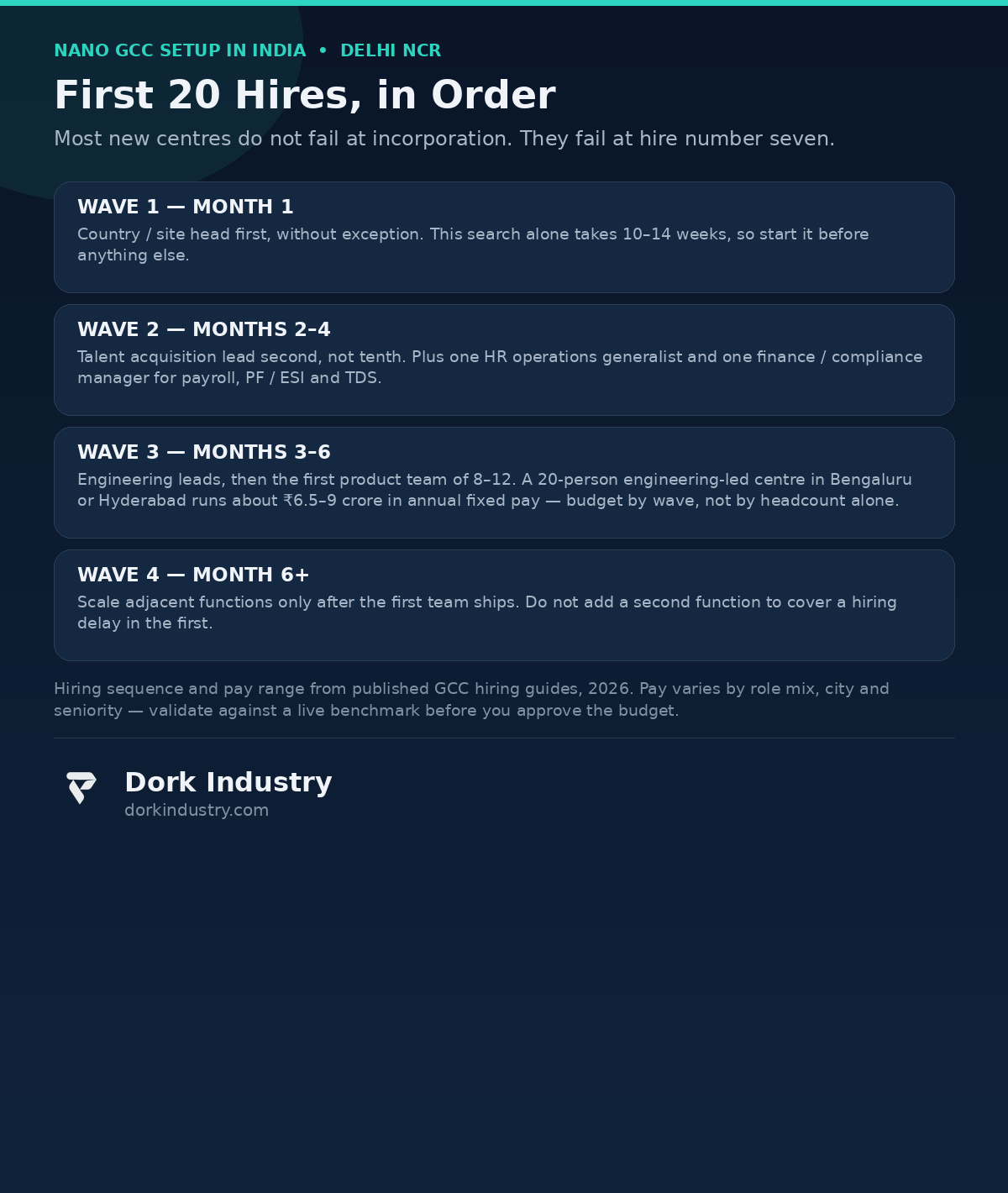
Hiring is a sequencing problem before it is a sourcing problem, and it is twice as hard from abroad, because you cannot see the market you are hiring in. Hire the country or site head first, without exception — that search alone typically takes 10–14 weeks, and if it slips, everything else slips with it. Hire a senior talent acquisition lead second, not tenth: at this scale the recruiter is the multiplier for the remaining 17 roles. Alongside TA, stand up a small people-operations and finance layer: one HR operations generalist and one finance / compliance manager covering payroll, PF / ESI, TDS and statutory filings. Many centres outsource the statutory piece for the first year and keep only an internal owner, which is usually the right call at this size. Only then hire engineering leads, then the first product team of 8–12. By the end of wave two you have four people and none of them write code — that feels wrong to engineering leaders, and it is correct anyway. The failure pattern to avoid is the one every hiring guide describes: board approval for 20 heads, a country head hired in month four instead of month one, no recruiting function, no employer brand, and month six ending with 11 offers, four reneges, and a leader doing recruitment coordination instead of building a mandate.
What legal and compliance steps come with a nano GCC in India?
If you choose your own entity, the checklist is bounded and solvable: SPICe+ incorporation, DIN and DSC for directors, PAN, TAN, GST and a bank account, Shops and Establishments registration, EPF and ESI registration, FEMA / FC-GPR filings for foreign investment, transfer pricing documentation for transactions with the parent, and DPDP Act readiness for personal data. If you choose EOR or BOT, the partner carries most of that stack and you carry governance: who owns IP, who can access production data, what happens on transfer, and how incidents are reported. Either way, keep two things in writing from day one: IP assignment to the parent, and a transfer plan with a date, not just an intention. This article is not legal advice — get an India counsel to sign off on entity, tax and transfer pricing before you file anything, especially when the parent is outside India.
Why Delhi NCR, and when does another city win?
Delhi NCR is Dork Industry’s home base, and it is a practical base for a foreign company’s nano GCC for three reasons: a deep pool of software, AI and product engineers across Delhi, Noida and Gurgaon; strong time-zone overlap with the UK, Europe and Dubai, and a workable overlap window to the US East Coast for a product team that needs to work with a parent abroad; and coworking and Grade A office supply that lets a 10–20 person team start without a long lease. Bengaluru wins when you need the broadest engineering breadth at scale, Hyderabad when you need hyperscale and product depth, and Tier-2 cities — Jaipur, Indore, Coimbatore, Kochi — when cost and attrition matter more than breadth. Pick the city on talent depth first and incentives second: an incentive that saves 10% on a team you cannot hire is not a saving. For a first team run from abroad, NCR’s advantage is not that it is cheapest, it is that a small team can hire, house and govern itself there without building a large-centre apparatus around it — and without you needing to be in India to run it.
How does Dork Industry fit a nano GCC, honestly?
Dork Industry is not a GCC advisory firm, and this post does not pretend otherwise. What Dork builds and runs is the technical team a nano GCC needs, from Delhi NCR, for a parent in the UK, the US or Dubai that has no India contact yet: custom software development for the product itself, AI development for the AI workflows a nano GCC is increasingly built around, cloud infrastructure for the platform it runs on — see our guide on how to compare GPU cloud providers in India — and the hiring, governance and delivery discipline to run that team on the ground, with weekly shipped-work reviews back to HQ. If you need entity filing, tax structuring or transfer pricing advice, you need a counsel and a GCC advisor alongside us; if you need the engineers, the product team, the cloud platform, and a single India contact who stays accountable for all of it, that is the enquiry Dork can take. A nano GCC that is only a legal entity with no shipping team is a shell. A nano GCC that is only a vendor team with no ownership is outsourcing with a new name. The version that works is the one in the middle: your team, your IP, your roadmap, built and run in India, with a contact you can actually call.
What is the 12–16 week build order?
Weeks 1–4: scope one function, pick the model (EOR, BOT or own entity), shortlist the city, and build a role-by-role cost model — with your India contact running the market checks you cannot run from abroad. Weeks 4–12: entity and compliance in parallel with the country-head search — do not sequence them, or you lose a quarter. Weeks 8–20: workspace or coworking, IT and cybersecurity setup, and DPDP protocols. Weeks 12–24: talent acquisition in waves, with the first cohort onboarded and shipping a real piece of work, not a training project. Week 24 onward: governance — SLAs, quality assurance, performance tracking and a scale roadmap that says, in writing, what triggers growth from 20 to 50 and from nano to micro. The test at week 16 is not “are 20 people hired?” It is “has the first team shipped something the parent actually uses?” If the answer is no, fix the mandate and the leadership before you add headcount.
What can still go wrong?
Attrition in a small team hurts more than in a large one: losing two of twenty is 10% of your capacity and 100% of a function. Leadership hiring delay is the most common failure, followed by a parent that treats the India team as a cost centre rather than a product team, and by compliance treated as an afterthought — transfer pricing, PF / ESI and data protection are not paperwork, they are the licence to operate. Distance makes all three worse if there is no on-ground owner, and manageable if there is. Guard against them with the same discipline: a named India leader with a budget, a product owner in the parent who reviews shipped work weekly, and a compliance owner from week one, even if that owner is outsourced. A nano GCC is small, but it is not casual. The companies that make it work treat a 20-person team with the same governance as a 200-person centre, and get the speed of a startup in return.
Frequently asked questions
What is a nano GCC in India?
A nano GCC is a small, company-owned capability centre in India with 5–50 specialists (some guides say 5–100), focused on one product or function, where the parent owns the talent and IP.
We are in the UK, the US or Dubai and have no India contact — how do we start?
Start by appointing one on-ground contact in India, not by incorporating. That contact runs hiring, workspace, compliance and delivery, and reports to your HQ. Dork Industry in Delhi NCR can be that contact for the engineering, AI and product team.
How long does nano GCC setup in India take?
EOR hiring can start in 2–3 weeks, a BOT team is typically live in 8–16 weeks, and an own-entity centre takes 8–12 weeks for the entity and 12–24 weeks for a first team in total.
How much does a nano GCC cost?
Published guides quote a 50-person Bengaluru nano GCC at $500K–$800K upfront and $1.5–2M a year to run, and a 20-person engineering-led centre at about ₹6.5–9 crore in annual fixed pay. Validate against your role mix and city.
Should I choose EOR, BOT or my own entity?
Choose EOR to test India fast with no entity, BOT to get a team without an entity on day one, and your own Private Limited company when you already plan 50+ staff and want full ownership, branding and ESOPs.
Who should hire first in a nano GCC?
The country or site head, without exception, then a talent acquisition lead, then HR operations and finance / compliance — only then engineering leads and the first product team.
Can a mid-market company really run a GCC in India?
Yes — that is the point of the nano model. 480+ mid-market GCCs already operate in India, and the HCLTech–AWS nano launch in October 2026 formalised small, product-centric teams as a mainstream option.
The bottom line
Nano GCC setup in India is not a cheaper version of a large GCC. It is a different decision: own a small, sharp team, prove it ships, and scale only when the work proves the headcount — and for a company in the UK, the US or Dubai, it starts with one thing you cannot skip: a trusted contact in India. Start with one function, hire the leader first, pick the model by speed and control, and budget by role, not by headcount alone. Done that way, a 20-person team in Delhi NCR can do work that used to need a 200-person centre — and it can do it in a quarter, not in a year, even when your HQ is on another continent.
Are you in the UK, the US or Dubai, looking to set up a Nano GCC in India, but you have no contact in India yet?
Talk to Dork Industry in Delhi NCR. We can be your India contact — hiring, running and governing your nano GCC team in engineering, AI and product, with a cost model by role, not by guesswork.
Sources and further reading: HCLTech–AWS nano GCC launch, 28 Oct 2026, as reported by Analytics India Magazine and Equity Pandit; Zyoin on the nano GCC phenomenon; Supersourcing GCC statistics 2026 (Zinnov–NASSCOM FY26); Salmon Attitude GCC setup costs; WiseMonk GCC setup guide; Cover photo: group of developers, by cottonbro studio on Pexels, free licence. Cost and timeline figures are published ranges, not Dork Industry quotes, and this article is not legal or tax advice.