
Custom software development is what turns NPCI’s new technology rails into revenue for your business: a checkout that actually settles, an onboarding flow that verifies a customer without a branch visit, and a reconciliation ledger that tells you what was really paid. NPCI has just created a dedicated technology company to build those rails further — and the businesses that move first on integrating them will keep the customers that leaky checkouts and slow KYC are losing today.
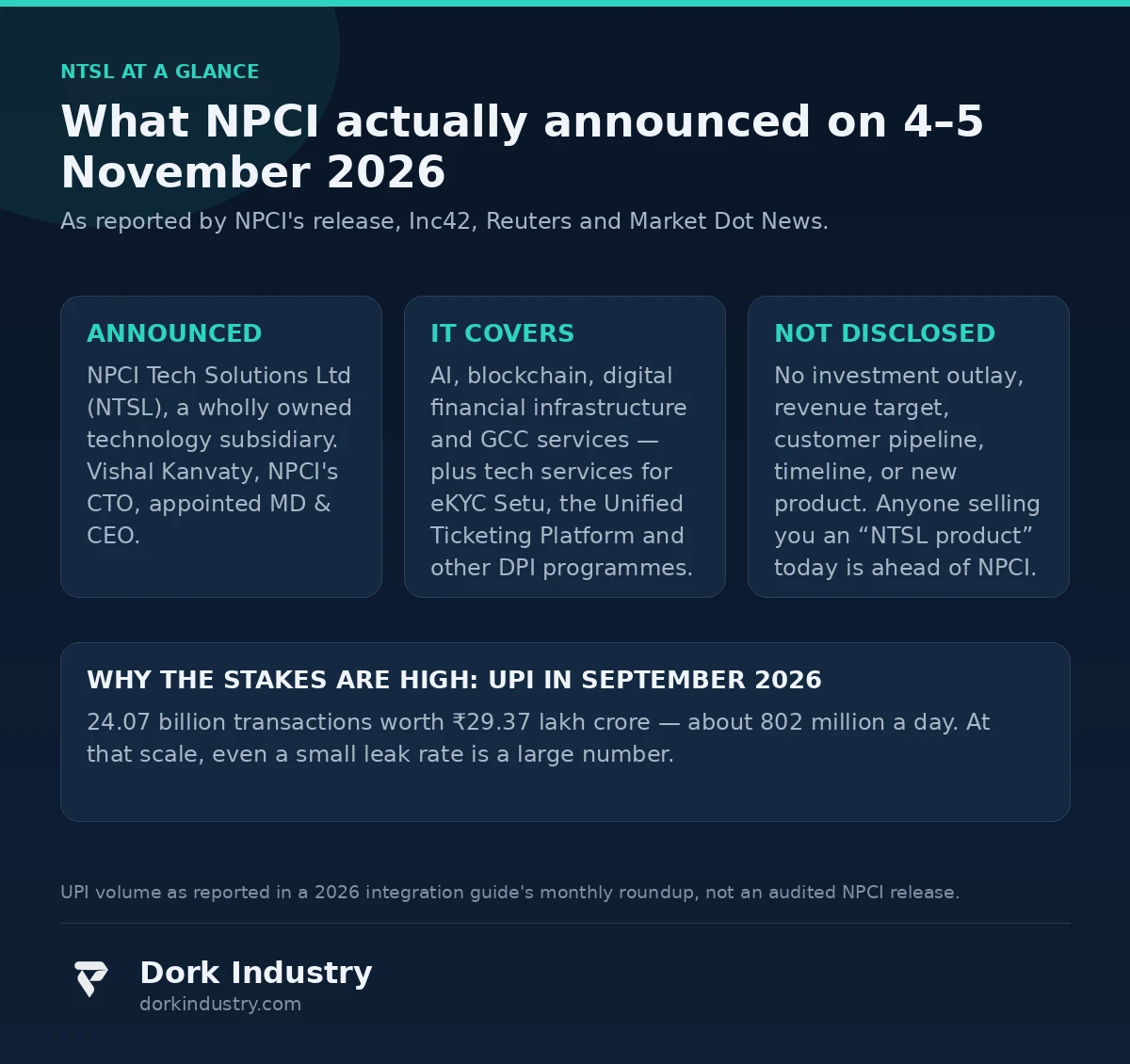
That is the opportunity behind this week’s announcement. According to Inc42, the National Payments Corporation of India (NPCI) has established NPCI Tech Solutions Ltd (NTSL), a wholly owned technology subsidiary, and appointed Vishal Kanvaty — NPCI’s chief technology officer, associated with NPCI for nearly a decade — as its managing director and chief executive officer. NTSL is NPCI’s technology and innovation arm: it will build capabilities beyond NPCI’s core payments mandate, with a focus on artificial intelligence (AI), blockchain, digital financial infrastructure, and Global Capability Centre (GCC) services, and it will provide technology services for eKYC Setu, the Unified Ticketing Platform (UTP), and other Digital Public Infrastructure (DPI) programmes. The announcement was reported on 4 November 2026, with NPCI’s own release datelined Bengaluru, 5 November 2026.
In brief: NPCI’s new company, NTSL, signals that India’s payment and identity rails are becoming a buildable platform, not just a utility you plug into once. For any Indian business that sells, lends, onboards customers, or issues tickets, the expensive problem is no longer “do we accept UPI?” — it is whether your checkout settles cleanly, your KYC completes without drop-off, and your books agree with your bank. That is a custom software development problem, and the smallest safe pilot is one payment flow and one onboarding flow, built properly, in weeks.
Why was this topic selected? This is today’s trending story, not a keyword essay: NPCI’s NTSL announcement (4–5 November 2026) is the spike, and the article translates it into the technology problem it creates for Indian businesses. The anchor keyword, custom software development, passed the playbook’s buying-intent gate on the most recent verified Planner baseline (October 2026: 1,900 searches/month, growing, LOW competition, high top-page bid) — fresh Planner verification was NOT possible today: on 5 November 2026 the Planner returned unauthenticated (Google Ads credentials not configured), so this article proceeds on the October 2026 verified baseline, flagged here. The FAQs below come from real questions in live UPI-integration guides and eKYC Setu explainers, not invented ones.
Key takeaways
- NPCI’s new wholly owned subsidiary, NPCI Tech Solutions Ltd, makes India’s payment and identity rails a buildable platform — but it disclosed no new product or timeline, so the work to do today is on the rails that already exist.
- UPI handled 24.07 billion transactions worth ₹29.37 lakh crore in September 2026, so even a small checkout leak rate is a large amount of money.
- Never trust an app callback as proof of payment: only a server-side status check counts, and webhooks must be treated as a doorbell, not a receipt.
- eKYC Setu returns demographic details with a masked Aadhaar number only — never store a full Aadhaar number in your own systems, and check eligibility first: it is for regulated entities.
- The smallest safe pilot is one checkout and one onboarding flow in four weeks, with a kill criterion, before scaling.

What is NPCI Tech Solutions Ltd?
NPCI Tech Solutions Ltd (NTSL) is the wholly owned technology subsidiary of the National Payments Corporation of India (NPCI), announced on 4 November 2026. It is NPCI’s technology and innovation arm: it builds capabilities in artificial intelligence, blockchain, digital financial infrastructure and Global Capability Centre services, and provides technology services for eKYC Setu, the Unified Ticketing Platform and other Digital Public Infrastructure programmes. Its managing director and chief executive officer is Vishal Kanvaty, NPCI’s chief technology officer.
Why now: NPCI is building a tech company, not just running payments
NPCI operates India’s retail payment and settlement infrastructure, including UPI. Until now, most businesses experienced NPCI as infrastructure in the background: your payment gateway handled it and you rarely thought about who built the rails. NTSL changes that shape. A dedicated technology subsidiary, formed after approvals from NPCI’s board and the Reserve Bank of India, exists to build new capabilities and to carry technology services for DPI programmes such as eKYC Setu and the Unified Ticketing Platform.
Two details in the announcement matter for buyers, and one honest limit matters just as much. First, NTSL’s remit explicitly includes AI: at the Global Fintech Fest in September, NPCI launched AiNxt and AtOM, platforms aimed at helping enterprises build AI agents and automate workflows across the payments ecosystem. Second, the remit includes the two DPI programmes businesses feel most directly — identity verification (eKYC Setu) and ticketing (UTP). The limit: NPCI did not disclose NTSL’s investment outlay, revenue targets, customer pipeline, or timelines for new services. So no honest article can promise you a new NTSL product on a date — what you can do today is build correctly on the rails that already exist.
The expensive problem: payments that look done but are not
India’s UPI scale is the reason this problem is expensive rather than theoretical. According to a September 2026 roundup of UPI network figures, UPI handled 24.07 billion transactions worth ₹29.37 lakh crore in September 2026 — about 802 million transactions a day. When a system moves that much money, even a small leak rate is a large number: orders marked paid that were never verified, refunds issued against payments that later failed, KYC journeys abandoned halfway, and finance teams reconciling by spreadsheet at month-end.
The leaks have specific, familiar causes. First, trusting the app instead of the server: a payment-success callback in your mobile app is a mobile event, not proof of payment — it can be delayed, lost, or spoofed, and only a server-side status check is authoritative. Second, treating the payment webhook as a receipt: webhooks are advisory and can arrive twice, so without idempotency and a status call you will double-count or miss orders. Third, the UPI handoff itself: customers leave your app to approve payment in their bank’s UPI app and return — and every integration guide warns that mishandling that return journey is where UPI integrations break. Fourth, onboarding friction: every customer who abandons a paper KYC form or a document re-upload is a sale or a loan account that never happened. Fifth, reconciliation drift: when your order system, gateway dashboard, and bank statement disagree, somebody pays in staff hours, delayed settlements, or write-offs.
None of this is a reason to avoid UPI or digital KYC. It is the reason to build the layer around them properly. The rails are free to ride; the engineering that makes them trustworthy is where the money is made or lost.
The custom software development intervention: build the layer around the rails
A correct integration has five concrete parts, and each one maps to a question real buyers actually ask.
1. Orders are created on your server, never in the app. The app never holds your provider’s secret key, and the app never decides the amount. Your backend creates the order, the checkout shows the amount your server authorised, and the order ID is what ties the whole journey together. This single rule kills an entire class of fraud in which a modified app pays less than the price.
2. Pick the right UPI flow for the journey. On Android, the intent flow opens the customer’s chosen UPI app with payment details pre-filled; the collect flow sends a request the customer approves with their UPI PIN and works across Android, iOS, and mobile web; dynamic QR suits counters and invoices; and an SDK or hosted checkout reduces development effort at the cost of some control. The right choice depends on your platform mix and your customers’ habits.
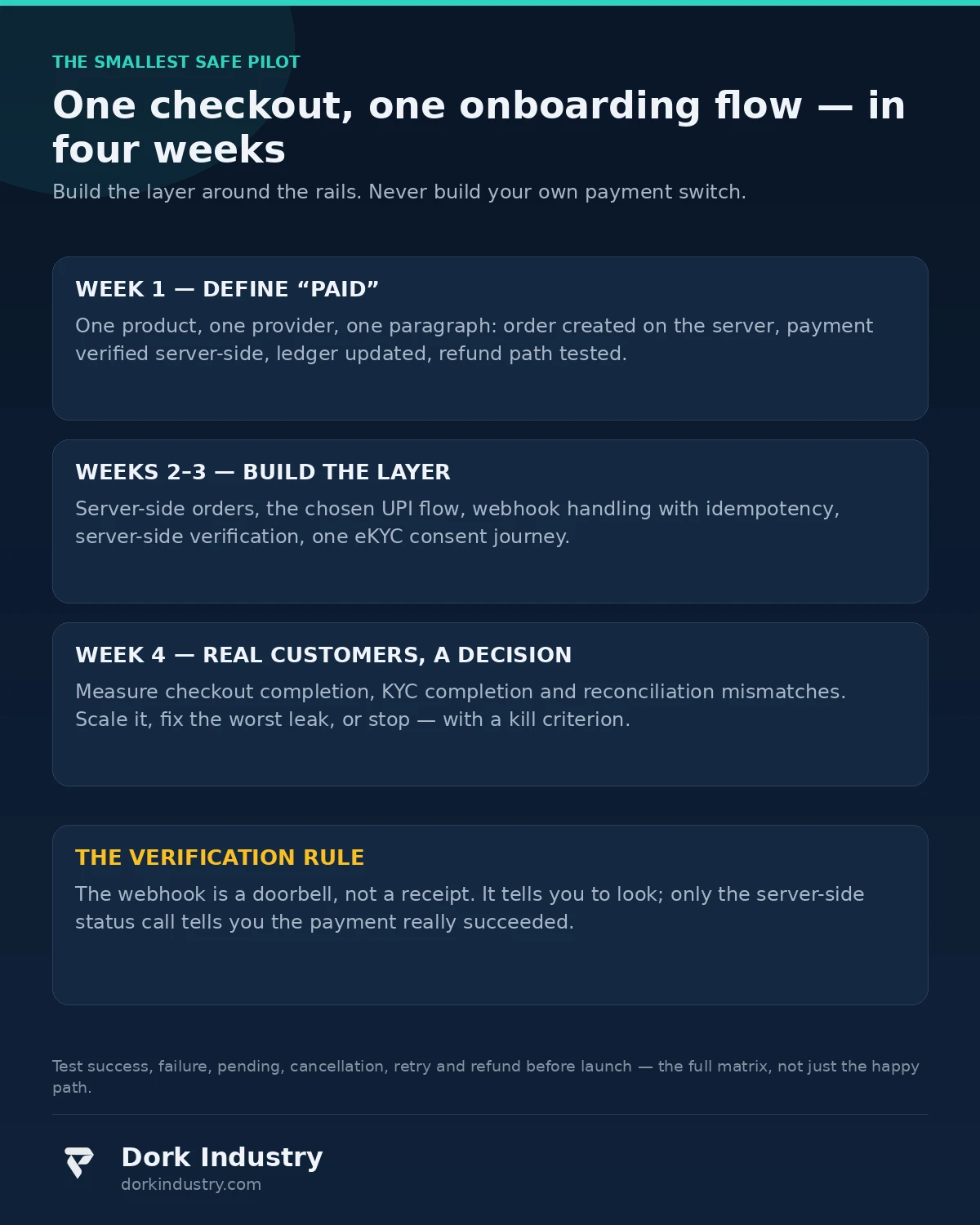
3. Verify on the server, and treat webhooks as a doorbell. When the customer returns to your app, your backend verifies the final payment status directly with the provider before marking the order successful. The webhook tells you something happened; the status call tells you what actually happened. Handle success, failure, pending, cancellation, retry, and refund as first-class states — not as afterthoughts — and test all of them before launch.
4. Make onboarding paperless, with consent and masked data only. eKYC Setu is NPCI’s Aadhaar-based KYC platform for regulated entities: the customer consents on a secure interface, provides an Aadhaar number or Virtual ID, NPCI routes authentication to UIDAI, and the entity receives demographic details with a masked Aadhaar number (last four digits only) — never the full number. Regulated entities under the RBI, SEBI, IRDAI, and PFRDA can use it, and SEBI has allowed its registered intermediaries to use it as an additional digital-KYC mechanism.
5. Keep one reconciliation ledger. Every order, payment, refund, and KYC event lands in one record with one status, so finance never triangulates between three dashboards. This unglamorous part saves the most money, because it turns “we think we were paid” into “we know we were paid.”
| What your business needs | Buy it (gateway / provider) | Build it (your software layer) |
|---|---|---|
| Moving money on UPI rails | Yes — licensed payment aggregator’s SDK and APIs | No — never build your own payment switch |
| Order creation and amount control | No | Yes — server-side orders, your prices, your rules |
| Payment verification and reconciliation | Provider gives you the status API | Yes — your ledger, idempotency, refund handling |
| Customer onboarding and eKYC | NPCI / UIDAI provide the rails | Yes — consent journey, masked-data handling, fallbacks |
| AI agents and workflow automation on top | Platforms such as NPCI’s AiNxt / AtOM direction | Yes — your workflows, your data, your guardrails |
What technology must never do alone
Four lines that must never be crossed. First, never store a full Aadhaar number in your own systems — eKYC Setu exists precisely so you receive masked data. Second, never let an app callback decide that money arrived — server-side verification is not optional. Third, never assume eligibility: eKYC Setu is for regulated entities under the financial-sector regulators, so a business outside that perimeter needs a different onboarding route, not a workaround. Fourth, never buy “blockchain” or “AI” as a label: NTSL’s announcement names capabilities, not products, and any vendor promising you an NTSL product today is selling something NPCI has not announced.
Build in-house, hire a team, or buy a product?
The honest answer is a split, and the table above is the split. Buy the regulated rails: a licensed payment aggregator’s SDK, NPCI’s KYC infrastructure, a provider’s hosted checkout where it fits. Build the layer that is yours: your order logic, your verification and reconciliation, your onboarding journey, your ticket inventory if you sell tickets. Building in-house is right only if you already have senior payments engineers and the months to spare; most Indian businesses selling, lending, or ticketing do not, and a payments bug discovered in production costs more than the build ever did.
The smallest safe pilot: one checkout, one onboarding flow
Week 1 — pick one flow and write down what “paid” means. One product or service, one payment provider, one definition of success: order created on the server, payment verified server-side, ledger updated, refund path tested. If your team cannot write that definition in one paragraph, the scope is not ready.
Weeks 2–3 — build the layer, not the rails. Server-side orders, the chosen UPI flow, webhook handling with idempotency, server-side verification, and the eKYC consent journey for one customer type. Test success, failure, pending, cancellation, retry, and refund — the full matrix, not just the happy path.
Week 4 — real customers and a decision. Measure checkout completion, KYC completion, and reconciliation mismatches, and decide: scale it, fix the worst leak, or stop. A pilot without a kill criterion becomes a permanent project — and a permanent project is how a four-week build becomes a four-month bill.
The numbers behind this article
NTSL facts (wholly owned subsidiary; Vishal Kanvaty as MD & CEO; AI, blockchain, digital financial infrastructure, and GCC services; technology services for eKYC Setu, the Unified Ticketing Platform, and other DPI programmes; board and RBI approvals) are as announced by NPCI and reported by Inc42 and other outlets on 4–5 November 2026. The absence of disclosed investment, timeline, or customer pipeline is itself reported — a limit on what can be claimed. UPI’s September 2026 volume (24.07 billion transactions, ₹29.37 lakh crore, about 802 million a day) is as reported in a 2026 UPI-integration guide’s monthly roundup, not an audited NPCI release. The Planner baseline for the anchor keyword is from October 2026 (see the pending note above) — the most recent verified baseline available to this run, not a fresh November measurement.
Frequently asked questions
How do I integrate a UPI payment gateway into my mobile app?
Choose a provider that supports UPI on your platforms, complete onboarding to get API keys and a test environment, create orders on your backend, connect the provider’s API or SDK, build a clear checkout experience, and verify payment status server-side before marking an order successful. Test success, failure, pending, cancellation, retry, and refund before going live.
Which UPI flow should my app use — intent, collect, QR, or SDK checkout?
It depends on platform and journey. Intent flow suits Android apps that can hand off to the customer’s UPI app; collect flow works across Android, iOS, and mobile web because the customer approves with a UPI PIN; dynamic QR suits counters and invoices; and an SDK or hosted checkout reduces development effort. Pick the flow your customers already use, not the one that demos best.
How do I know a payment really succeeded?
Never trust the app callback alone. Your backend must verify the final payment status directly with the provider — only a captured or authorised status from that check counts. Treat the webhook as a doorbell, not a receipt: it tells you to look, and the status call tells you the truth. Handle duplicate webhooks with idempotency so no order is counted twice.
What is eKYC Setu, and who can use it?
eKYC Setu is NPCI’s Aadhaar-based KYC platform: with the customer’s consent, NPCI routes authentication to UIDAI and returns demographic details with a masked Aadhaar number (last four digits) to the regulated entity — no physical documents, no branch visit, no full Aadhaar number stored by the business. It is available to regulated entities under the RBI, SEBI, IRDAI, and PFRDA, and SEBI has allowed its registered intermediaries to use it as an additional digital-KYC mechanism.
Does NPCI’s new company change my existing UPI integration today?
No — nothing in the NTSL announcement changes an existing integration, and NPCI disclosed no new product, timeline, or migration for existing users. What changes is the direction: AI, blockchain, and DPI services now have a dedicated company behind them, so the businesses that already have a clean, verified, well-reconciled integration will be the ones able to adopt new capabilities first. The work to do today is fixing your checkout and onboarding layer, not waiting for a product that has not been announced.
The bottom line: NPCI just told the market that India’s payment and identity rails are a technology business, not just infrastructure. The winners will not be the businesses that wait for NTSL’s first product — they will be the ones whose checkout already settles cleanly, whose onboarding already completes on a phone, and whose books already agree with their bank. Build that layer now, in one pilot, and the next wave of rails will be an upgrade, not a rebuild.
Is your checkout leaking orders or your onboarding losing customers to KYC friction?
Get a free DPI-readiness assessment: we audit one UPI checkout flow and one customer-onboarding journey — verification, reconciliation, and eKYC readiness — and hand you a fixed-scope pilot plan to fix the worst leak first.
Request a free DPI-readiness assessment WhatsApp +91 8210792477
About Dork Industry: Dork Industry builds custom web, mobile, AI and IoT systems for businesses across India. Our editors and engineers write from production experience — every assessment, pilot framework and cost breakdown here reflects how real payment, onboarding, and reconciliation systems are scoped, tested, and handed over to the teams that run them. See our IT services for the full range.
Sources
Sources: According to Inc42, NPCI formed NPCI Tech Solutions Ltd (NTSL) as a wholly owned subsidiary and appointed Vishal Kanvaty as MD & CEO, with a remit covering AI, blockchain, digital financial infrastructure, GCC services, eKYC Setu, and the Unified Ticketing Platform. According to Market Dot News, NPCI’s release is datelined Bengaluru, 5 November 2026. UPI integration flows and server-side verification guidance from PayU; September 2026 UPI volume from UroPay’s 2026 integration guide. eKYC Setu mechanics from Compliance Calendar; SEBI permission for intermediaries from Taxmann.