
AI automation can build custom approval workflows for invoices — reading each invoice, matching it to its purchase order, and routing it to the right approvers with the evidence attached. That is the direct answer. The expensive part is not the AI reading the invoice. It is the approval workflow itself: who may approve what, what happens when the approver is on leave, and the audit trail that proves every payment was authorized when the auditors arrive a year later.
Most finance teams do not have an invoice problem. They have an approval problem wearing an invoice costume. Invoices arrive by email, wait three days in a manager’s inbox, get approved on WhatsApp with a thumbs-up that leaves no record, and get paid twice because nobody marked the first payment. This article examines what AI automation can realistically do about that chain, what it must never do alone, and how to test it on one department’s invoices before committing.

Where do invoice approvals actually bleed money?
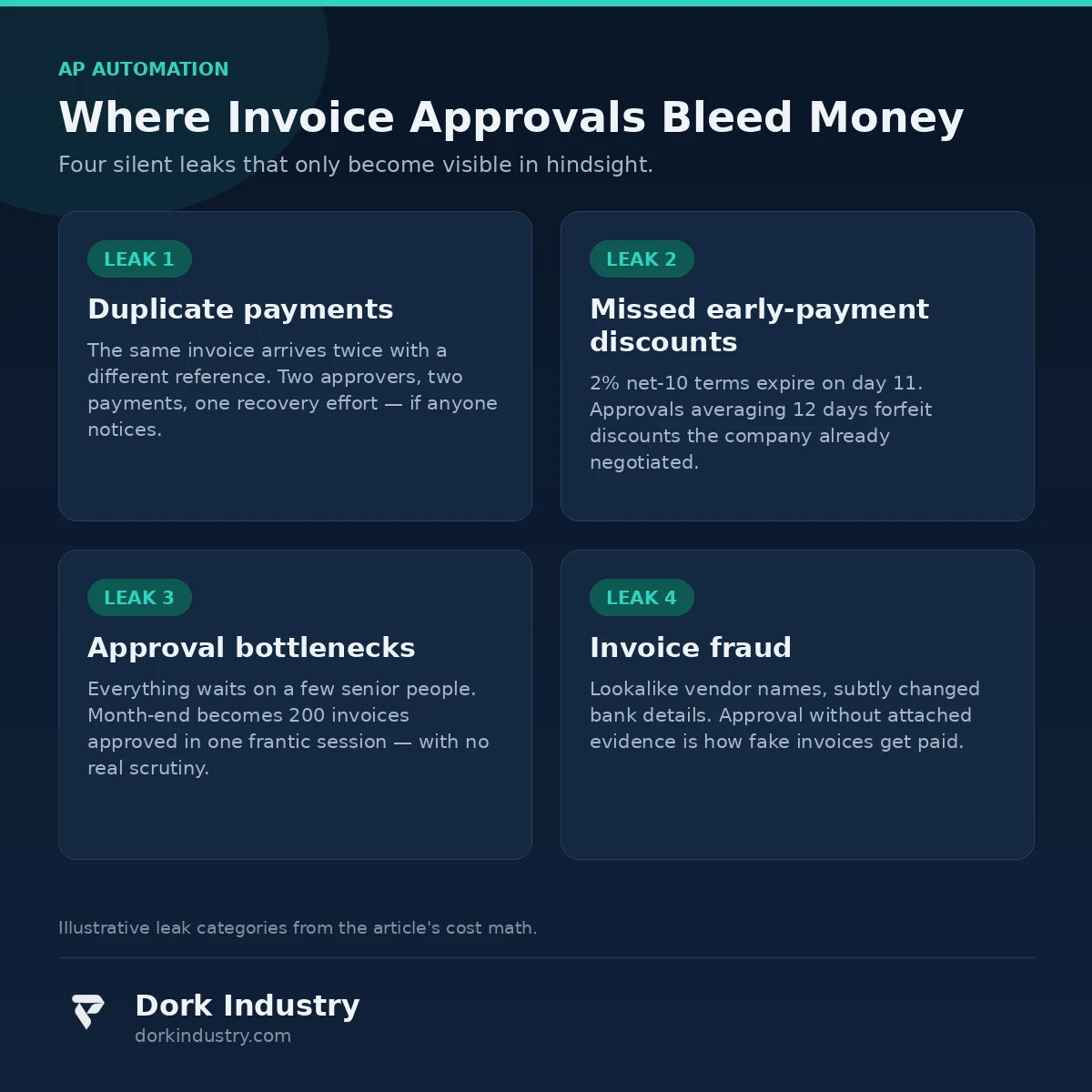
The money leaks through four channels that only become visible in hindsight.
How do duplicate payments slip through?
A vendor sends the same invoice twice — by email and by post — with a slightly different reference number. Both copies enter the queue, and two different people approve them. The double payment is found during reconciliation, if at all. Each one is small and embarrassing; together they add up to real money recovered only by accident.
What do missed early-payment discounts cost?
Many vendor contracts offer 2% off for payment within 10 days — free money that expires on day 11. An approval workflow averaging 12 days systematically converts every early-payment discount into a penalty. Finance never sees a line item called “discounts we failed to capture,” so the loss stays invisible while invoices keep aging.
Why do approvals stall at exactly the wrong moment?
Approvals concentrate around a few senior people. When the plant head is traveling or the controller is on leave, invoices wait. Month-end becomes a pile-up: 200 invoices approved in one frantic session means 200 invoices approved with almost no scrutiny. Rushed approval is worse than slow approval — it keeps the speed of delay and loses the scrutiny that justified the wait.
How does invoice fraud actually happen?
Real invoice fraud is rarely sophisticated: a fake invoice from a lookalike vendor name, a genuine invoice with the bank details subtly changed, a payment approved by someone who never checked whether goods arrived. The common thread is approval without evidence — the approver clicks approve because the email came from a known address, not because the invoice matched a purchase order. According to the IRS’s recordkeeping guidance, businesses must maintain records supporting every deduction — a WhatsApp thumbs-up is not an approval record.
Why do invoice approvals get stuck in the first place?
Five organizational habits, repeated everywhere:
- Invoices arrive through every channel at once. Email, courier, WhatsApp from the vendor’s sales rep, hand-delivered to reception. With no single intake point, there is no single queue — and an invoice nobody owns waits the longest.
- Approval rules live in people’s heads. “Anything above two lakhs goes to the director” is known to the AP clerk but written nowhere. When that clerk leaves, the rule leaves too.
- Approvers see invoices without evidence. The approver gets a PDF and is expected to know whether the goods arrived and whether the price matches the quote. They know none of this from the PDF, so they delay or approve blindly.
- Nobody deputizes. When the approver is unavailable, there is no formal delegate. The invoice waits, or the deputy approves without authority.
- Approvals have no SLA. Nothing says plant invoices must clear within 48 hours. Without a clock, every invoice is equally urgent, which means none are.
AI automation over these habits without fixing ownership produces a faster mess — invoices flowing quickly through rules nobody wrote, approved by people who never saw the evidence.
What data does your business already have — and what is it missing?
Most companies already hold the raw material: a vendor master list, PO records in the ERP, the email history of who approved what, bank statements showing payment dates, and years of past invoices that — once digitized — are labeled training data for how the company handles exceptions.
What is missing is structure. Line items live inside PDFs instead of fields. Approvals live in email threads instead of a log. Delegations are verbal. The vendor master has three entries for the same supplier with two different bank accounts.
An AI approval system needs permission to connect the data that already exists — purchase orders, goods receipts, vendor records, approval history — and a human who signs off on exceptions, because an exception is a judgment about risk, not a pattern to classify.
What can AI automation actually do with invoice approvals?
Strip away the marketing language and invoice-approval AI automation does five concrete jobs.
Can it read any invoice, in any format?
Yes — this is the solved part. Modern extraction reads line items, totals, tax, vendor details, and payment terms from PDFs, scans, and photos. According to Google Cloud’s Vision API documentation, OCR extracts structured text from invoices and receipts as a standard capability. The remaining work is normalizing: mapping each vendor’s creative column names onto your chart of accounts.
Can it match invoices to purchase orders automatically?
This is the highest-value job. Two-way matching compares the invoice against the purchase order; three-way matching adds the goods receipt — did we order it, did it arrive, does the price match. Exact matches post straight to the ERP. Mismatches — a price above the PO, a short quantity — route to a human with all three documents side by side and the discrepancy highlighted. Judgment about tolerance stays human; assembling the evidence becomes instant.
Can it build genuinely custom approval workflows?
Yes, and this is where off-the-shelf tools fall short. Real rules look like this: plant invoices above ₹50,000 need the plant head plus finance; new vendors need procurement sign-off for the first three invoices; matched-PO invoices below ₹25,000 auto-approve; anything on the director’s cost center escalates to the director regardless of amount. A custom workflow encodes these company-specific rules as executable policy.
Can it chase approvers and escalate?
The unglamorous job that pays for everything else. The system reminds the approver at 24 hours, nudges at 48, and escalates to the delegate at 72 — with the evidence attached, and rerouting automatically when someone is on leave. SLA compliance stops depending on the AP clerk’s memory and politeness.
Can it keep the audit trail the auditors actually want?
Every invoice carries its full history: extracted data, PO match result, every approver, every delegation, every exception, every timestamp. When the auditor asks “who approved this payment and on what basis,” the answer is one screen.
What does the math look like?
Consider a company processing 800 vendor invoices a month, averaging ₹45,000 each. These are illustrative assumptions, not benchmarks.
Start with labor: manual processing — data entry, chasing approvals, answering “where is my payment” emails — runs about 8 minutes per invoice, roughly 107 staff hours a month: two-thirds of a full-time AP clerk spent on coordination rather than judgment.
Now the leaks. Assume duplicates hit 0.2% of invoices — two a month at this volume: ₹90,000 paid twice, recovered only if someone notices. Early-payment discounts: if 2% net-10 terms apply to even a quarter of spend and average approval takes 12 days, the company forfeits about ₹1.8 lakh a month in discounts it already negotiated.
The honest framing: invoice automation is not a headcount project. It is a leakage project — captured discounts, eliminated duplicates, approvals measured in hours instead of weeks.
Should you build or buy?
The honest options, in order of investment:
| Approach | Best for | Relative investment | Where it breaks |
|---|---|---|---|
| Accounting software’s built-in approvals | Under ~200 invoices/month, one entity, simple rules | Included in your subscription | Rules stay simple; no matching depth, no custom escalation logic |
| Dedicated AP automation tools | Standard approval needs, common ERPs, multi-entity | Per-invoice or per-seat subscription | Your rules bend to fit their model; exceptions get awkward |
| RPA + your existing ERP | High volume, standard formats, rigid processes | Moderate build, ongoing maintenance | Brittle against format changes; approval logic still lives in email |
| Custom AI automation | Complex hierarchies, messy vendor formats, strict audit needs | Highest | Overkill below ~500 invoices/month or when standard tools fit |
A good rule: if your approval rules fit on one page and your invoice formats are standard, turn on your accounting platform’s native approval module first and use it for a quarter. Custom AI automation earns its cost when the rules are genuinely custom — plant-specific thresholds, delegate chains, vendor-risk tiers — or when the mess is structural: dozens of formats, multiple entities, and an audit function that asks hard questions.
What must AI automation never do with invoices alone?
A wrong automated payment is money gone — the boundaries matter as much as the capabilities.
- Never auto-approve above a threshold without a named human. Auto-approval is safe for matched POs under a written limit. Above it, the system assembles the evidence and a named person signs — the signature is the control.
- Never change vendor bank details on AI say-so. A “please update our account details” email is the oldest fraud in the book. Bank detail changes always require an independent human callback to a known number. No exceptions.
- Never pay a no-PO, no-receipt invoice without human review. Non-PO spend — consultants, utilities, one-off services — is where fraud hides. The system can prepare the case; a human approves the exception.
- Never silently skip an approver. If a delegate approves, the record must show the delegation: who delegated, to whom, for what period, and why. An approval without a visible chain of authority fails audit.
- AI proposes; humans decide on first-time vendors. A new vendor with a large first invoice is a trust decision, not a pattern-matching exercise. The system can verify the registration and flag the risk — the business decides.
How do you test it in 30 days before full investment?
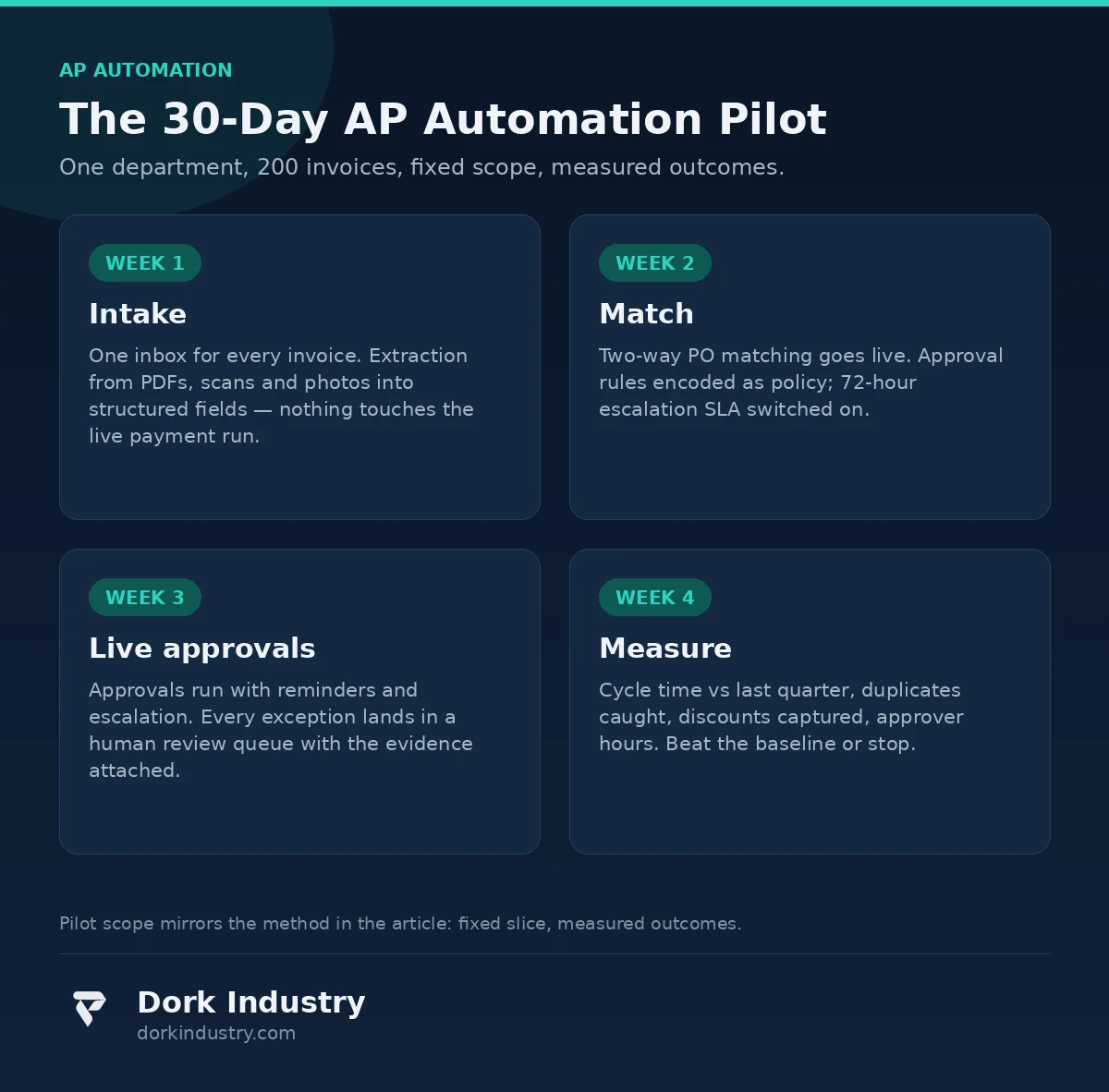
One department, 200 invoices, fixed scope, measured outcomes:
- One department or vendor category — messy enough to be real, small enough to review by hand
- All invoices route through a single intake inbox (nothing touches the live payment run)
- Extraction plus two-way PO matching; every exception lands in a human review queue with evidence attached
- Approval rules encoded and enforced; escalations run on a 72-hour SLA
- Run for 30 days
- Measure: approval cycle time vs the previous quarter, duplicate catches, discounts captured, approver hours per week
If the pilot department does not beat its own baseline, a bigger investment will not fix payables either. The pilot validates the workflow and the ownership model, not just the software. This mirrors our guide on how to test AI document automation before buying: fixed slice, measured outcomes, human approval gates.
What actually drives the cost of invoice automation?
- Invoice volume and format chaos: 200 clean e-invoices vs 5,000 mixed PDFs, scans, and photos from 300 vendors are different projects
- Approval-graph complexity: three approvers vs five entities with plant-specific thresholds and delegate chains
- ERP integration reality: modern APIs vs an accounting system that imports CSV once a day
- Exception rate: the 80% that match cleanly are cheap; the 20% of exceptions are where the engineering goes
- Audit depth: a basic approval log vs a tamper-evident trail with segregation-of-duties enforcement
- Continuous vs one-time: a pilot has an end; a live system with new vendors and rule changes needs ongoing operation
Anyone quoting a fixed price without asking about invoice formats, the real approval graph, and who handles exceptions is guessing.
Frequently asked questions
How do you create custom approval workflows for invoices?
Start by mapping who actually approves what today — thresholds, departments, delegates — because undocumented rules are why workflows fail. Then encode the map as executable policy: amount thresholds route to named approvers, vendor tiers add checks, unmatched invoices and new vendors go to human review with evidence attached, and every step carries a time SLA with automatic escalation. The workflow is company policy, in a form the system can enforce.
Can AI automation match invoices to purchase orders automatically?
Yes, for the clean cases. When the invoice, PO, and goods receipt agree within written tolerances, the match posts straight to the ERP. Variances — price differences, short quantities, missing receipts — route to a human with the documents and the discrepancy highlighted. Full auto-matching without tolerance limits is how errors compound; the tolerances are the control.
What is the biggest risk of automating invoice approvals?
Automating the wrong rules faster. If the approval graph was broken — verbal delegations, no SLAs, approvers signing without evidence — automation executes that broken graph at machine speed. Map and repair the rules during the pilot, before the system enforces them. And remember bank-detail fraud: vendor bank changes must always require an independent human callback, never automated acceptance.
How long does an invoice automation pilot take?
A 30-day pilot covers one department end to end: one week for intake and extraction, one for matching and rule encoding, two for live approvals with human review of every exception. Allow one more month to measure discounts captured and cycle-time improvement. Realistic full rollout is 2–4 months after a successful pilot.
Do we need to change our accounting software?
Usually not. The workflow sits in front of the ERP: invoices are extracted, matched, approved, and posted through existing APIs. What changes is the process around it — one intake channel, written rules, named delegates, measured SLAs. If your accounting software’s native approval module already handles your volume, use it first and automate around the gaps.
The bottom line
The question is not whether AI automation can read invoices and route approvals. It can — extraction, PO matching, and rule-based routing are solved problems with known guardrails. The question is whether the company will give the project what it needs: a written approval graph with named owners and delegates, time SLAs with escalation, and 30 days on one department’s invoices with measured outcomes.
Free AP Automation Assessment
We map your real invoice approval graph — who approves what, where invoices stall, which discounts you are forfeiting — and show you exactly which department to pilot first, with the rules and SLAs your team can actually run. You walk away with a measured automation plan and an honest verdict on whether custom AI automation earns its cost for your payables, before any development is discussed.
Request your free AP automation assessment WhatsApp +91 8210792477
About Dork Industry
Dork Industry (dorkindustry.com) is a custom software development company building AI automation, mobile apps, and IoT systems for businesses across India — from 30-day pilots to full production rollouts.