
AI development can now transcribe and score every support call your team handles — not the 2–4% your reviewers have time for, but all of them — and it costs less than one more QA hire. The direct answer: a production AI quality pipeline converts call audio into a speaker-separated transcript, evaluates it against your QA rubric (greeting, empathy, ownership, resolution, compliance disclosures), and routes only the flagged, low-confidence, or high-risk calls to human reviewers — typically 10–20% of volume. Your reviewers stop spending their week on random sampling and start spending it on coaching, calibration, and the calls that actually decide customer loyalty. Human reviewers keep the final say on coaching notes, disciplinary decisions, and every compliance-critical call.

Why do quality teams still listen to only a handful of calls?
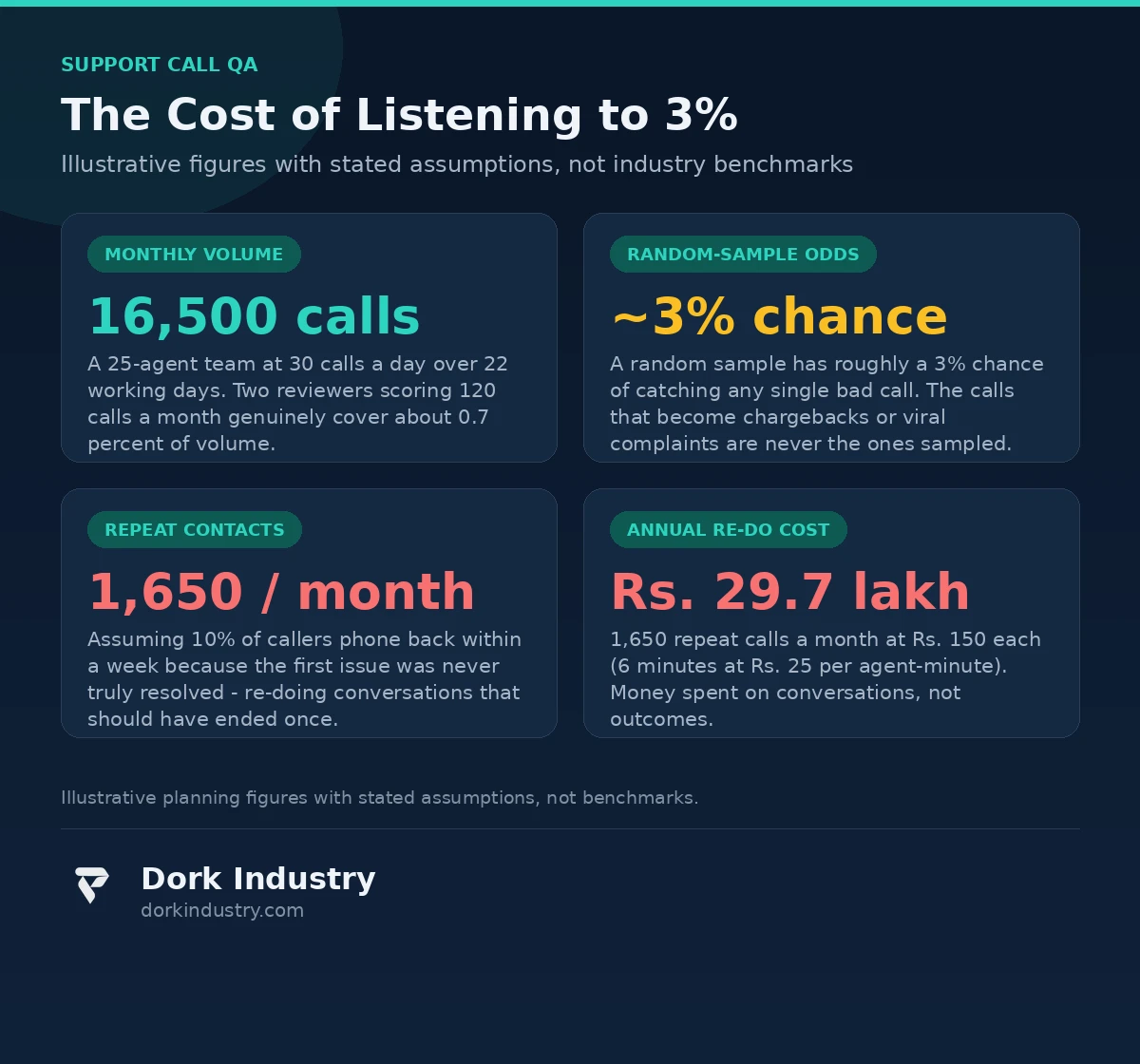
The expensive failure is not that QA teams are lazy — it is that the math of manual review has never worked. A reviewer scoring a six-minute call, writing notes, and filing the scorecard spends roughly fifteen minutes per call. Two reviewers working full-time on scoring can genuinely cover perhaps 120 calls a month. A 25-agent team takes 16,500 calls in that same month. Your QA coverage is not a program; it is a rounding error.
Why is manual call scoring so slow?
Because scoring is not listening — it is listening, pausing, re-listening, matching behavior to a rubric, and defending the score in calibration meetings. Every minute of audio costs two to three minutes of reviewer time. The backlog grows with every hiring wave, and “we’ll catch up next quarter” is how unreviewed quarters become unreviewed years.
Why do two reviewers score the same call differently?
Human reviewers calibrate poorly at scale. The same call gets a 4 from one reviewer and a 2.5 from another depending on mood, fatigue, and which agent they have already decided is a problem. Agents learn this quickly, and the scorecard’s authority collapses: “that’s just your opinion” becomes the default defense in every coaching conversation.
Why does random sampling miss the calls that matter?
Random samples are designed for averages, but customer damage concentrates in outliers — the mishandled refund, the skipped disclosure, the agent who was polite for 89 calls and contemptuous for one. A 3% sample has roughly a 3% chance of catching any single bad call. The calls that end up as chargebacks, regulatory complaints, or viral complaints are almost never the ones that got sampled.
What does unreviewed call quality actually cost?
Consider an illustrative 25-agent support team. These are illustrative figures with stated assumptions, not industry benchmarks: assume 30 calls per agent per day over 22 working days, a fully-loaded agent cost of ₹25 per minute, a 6-minute average handle time, and that 10% of callers contact you again within a week because their first issue was not truly resolved — the unmeasured, repeat-contact kind of failure.
Monthly call volume: 25 × 30 × 22 = 16,500 calls. Repeat contacts at 10% = 1,650 repeat calls. Each repeat costs 6 minutes × ₹25 = ₹150. Monthly cost of unreviewed quality gaps: 1,650 × ₹150 = ₹2,47,500 — roughly ₹29.7 lakh per year, spent entirely on re-doing conversations that should have ended the first time.
The second cost is invisible: churn you never attribute. A customer who gets a dismissive agent does not file a complaint about the agent — they quietly renew with your competitor. According to the Azure AI Speech documentation, modern speech services support transcription with speaker diarization — identifying who said what — on both live and prerecorded call audio, which is the raw material that makes systematic quality measurement possible for the first time at this scale. The question is no longer whether every call can be reviewed; it is whether you can afford not to.
What data does your support operation already generate?
Most teams are sitting on everything the AI needs: call recordings from the telephony or contact-center platform, CRM tickets linked to callers, IVR paths, hold and transfer events, CSAT responses (biased, but useful as a weak signal), and agent tenure and training history. The expensive failure here is fragmentation — recordings in the telephony system, outcomes in the CRM, scores in a spreadsheet — so the pilot’s first job is stitching call identity to outcome, not buying new data capture.

What does AI development actually build to score calls?
An AI quality pipeline is unglamorous plumbing with one glamorous result: a score for every call, with the evidence linked to the exact transcript line. The pipeline has four stages, each boring and each essential.
How does audio become a score?
Stage one is transcription: the call audio is converted to text with speaker diarization — separating the agent’s turns from the customer’s — plus timestamps and confidence scores. Stage two structures the transcript: greeting detection, hold segments, silence gaps, talk-over ratios, and the resolution summary. Stage three applies your rubric: a set of scored questions (“Did the agent state their name and the company within 20 seconds?”) answered by a language model against transcript evidence, each with a quoted excerpt. Stage four routes: calls above the auto-score threshold file themselves; low-confidence or high-risk calls land in a human review queue with the evidence pre-highlighted.
| Manual QA sampling | AI development scoring | |
|---|---|---|
| Coverage | 2–4% of calls (reviewer-bound) | 100% of calls, every day |
| Turnaround | Days to weeks after the call | Minutes after hang-up |
| Consistency | Reviewer disagreement of 20–40% | Deterministic rubric, calibrated once |
| Catches outliers | Almost never (random sample) | Flag rules catch every instance |
| Coaching material | Anecdotes from samples | Every agent’s real distribution |
| Marginal cost per extra call | ~15 reviewer-minutes | Seconds of compute |
What does the rubric look like in practice?
A production rubric is your existing QA scorecard, digitized — not invented by the AI. Typical scored dimensions: greeting and identity (did the agent identify themselves and the company?), empathy markers (acknowledged the customer’s emotion before troubleshooting?), ownership language (no “that’s not my department” without a warm transfer), resolution completeness (was the stated issue actually addressed, per the customer’s own words?), compliance disclosures (required statements delivered verbatim where regulations demand them), and wrap etiquette (hold announcements, summaries, next steps). According to Google Cloud’s Conversational Insights documentation, Quality AI provides scorecards with questions to evaluate agent performance and can perform automatic evaluations that human evaluators edit, appeal, and share — the human-in-the-loop pattern is built into the reference architecture, not bolted on afterward.
What must the AI never decide alone?
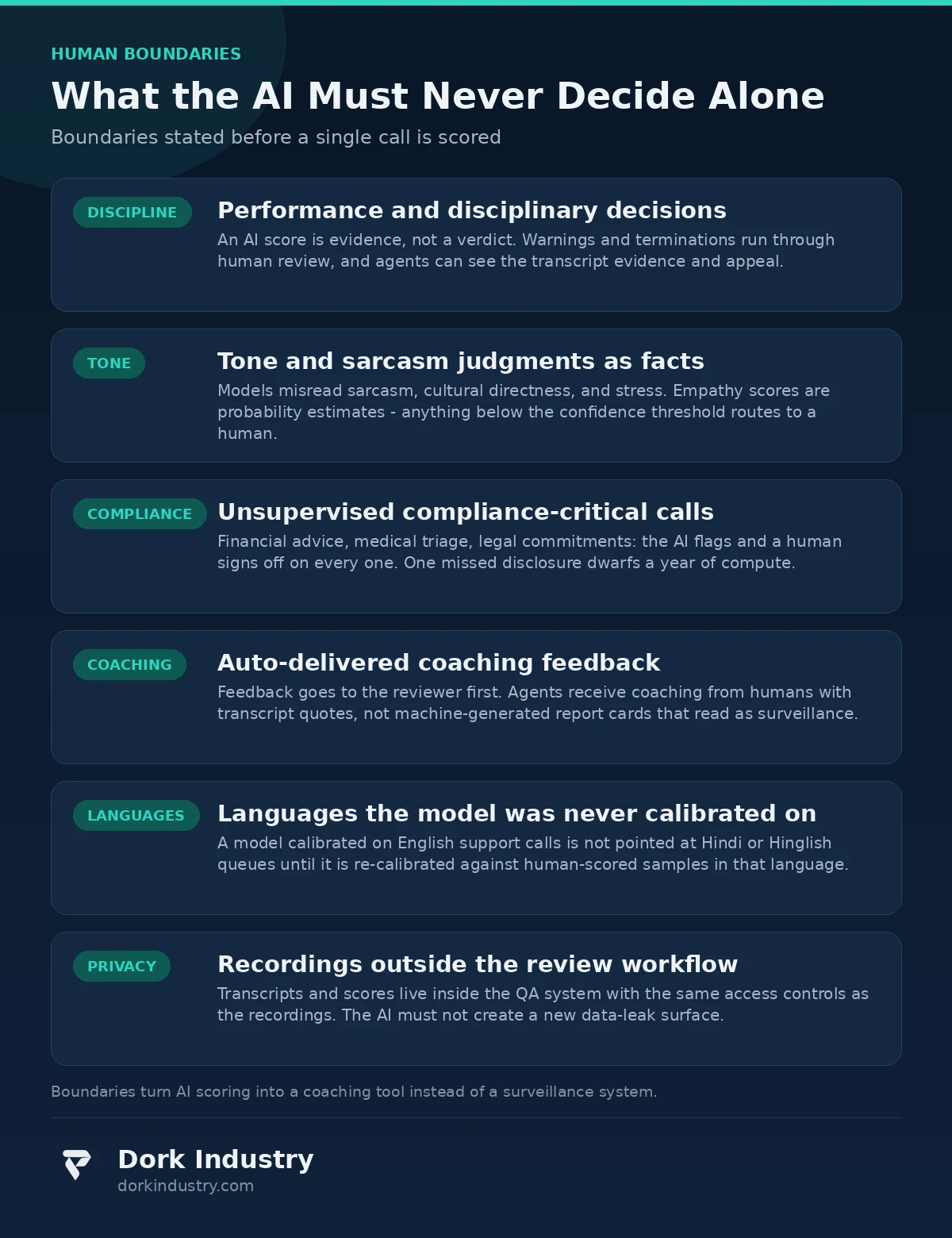
This is where AI quality programs die or survive — the boundaries, stated before a single call is scored:
- Never performance or disciplinary decisions. An AI score is evidence, not a verdict. PIPs, warnings, and terminations run through human review, with the agent able to see the transcript evidence and appeal — exactly the appeal workflow the reference platforms ship with.
- Never tone or sarcasm judgments as facts. Models misread sarcasm, cultural directness, and stress. “Empathy” scores are probability estimates with confidence intervals, and any score below the confidence threshold routes to a human instead of filing itself.
- Never unsupervised compliance calls. On calls with regulatory weight — financial advice, medical triage, legal commitments — the AI flags and a human signs off. Every single one. The cost of one missed disclosure dwarfs a year of compute.
- Never auto-delivered coaching. Feedback goes to the reviewer first. Agents receive coaching from humans, with transcript quotes, not machine-generated report cards that read as surveillance.
- Never scoring in languages or accents the model was not calibrated on. A model calibrated on English support calls does not get pointed at Hindi or Hinglish queues until it has been re-calibrated against human-scored samples in that language.
- Never recordings outside the review workflow. Transcripts and scores live inside the QA system with the same access controls as the recordings — the AI does not create a new data leak surface.
Should you build custom, buy a package, or do nothing?
Honest answer: most teams under 20 agents should buy, most teams with regulatory or multilingual complexity should build, and some teams should do nothing yet.
| Buy a package | Build custom | Do nothing yet | |
|---|---|---|---|
| Call volume | Under ~20k calls/month | Over ~50k calls/month (unit economics flip) | Under ~5 agents |
| Languages | Primarily English | Hindi/Hinglish/regional mix, domain jargon | Single language, small team |
| Rubric | Standard CSAT/quality scorecards | Rubric tied to your CRM outcomes and compliance regime | Founders still listen to calls themselves |
| Data residency | Comfortable with vendor cloud | On-prem or in-country processing required | — |
| Time to value | Weeks | 2–3 months including calibration | — |
| When it fails | Vendor rubric cannot express your compliance rules | Team skips calibration and trusts raw scores | Churn stays low and you verify it |
Buy when you want value in weeks and your rubric is standard. Build when your compliance rules, languages, or integrations make the vendor’s rubric a straitjacket. Do nothing when the team is small enough that the founders still listen — but re-check that claim every quarter, because it has a way of becoming folklore.
What does a 30-day pilot look like?
Week 1 — collect and baseline. Pull 500 recent calls with linked CRM outcomes. Two of your reviewers score them independently; the disagreement rate between your own reviewers becomes the bar the AI has to beat (it usually can).
Week 2 — calibrate. Run the pipeline over the 500 calls and measure AI-vs-human agreement per rubric dimension. Tune the rubric wording, not the model — most mismatches are ambiguous scorecard language, and fixing them improves your human QA too. Target: agreement at or above your reviewers’ own agreement rate.
Week 3 — shadow mode. Score every new call, but change nothing in operations. Reviewers work the AI’s flagged queue instead of random samples. Measure: what fraction of flags were worth a human’s time, and what the random sample would have missed.
Week 4 — first intervention. Pick the single highest-volume failure pattern the data revealed (skipped disclosures, missing ownership language, premature transfers) and run one week of targeted coaching. Compare repeat-contact rates for coached agents against the baseline. The pilot’s decision criterion is measured repeat-contact reduction, not dashboard beauty.
What drives the cost?
Transcription is the dominant line item — per-minute speech-to-text pricing scales linearly with call volume, which is why the build-vs-buy table pivots at ~50k calls/month (self-hosted open models like faster-whisper flip the economics for high volumes, at the cost of you operating the infrastructure). Next is calibration labor: two to four weeks of reviewer time to build the ground-truth set, which you would be paying for in manual QA anyway. Integration is the wild card — stitching telephony recordings to CRM outcomes ranges from an afternoon (modern CCaaS with webhooks) to weeks (on-prem PBX with FTP dumps). Skip real-time scoring in the pilot; batch scoring after hang-up captures 95% of the value at a fraction of the complexity. If you need live agent assist later, that is a separate project with separate math.
Frequently asked questions
Can AI scoring work if our calls are in Hindi, Hinglish, or other regional languages?
Yes, but each language needs its own calibration. Multilingual speech models handle Hindi and Hinglish well, but rubric phrases like “empathy markers” behave differently across languages. Budget a 200-call human-scored calibration set per language before trusting auto-scores — running an English-calibrated model on regional-language calls is exactly how programs lose agent trust.
Will agents see this as surveillance and push back?
They will if scores arrive as unexplained numbers. The programs that survive frame scoring as coaching evidence: agents see the transcript excerpts behind every score, can appeal any assessment to a human reviewer, and team-level trends are shared before individual scores are used in reviews. Start with coaching-only use for 90 days; attach scores to performance processes only after agents trust the evidence.
How accurate is AI scoring compared to human reviewers?
On well-defined rubric dimensions (greeting, disclosures, hold etiquette), calibrated AI typically matches or exceeds human inter-reviewer agreement. On judgment-heavy dimensions (empathy, resolution quality), it is a triage tool, not a judge — those calls route to humans with the evidence pre-highlighted. Measure agreement per dimension during calibration; publish the numbers to your reviewers so trust is earned, not demanded.
What happens with noisy audio, overlapping speech, or heavy accents?
Transcription confidence drops, and the pipeline is designed for that: low-confidence segments are excluded from scoring, and calls below a confidence threshold route to human review automatically. Diarization struggles when agent and customer talk over each other — which, conveniently, is itself a scorable quality signal (talk-over ratio).
Do we need to replace our telephony system to do this?
No. The pipeline works from call recordings plus a call-to-outcome mapping, which every contact-center platform already produces. If your platform has webhooks or an API, scoring runs minutes after hang-up; if it exports recordings on a schedule, batch scoring runs nightly. Telephony replacement is never part of a call-quality pilot.
About Dork Industry
Dork Industry (dorkindustry.com) is a custom software development company building AI development, AI automation, mobile apps, and IoT systems for businesses across India. Our team designs call-quality and conversation-analytics systems — transcription pipelines, QA rubric automation, and human-in-the-loop review workflows for support operations — from 30-day pilots to full multi-site rollouts.
The bottom line
The question is not whether AI development can score calls — transcription plus rubric scoring is settled engineering. The question is whether your operation will do the unglamorous work that makes the scores trustworthy: calibrating the rubric against your own reviewers, routing low-confidence calls to humans, keeping disciplinary decisions human, and running the 30-day pilot against measured repeat-contact reduction instead of dashboard screenshots. Do that, and every call gets reviewed for the price of the 3% you review today.
Get a free support call-quality AI scoring assessment
We map your call recordings, CRM outcomes, and current QA rubric against what AI scoring would catch — and where human review must stay. You walk away with a coverage-gap estimate, a calibration plan for your languages, and a 30-day pilot scope, with no commitment to build.
Request your free call-quality AI scoring assessment WhatsApp +91 8210792477