Yes — ecommerce development can give festive sellers their margins back. It works by fixing the two leaks that eat festive profit: dependence on rented marketplace traffic, and inventory placed on yesterday’s demand. This festive season proves it: online sales are surging while marketplace shipments are falling, so the sellers winning are not the ones with the most traffic — they are the ones keeping the most of every order.
In brief
- Festive online sales: $15–16 billion forecast, up about 25% year-on-year (Redseer, October 2026).
- Early marketplace shipments: down 10–12% year-on-year for Amazon and Flipkart as premium gadget prices rose 30–40%.
- Where growth moved: grocery up 48–50%, beauty and personal care up 35–40%, mobiles up only 5–7%.
- The fix: ecommerce development — an owned direct-to-consumer channel plus one inventory ledger across channels — protects contribution margin per order.
What just happened this festive season?
According to Redseer Strategy Consultants, India’s online retail market is set to cross $90 billion in 2026, and the 30–35 days leading up to Diwali were forecast to generate $15–16 billion in online sales — up about 25% year-on-year, the strongest festive growth in five years. Grocery was forecast to grow 48–50%, beauty and personal care 35–40%, and home and furniture 32–35%, while mobiles were forecast to grow only 5–7%. Mobiles and electronics together were expected to fall below half of festive gross merchandise value, from 51% to 46%.
But the same season delivered a contradiction. According to industry reporting on early festive dispatches, Amazon and Flipkart shipments fell 10–12% year-on-year in the first days of the festive sales, as premium electronics prices rose 30–40% and discounts thinned. Datum Intelligence estimated gross merchandise value of ₹29,800–30,900 crore from October 7 to October 10, 2026, against ₹33,200 crore in the same period last year. Sales are up for the season; early shipments are down. That split is the story — and the opportunity.

Why are shipments falling while sales are rising?
Three forces explain the gap. First, the demand mix moved. The growth is in grocery, beauty and home categories — steady, everyday purchases — while the premium electronics that used to anchor festive shipments got expensive and stayed on shelves. Second, some electronics demand was “pre-loaded”: buyers advanced purchases earlier in the year after the GST cut on large appliances and ahead of expected component price rises, so the festive window itself had less left to sell. Third, discounts are thinner because input and product costs rose, which means the same traffic converts into fewer shipped premium orders.
For a seller, that combination is worse than a slow season. Traffic still costs money — marketplace ads, listing optimisation, sale-event participation — but it lands on categories and price points where margins are thinner and returns are higher. A seller can report “record festive traffic” and still close the season with less profit than last year.
Where does a seller’s festive margin actually go?
Most sellers track revenue and ad spend. Few track contribution margin per order — what is left after product cost, marketplace commission, advertising, logistics and returns on a single shipped order. That is the number that decides whether the festive season made money, and it is the number most sellers discover too late.
Illustrative example — assumptions stated, not market data. Take a seller doing ₹1 crore of festive gross merchandise value. Assume product cost at 55% of GMV. On a marketplace-heavy path, assume commission at 15%, advertising at 10%, logistics and fulfilment at 8%, and returns and refunds cost at 5%. Total costs reach ₹93 lakh, leaving ₹7 lakh — a 7% margin — before salaries, rent and software costs. On an owned-channel path at the same ₹1 crore GMV and the same 55% product cost, assume payment gateway at 2%, logistics at 8%, own advertising at 8%, returns at 3% and platform costs at 1%. Total costs reach ₹77 lakh, leaving ₹23 lakh — a 23% margin. The rates are illustrative and vary by category and marketplace; the structural point is not: commission on every order, rented traffic, and higher return rates are a permanent tax on the marketplace-only seller, while the owned channel keeps the customer, the data and the repeat order.
What does ecommerce development actually build for a seller?
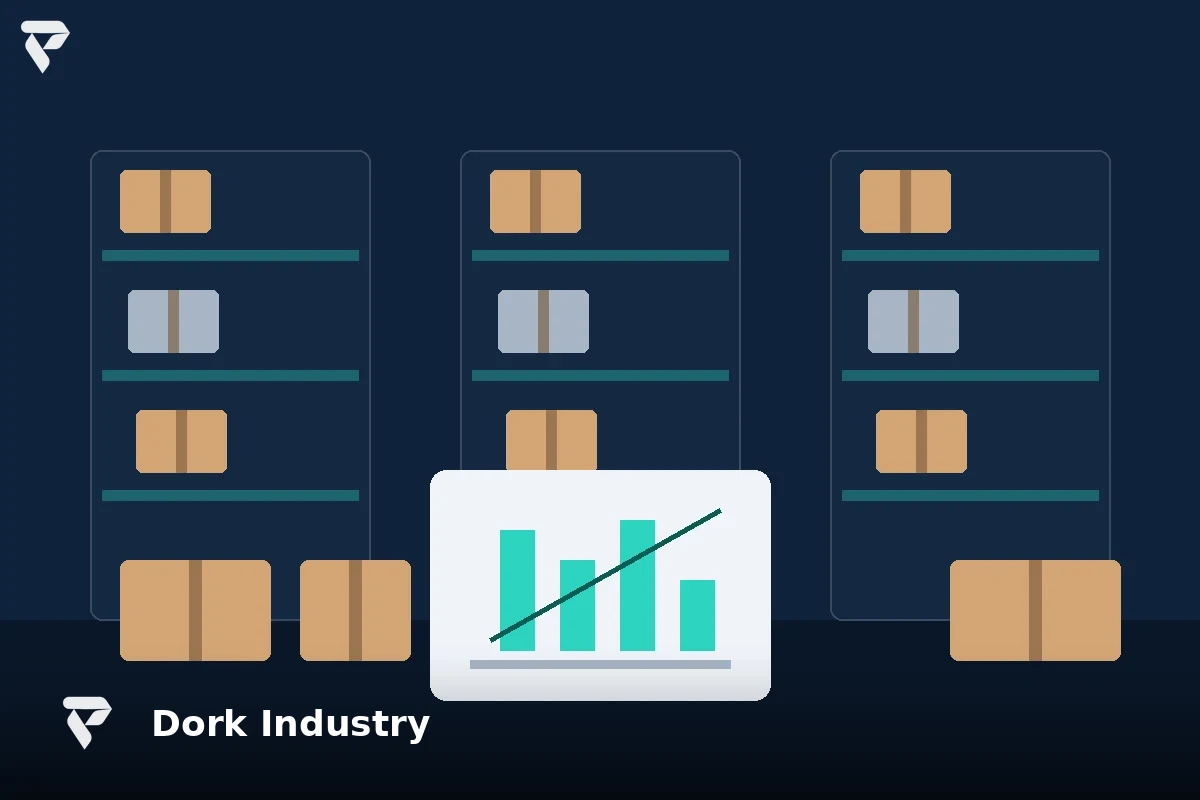
Ecommerce development for a festive seller is not a prettier website. It is four systems working together. First, an owned direct-to-consumer storefront — on Shopify, WooCommerce or a custom build — where there is no marketplace commission, the seller owns the customer list, and repeat purchases cost a fraction of first-order acquisition. Second, a single inventory truth across every channel: one stock ledger feeding Amazon, Flipkart, the seller’s own store and offline billing, so a Diwali bestseller never oversells on one channel while sitting unsold on another. Third, demand forecasting that reads the category shift — grocery and everyday categories surging, premium electronics cooling — and moves purchase and advertising budgets with it instead of repeating last year’s plan. Fourth, GST-ready invoicing and returns analytics, so input tax credit is claimed cleanly and the products and pin codes driving returns are visible before they eat the next quarter.
What should technology never decide on its own?
Automation earns its place in festive selling, but four decisions must keep a human in the loop. Technology must never reprice products below a margin floor on its own — an automated price war during a sale event can clear stock at a loss faster than any manager can react. It must never auto-accept returns or refunds beyond policy, because festive return fraud and wardrobing concentrate exactly when teams are busiest. It must never auto-reorder stock on a forecast spike without sign-off, because a wrong forecast becomes dead stock in January. And it must never sync prices blindly across channels, because a marketplace promotion can accidentally undercut the seller’s own store and train customers to wait for the discount. The system proposes, flags and executes within limits; the seller approves anything that touches margin, refunds or purchase orders.
Should you build custom, or start with Shopify?
Honest answer: most sellers should start with a proven platform. A Shopify store launches in weeks, covers payments, GST invoicing, shipping and discounting out of the box, and handles festive traffic spikes without a dedicated infrastructure team. WooCommerce suits content-heavy brands and sellers already on WordPress. A custom build earns its cost when the business outgrows platforms: multiple warehouses with location-wise stock, combined business-to-business and direct-to-consumer pricing, ERP or Tally synchronisation, or subscription and marketplace-style multi-vendor logic. Our custom software development work usually starts where platforms stop — the integrations and workflows, not the storefront itself. Buying a platform and customising the 20% that is genuinely unique beats rebuilding the 80% that every store needs.
What does a 30-day pilot look like?
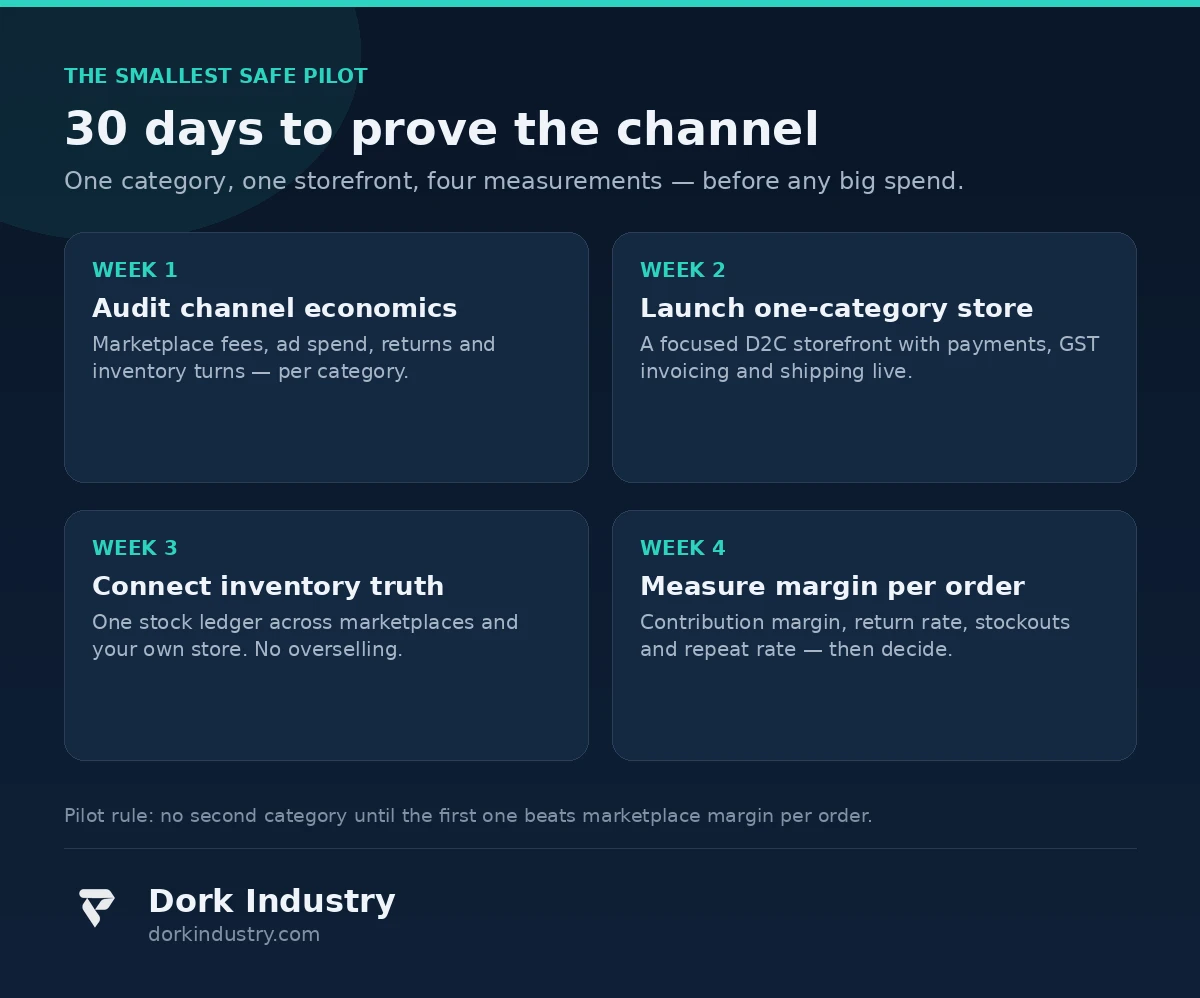
Do not rebuild everything before Diwali. Run one category through the new channel for 30 days. Week one: audit channel economics for that category — marketplace fees, ad spend, returns and inventory turns, per product line. Week two: launch a focused direct storefront for that one category, with payments, GST invoicing and shipping live. Week three: connect the single inventory ledger across marketplaces and the new store, and switch on stock alerts. Week four: measure four numbers — contribution margin per order, return rate, stockout rate and repeat purchase rate — against the same category’s marketplace numbers. Expand only the categories that beat marketplace margin per order. One category, proven, is worth more than five categories launched on hope.
What does it cost, and what drives the price?
Cost depends on scope, not on the word “ecommerce”. A focused Shopify storefront with standard payments, shipping and GST invoicing is the lowest-cost serious option. Price rises with custom design, product configurators, multi-warehouse logic, ERP or Tally integration, data migration from marketplaces, and the number of channels the inventory ledger must cover. Ongoing costs are hosting, platform fees, payment gateway charges, maintenance and the marketing needed to drive traffic to an owned channel — because an owned store does not come with marketplace footfall built in. Any quotation that hides gateway, logistics and advertising costs behind a build-only price is misleading; compare vendors on total cost per order, not build cost alone.
Marketplace-only vs owned channel vs hybrid
| Marketplace-only | Owned D2C store | Hybrid (both) | |
|---|---|---|---|
| Fees per order | Commission on every sale | Gateway fee only | Commission only where it earns reach |
| Customer data | Marketplace owns it | Seller owns it | Owned on D2C, rented on marketplaces |
| Pricing control | Discount pressure from rivals | Full control, margin floors enforced | Margin floors on D2C, tactical pricing on marketplaces |
| Repeat purchases | Paid acquisition every time | Email, WhatsApp and loyalty, near-free | Marketplaces acquire, D2C retains |
| Festive risk | Fee and discount squeeze | Must drive own traffic | Balanced: reach plus margin |
The bottom line
This festive season’s numbers tell sellers exactly what to do: demand has moved to everyday categories, premium electronics cooled, and early marketplace shipments fell even as season sales grew. The sellers who keep their margins will be the ones who stop renting every order and start owning the channel, the customer and the inventory truth. A 30-day, one-category pilot is the cheapest way to prove it on your own numbers before committing to a rebuild.
Selling this festive season and watching marketplace fees eat your margin?
Dork Industry will audit your festive channel economics — marketplace fees, ad spend, returns and inventory turns — and show you exactly which category and channel to pilot your own store on first. You walk away with a margin plan, not a sales pitch.
Request your free festive-margin assessment WhatsApp +91 8210792477
Sources
- Redseer Strategy Consultants festive outlook, October 2026, via IBEF: India’s online retail market to cross $90 billion in 2026; festive online sales of $15–16 billion, up about 25% year-on-year — IBEF report.
- Industry reporting on early festive dispatches and Datum Intelligence estimates: Amazon and Flipkart festive shipments down 10–12%; early festive GMV of ₹29,800–30,900 crore against ₹33,200 crore last year — dispatch report.
About Dork Industry
Dork Industry (dorkindustry.com) is a custom software development company building AI automation, mobile apps, ecommerce systems and IoT solutions for businesses across India — from 30-day pilots to full production rollouts. Our Shopify development services cover store builds, custom themes, app integrations and ERP synchronisation for sellers moving from marketplaces to owned channels.
Frequently asked questions
Why are festive shipments down if festive sales are up?
Because the growth moved to everyday categories like grocery and beauty, while premium electronics — the traditional shipment driver — got more expensive and saw thinner discounts. Season sales can grow while early marketplace dispatches fall when the product mix shifts.
Should I leave Amazon and Flipkart?
No. Marketplaces still deliver reach no new store can match. The winning structure is hybrid: marketplaces for discovery and reach, an owned store for margin and repeat purchases, with one inventory ledger across both so neither channel oversells.
How fast can a direct store launch?
A focused one-category Shopify storefront with payments, GST invoicing and shipping can launch in weeks, not months. Custom builds and complex integrations take longer, which is why the pilot starts with one category on a proven platform.
What does inventory software cost?
It depends on warehouses, channels and integrations. A single-warehouse, two-channel setup is modest; multi-warehouse stock with ERP or Tally synchronisation costs more. Compare any quote on total cost per order, including gateway, logistics and advertising, not build cost alone.
Custom build or Shopify for my store?
Start with Shopify unless you have a concrete reason not to: multiple warehouses, combined wholesale and retail pricing, or ERP synchronisation that platforms cannot handle cleanly. Build custom for the workflows that are genuinely unique, not for the storefront every seller needs.