
AI development can predict a commercial kitchen’s equipment failure before the dinner rush — yes, reliably — but only as an early-warning assistant, never as an autonomous decision-maker. The short answer: an AI agent that watches sensor data from ovens, walk-in refrigerators, fryers, and exhaust systems can flag degradation patterns — a compressor short-cycling, an oven taking eight minutes longer to heat than last month, a fryer struggling to recover oil temperature — days or hours before the breakdown. It cannot decide to shut down a line mid-service, and it must never override a chef’s judgment. If your kitchen has ever lost a Friday-night service to a dead oven, the fix is predictive monitoring piloted on one equipment line for 30 days.
This article walks through why kitchen equipment fails at the worst time, what a dinner-rush failure costs, what data your kitchen already generates, what AI development concretely builds, what the system must never do alone, and how to test the idea in a 30-day pilot before committing to a build.
Key takeaways:
- AI development can predict commercial kitchen equipment failure days to weeks before it happens — as an early-warning assistant, never a decision-maker.
- A dinner-rush failure costs roughly ₹1.2 lakh in one evening (illustrative): lost covers, wasted prep, and emergency repair — before the bad reviews.
- The signals already exist — compressor cycling, oven heat-up drift, fryer recovery time — kitchens just never log them continuously.
- The AI must never shut down equipment automatically, silence food-safety alerts, or override the chef’s cooking parameters.
- A 30-day, single-kitchen pilot in shadow mode — validated alerts vs false ones, lead time before faults — is the smallest safe test.
Why does kitchen equipment always fail at the worst possible time?
It is not bad luck. It is physics meeting scheduling: equipment runs hardest exactly when failure costs the most. Doors open every ninety seconds during service, ovens cycle constantly, and compressors fight both ambient heat and constant door openings. Wear concentrates in the same window as revenue. Three failure patterns repeat across restaurants.
Why do walk-in refrigerators die on Friday nights?
Refrigeration compressors fail when asked to do the most work in the worst conditions. During service, the walk-in door opens dozens of times an hour, flooding the cold room with warm, humid air. A compressor that was already cycling long to hold temperature starts short-cycling — on-off bursts that overheat the motor and kill the unit in days. The stakes are food safety, not just convenience: according to the FDA Food Code §3-501.16, time-and-temperature-controlled food must be held at 41°F (5°C) or below. A walk-in drifting above that line is a violation that can follow you into your next health inspection — not just a repair bill.
Why do ovens lose temperature mid-service?
Heating elements degrade gradually, then suddenly. Scale builds on heating surfaces, thermostats drift, door gaskets leak — each stealing a little heat. The oven compensates until it cannot, and the tipping point arrives mid-rush when every burner is on and recovery time between orders is tightest. The telltale signal is heat-up time — 12 minutes last quarter, 20 now. Nobody logs that drift, so the failure arrives as a surprise.
Why is the exhaust hood the silent killer?
Hoods fail quietly and catastrophically. Grease-laden filters restrict airflow, fan belts loosen, the kitchen gets hotter. Hoods are inspected annually, but degradation happens weekly. Nobody watches it in between.
What does a dinner-rush failure actually cost?
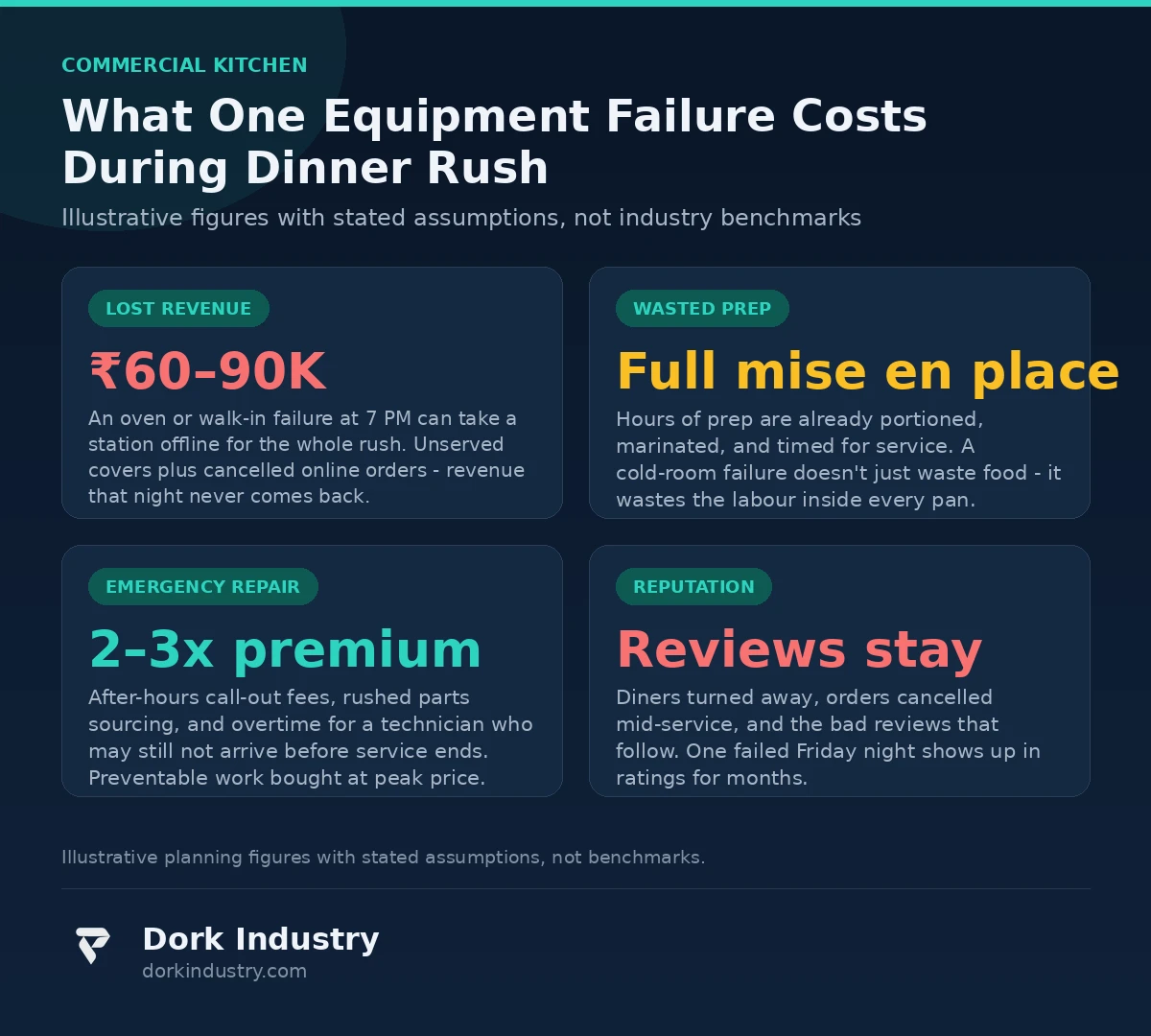
Consider an illustrative Friday-night scenario for a 120-cover restaurant. These are illustrative figures with stated assumptions, not industry benchmarks: assume an average cover value of ₹1,800, a failed combi oven that takes one station offline for the entire 7–11 PM rush, and 40 covers either turned away or cancelled.
Lost revenue: 40 covers × ₹1,800 = ₹72,000 in a single evening, never recoverable — the night’s rush does not reschedule. Wasted prep: the mise en place for those covers — marinated proteins, portioned sides, sauces — is already committed; assume ₹25,000 of food plus the labour inside it, largely unusable by tomorrow. Emergency repair: an after-hours call-out for a combi oven, assume ₹15,000–25,000 versus ₹6,000 for a planned daytime visit — and the technician may still not arrive before service ends. Energy waste compounds it: according to the EPA, restaurants and commercial kitchens use roughly five to eight times more energy per square foot than other commercial spaces — a degraded oven burns that energy for months before it dies.
Total the illustrative scenario: ₹72,000 revenue + ₹25,000 prep + ₹20,000 emergency repair ≈ ₹1.2 lakh for one Friday night — before the reviews from turned-away diners. An alert arriving 48 hours earlier converts an emergency into a scheduled fix.
What data does your kitchen already generate about its equipment?
Most kitchens already hold the raw material; it is just never assembled. Maintenance invoices and AMC records show what broke and when. Energy bills show consumption drift — a compressor drawing more power every quarter is telling you something. The chef’s memory holds the rest: “the oven has been slow since the rains.” What is missing is continuous measurement. Nobody logs heat-up times or compressor cycling — the signals that change gradually for weeks before the failure. An AI monitoring workflow captures what the equipment is already doing, in a form an engineer can use, without creating new work for kitchen staff.
What does AI development actually build in a commercial kitchen?
Strip away the buzzwords and the system is five concrete components, each with a human checkpoint:
- Non-invasive sensors: clamp-on current meters on oven and compressor circuits, temperature probes in walk-ins and oven cavities, vibration pucks on fan motors. No drilling into equipment, no voiding warranties — everything attaches externally.
- A baseline model: for two to four weeks the agent learns what “normal” looks like for your kitchen — heat-up curves, compressor duty cycles, recovery times after door openings — across your actual service patterns, not a manufacturer’s lab spec.
- Anomaly detection: the agent compares live readings against the baseline and flags deviations with a trend: heat-up time drifting upward for three weeks, compressor cycling frequency doubling, fryer recovery lagging 15% behind baseline.
- Alert routing with context: each alert arrives with the evidence attached — “Oven 2 heat-up now 19 min vs 12 min baseline, trend started 11 days ago” — and a suggested action, routed to the engineer or facility manager, not blasted to the whole kitchen.
- A human-verified log: every alert is marked validated or dismissed by the engineer, and the agent’s thresholds tune on that feedback. We applied the same predictive-monitoring discipline to cold storage in our article on predicting a cold store’s temperature loss before the compressor fails.
Note what is deliberately absent from this list: automatic shutdowns, automatic vendor work orders, and anything touching the cooking process. The agent watches the machines.
Which signals actually predict a failure?
| Equipment | Signal the AI watches | What it means | Typical lead time |
|---|---|---|---|
| Walk-in / freezer compressor | Short-cycling frequency, current draw per cycle | Refrigerant loss or failing start capacitor | 3–10 days |
| Combi / deck oven | Heat-up time drift, temperature recovery after door open | Element degradation, thermostat drift, gasket leaks | 1–3 weeks |
| Deep fryer | Oil temperature recovery time after a basket drop | Heating element wear or thermostat fault | 5–14 days |
| Exhaust hood / fan | Motor vibration spectrum, airflow pressure differential | Belt wear, bearing failure, grease clogging | 2–4 weeks |
Lead times vary with equipment age and duty cycle — the point is that every one of these degrades for days or weeks before it breaks, and that window is what predictive monitoring buys you.
How does the AI agent turn sensor noise into a decision?
A kitchen is a noisy sensor environment: doors slam, power dips, a compressor behaves differently on a humid monsoon evening than in January. The agent filters first — one-minute spikes are ignored, multi-day trends are what matter — then correlates: slow heat-up plus rising current draw is a failing element; slow heat-up alone might be a cold start. A flag strengthens only when the same deviation appears across multiple service cycles. This is the same anomaly-detection thinking behind our work identifying an underperforming solar inverter before generation is lost — the equipment differs, the discipline of separating signal from noise is identical.
What must the AI never do alone?
Boundaries matter in a kitchen, because a bad automated action can endanger food safety or a Friday service.
- Never shut down equipment automatically. The agent recommends; the engineer decides. An automatic shutdown of an oven at 7:30 PM based on a false positive would be worse than the failure it tried to prevent.
- Never silence or deprioritize food-safety signals. A walk-in temperature drifting toward 41°F (5°C) — the FDA Food Code limit — must always escalate loudly, even if the agent believes the compressor will recover.
- Never touch cooking parameters. Temperatures, timings, and recipes are the chef’s domain. The agent monitors the machine, never the menu.
- Never auto-order parts or dispatch vendors. A flagged anomaly goes to the engineer, who confirms the diagnosis before money is spent. Automated work orders on unvalidated flags burn trust fast.
- Never diagnose what it cannot evidence. If the agent sees a deviation it has no baseline for, the alert must say “unknown pattern — human review needed,” not invent a confident diagnosis.
Should you build custom, buy a package, or do nothing?
Not every kitchen needs custom AI development. The honest options, in order of investment:
| Approach | Best for | Relative investment | Where it breaks |
|---|---|---|---|
| AMC + reactive repairs | One small kitchen, newer equipment | Minimal | Failures still arrive mid-service; no warning |
| Smart equipment (OEM-connected) | New kitchens buying connected appliances | Medium (in the equipment price) | Only covers that brand; no cross-equipment view |
| Packaged predictive-maintenance SaaS | Standard equipment, standard alerts | Low–medium subscription | Generic thresholds; no learning your kitchen’s patterns |
| Custom AI development | Multi-outlet, mixed equipment, high dinner-rush stakes | Highest | Overkill for a single small kitchen with new equipment |
At Dork Industry, we regularly advise single-outlet kitchens with recent equipment against custom builds — a good AMC and one connected-oven brand is enough. Custom development earns its cost with multiple outlets, mixed aging equipment, and one failed Friday night costing more than a month of monitoring. A credible technology partner should be willing to tell you that you do not need custom AI.
What does a 30-day pilot look like?
The lowest-risk path is a fixed-scope pilot on one kitchen’s critical line:
- Week 1 — Instrument: fit non-invasive sensors to the oven line and walk-in; baseline today’s reality — failure history, emergency call-outs, energy draw.
- Week 2 — Learn normal: the agent studies sensor data across service cycles and builds the equipment’s normal fingerprint.
- Week 3 — Shadow alerts: the agent flags anomalies in shadow mode only; your engineer validates every flag, and thresholds tune on the feedback.
- Week 4 — Measure: compare alerts validated vs dismissed, lead time on any caught fault, and energy drift identified against the week-1 baseline; expand only if the numbers moved.
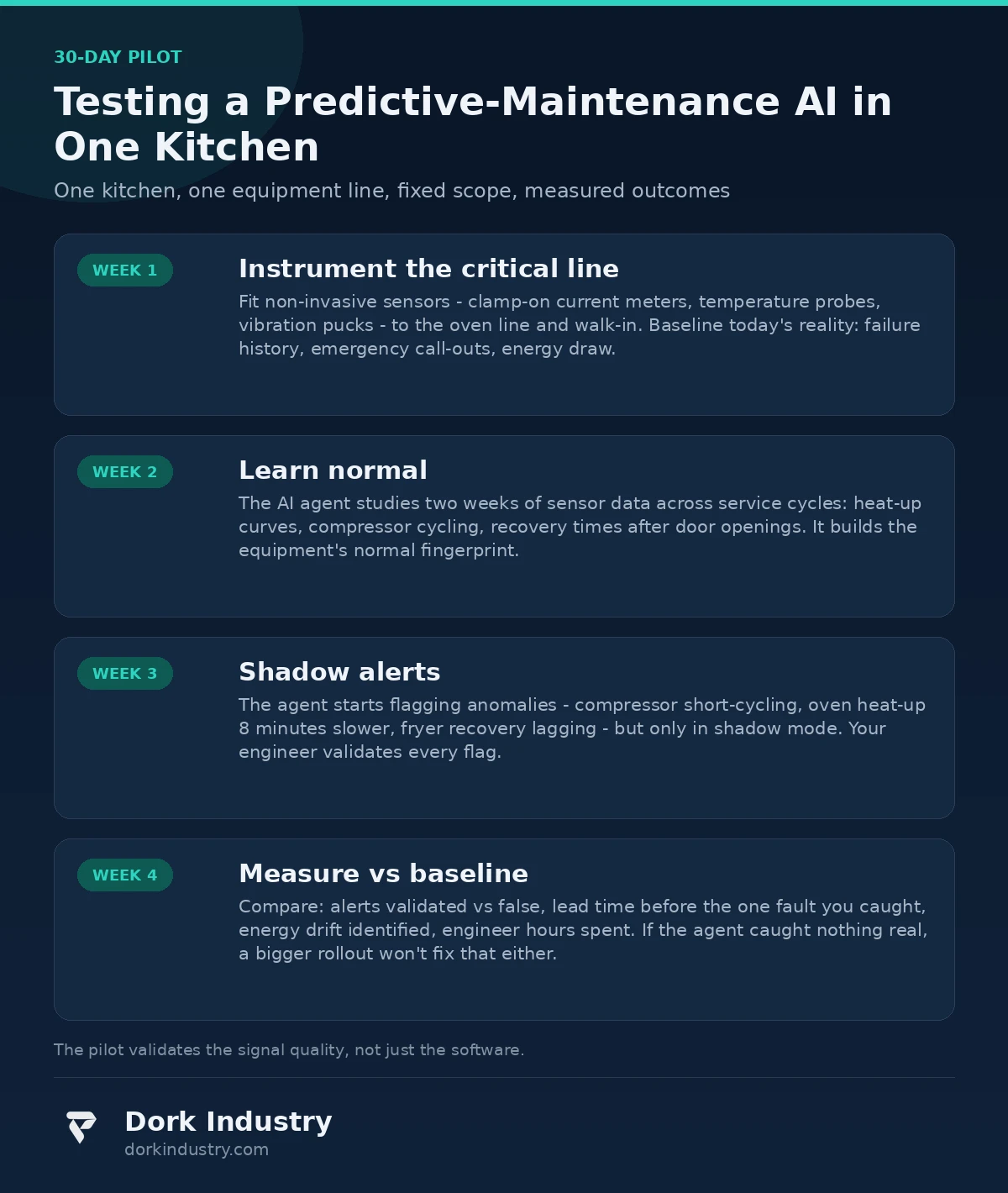
If the agent catches nothing real in the pilot, a larger rollout will not fix that either. The pilot validates signal quality — not just the software. This is the assessment Dork Industry runs before quoting any predictive-maintenance project: map the equipment, name the failure costs, then decide what monitoring earns its price.
What drives the cost of kitchen AI development?
- Equipment count and variety: five ovens of one brand is a different system from twenty mixed units across brands and ages.
- Outlets: one kitchen vs a multi-outlet rollout with a central dashboard multiplies the data pipeline.
- Sensor invasiveness: clamp-on external sensors are cheap and fast; in-line sensors need downtime and certification.
- Alert logic: simple thresholds vs multi-signal correlation with shadow-mode learning and feedback tuning.
- Integration: pushing alerts into your existing facility-management tools vs a standalone dashboard.
- Connectivity: kitchens with unreliable internet need edge processing on a local gateway.
Anyone quoting a fixed price without asking about equipment inventory, outlet count, and network conditions is guessing.
Frequently asked questions
Can AI development predict all types of kitchen equipment failure?
No. It predicts gradual degradation — element wear, compressor decline, belt and bearing wear — where the signal degrades for days or weeks before the break. Sudden electrical faults and physical damage have no lead time. The honest question is what fraction of your failures are gradual, and the week-1 baseline answers that.
Will sensors void my equipment warranty?
Non-invasive sensors — clamp-on meters, stick-on probes, external vibration pucks — do not require opening equipment, and are generally warranty-safe. In-line sensors should be checked with your OEM first; the pilot’s week-1 scope stays non-invasive.
How does this affect food safety compliance?
It strengthens it. Continuous temperature logging gives you a timestamped record that your walk-in held 41°F (5°C) or below — the evidence health inspectors want under the FDA Food Code. Temperature alerts always escalate loudly, regardless of the agent’s confidence.
What about kitchens with old, mixed-brand equipment?
Old mixed equipment is actually the best case for custom monitoring: OEM-connected smart features do not exist for it, and packaged SaaS has no profile for your units. The baseline model learns your equipment as it is — a 12-year-old combi oven’s “normal” differs from a new one’s, and the agent learns it from your data.
How long until we see results?
A fixed-scope pilot runs 30 days and tells you whether signal quality justifies investment. Production rollout on one kitchen typically follows in 4–8 weeks; multi-outlet only after the first kitchen proves the pattern.
About Dork Industry
Dork Industry (dorkindustry.com) is a custom software development company building AI development, AI automation, mobile apps, and IoT systems for businesses across India. Our team designs predictive-monitoring systems — commercial kitchens, cold storage, solar plants, and industrial equipment — from 30-day pilots to multi-site rollouts.
The bottom line
The question is not whether AI development can watch your kitchen’s equipment. The question is whether your maintenance process has the discipline to act on an early warning: a validated alert, a scheduled fix before the rush, an engineer who trusts the signal because they trained it. Start with the equipment, pilot monitoring on one line for 30 days, and let measured lead time and avoided emergency costs — not feature lists — decide whether to build further.
Running restaurants or cloud kitchens and want to know what predictive monitoring would change in your specific operation?
We map your equipment, failure history, and maintenance spend and show you exactly what AI development would (and would not) predict, before any build is discussed.
Request a kitchen-equipment monitoring feasibility assessment WhatsApp +91 8210792477