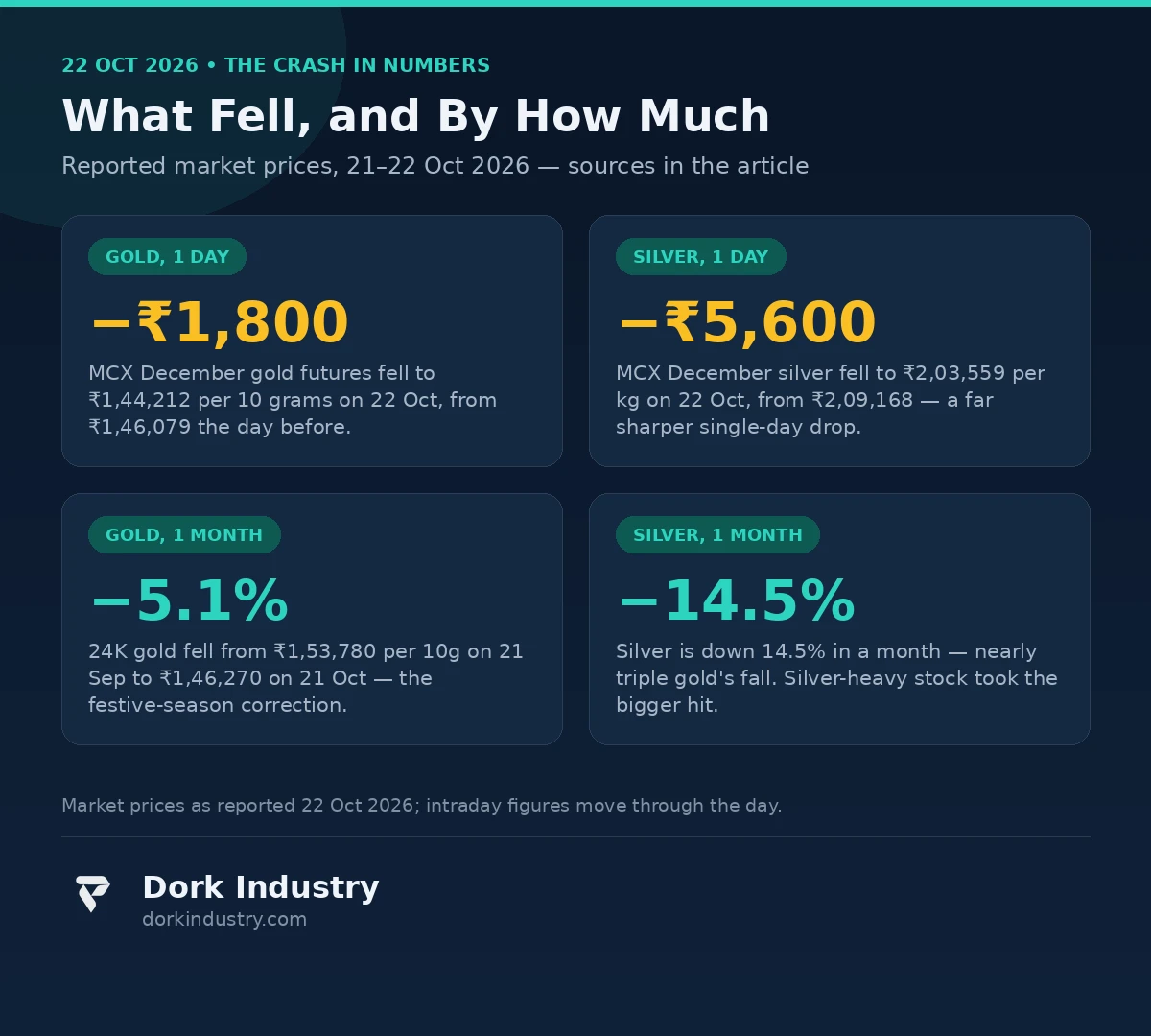
Yes — inventory management software can save jewellery chains as gold crashes before Diwali: it reprices every item from one live metal rate, holds all stock in one ledger, and enforces a margin floor so crash-time discounts stay decisions, not accidents. On 22 October 2026, MCX December gold futures fell ₹1,800 in a day to ₹1,44,212 per 10 grams, and silver plunged ₹5,600 to ₹2,03,559 per kilogram — right in the middle of India’s festive buying season, with Dhanteras on 6 November and Diwali on 8 November. For a jeweller, that is not a market headline. It is every price tag in every store going stale at once.
In brief
- What happened: Gold fell ₹1,800 in a day on 22 October 2026; silver fell ₹5,600. Over the past month, 24K gold is down 5.1% and silver down 14.5%.
- Why it hurts jewellers: Stock bought at higher rates must now sell into lower rates, while customers wait for further falls — and every store reprices at a different speed.
- Direct answer: Yes — inventory management software can protect a jewellery chain in a crash, by repricing every item from one live metal rate, holding all stock in one ledger, and enforcing a margin floor so discounts never quietly eat the business.
- What it cannot do: It cannot predict prices, hedge metal, or replace the owner’s call on how much stock to carry into Diwali.
- Fastest safe move: A 30-day pilot in one store — live rate feed, one stock ledger, one margin floor — measured on repricing time, stock accuracy and margin leakage.
- Region: India — prices in rupees, 3% GST on gold value, hallmarking rules and the Dhanteras–Diwali calendar are India-specific.
What just happened to gold and silver?
The crash of 22 October did not come from nowhere. Brent crude crossed $110 a barrel after fresh West Asia tensions, US Treasury yields pushed higher, and the rupee strengthened — a combination that raises the opportunity cost of holding non-yielding metals and pulls domestic bullion prices down with it. COMEX gold traded at $4,129.60 an ounce, down 0.49% on the day, and traders are now watching the US Federal Reserve meeting on 27–28 October as the next trigger.
The month-long picture is worse than the single day. On 21 October, 24K gold stood at ₹1,46,270 per 10 grams and 22K at ₹1,34,081 — against ₹1,53,780 for 24K on 21 September, a 5.1% fall in a month. Silver’s monthly fall is 14.5%, nearly triple gold’s. And this is happening as festive demand returns: the World Gold Council’s India update notes that domestic gold discounts narrowed sharply in October, from an average of $66 an ounce in September to just $8 by 16 October, as retailers restocked for the season and footfall improved. Jewellers are therefore caught in the worst combination — stocking up for Diwali into a falling market.
Why a falling market is an inventory problem, not a price problem
Most jewellers frame a gold crash as a buying problem — “should we buy now or wait?” For a chain, it is an inventory problem, and the maths shows why. Take an illustrative chain carrying ₹50 crore of gold stock across its stores. A 5.1% monthly fall in the gold price is a ₹2.55 crore swing in the paper value of that stock. On the single day of 22 October alone, ₹1,800 per 10 grams equals ₹1.8 lakh per kilogram — so a chain holding 100 kg of gold saw ₹1.8 crore of stock value move in one session. These are illustrative figures with stated assumptions, not any real chain’s books — but they show the scale at which a pricing delay becomes a loss.
The damage arrives through four channels. First, stale price tags: each store reprices from yesterday’s rate, or from a WhatsApp message, or not at all, so the same design sells at different prices in different branches. Second, discount leakage: to keep footfall up, staff discount making charges or round prices down, and nobody totals what the crash plus the discount cost together. Third, stock blindness: with no single ledger, the head office cannot say how many kilograms of 22K are sitting in which store, so slow-moving heavy pieces stay locked in one branch while another branch turns customers away. Fourth, old-gold chaos: exchange schemes — a major festive-season driver — are calculated by hand at the counter, and a rate error on an exchange is a loss the chain only finds at reconciliation.
There is also a demand twist. Falling prices do bring buyers back — dealers flipped from discounts to premiums of up to $7 an ounce in mid-October, the first premium in three months. But buyers in a falling market also wait: if gold fell ₹1,800 today, why not wait for tomorrow? A chain that cannot reprice confidently cannot run the “buy today” offers — lightweight pieces, exchange bonuses, fixed making-charge windows — that convert waiting buyers into Diwali sales.
What inventory management software actually does for a jewellery chain
Strip away the vendor brochures and a jewellery inventory system does five concrete things, each mapped to one of the four damage channels above.
1. One live metal-rate engine. The system pulls the day’s gold and silver rates — and, where the feed supports it, intraday moves — and recalculates every item’s price from weight, purity and the day’s rate. Commmerce’s jewellery OMS, for example, pushes rate changes to stores, online listings and marketplaces within minutes of a rate change, with margin rules per category. The point is not speed for its own sake: it is that every branch reprices from the same rate at the same time, so the chain stops competing with itself.
2. One stock ledger, down to the piece. Every item carries its weight, purity, making charge, certification and store location in one record. Barcode or RFID tagging at intake means a transfer between stores is a scan, not a phone call and a register entry. ZSolTech’s platform, used by more than 500 jewellery businesses, adds bullion-aware accounting — trial balance, profit and loss and balance sheet revalued against current metal rates — so month-end close takes hours instead of days. When the ledger is single, the head office can move slow stock to the branch where it will sell before Diwali instead of discovering it in January.
3. A margin floor that bites. The system is configured with a minimum margin per category — say, making charge plus a floor on metal margin — and flags or blocks any bill that goes below it. Discounts during a crash then become a decision with a number attached, not a quiet erosion. This is the single highest-value control in a falling market: it converts “we discounted to keep the customer” into “we gave away ₹X of margin on ₹Y of sales this week.”
4. Old-gold exchange at the counter, priced right. Exchange value is calculated from the live rate, purity testing and the chain’s exchange policy in one step, with the old piece logged into stock the moment it is accepted. Hand-calculated exchanges are where rate errors hide; system-calculated ones are auditable.
5. GST, hallmarking and audit trails built in. Indian jewellery billing carries 3% GST on the gold value and 5% on making charges, plus hallmarking (HUID) records and KYC for high-value purchases. A system that generates these from the same transaction record removes the second round of manual work — and the second chance for error — that spreadsheet billing creates.
Manual vs software, side by side
| Job | Manual / spreadsheet chain | Inventory management software |
|---|---|---|
| Repricing after a rate move | Hours per store; branches drift apart | Minutes, chain-wide, from one rate |
| Knowing what stock sits where | Phone calls + registers; days old | Live ledger by piece, weight and purity |
| Discount control in a crash | Found at month-end reconciliation | Margin floor flags every sub-floor bill |
| Old-gold exchange pricing | Hand calculation at the counter | Live-rate calculation, logged to stock |
| Month-end stock valuation | Days of recounting and revaluation | Revalued against current rates automatically |
| Moving slow stock before Diwali | Discovered after the season | Visible daily; transfer by scan |
What technology must never do on its own
Software earns its place by being explicit about its limits. It must never decide how much gold to buy or hold — that is a trading decision, and no inventory system is a hedge. It must never auto-discount below the margin floor without a human override record. It must never be the only record of hallmarking, KYC or GST filings — the system should produce the records, but legal responsibility stays with the business. And it must never reprice from a rate feed nobody verified: a wrong feed, applied chain-wide in minutes, is worse than a slow manual price, because the error is also chain-wide. Every automated price needs a named rate source, a timestamp, and a one-click rollback.
Build custom, or buy a jewellery package?
Honest answer: most single-brand chains should buy first. Mature jewellery packages — RPS Jewel PRO, ZSolTech, Commmerce and their peers — already carry the hard parts: purity maths, making-charge structures, exchange workflows and GST billing. Buying gets a chain live before Diwali, which is the window that matters. Custom software development earns its money in three situations: the chain runs a genuinely unusual model (franchise-owned stock, karigar job-work at scale, or a bullion-trading arm alongside retail); it needs deep integration with an existing ERP, accounting or e-commerce stack that packages will not touch; or it has outgrown two packages already and knows exactly which workflows broke. A useful rule: if you cannot name three workflows a package cannot do, you do not need custom yet. Start packaged, and custom-build only the integration layer around it.
What does a 30-day pilot look like?
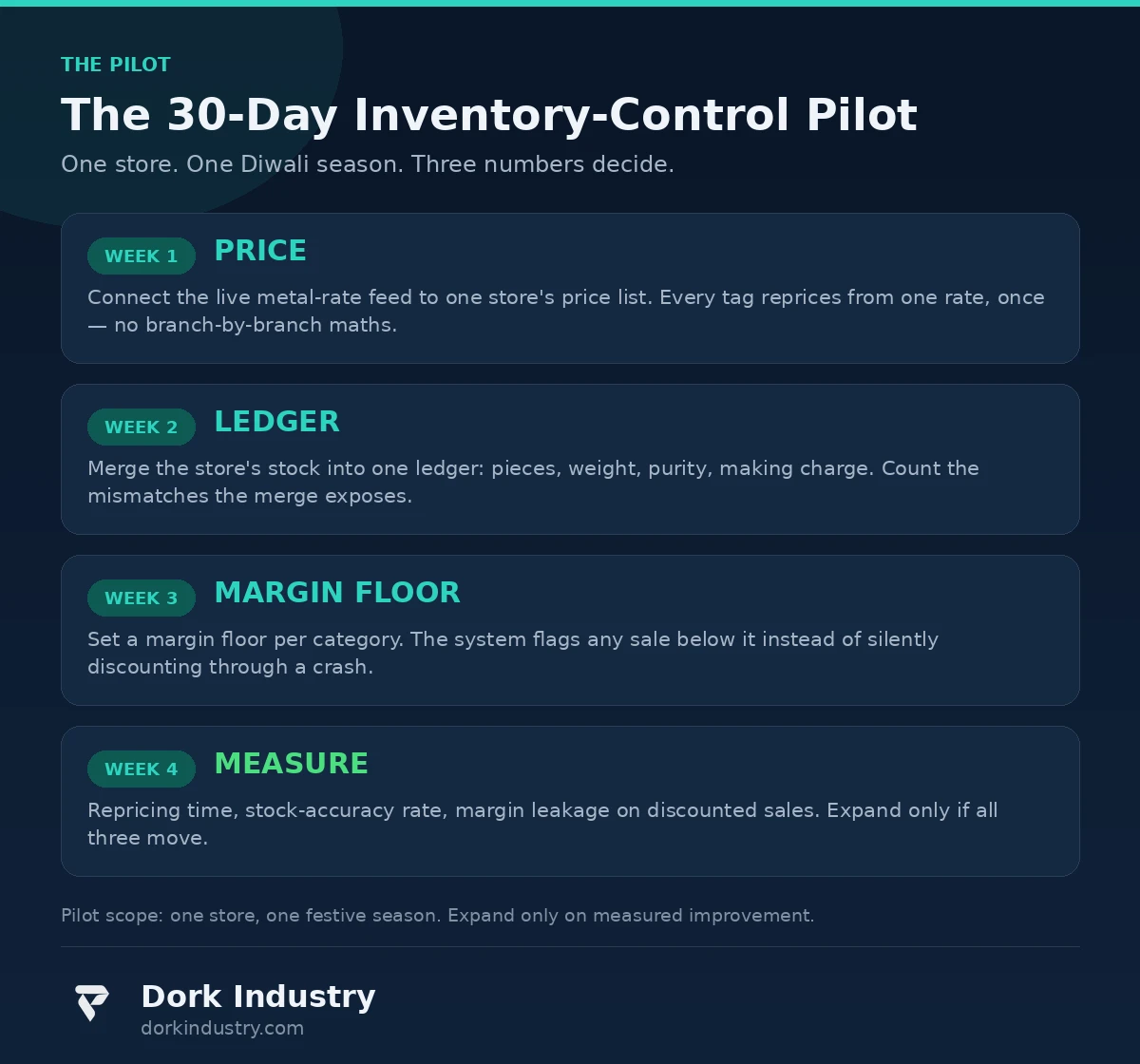
The pilot is deliberately small: one store, the Diwali season, three numbers. Week one connects the live metal-rate feed to that store’s price list and measures repricing time. Week two merges the store’s stock into one ledger — pieces, weight, purity, making charge — and counts the mismatches the merge exposes. Week three sets a margin floor per category and tracks every flagged sale. Week four measures three numbers: repricing time, stock-accuracy rate, and margin leakage on discounted sales. Expand to the next store only if all three move. If the ledger merge exposes almost no mismatches and repricing already takes minutes, stop and save the money — the chain’s problem is elsewhere, probably in buying, not in systems.
What does it cost, and what drives the price?
Packaged jewellery software in India is typically subscription-priced per store or per user, with implementation for data migration and training on top; a multi-store rollout with RFID tagging and ERP integration costs several times a single-store subscription. Custom inventory development is a project cost, driven by store count, karigar and job-work workflows, integrations, and whether the chain wants its own rate-feed and analytics layer. The number that matters is not the software price but the leakage it stops: on the illustrative ₹50 crore stock example above, stopping even 0.5% of margin leakage is ₹25 lakh — which is the budget conversation to have with any vendor. Get that leakage number from your own last quarter before signing anything.
The bottom line
Gold fell ₹1,800 in a day and silver ₹5,600, with Dhanteras and Diwali weeks away and another rate-moving event — the Fed meeting on 27–28 October — still to come. Jewellery chains cannot control the gold price. They can control how fast every price tag in every store reflects it, whether every piece of stock is visible in one ledger, and whether a discount in a falling market is a decision or an accident. That control is what inventory management software buys, and the Diwali season is the worst possible time to discover you do not have it. Start with one store, one rate feed and one margin floor — and measure before you expand.
If you are shortlisting a partner for this kind of system, see our comparison of the best AI automation company in India, which covers eight providers on delivery, integrations and governance.
Is your stock still priced on yesterday’s gold rate while today’s rate is already lower?
Dork Industry will audit one store’s inventory, repricing and margin leakage — live rate feed, stock ledger and discount controls — and show you exactly where a falling market is eating your Diwali margin, before you commit to any software.
Data and assumptions
Market figures in this article are as reported on 21–22 October 2026: MCX December gold futures and silver futures (22 October reporting), 24K/22K retail rates and monthly changes (Livemint, 22 October), Brent and COMEX figures and the Fed meeting date (CNBC-TV18, 22 October), and World Gold Council India data (September–October 2026, via Kitco). Vendor claims — including Commmerce’s reported 25% margin improvement during volatile periods and ZSolTech’s 500+ onboarded businesses — are the vendors’ own claims, not independently verified. The ₹50 crore stock and 100 kg examples are illustrative planning figures with stated assumptions, not any real chain’s financials. Intraday prices move through the day; check the live rate before acting.
Sources
- Livemint — Gold, silver prices today, 22 October (retail rates and monthly changes)
- The Daily Jagran — Gold slides to ₹1.44 lakh, silver plunges ₹5,600 (MCX futures, 22 October)
- CNBC-TV18 — Gold and silver decline as crude rises (COMEX, Brent, Fed meeting)
- Kitco / World Gold Council — India gold market update, October 2026 (discounts, festive demand)
- Commmerce — How jewellery chains manage gold price volatility with real-time OMS
For Dork Industry’s retail and inventory software work, see dorkindustry.com or talk to the team.
About Dork Industry
Dork Industry builds custom software, mobile apps, ecommerce and inventory systems for growing businesses in India and worldwide — from single-store retailers to multi-branch chains. Every engagement starts with the operational pain, not the technology, and every pilot is measured before it expands.
Frequently asked questions
Can inventory management software save jewellery chains as gold crashes before Diwali?
Yes — it reprices every item from one live metal rate, holds all stock in one ledger, and enforces a margin floor so crash-time discounts stay decisions, not accidents. It cannot predict prices or hedge metal.
How fast can a jewellery chain reprice after a gold rate move?
With a live rate feed connected to the price list, chain-wide repricing takes minutes. Manual chains take hours per store, and branches drift to different prices in between.
What is the biggest margin leak for jewellers in a falling market?
Uncontrolled discounting: making-charge cuts and round-downs made to hold footfall, never totalled against the metal-price fall. A margin floor per category turns that leak into a visible number.
Should a jewellery chain build custom inventory software or buy a package?
Buy first, unless the chain runs an unusual model (franchise stock, large-scale karigar job-work, bullion trading) or needs deep ERP integration a package will not touch. Start packaged; custom-build only the integration layer.
What should a 30-day inventory pilot measure?
Three numbers: repricing time after a rate move, stock-accuracy rate after the ledger merge, and margin leakage on discounted sales. Expand only if all three move.
How does GST work on jewellery sales in India?
GST is charged at 3% on the gold value and 5% on making charges, with hallmarking (HUID) records for the piece. An inventory system that generates tax and hallmarking records from the same transaction removes a second round of manual work — and a second chance for error.