
SEO services investigate a sudden Google rankings drop the way a forensic team works a scene: reconstruct the timeline before touching anything. If your traffic fell off a cliff overnight, the right first move is diagnosis, not fixes — the six common causes each demand a completely different response, and the wrong fix can turn a temporary dip into a permanent loss.
This article walks through what actually happens when rankings collapse overnight: what it costs, what data you already have, the six cause families and how to tell them apart, what a disciplined recovery process looks like, what no tool or agency should ever do without human judgment, and how to run a 30-day recovery with clear checkpoints.
Why does an overnight rankings drop feel like a cliff — and what does it actually cost?
A rankings drop is rarely gradual: you open analytics on a Monday morning and the organic traffic line has fallen off a ledge. The panic is understandable — for many businesses, organic search is the pipeline. But the cliff feeling misleads. Not every sharp fall is a penalty: some are indexing failures, some are bot-traffic corrections, some reverse within days. The expensive mistake is treating them all the same way.
What does a 50% traffic loss do to a business that lives on organic search?
Consider an illustrative example with stated assumptions — not industry statistics. A B2B services company gets 8,000 organic visits a month. Their analytics show roughly 1.5% of visitors request a quote (120 quote requests), their sales team closes about one in five (24 deals), and the average deal is worth ₹4,00,000. That funnel produces about ₹96 lakh in monthly pipeline value. If organic traffic halves overnight and stays down for two months, the pipeline hole is roughly ₹96 lakh — before a single salesperson changes anything.
Now stretch the timeline. Every week spent guessing is a week the funnel stays broken — and every panicked fix, from a hasty redesign to mass-deleting “thin” pages, adds recovery time on top of the original problem. The cost of a rankings drop is lost traffic multiplied by the weeks you spend on the wrong diagnosis.
What should you check in the first 48 hours?
Before anyone proposes a fix, gather evidence from sources you already own. No new tools are needed for the first 48 hours — just your own data, read in the right order.
Is it really Google, or is it your own site?
Start with the calendar: line up deployments, plugin and theme updates, CDN or firewall rule changes, and DNS or hosting changes against the exact date traffic fell. A large share of “overnight” drops trace to something the business shipped — a redesign that changed URLs, a migration that dropped redirects, a CMS update that altered canonicals, or a staging robots.txt that went live. If the drop matches a ship date, you have your prime suspect before looking at Google.
What does Search Console tell you that analytics can’t?
Analytics shows traffic fell; Search Console shows why — or where to look. The Performance report, split by page and compared to the previous period, tells you whether the drop is sitewide, template-level, or single-page. That one distinction narrows the cause family dramatically.
Next, check the Manual Actions and Security Issues reports. A manual action is the one cause where Google tells you outright what happened — but only if you look. Then check the Pages (indexing) report for spikes in “Excluded” URLs: a sudden jump in blocked, noindexed, or unindexed pages is the fingerprint of technical breakage, not an algorithm change.
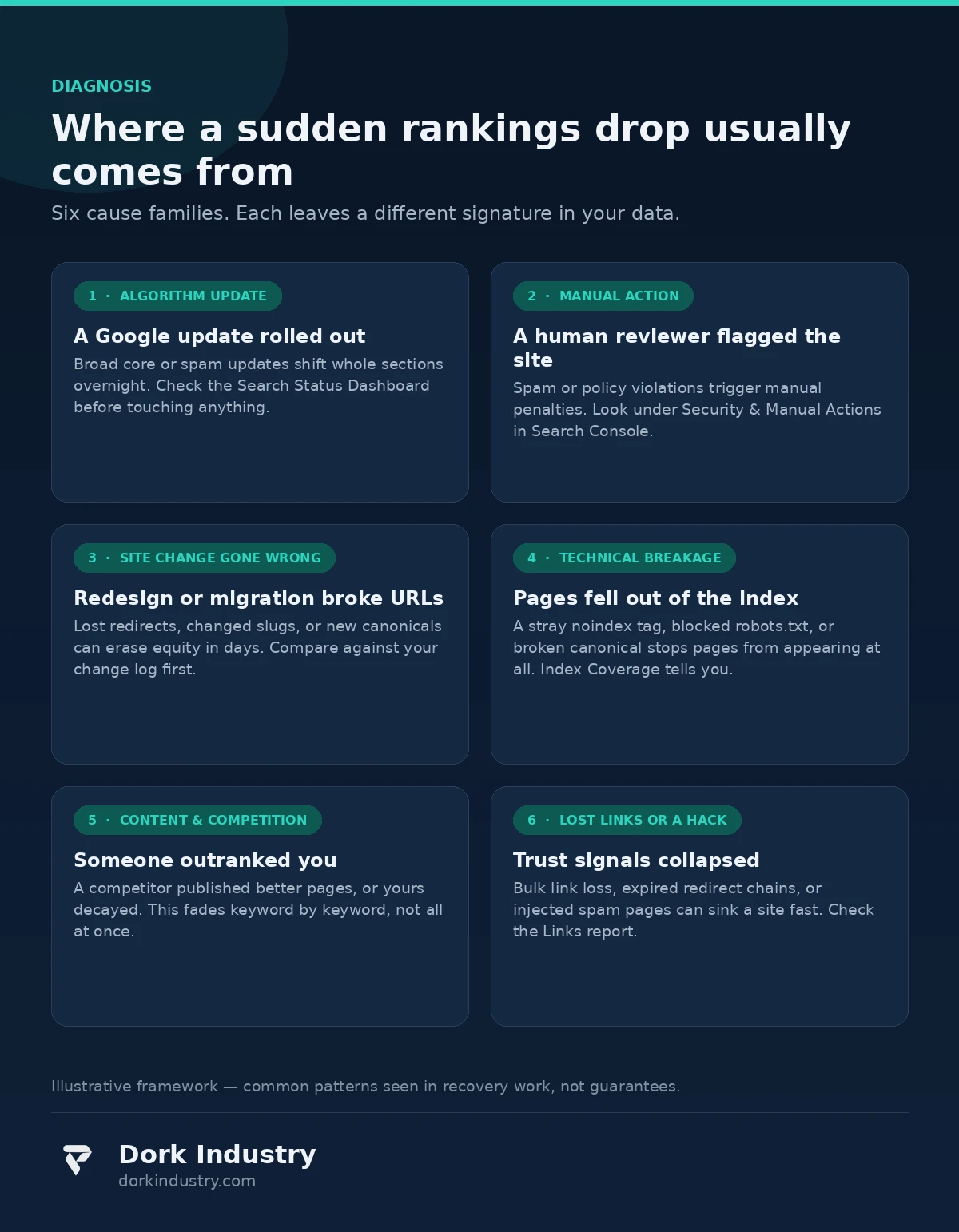
Where do sudden drops usually come from?
Six families cover the vast majority of overnight collapses. Each pairs with the signature it leaves in your data, the first check to run, and a typical recovery window — typical, not guaranteed, because every site’s crawl budget and authority differ.
| Cause | Signature in your data | First check | Typical recovery window |
|---|---|---|---|
| Google algorithm update | Sitewide or section-wide position shifts, same date across competitors | Search Status Dashboard for confirmed updates | Weeks to months; no instant fix |
| Manual action | Sharp drop, sometimes with a notification in Search Console | Manual Actions report | After fixing + reconsideration request |
| Site change gone wrong | Drop date matches a deploy; URL patterns change | Change log vs drop date; crawl before/after diff | Days to weeks once reverted |
| Technical breakage | Indexed page count collapses; exclusions spike | Pages report; robots.txt; noindex tags | Days once fixed and recrawled |
| Content and competition | Keyword-by-keyword fade over weeks, not a single cliff | Page-level performance comparison; SERP review | Weeks to months of content work |
| Lost links or a hack | Referring domains fall off; strange pages appear in the index | Links report; site: search for injected pages | Weeks after cleanup |
A note on the trickiest row: algorithm updates. According to Google’s own guidance on core updates, there is no specific action to take beyond improving the site overall — which is exactly why you must rule out the other five causes first. If you assume “it was an update” when your developer actually shipped a noindex tag, you will wait months for a recovery that a one-line fix would have delivered in days.
What does a competent recovery process look like?
Technology helps recovery enormously — but as evidence gathering, not as autopilot. Here is what the concrete, non-buzzword version of a rankings recovery looks like when SEO services do it properly.
First, the change-timeline reconstruction: every deployment, config change, and content push mapped against the drop date. Second, a crawl-before/crawl-after diff comparing status codes, canonical tags, robots directives, and internal link counts — this catches migration damage that spot-checking misses. Third, server log analysis: if Googlebot’s crawl frequency collapsed alongside rankings, that is an early technical signal analytics will never show.
Fourth, segmented rank tracking: positions cut by page template, because a template-level drop and a sitewide drop are different diseases. Fifth, a backlink profile diff from the Links report against historical exports, to catch bulk link loss or an expired redirect chain. Larger sites often run custom tooling that diffs crawls automatically and alerts on index-coverage changes — the same discipline as monitoring any production system. According to the Google Search Status Dashboard, confirmed ranking incidents and update rollouts are published there — matching your drop date against that timeline takes two minutes and eliminates an entire class of guesswork.
Finally, the fix-validation loop: after any technical fix, the corrected pages must be verified in Search Console and recrawled. Google’s own recrawl documentation at developers.google.com explains how to request re-indexing — a step panicked owners routinely skip, then wonder why a correct fix “didn’t work” for three weeks.
What must SEO services never do alone?
Recovery is where automation does the most damage: every panic-driven bulk action is fast, irreversible, and aimed at the wrong target. Trustworthy providers hold these boundaries — their absence is a red flag:
- Never auto-disavow backlinks. A disavow file generated by software can nuke legitimate links along with the spammy ones. Every domain on that list needs a human decision.
- Never mass-noindex or delete pages in a panic. Thin pages can be merged, redirected, or improved. Deletion is irreversible, and mass deletions during a drop destroy the evidence you need.
- Never let software rewrite your content at scale. Recovery content needs editorial judgment about what the page should actually say — a bulk rewrite aimed at “keyword density” is how sites earn the next penalty.
- Never buy links to “recover fast.” This trades a traffic dip for a manual action. Any provider proposing paid links during recovery is disqualified on the spot.
- Never restructure URLs again while recovering. One migration at a time. Changing URL architecture mid-recovery makes it impossible to tell which change moved the needle.
- Never submit a reconsideration request before the cause is fixed and documented. A premature request wastes your one credible shot at a reviewer.
- AI and tools surface suspects; humans convict. A crawler can flag 400 suspicious redirects in seconds. Deciding which ones matter — and what to do about them — is a judgment call, every time.
Should you hire SEO services, or can you recover this yourself?
Honest answer: sometimes you don’t need anyone. A single page slipping a few positions is normal flux — wait two weeks. A three-day dip that recovered on its own was likely transient. And if you know you shipped a broken deploy yesterday and can revert it today, revert it — no audit needed.
Bring in outside help when the pattern exceeds your ability to read it: a sitewide cliff you can’t explain, a manual action you’ve never handled, migration damage you can’t fully map, or a hacked site with injected pages. The other honest signal is Search Console literacy — if you can’t confidently read the Pages report, the cause will stay invisible no matter how long you stare at analytics.
And vet providers the way you’d vet a surgeon: anyone guaranteeing #1 rankings, promising “instant recovery,” describing secret proprietary methods, or proposing to start with link purchases is telling you exactly who they are. A credible provider starts with your data, names the cause family, and tells you when the answer is “wait and watch” — even though that answer earns them nothing.
What does a 30-day recovery look like?
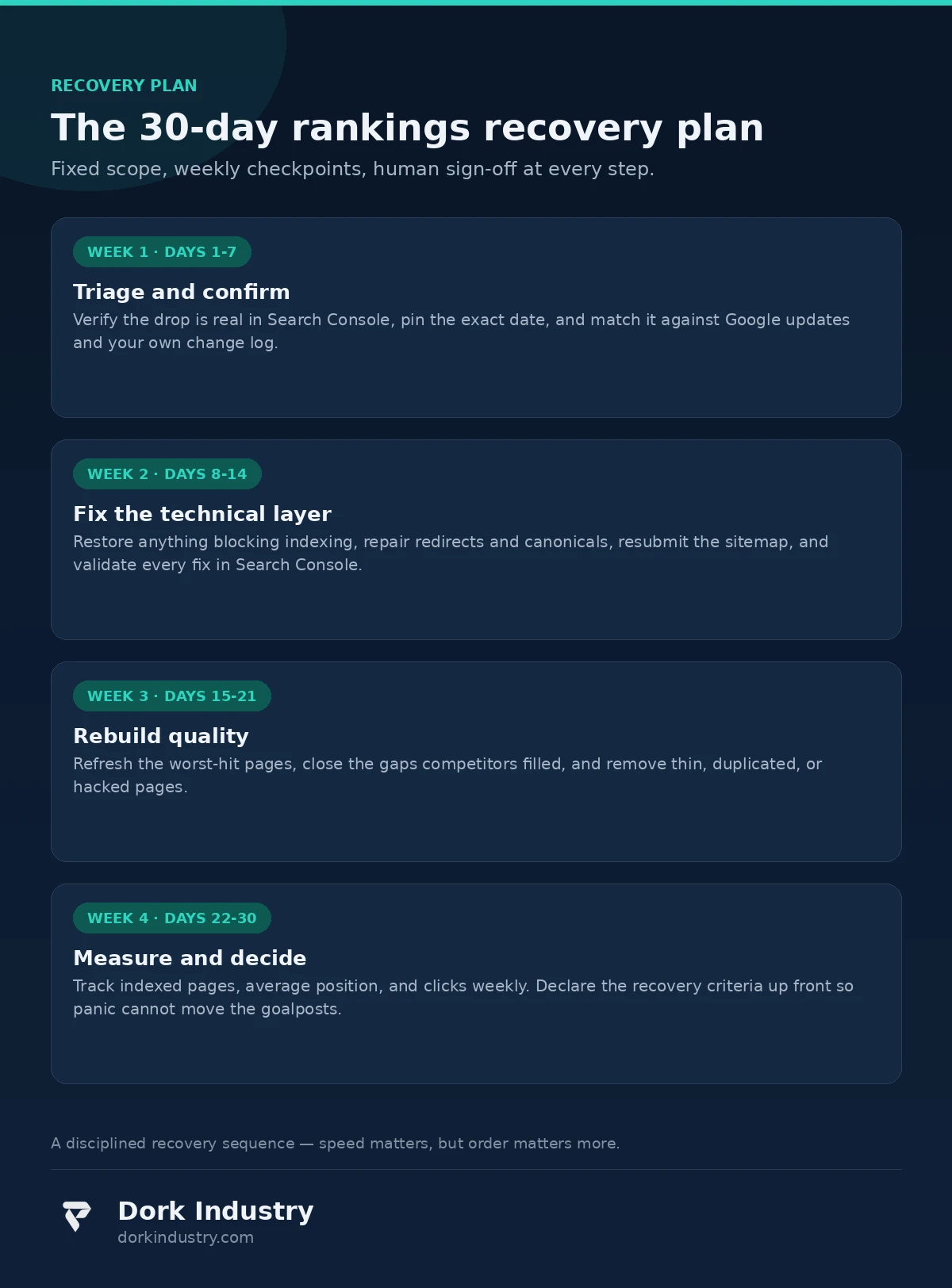
The lowest-risk structure is a fixed 30-day recovery with weekly checkpoints and human sign-off at every step — the same discipline as a product pilot: bounded effort, measured learning, then a decision.
- Week 1 — Triage and confirm. Confirm the drop is real in Search Console, pin the exact date, match it against Google updates and your change log, and pull the Manual Actions and Security reports.
- Week 2 — Fix the technical layer. Restore anything blocking indexing, repair redirects and canonicals, resubmit the sitemap, and validate every fix in Search Console. Deliverable: indexed-page counts moving back up.
- Week 3 — Rebuild quality. Refresh the worst-hit pages with genuinely better content, close the gaps competitors filled, and remove thin, duplicated, or hacked pages.
- Week 4 — Measure and decide. Track indexed pages, average position, and clicks weekly against the pre-declared recovery criteria. Deliverable: a verdict — recovering, still diagnosing, or escalated.
If the cause was a manual action, week 2 also includes the reconsideration request — documented, specific, and filed once. If it was an algorithm update, weeks 2–4 shift toward quality work, because there is nothing technical to fix. The plan flexes around the diagnosis; that is the entire point of diagnosing first.
What drives the cost of SEO services for a recovery?
The real cost drivers of a rankings recovery:
- Site size: auditing and crawling 50 pages vs 50,000 pages is a different job entirely.
- Penalty vs technical: a manual action needs documented remediation plus a reconsideration request; a noindex typo needs one line changed. The former costs more because the evidence burden is higher.
- Content depth: refreshing ten key pages is editorial work; rebuilding hundreds of thin pages is a content program.
- Link profile cleanup: reviewing, disavowing, and documenting a toxic backlink profile is slow, careful work — and it cannot be rushed without risk.
- Development involvement: migration repair and redirect architecture need web development time; pure content recovery does not.
- Ongoing monitoring: rank tracking, index-coverage alerting, and change-log discipline after recovery — the insurance policy against the next cliff.
Anyone quoting a fixed recovery price without asking about your site’s size, whether there’s a manual action, and what changed on the drop date is guessing — and guessing is what got most sites into this situation.
Frequently asked questions
How long does it take to recover Google rankings after a sudden drop?
It depends entirely on the cause. A technical breakage like a stray noindex tag can recover within days of the fix being recrawled. A manual action takes as long as remediation plus Google’s review of your reconsideration request. An algorithm update has no fixed timeline — recovery comes from sustained quality improvement over weeks or months, not from a single change.
Can a Google algorithm update permanently destroy my rankings?
An update doesn’t “target” your site; it re-evaluates all sites against changed criteria. If competitors now outrank you, the durable response is to close the quality gap they exposed — better content, better experience, better authority signals. Sites do recover from update losses, but only by becoming the kind of result the new criteria reward.
Should I disavow backlinks after a traffic drop?
Almost certainly not as a first step — and never automatically. Disavow is a scalpel for confirmed toxic link patterns, usually tied to a manual action. A software-generated disavow file can remove links that were helping you. Get a human review of the actual linking domains before touching this tool.
My rankings dropped right after a website redesign. Is that normal?
Small, temporary fluctuations after a redesign are normal. A cliff is not. Post-redesign cliffs almost always trace to broken redirects, changed URL structures, lost internal links, or new canonical tags. Compare a crawl from before and after the launch — the damage is usually visible in that diff within an hour.
When should I hire SEO services instead of fixing a rankings drop myself?
When the drop is sitewide and unexplained, when there’s a manual action involved, when a migration went wrong and you can’t map the damage, or when you can’t confidently read Search Console’s indexing and performance reports. If you can name the cause and revert it yourself today, do that first — no audit needed.
About Dork Industry
Dork Industry (dorkindustry.com) is a custom software development company building web platforms, mobile apps, AI automation, and IoT systems for businesses across India. Our team designs and ships production software — from 30-day pilots to full-scale rollouts — and works with clients on the technical foundations of growth: site performance, analytics, indexing health, and the diagnostic systems behind search visibility.
The bottom line
A rankings cliff is a symptom, and symptoms demand diagnosis before treatment. The businesses that recover fastest are not the ones that act fastest — they are the ones that name the cause family in the first 48 hours, fix in the right order, and refuse every panic-driven shortcut. The sequence: change log first, Search Console second, updates timeline third, fixes only after all three agree.
Get a Free Rankings Recovery Audit
Dork Industry’s free rankings recovery audit runs your drop through our full diagnostic checklist: we pull your Search Console signals, reconstruct what changed on the date your rankings fell, and name the most likely cause family — with the evidence to back it. You walk away with a written triage report covering the cause, the proof, and the fix order, with no obligation to hire us for the recovery itself.
Request your free rankings recovery audit WhatsApp +91 8210792477