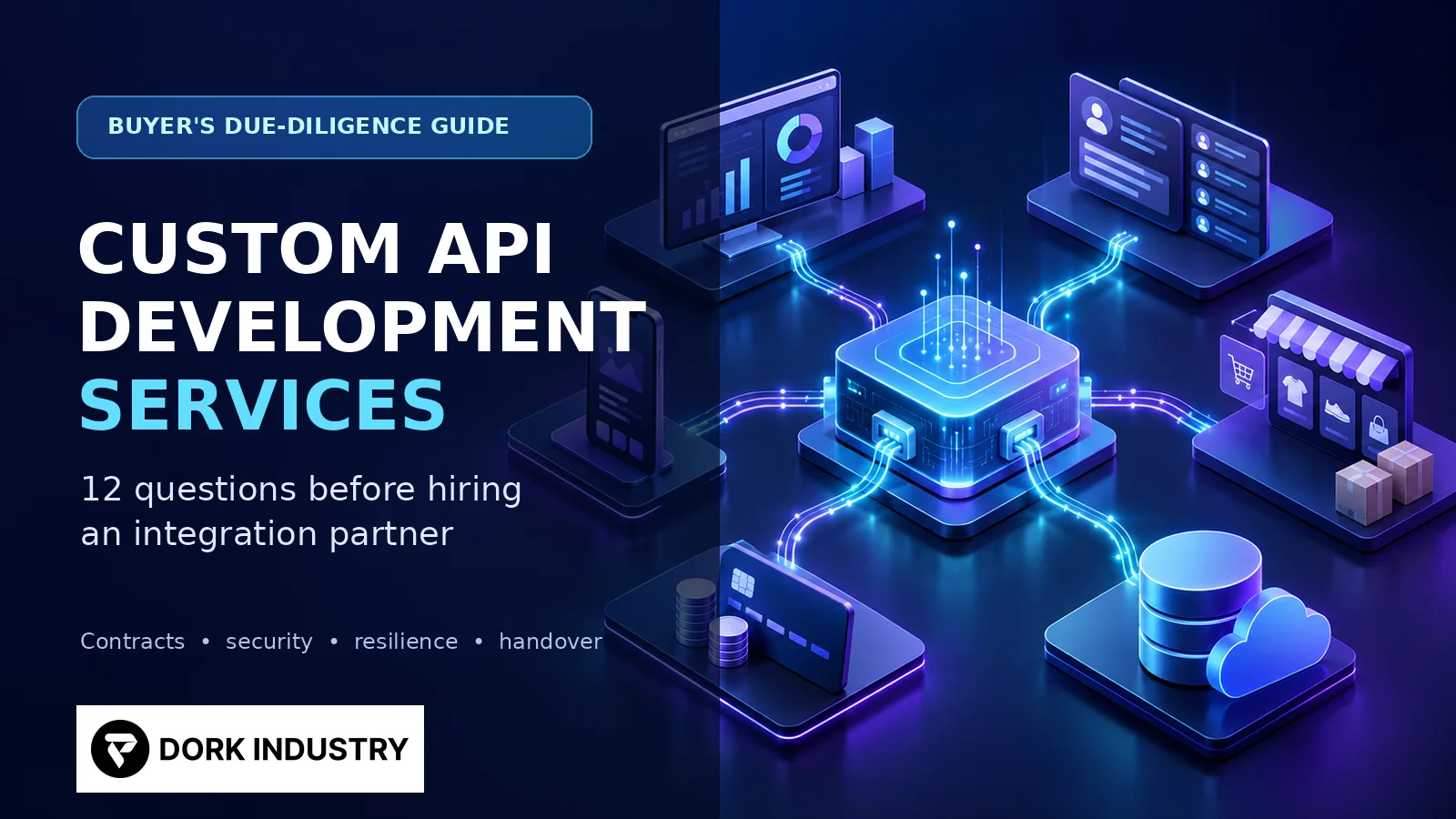
Custom API development services design, build and operate the interfaces that let ERP, CRM, ecommerce, mobile, payment and legacy systems exchange data reliably. Before hiring a partner, buyers should verify more than programming skill: the engagement must define system ownership, an API contract, access controls, failure recovery, observability, testing, versioning and a complete handover.
Quick answer
A strong API partner starts with the business workflow and data ownership, produces an agreed OpenAPI contract before implementation, tests normal and failure paths, instruments the integration for support, and transfers the repository, documentation, credentials process and runbook. A demo alone is not proof of production readiness.
This guide is for founders, product leaders, operations managers and technology teams preparing to connect software, replace spreadsheet transfers, expose services to a mobile app or repair an unreliable integration. It gives you 12 commercial questions, a build-versus-configure decision, an acceptance-evidence matrix and a small paid-pilot plan.
What are the key takeaways?
- Define the business event, system of record and failure consequence before selecting API technology.
- Require a reviewable OpenAPI contract, explicit permission model and operational recovery design.
- Judge custom API development services by test evidence, observable business outcomes and a controlled pilot—not a happy-path demo.
- Confirm ownership of the repository, documentation, deployment process, runbook and support boundary.
Planning an ERP, CRM, ecommerce or mobile integration?
Ask Dork Industry for a focused API architecture assessment before committing to a full build. We map the workflow, dependencies, risks and pilot boundary.
Why are buyers searching for custom API development services now?
The commercial trigger is usually not “we need an API.” It is a broken workflow: sales orders are retyped from ecommerce into an ERP; customer status differs between a CRM and support portal; a mobile app cannot access reliable inventory; or a payment event reaches one system but not another.
External Google Ads keyword research performed for this article found measurable exact-query demand for custom API development services across India, the United States, the United Kingdom, Canada, Australia, the UAE and Singapore. India had the highest measured volume among those tested markets at 70 average monthly searches, followed by the United States at 50. The three-month change was +200% in India and +125% in the United States at the time of research. These numbers are directional estimates—not guaranteed traffic—but the query clearly expresses a need to evaluate or hire a provider.
India is therefore the primary geographic context for this article, without turning it into a city doorway page. The architecture, procurement and acceptance criteria remain useful to global buyers considering an India-based delivery partner.
What do the current top results explain—and what do they miss?
We reviewed five current organic results for the target query: Cubix, Orases, Clutch’s Mumbai API-developer directory, WorldMetrics’ expert-picks page and Apriorit. The strongest pages explain API architecture, integration, migration, testing and common technology choices. Directory pages help with initial vendor discovery, while service pages establish capability and invite a consultation.
The recurring gap is buyer-side acceptance. Most pages do not tell a decision-maker who owns the data contract, how failed transactions are reconciled, what evidence proves resilience, how an API is deprecated safely, or what must be transferred at handover. This guide concentrates on those purchasing decisions.
What business problem should the API solve?
Write the workflow in plain language before discussing REST, GraphQL, webhooks or message queues. A useful statement names the event, source of truth, receiving system, acceptable delay and business consequence of failure.
Weak requirement: “Connect Shopify to our ERP.”
Testable requirement: “When a paid order is confirmed, create the ERP sales order within two minutes, reserve stock once, return the ERP order number to ecommerce, and place exceptions in a queue that operations can reconcile without developer access.”
Can you run this five-minute workflow diagnostic?
- Name the event that starts the workflow.
- Identify the system that owns each important field.
- List transformations, approvals and duplicate-prevention rules.
- Define the maximum acceptable delay.
- Describe what a human should see and do when automation fails.
If the team cannot agree on these answers, development estimates will hide assumptions. Custom API development services should make those assumptions visible before the main build.
Which 12 questions should you ask before hiring an API partner?
1. Will you map the workflow and systems of record first?
A partner should identify where customers, prices, inventory, orders and payment status are authoritative. Two systems must not silently become equal owners of the same field. Ask for a system map, data dictionary and decision log as discovery outputs.
2. Will you create the API contract before implementation?
An API contract should define endpoints, operations, request and response schemas, errors, authentication and examples. The OpenAPI Initiative publishes the authoritative OpenAPI specifications used to describe HTTP APIs in a machine-readable format. Contract-first work lets client, server and testing teams review the interface before code hardens a poor assumption.
3. How will identity and permissions be enforced?
Ask how users, services and tenants are authenticated and authorized. The answer should cover least-privilege permissions, token scope, secret storage, rotation, revocation and audit records. “We use an API key” is incomplete unless the provider explains who receives it, what it can do and how exposure is contained.
4. How will object-level access be tested?
The OWASP API Security Top 10 highlights risks such as broken object-level authorization, broken authentication, unrestricted resource consumption and unsafe consumption of third-party APIs. Request negative tests that prove one customer or tenant cannot read or change another customer’s resources.
5. What happens when either system is slow or unavailable?
Production integrations experience timeouts, rate limits and partial outages. The design should specify timeouts, bounded retries, backoff, circuit breaking where appropriate, dead-letter or exception handling and a reconciliation path. Repeatedly retrying a non-idempotent payment or order request can create duplicate business records.
6. How will duplicate and out-of-order events be handled?
Ask for idempotency rules, unique business keys and ordering assumptions. A reliable design can receive the same event more than once without duplicating its business effect. It should also explain what happens when “shipped” arrives before “confirmed,” or when delayed events are replayed.
7. What will operations be able to observe?
Logs alone are rarely enough. The team should define correlation or trace IDs, meaningful metrics, health checks, dashboards and alerts tied to business outcomes. OpenTelemetry documentation provides an open framework for generating and collecting traces, metrics and logs. Buyers should require evidence that a failed order can be followed across system boundaries.
8. Which tests are included?
Look for contract, unit, integration, authorization, load and failure-path tests. The acceptance plan should name test environments, representative data, expected results and who signs off. A successful happy-path demo is necessary, but it is not sufficient.
9. How will versions change without breaking consumers?
The proposal should describe backward compatibility, version identifiers, consumer notification, migration windows and deprecation. For third-party APIs, ask who monitors provider changes and how urgent upgrades are estimated. Versioning is a product-management commitment, not only a URL convention.
10. Who owns the code, cloud resources and documentation?
Confirm repository ownership, deployment access, infrastructure definitions, third-party licences and documentation rights in the contract. Avoid a handover that consists only of a code archive. Your team should be able to build, deploy, operate and modify the integration with the agreed access.
11. What support boundary and service level apply?
Define business hours, response targets, severity levels, monitoring responsibility and exclusions. Separate defects from new change requests. If an external ERP or payment provider changes its interface, the agreement should say who diagnoses the problem and how remediation is approved.
12. Can you prove the approach with a narrow paid pilot?
A good pilot implements one valuable workflow end to end, including an intentional failure and recovery. It should produce reusable artifacts rather than throwaway code. Agree the pilot’s success measures, evidence and decision date before work begins.
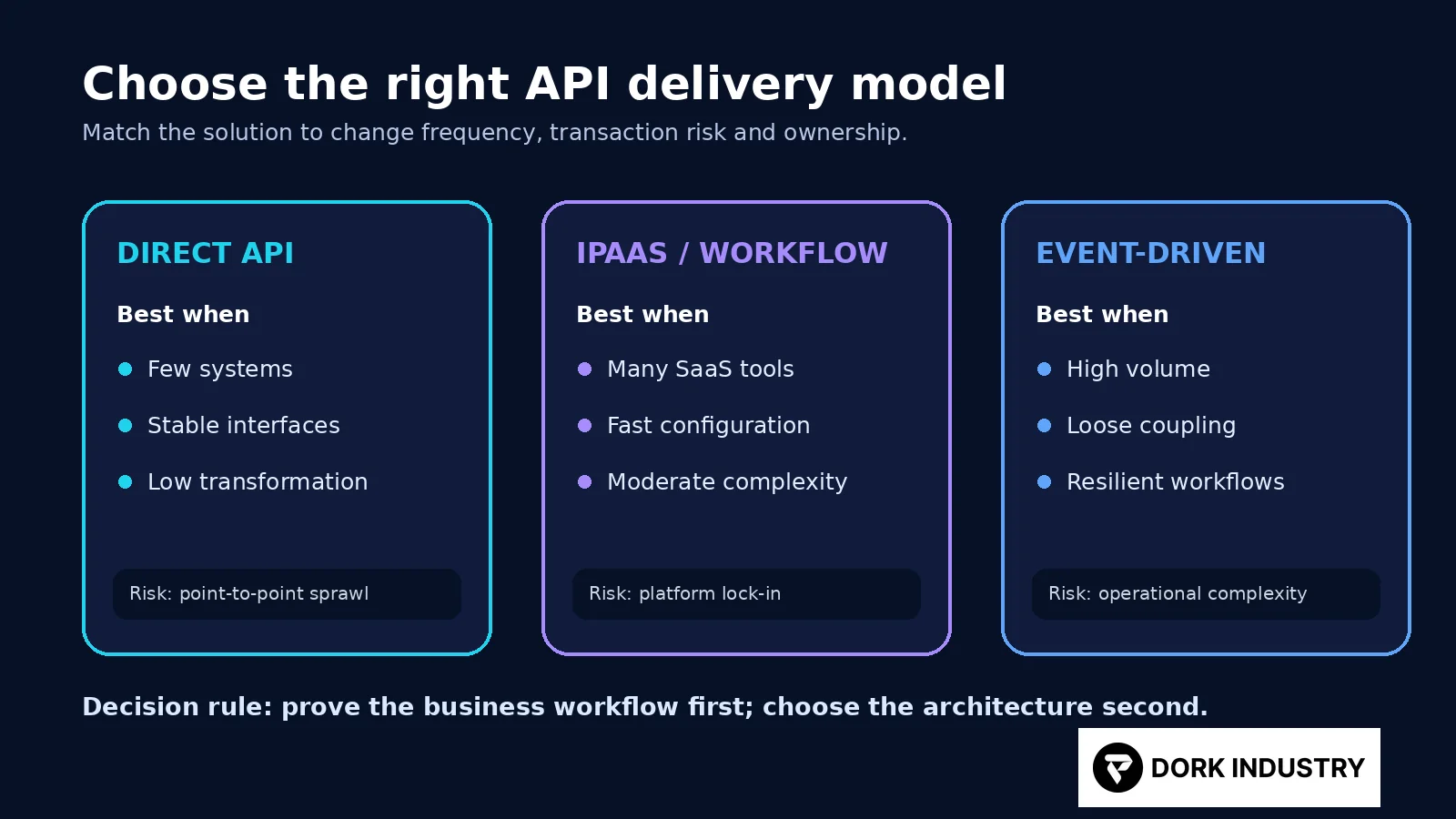
Should you build, configure or buy the integration?
| Option | Best fit | Main advantage | Question to resolve |
|---|---|---|---|
| Configure an existing connector | Standard systems and standard fields | Fastest route to value | Can it support your exceptions and volume? |
| Use an iPaaS or workflow platform | Several SaaS tools and changing workflows | Visual orchestration and reusable connectors | What are run costs, limits and exit options? |
| Build a direct custom API | Unique rules, tight control or product capability | Precise behavior and ownership | Who will operate and evolve it? |
| Use an event-driven layer | High-volume or loosely coupled workflows | Resilience and independent consumers | Can the team manage additional operational complexity? |
A hybrid is common: standard connectors for commodity transfers, custom services for differentiated rules and events for workflows that need resilience. Dork Industry’s custom application services and web development capabilities can cover the surrounding portal, workflow and operational tooling when an API alone is not the complete solution.
What data and privacy questions belong in the scope?
Inventory every sensitive field that crosses the interface, why it is needed, where it is stored, how long it is retained and who can access it. Remove unnecessary fields before transfer. Define masking for logs and test data, encryption requirements, regional hosting constraints, deletion behavior and audit evidence.
The NIST Secure Software Development Framework organizes secure development practices around preparing the organization, protecting software, producing well-secured software and responding to vulnerabilities. Buyers can use those practice areas to question a vendor’s development and maintenance process without prescribing a specific programming language.
What should the API project acceptance checklist include?
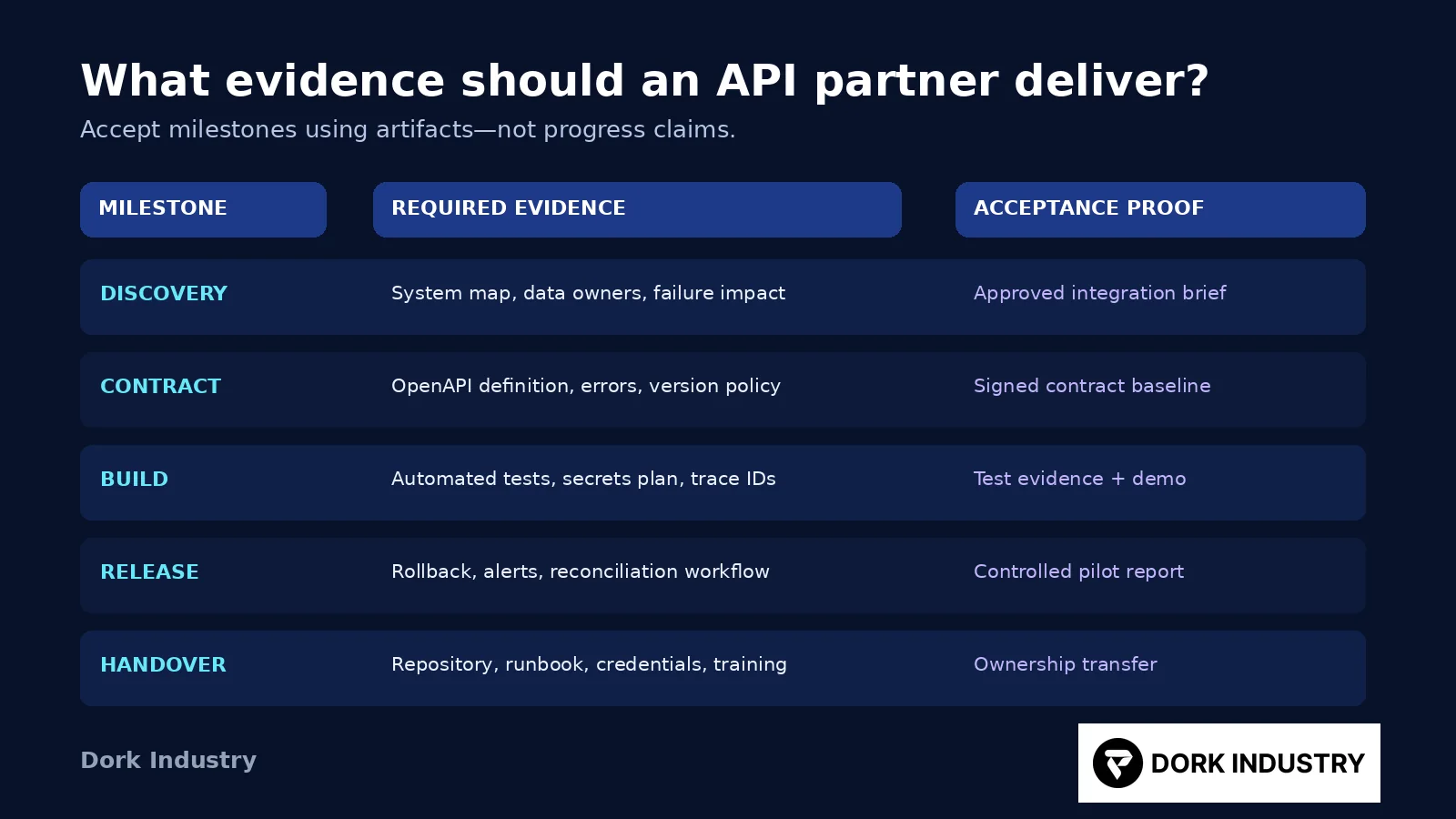
- Discovery: workflow map, system owners, field mapping, constraints and measurable success criteria.
- Contract: versioned OpenAPI definition, examples, errors, permissions and change policy.
- Build: source repository, automated tests, configuration strategy and traceable demo.
- Release: deployment record, rollback procedure, dashboards, alerts and reconciliation queue.
- Handover: runbook, architecture notes, access transfer, training and agreed support boundary.
How can you run a low-risk API pilot?
- Select one high-friction workflow. Choose a repeated manual transfer or unreliable integration with a measurable cost.
- Limit the boundary. Use one source system, one destination and a small set of business fields.
- Define success. Measure accuracy, latency, duplicate prevention, exception visibility and operator effort.
- Include a controlled failure. Pause a dependency, trigger a timeout or submit invalid data and demonstrate recovery.
- Review ownership. Confirm that the buyer can inspect the contract, repository, logs, dashboard and runbook.
- Make a go/no-go decision. Expand only when the pilot proves value and reveals an affordable operating model.
Need an independent scope before requesting quotes?
Dork Industry can map your systems, define the API contract and pilot one workflow before a larger implementation. The output is designed to support a build, integration, repair or vendor-hiring decision.
Email: support@dorkindustry.com | WhatsApp: +91 8210792477
Frequently asked questions about custom API development services
What is included in custom API development services?
They should include workflow discovery, data mapping, API contract design, authentication and authorization, implementation, automated testing, deployment, monitoring, documentation and handover. The exact scope depends on the systems, transaction risk, volume and support model.
How much does custom API development cost?
Cost depends on the number of systems and workflows, interface quality, data transformation, security requirements, transaction volume, testing depth and support expectations. A paid discovery or narrow pilot is more reliable than pricing from endpoint count alone.
How long does a custom API integration take?
A narrow, well-documented workflow may be piloted in weeks; multi-system programs take longer because discovery, access, data cleanup, approvals and testing become critical. Ask for milestones and acceptance evidence instead of relying only on a completion date.
Is an iPaaS better than a custom API?
Neither is universally better. An iPaaS suits common SaaS integrations and frequently changing workflows. A custom API suits unique rules, product features or tighter control. Some architectures combine both to balance speed, ownership and operating cost.
How do we prevent vendor lock-in?
Contract for repository ownership, portable API definitions, documented configuration, exportable data, deployment instructions and access to operational dashboards. Also document third-party dependencies, licences and a transition-assistance period.
Can Dork Industry repair an existing API integration?
Yes. A repair engagement can begin with logs, traces, API contracts, failure examples and business reconciliation records. Dork Industry can isolate whether the issue is contract mismatch, data mapping, permissions, rate limits, resilience, deployment or operational visibility.
What should you do next?
Do not begin by comparing programming languages or counting endpoints. Start with the workflow, the system of record, the financial consequence of failure and the evidence required at handover. Then evaluate custom API development services against the 12 questions above.
For an API assessment, integration pilot or existing-integration repair, contact support@dorkindustry.com or message Dork Industry on WhatsApp.
Discuss this for your business?
Book a free consultation — we scope the problem, outline the approach, and give you an honest verdict before any development is discussed.
About the author: The Dork Industry Editorial Team develops practical guidance with input from software, API integration, cloud and automation practitioners. Dork Industry helps businesses assess, build, integrate and repair custom applications and connected workflows. Editorial recommendations are based on documented buyer requirements, current primary technical sources and implementation-focused review. Learn more at dorkindustry.com.
Research note: Competitor and keyword research was completed on 17 October 2026. Keyword Planner figures are average estimates and can change by market, match type and date. Sources consulted include the OpenAPI Initiative, OWASP API Security Project, OpenTelemetry and NIST SSDF.