
Overview
A growing private school group operating 6 campuses (K–12) across a metropolitan region was managing core operations — admissions, attendance, fee collection, timetabling, exams, and parent communication — through a patchwork of spreadsheets, a legacy desktop accounting tool, and manual paper registers. As the group expanded from 2 to 6 campuses over three years, this fragmented approach caused mounting administrative overhead, data inconsistency, and poor visibility for leadership.
The client engaged our team to design and deploy a unified, cloud-based school management platform covering the full academic and administrative lifecycle — from admission inquiry to alumni record — with real-time dashboards for campus principals and the group’s central management office.
Project scope:
- 6 campuses, ~7,800 students, ~520 teaching/administrative staff
- Modules: Admissions, Attendance, Fee Management, Timetabling, Examinations & Report Cards, Parent-Teacher Communication, HR/Payroll (staff), Library, Transport
- Timeline: 16 weeks development + phased rollout, plus 45-day hypercare
- Team: 3 backend engineers, 2 frontend engineers, 1 mobile app developer, 1 data migration specialist, 1 QA engineer, 1 project manager
Key stakeholders:
- Group management/trustees (network-wide visibility, financial oversight)
- Campus principals (day-to-day academic and administrative control)
- Teachers (attendance, grading, communication)
- Administrative/front-office staff (admissions, fees, records)
- Parents (fee payments, progress tracking, communication)
The Challenge
The client came to us with operational pain points typical of a fast-scaling multi-campus institution that had outgrown manual/spreadsheet-based processes.
1. Fragmented Admissions Process
Each campus ran admissions independently using separate Excel sheets and paper forms, with no shared visibility for group management. This caused:
- Duplicate applications across campuses going unnoticed
- No standardized admission funnel tracking (inquiry → application → interview → offer → enrollment)
- Manual, error-prone data entry when converting an accepted applicant into a student record
2. Manual Attendance Tracking
Attendance was recorded on paper registers by teachers and manually compiled monthly for reporting. This resulted in:
- Delayed visibility into chronic absenteeism (often noticed only at term-end)
- No real-time parent notification when a child was marked absent
- ~3–4 hours/week per campus spent on manual attendance compilation by administrative staff
3. Inconsistent Fee Management
Fee structures varied by campus and grade, tracked in separate spreadsheets with manual reconciliation against bank deposits. Problems included:
- Frequent errors in fee calculation (especially with sibling discounts, scholarships, and installment plans)
- No automated reminders for overdue payments, relying on front-office staff to manually call parents
- Difficulty for group management to get a consolidated, real-time view of fee collection status across all 6 campuses
- Estimated 8–10% of fees collected late each term due to lack of systematic reminders
4. Timetabling Conflicts
Timetables were built manually by each campus’s academic coordinator using spreadsheets, leading to:
- Occasional teacher double-booking across sections
- Inefficient use of shared resources (labs, sports facilities) since there was no cross-campus resource visibility
- Time-consuming manual rework whenever a teacher was absent or a schedule change was needed (~half a day per major change)
5. Exam & Report Card Bottlenecks
Grades were collected from teachers via spreadsheets, manually compiled, and report cards formatted individually in Word/Excel. This caused:
- Report card generation taking 10–14 days after exams concluded
- Frequent transcription errors when consolidating marks from multiple subject teachers
- No historical academic performance trends easily accessible for a given student across years
6. Poor Parent Communication & Engagement
Parent communication relied on printed circulars, occasional SMS blasts, and phone calls, resulting in:
- Missed communications (circulars lost in student bags)
- No single channel for parents to track attendance, grades, fee dues, and school announcements
- High front-office call volume for routine queries (“Has my child paid the fee?” “What’s today’s homework?”)
7. No Centralized Reporting for Management
Group leadership had no consolidated, real-time dashboard to view enrollment trends, fee collection, staff attendance, or academic performance across all 6 campuses — every board meeting required a multi-day manual data-gathering exercise from each campus.
Quantified Business Impact (Pre-Solution)
| Issue Area | Impact |
|---|---|
| Late fee collection | 8–10% of term fees collected late |
| Admin time on attendance compilation | 3–4 hrs/week per campus (~18–24 hrs/week network-wide) |
| Report card turnaround | 10–14 days post-exam |
| Front-office query call volume | ~40–50 calls/day per campus on routine queries |
| Board reporting prep time | 4–5 days per quarter, manually compiled |
| Duplicate/erroneous admissions records | ~15–20 cases/year requiring manual cleanup |
Solution
We designed and built EduManage Pro, a unified cloud-based school management platform, with the following core modules:
1. Admissions & Enrollment Management
- Centralized inquiry-to-enrollment funnel visible across all campuses, with automatic duplicate-application detection (matching by name, DOB, parent contact).
- Online application forms with document upload, automated status updates to parents via email/SMS.
- One-click conversion of an accepted applicant into a full student record, eliminating manual re-entry.
2. Digital Attendance System
- Teachers mark attendance via a mobile/web app in under a minute per class, with biometric/RFID card integration offered as an optional add-on for larger campuses.
- Instant parent notification (SMS/app push) the moment a student is marked absent.
- Real-time absenteeism dashboards flagging students with attendance patterns below a configurable threshold, so counselors can intervene early rather than at term-end.
3. Automated Fee Management
- Configurable fee structure engine supporting per-campus, per-grade fee plans, sibling discounts, scholarships, and installment schedules.
- Online payment gateway integration (cards, UPI, net banking) with automatic receipt generation.
- Automated reminder workflows (SMS/email) triggered at configurable intervals before and after due dates.
- Real-time, consolidated fee collection dashboard for group management, filterable by campus, grade, or payment status.
4. Intelligent Timetabling
- Drag-and-drop timetable builder with automatic conflict detection (teacher double-booking, room/resource clashes).
- Cross-campus shared resource visibility for institutions sharing specialized facilities (e.g., a science lab used by two nearby campuses).
- One-click substitute teacher suggestion when a scheduled teacher is marked absent, based on subject expertise and current free periods.
5. Examinations & Report Card Automation
- Teachers input marks directly through the platform (web/mobile), validated against expected mark ranges to catch data-entry errors.
- Automated grade computation (weighted averages, grading scales, rank calculation) and auto-generated report cards in the school’s branded template.
- Report card turnaround reduced from manual compilation to same-day generation once all marks are submitted.
- Historical academic performance view per student, tracking trends across terms and years.
6. Parent-Teacher Communication Portal
- Single mobile app/web portal for parents to view attendance, grades, fee status, homework, and school announcements.
- Direct messaging channel between parents and teachers, plus broadcast announcements from school administration.
- Digital circulars with read-receipt tracking, replacing printed notices.
7. HR & Staff Management
- Staff attendance, leave management, and payroll processing integrated with the same platform.
- Performance review workflows and document management (contracts, certifications) per staff member.
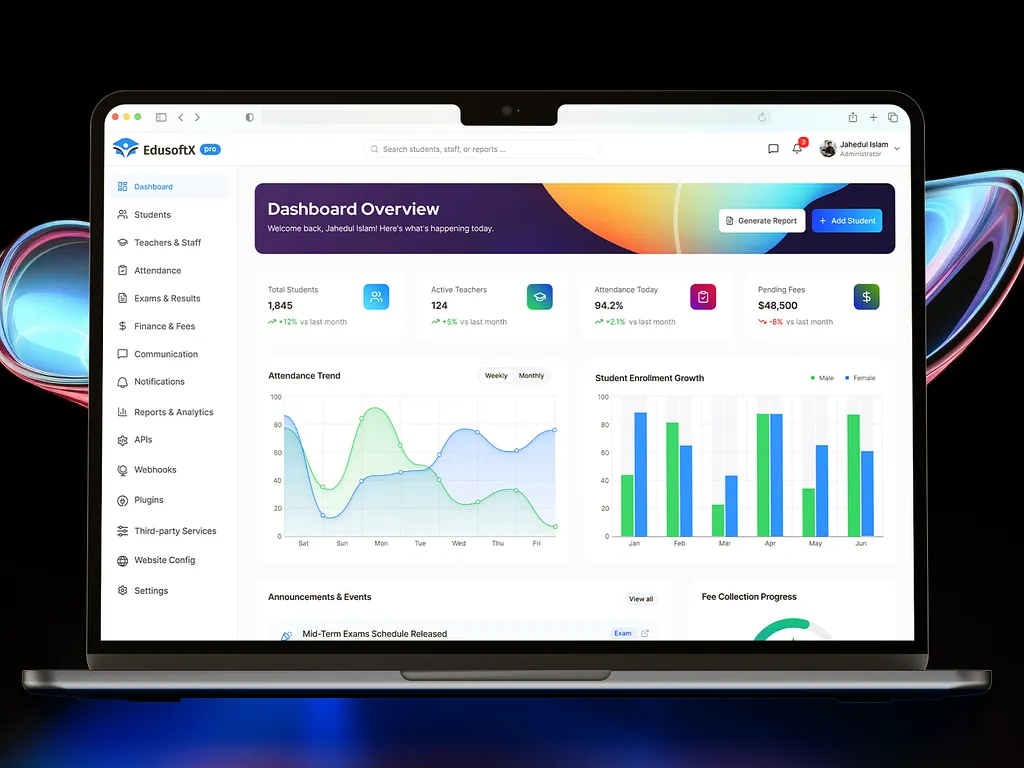
8. Centralized Management Dashboard
- Real-time, group-wide dashboard for trustees/management showing enrollment trends, fee collection status, staff attendance, and academic performance summaries across all 6 campuses.
- Configurable automated reports generated on a schedule (weekly/monthly/quarterly) for board meetings.
Implementation
Phase 1: Requirements Gathering & Data Audit (Weeks 1–3)
- Conducted workshops with campus principals, front-office staff, and group management to map existing workflows across all 6 campuses.
- Audited existing data sources: spreadsheets, the legacy accounting tool, and paper records, to plan migration.
- Identified campus-specific variations in fee structures and grading systems that the platform needed to support via configuration rather than hardcoding.
Phase 2: Platform Architecture & Design (Weeks 4–5)
- Designed a multi-tenant architecture allowing each campus to operate with its own configuration (fee structures, grading scales, academic calendar) while rolling up into a unified group-level view.
- Planned role-based access control: principals see campus-wide data, teachers see their classes only, parents see only their own child’s data.
- Designed the mobile app (parent + teacher facing) alongside the web admin portal.
Phase 3: Core Development (Weeks 6–11)
- Built admissions, attendance, fee management, and timetabling modules first, as these addressed the highest-impact pain points.
- Integrated payment gateway and SMS/email notification services.
- Developed the exam and report card module with configurable templates to match each campus’s existing report card format (important for parent familiarity during transition).
Phase 4: Data Migration (Weeks 9–12, overlapping development)
- Migrated 3 years of historical student records, attendance history, and fee records from spreadsheets and the legacy system.
- Ran extensive data validation to catch and correct inconsistencies surfaced during migration (e.g., mismatched student IDs across different source files).
Phase 5: Pilot Testing (Weeks 12–13)
- Piloted the full platform at 2 campuses (one larger flagship campus, one smaller campus) for 2 weeks before wider rollout.
- Gathered feedback from teachers and front-office staff on usability; refined the attendance-marking flow and fee reminder templates based on pilot feedback.
Phase 6: Phased Rollout & Training (Weeks 14–16)
- Rolled out to the remaining 4 campuses in two batches of 2 campuses/week.
- Conducted on-site training sessions: half-day for teachers (attendance, grading, communication features), full-day for front-office/admin staff (admissions, fees, reporting).
- Ran a parent onboarding campaign (email + SMS with app download instructions and a short how-to video) ahead of each campus’s go-live.
Phase 7: Post-Launch Support
- 45-day hypercare period with a dedicated support channel for teachers and front-office staff during the transition from old processes.
- Weekly check-ins with each campus principal during the first month to address adoption friction.
- Iterative refinement of automated fee reminder timing and report card templates based on real-world usage.
Results / Outcome
Quantitative Results (First Academic Term Post-Rollout)
| Metric | Before | After | Improvement |
|---|---|---|---|
| Late fee collection | 8–10% of term fees | ~2–3% | ~70–75% reduction |
| Attendance compilation admin time | 18–24 hrs/week (network-wide) | Near-zero (automated) | ~95% reduction |
| Report card turnaround | 10–14 days | Same-day (post marks submission) | ~90% faster |
| Front-office routine query calls | 40–50/day per campus | 12–15/day per campus | ~70% reduction |
| Board reporting prep time | 4–5 days/quarter | Real-time (on-demand) | ~95% time reduction |
| Duplicate/erroneous admission records | 15–20/year | 1–2/year | ~90% reduction |
| Parent app adoption rate | N/A (no app existed) | 87% of parent base within first term | High engagement |
Financial Impact
- Recovered fee revenue from reduced late/missed payments estimated at ₹40–50 lakh (~$48K–60K) annually across the 6-campus network.
- Administrative time savings equivalent to freeing up ~1.5 full-time front-office roles per campus, redirected to higher-value parent engagement and academic support tasks.
- Estimated overall ROI payback period: approximately 6–7 months.
Operational & Qualitative Outcomes
- Group management gained a real-time, single-dashboard view of enrollment, finances, and academic performance across all 6 campuses for the first time — board meetings shifted from data-gathering exercises to strategic discussions.
- Teachers reported significant time savings on attendance and grading, redirecting more time to actual instruction and student support.
- Early-warning attendance flags enabled counselors to intervene with at-risk students weeks earlier than the previous term-end discovery pattern.
- Parent satisfaction improved measurably, with the parent portal/app becoming the primary channel for fee payments and academic updates, reducing reliance on phone calls and printed circulars.
- Onboarding a new 7th campus (opened mid-year) onto the platform took under a week, compared to what would previously have been months of manual process setup.
Client Feedback
The client’s group management described the platform as transforming the institution from “six schools running independently on paper and spreadsheets” to “one connected network with real-time visibility” — citing the fee automation and centralized reporting as the two highest-value improvements for leadership, and the parent communication portal as the most appreciated feature among families.
Future Roadmap (Discussed with Client)
- Adding a learning management system (LMS) layer for digital assignments and online learning content.
- Building predictive analytics for academic performance trends to flag students needing early academic intervention, similar to the attendance early-warning system.
- Extending transport module with live bus tracking for parent visibility.
- Standardizing the onboarding playbook further to support the group’s planned expansion to 10+ campuses over the next two years.
