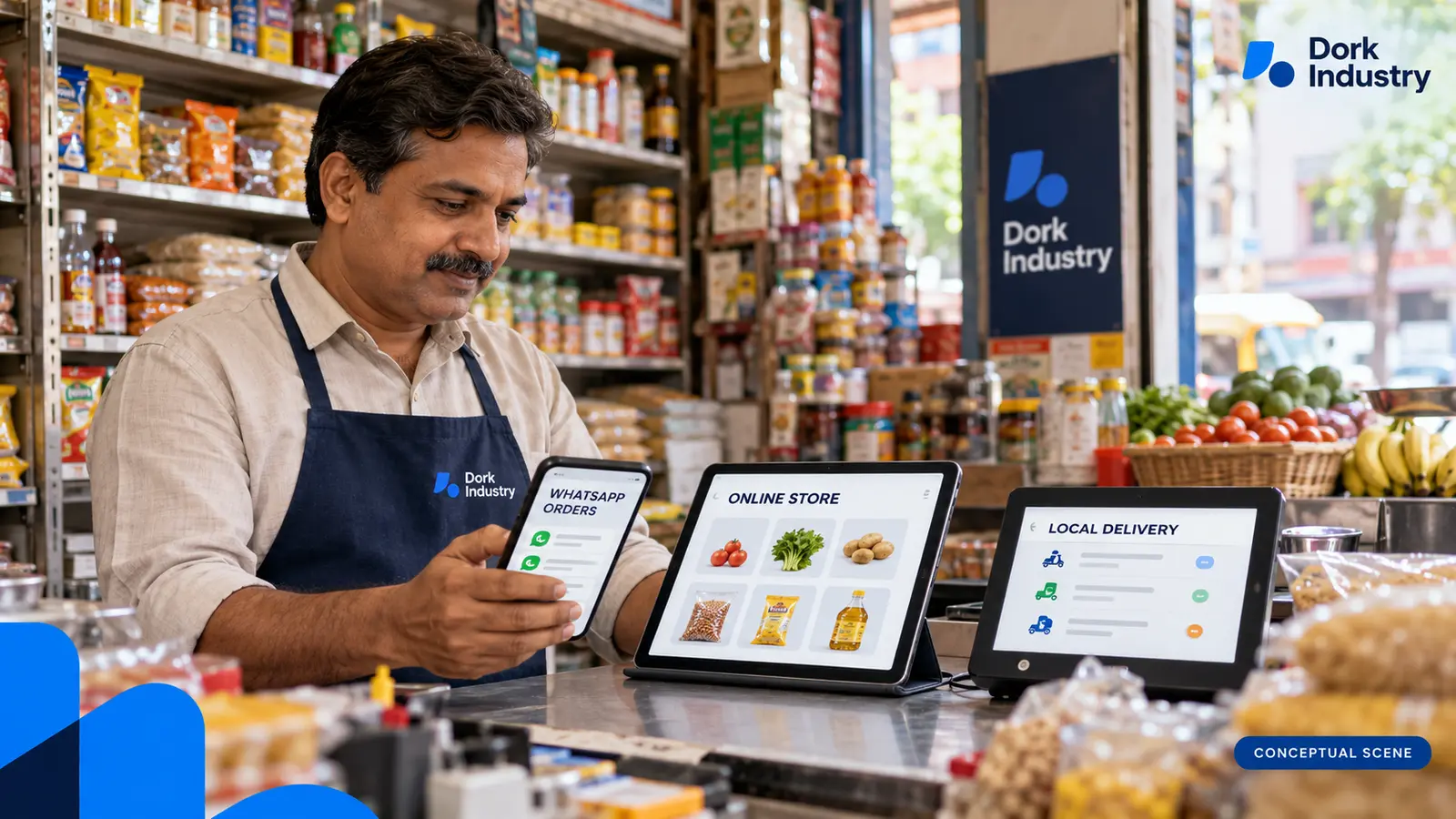
How can a grocery shop take online orders? Start with the simplest channel the shop can operate reliably: structured WhatsApp ordering for a small catalogue, an ecommerce website for searchable products and checkout, or a custom application only when repeat-order and operational requirements justify it.
The technology is not the first decision. A Delhi grocery shop must first know which products are available, who confirms each order, which addresses it can serve, how substitutions work and who handles picking, payment, delivery and customer questions. A sophisticated storefront connected to unreliable stock can create more confusion rather than more sales.
What problem must the grocery shop solve first?
The customer sees a catalogue and a checkout button. The shop must manage the less visible work: item availability, pack sizes, substitute products, delivery boundaries, minimum order rules, payment confirmation, picking priority, dispatch and returns. Online ordering fails when these decisions live only in one employee’s memory.
Begin by choosing one service area and a manageable set of products. A neighbourhood shop does not need to copy the operating model of a quick-commerce company. It needs an ordering promise that its own stock, staff and delivery capacity can support consistently.
If the immediate problem is that the owner cannot identify fast- and slow-moving products, first read Dork Industry’s guide to inventory management for Delhi retailers and wholesalers. Catalog publishing should follow a stock-control decision, not hide the absence of one.
What is the minimum workable online-ordering flow?
- Customer identifies the shop and delivery area. Do not accept an address the shop cannot serve.
- Customer selects products and quantities. Use consistent names, pack sizes and prices.
- The shop validates availability. Define whether stock is live, periodically updated or manually confirmed.
- Substitutions are approved. Never silently replace a requested brand or pack size.
- Payment is confirmed. State which online and pay-on-delivery methods are supported.
- Staff pick and pack the order. Assign an owner and record unavailable items.
- Delivery or pickup is completed. Provide a realistic slot rather than an unsupported speed promise.
- Exceptions are handled. Record cancellation, damaged-item, refund and support rules.
This workflow can begin manually and become more integrated as orders increase. Automation should remove repeated handling only after the shop has agreed how each exception should work.
How can a grocery shop take online orders: which option fits?
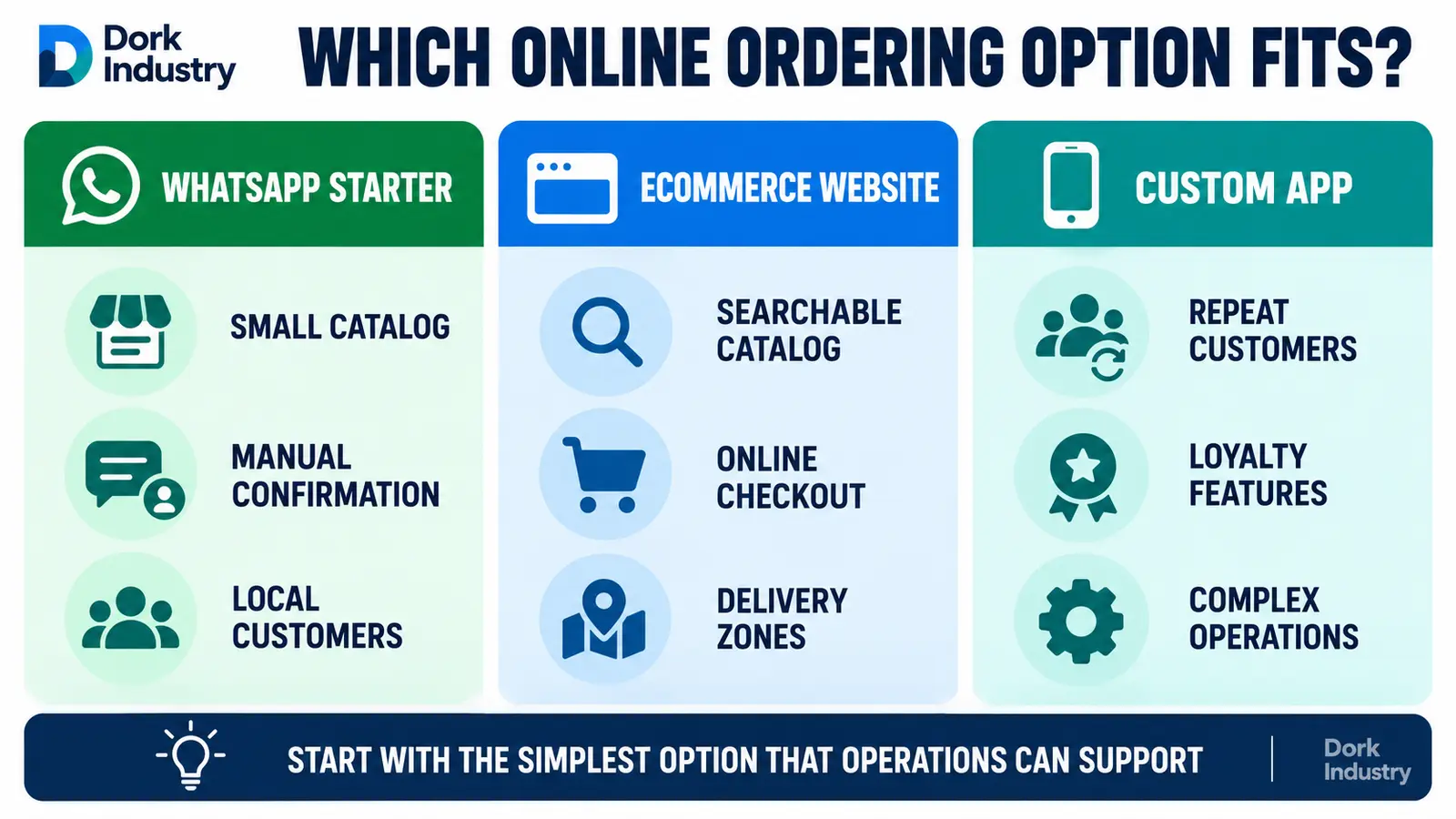
| Option | Good starting condition | Main limitation | Likely project |
|---|---|---|---|
| Structured messaging | Small catalogue and familiar local customers | Manual search, confirmation and reporting | Catalogue, order template and operating process |
| Shopify or WooCommerce website | Searchable catalogue, online checkout and delivery zones are required | Needs accurate product, stock and fulfilment ownership | Ecommerce setup, customisation and integrations |
| Custom web application | Special pricing, multiple stores, complex routing or account rules | Higher product and maintenance responsibility | Discovery, UX, software build and integration |
| Native mobile application | Proven repeat usage and app-specific features | Installation and ongoing platform maintenance | Mobile product development and backend services |
Do not select a mobile app merely because large delivery businesses have one. For many local shops, a responsive website gives customers a searchable catalogue and checkout without requiring an installation.
When is an ecommerce website better than WhatsApp ordering?
A website becomes useful when customers need to search many products, see pack sizes, build a basket, choose delivery or pickup and receive a consistent order record. It also gives the shop structured product and order data that can later connect to inventory, accounting or customer follow-up.
According to Shopify’s current fulfilment documentation, merchants can configure locations, order routing, local delivery, pickup and customer notifications. According to WooCommerce’s official documentation, geographic shipping zones can include postcode-level matching, while local pickup is available as a core shipping method. These capabilities support local ordering, but neither platform decides the shop’s real delivery boundary or picking capacity. See the official Shopify fulfilment guide and WooCommerce shipping-zone guide.
Choose Shopify when a hosted commerce platform and standard operating model fit. Choose WordPress with WooCommerce when the business needs WordPress content flexibility and accepts responsibility for hosting, updates and extension compatibility. Consider custom development only when standard configuration cannot express the required workflow.
When does a custom grocery app make sense?
A custom app should solve requirements that a responsive store and existing tools cannot handle economically. Examples include customer-specific catalogues, negotiated B2B prices, several fulfilment locations, reusable shopping lists, controlled subscriptions, delivery-agent workflows or integration with a specialised inventory system.
Before approving an app, validate the repeat-order journey on a website or controlled pilot. The paid scope should name user roles, catalogue ownership, stock source, payment flow, serviceable areas, substitution approval, order status, customer support and ongoing maintenance.
Dork Industry can connect this assessment to its verified web development and custom software development capabilities. The recommendation should follow the operating requirement rather than forcing a preferred technology.
How should a grocery shop check online-order readiness?
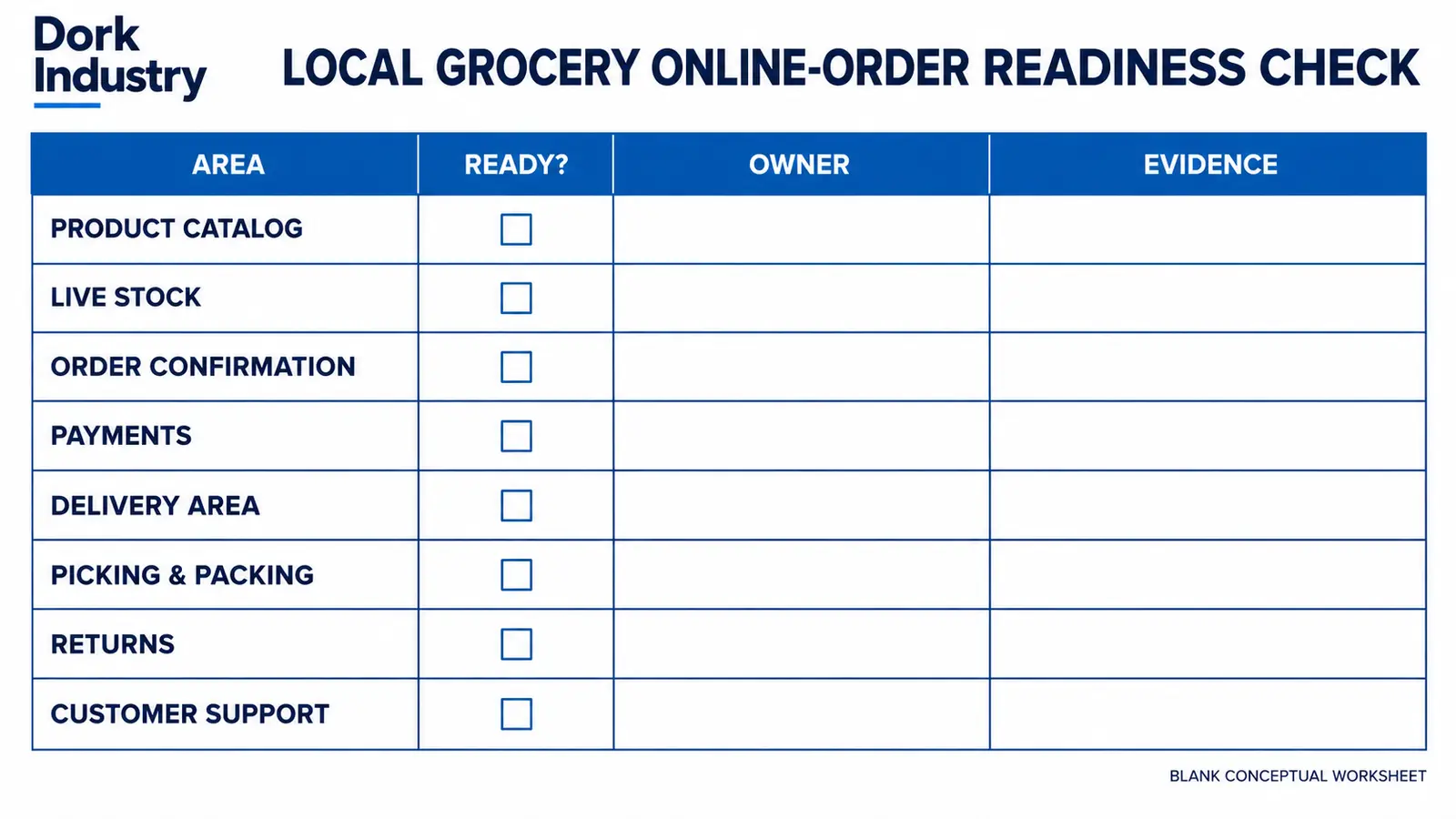
Complete the worksheet before choosing a platform. For every area, name an owner and attach evidence such as a sample product sheet, postcode list, packing checklist or approved return rule.
| Readiness area | Decision required | Minimum evidence |
|---|---|---|
| Catalogue | Which products, variants and pack sizes will be online? | Approved sample catalogue |
| Stock | Live sync, scheduled update or manual confirmation? | Stock ownership rule |
| Delivery | Which postcodes, fees and time slots are supported? | Service-area list |
| Substitution | When must the customer approve a replacement? | Substitution policy |
| Payment | Which prepaid and pay-on-delivery methods are accepted? | Payment workflow |
| Exceptions | Who handles cancellations, returns and missing items? | Named owner and process |
How should the shop launch a small pilot?
Launch to one delivery area with a controlled catalogue and agreed operating hours. Place test orders for an available item, an unavailable item, a substitute, a cancelled order, a pickup order, a delivery outside the supported zone and a payment exception. Capture what the customer and shop staff see at every step.
Measure operational facts rather than promising revenue: accepted orders, rejected addresses, stock mismatches, substitution decisions, packing errors, support contacts and incomplete deliveries. These observations reveal whether the next investment should be better catalogue data, ecommerce configuration, inventory integration, delivery software or a custom application.
What do grocery owners ask about online ordering?
Does a grocery shop need a mobile app to take online orders?
No. A shop can begin with structured messaging or a responsive ecommerce website. A custom app becomes relevant when proven repeat usage, loyalty features, multiple locations or specialised operational workflows justify the additional build and maintenance responsibility.
Should the shop use Shopify or WooCommerce?
Shopify offers a hosted commerce model, while WooCommerce runs within WordPress and offers more direct control over the site and extensions. The decision depends on catalogue complexity, integrations, internal maintenance capacity and the required checkout and delivery workflow.
How can the shop avoid accepting unavailable products?
Define a stock source and update frequency before launch. Use live integration where justified, scheduled stock updates for simpler operations or manual confirmation for a small pilot. The customer must be told when an order is provisional rather than confirmed.
Can online ordering guarantee higher grocery revenue?
No. An ordering channel can improve access and convenience, but revenue also depends on demand, pricing, assortment, availability, fulfilment and customer experience. Test the workflow and measure real orders and exceptions before expanding the investment.
How large should the first online catalogue be?
Use a catalogue the team can keep accurate and fulfil reliably. Include representative categories and pack sizes, but avoid publishing every item if stock and product data cannot be maintained. Expand after the pilot identifies a repeatable operating process.
What should the shop send when requesting a development estimate?
Provide the catalogue size, delivery postcodes, store locations, payment choices, stock system, expected order flow, substitution rules and examples of unusual orders. State whether the requirement is a pilot, website, integration, repair or custom product.
Discuss this for your business?
Book a free consultation — we scope the problem, outline the approach, and give you an honest verdict before any development is discussed.