AI automation can handle fintech data entry — document classification, OCR extraction, field validation, duplicate detection — but it must never own the compliance decision. Yes: a fintech can cut manual data-entry effort dramatically while keeping full control of KYC and compliance evidence, provided the system is built as a human-in-the-loop pipeline in which every automated step leaves evidence a human can replay and an examiner can audit. The expensive failures in this industry are not slow keyboards. They are onboarding queues that stall for weeks, extraction errors that silently become official KYC records, and audit trails that collapse the moment an examiner asks the simplest question: show me exactly how this customer’s record was created.
This article examines how a fintech can automate data entry without surrendering control: where manual entry actually fails, why KYC is the wrong place for full automation, what AI automation should concretely do, what it must never do alone, how to pilot it in 30 days, and what drives the cost.

Where does manual data entry actually break a fintech?
Before discussing technology, it is worth naming the specific failures. In our experience working with lending and payments businesses, the expensive problems are rarely about typing speed. They are about decisions hiding inside the data-entry queue.
Why do onboarding teams drown in document queues?
Every application arrives with three to five documents — an identity proof, an address proof, income evidence, a photograph, sometimes a bank statement. Each one must be classified, read, validated against the application form, and entered. On peak days the queue compounds; a three-day backlog becomes a three-week one. Customers drop off while waiting. The bottleneck is not how fast analysts type — it is that every document quietly demands a judgment call: is this the right document, is it legible, does it match the name on the form?
Why do the same errors recur every month?
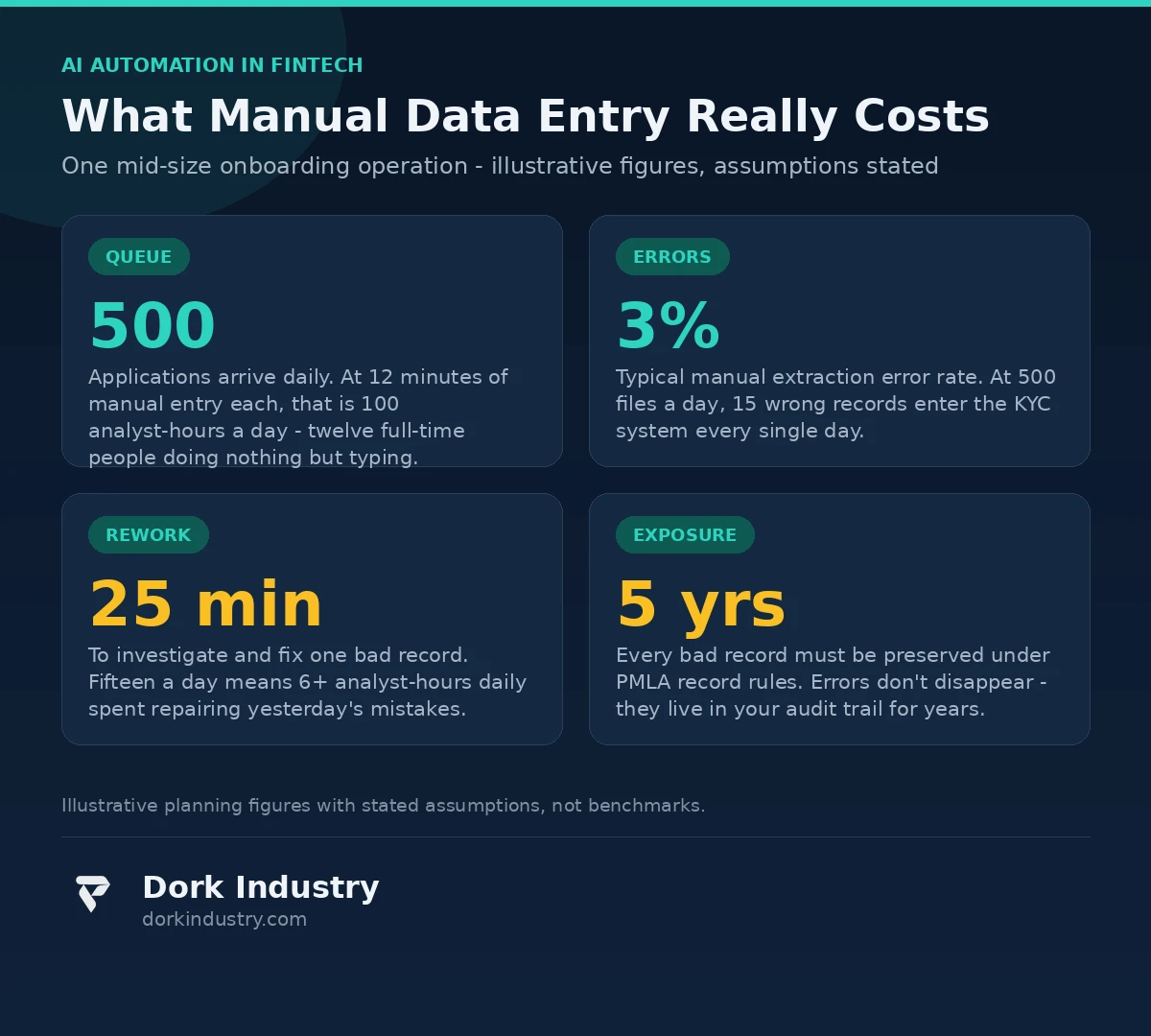
Tired analysts mistype document numbers, transpose dates of birth, and misread blurred scans. These errors are usually discovered late — at disbursal, or worse, during an internal audit. The same fields fail repeatedly because nothing in a manual process learns: every fix is local, applied to one record, while the underlying failure repeats across thousands. An error rate that looks small on a dashboard — two or three percent — translates into dozens of wrong records entering the system every day.
Why does the audit trail collapse?
Decisions get made in email threads, chat messages, and spreadsheet comments. A field is corrected, but the record of who corrected it, based on what document, and why, lives nowhere. When an examiner asks how a customer’s record was created, the team spends days reconstructing it from fragments. The manual process does not just produce errors — it produces errors nobody can explain afterwards.
Why is KYC data entry the wrong place for full automation?
KYC decisions are legal determinations with liability attached. Automating the typing is safe; automating the judgment is not. The regulatory framework makes this explicit: according to the RBI’s Know Your Customer (KYC) Amendment Directions, 2025, regulated entities must record customer intimations in their systems against each customer for audit trail. The same evidence discipline applies to every automated extraction: if a system changed a record, the record must show what changed, when, and on whose authority.
And the evidence lives a long time. Under the PMLA (Maintenance of Records) Rules, 2005 — referenced throughout the RBI’s KYC directions — reporting entities must preserve transaction records for five years from the transaction date, and client-identification records for five years after the business relationship ends. Every bad record an automated system creates is preserved, with your name on it, for years.
What must happen when an examiner asks to replay a decision?
An examiner does not ask whether your software is clever. They ask for the evidence chain: the source document, the extracted values, the confidence at extraction time, the human who approved the record, and the timestamp of the approval. A pipeline that auto-approves applications cannot answer “who decided and why” — and “the model decided” is not an acceptable answer in a compliance review. Any AI automation design must be able to replay any record, field by field, to the exact state an examiner needs to see.
Why do sanctions and watchlist hits demand human judgment?
Name matching against sanctions lists is probabilistic: transliteration variants, common names, and partial matches generate both false positives and false negatives. A false positive blocks a legitimate customer and creates a grievance; a false negative is a regulatory catastrophe. According to the FATF’s Guidance on Digital Identity, reliable digital ID can make customer identification easier and more secure — provided the assurance levels of the technology are understood. That is precisely the boundary: technology can surface and rank the matches, but only a trained human can clear a hit.
What data does your fintech already have — and what is it missing?
Most fintechs already generate the raw material: scanned identity documents, application forms, CRM notes, email threads with customers, prior KYC records, and in many cases CKYCR reference numbers. What is missing is structure. Documents are not linked to the fields extracted from them. Nobody records how confident the reading was. Decision provenance — who verified what, against which document — does not exist as data.
AI automation for data entry does not create new work for your analysts; it captures the verification they already do in evidence form. The most common implementation failure is designing for extraction accuracy while ignoring the review workflow. If the exception queue is painful to work in, analysts will rubber-stamp everything — and you will have automated the appearance of verification while losing the reality of it.
What does AI automation actually do inside a KYC data-entry pipeline?
Strip away the marketing, and a defensible pipeline has six concrete jobs:
- Document classification: route each upload — identity proof, address proof, income evidence, photograph, bank statement — without an analyst triaging the inbox first.
- Intelligent extraction: pull name, date of birth, address, and document numbers from each document, with a per-field confidence score attached to every value.
- Cross-document consistency: check that the name on the PAN card matches the name on the Aadhaar card, that the address on the application matches the address proof, and flag mismatches before they become records.
- Duplicate detection: catch the same document number or photograph appearing across multiple applications — the classic fraud and re-entry signal.
- Evidence packaging: bundle every extraction with its source image, timestamp, document hash, and model version, so the record is self-describing.
- Exception queues: route only low-confidence or inconsistent fields to analysts, with the exact reason for review attached — not the whole document.
Notice the pattern: the AI prepares, cross-checks, and packages. The human decides. That division is the entire product.
What must the system never do on its own?
Technology boundaries in AI automation matter more than features when compliance evidence is at stake:
- Never approve or reject a KYC application without a named human approver attached to the decision.
- Never clear a sanctions, PEP, or watchlist hit on its own. The system may rank and summarize matches; only a trained human clears them.
- Never delete or overwrite source documents. Originals are immutable; corrections arrive as new versions with their own evidence trail.
- Never backfill missing fields by guessing. A blank field is evidence too — it records that the document did not contain the information.
- Never hide its confidence. Every auto-filled field must show how sure the system was, so reviewers know where to look.
- AI should draft, route, and package evidence — never sign off. The signature on the record is always a person’s.
Should you build or buy? An honest breakdown
Not every fintech needs custom AI automation. The honest options, in order of investment:
| Approach | Best for | Evidence quality | Where it breaks |
|---|---|---|---|
| Manual teams only | Tiny volumes, simple documents | Depends on analyst discipline; usually degrades | Queues compound, errors recur, nothing is replayable |
| Off-the-shelf IDP / OCR SaaS | Extraction at scale with standard documents | Good if you configure retention and audit exports | Generic confidence models; evidence packaging is your problem |
| KYC vendor suites | Full onboarding with watchlist screening built in | Strong out of the box | Their workflow, their roadmap; switching costs are high |
| Custom AI automation pipeline | High volumes with custom workflows and evidence needs | Strongest — you define the evidence model | Overkill under ~50 applications a day; needs compliance-first design |

At Dork Industry, we regularly advise fintechs against custom builds when an IDP product plus disciplined review workflows fits. A credible technology partner should be willing to tell you that packaged software is enough. If every consultation ends with a quotation for a custom pipeline, get a second opinion. Before you buy anything, read our companion piece on how to test AI document automation before buying — the 12 tests there apply directly to any vendor shortlist.
What does the math look like? An illustrative example
Consider a lending fintech processing 500 applications a day, each with about five documents. Assume 12 minutes of manual data entry per application, analysts costing ₹700 per hour fully loaded, and a 3% field error rate. That is 100 analyst-hours a day — roughly twelve full-time people doing nothing but typing — costing about ₹2 crore a year. A further assumption: each of the ~15 bad records a day takes 25 minutes to investigate and fix, adding 6+ hours of rework daily that never appears in the headcount plan.
Now assume AI automation straight-through processes 70% of applications with no human touch, analysts review only flagged exceptions at about 5 minutes each, and the error rate on reviewed fields falls below 1%. Daily analyst effort drops from 100 hours to roughly 12–15. The annual data-entry cost falls from ~₹2 crore toward ~₹40 lakh. These are illustrative figures with stated assumptions, not industry benchmarks — but they show why the queue, not the typing, is the real cost: the savings come from eliminating rework and backlog, not just from typing faster.
How do you test it in 30 days before full investment?
The lowest-risk path is a single-document-type pilot with evidence replay as the pass criterion:
- Week 1: pick one document type (PAN cards are the classic start). Run 500 historical documents through extraction and measure accuracy against your analysts’ verified records.
- Week 2: shadow mode on live applications — the AI extracts, analysts verify everything, and every decision stays human.
- Week 3: turn on the exception-queue workflow for one product line: only low-confidence fields reach analysts, with reasons attached.
- Week 4: measure throughput, error rate, review time per exception, and — most importantly — run a mock evidence replay: pick ten random records and reconstruct their full history.
If the evidence replay fails even once — a missing source document, an untimestamped correction, a decision nobody can attribute — do not scale. The pilot validates the evidence model, not just the extraction accuracy. This is the assessment Dork Industry runs before quoting any fintech document project: map the current entry process, name the evidence gaps, then decide what automation earns its cost. Our AI automation services page describes how we structure these engagements.
What actually drives the cost of AI automation for fintech data entry?
- Document variety: five document types is a project; fifty is a program. Each new layout needs extraction templates and confidence tuning.
- Language mix: English-only documents are the easy case; regional scripts on Indian IDs multiply the extraction work.
- Evidence model depth: hashing, versioning, immutable storage, and five-year retention architecture cost real engineering — this is where cheap pilots die.
- Watchlist integration: sanctions screening APIs, fuzzy-matching tuning, and the review tooling around hits are a project on their own.
- Exception-queue UX: the analyst review interface decides whether the human-in-the-loop actually works. Underinvest here and reviewers rubber-stamp.
- Data residency: on-premise or India-region cloud deployment for regulated data changes the infrastructure bill.
Anyone quoting a fixed price without asking about document types, languages, retention requirements, and the review workflow is guessing.
Frequently asked questions
Can AI automation fully replace KYC analysts?
No — and it should not try. Regulators hold people and institutions accountable, not models. AI automation can classify documents, extract fields, and package evidence far faster than analysts, but every KYC decision still needs a named human approver. The realistic target is analysts handling exceptions and judgments, not typing.
How accurate is automated document extraction?
Modern intelligent document processing reaches the high nineties on clean, standard documents. Blurred scans, skewed mobile photos, and unusual layouts drag accuracy down — which is why per-field confidence scores and exception queues matter more than headline accuracy. Measure on your own documents, not vendor demos.
What happens to our documents during automation?
Originals stay immutable in your storage; extraction results arrive as versioned overlays with timestamps, document hashes, and model versions. Under the PMLA record rules, this evidence must remain retrievable for five years — design the storage for that on day one, not as an afterthought.
Will automation slow down our onboarding?
The opposite, when designed well. Clean applications flow straight through in minutes while analysts spend their time only on flagged exceptions. The queue shrinks because the work that used to wait for typing now waits only for judgment — and most applications need no judgment at all.
How long does a fintech document-automation pilot take?
A single-document-type pilot with a mock evidence replay can run in 30 days. A production pipeline covering multiple document types, watchlist integration, and five-year retention typically runs three to six months. Request a pilot scoping call for a concrete estimate.
About Dork Industry
Dork Industry (dorkindustry.com) is a custom software development company building AI automation, mobile apps, and IoT systems for businesses across India. Our team designs document-automation pipelines, KYC workflow systems, and AI agents with human-in-the-loop controls — from 30-day pilots to full production rollouts.
The bottom line
The question is not whether a fintech should automate data entry. It is whether, three years from now, every record in your system can answer: what was extracted, from which document, with what confidence, and who approved it. If the answer is yes, AI automation is the cheapest compliance investment you will ever make. If the answer is no, you have built a very fast way to manufacture evidence problems.
Start with one document type, run the 30-day pilot, and let the evidence replay — not the extraction accuracy — decide whether to scale the AI automation.
If you are comparing providers to build this, see our comparison of best AI automation companies in India, which rates eight providers on delivery, integrations, governance and pricing.
Running a lending, payments, or wealth-tech operation and want to know what document automation would change in your specific workflow?
We map your current data-entry and review process, name the evidence gaps, and show you exactly what automation would (and would not) fix, before any development is discussed.
Request a fintech document-automation pilot WhatsApp +91 8210792477