
Poultry farm automation should keep temperature, humidity, ventilation and air quality within the farm’s approved operating range while preserving local control, alarms and manual override. The safest design does not depend on cloud connectivity: a shed-level controller reads validated sensors, operates fans or heaters through interlocks, and escalates abnormal conditions to a named person.
Written by the Dork Industry Editorial Team · Updated 21 October 2026 · For poultry-farm owners, integrators, operations managers and equipment partners evaluating automatic environmental control in India.
Why does poultry-shed temperature control fail even when a thermometer is installed?
A thermometer proves that one point had one reading at one moment. It does not prove that the birds experienced a stable environment, that air moved uniformly, that a heater or fan actually responded, or that anybody acted when a threshold was crossed. The operational problem is the gap between a developing condition and a verified corrective action.
FAO guidance on poultry housing emphasizes the importance of satisfying birds’ thermal requirements and notes that newly hatched birds have limited ability to regulate body temperature. The FAO poultry-housing review also explains why supplementary heating and suitable housing matter. Aviagen’s 2025 Ross Broiler Management Handbook treats temperature, humidity, ventilation and bird behaviour as connected management variables—not isolated dashboard numbers.
That distinction changes the project. A useful poultry farm automation system must detect conditions, decide within approved rules, operate equipment, confirm the result and involve people when the system cannot safely resolve the situation.
What should you diagnose before discussing hardware?
Choose one recent hot afternoon, one cold night and one power interruption. For each event, reconstruct the timeline:
- When did the shed condition begin changing?
- Which instrument detected it first?
- Did that instrument represent the birds’ occupied zone?
- Who received the alert and how quickly was it acknowledged?
- Which fan, heater, curtain or cooling stage was expected to respond?
- Was the command executed, and was equipment operation independently confirmed?
- What happened when power, connectivity or a sensor became unavailable?
If any timestamp, equipment state or responsible person is missing, the farm has a workflow gap. Buying more sensors without correcting that gap can create more alarms without creating better control.
Need a shed-control workflow assessment?
Dork Industry can map sensors, equipment, local control logic, alerts, integrations and manual-override requirements before you invest in a full rollout.
Discuss the project on WhatsApp Email support@dorkindustry.com
What are the nine essential controls in poultry farm automation?
The following controls form one operating system. A vendor may supply individual devices, but the farm still needs clear ownership for how readings, commands, alarms and inspections connect.
| Control | What it must prove | Common failure to test |
|---|---|---|
| 1. Thermal sensing | Conditions are measured at representative bird level and across meaningful zones. | One convenient wall sensor hides hot or cold pockets. |
| 2. Humidity sensing | Ventilation and heating decisions consider moisture as well as dry-bulb temperature. | Temperature appears acceptable while litter moisture or condensation develops. |
| 3. Air-quality monitoring | Ammonia, carbon dioxide or other approved indicators trigger inspection and ventilation responses. | A ventilation reduction preserves heat but allows air quality to deteriorate. |
| 4. Staged equipment control | Fans, heaters, inlets, curtains and cooling stages follow documented interlocks. | Two opposing stages operate together or equipment short-cycles. |
| 5. Feedback verification | The system distinguishes “command sent” from “equipment actually running.” | A failed fan contactor looks healthy because the software recorded its command. |
| 6. Local offline operation | Approved control rules continue during internet or cloud failure. | Loss of connectivity disables control or floods staff with duplicate alerts. |
| 7. Alarm ownership | Every alert has severity, recipient, acknowledgement time and escalation path. | Notifications reach several people but nobody owns the response. |
| 8. Manual override | Trained staff can place equipment in a safe operating state without the application. | A faulty controller leaves staff unable to operate critical ventilation. |
| 9. Evidence and review | Readings, commands, overrides and maintenance actions create an auditable timeline. | A graph shows deviation but cannot explain what action followed. |
Which sensors should a poultry farm monitor?
A practical sensor plan starts with the decisions the farm needs to make. It should not begin with a catalogue. The final selection depends on shed design, bird type and age, equipment, stocking pattern, local climate and the farm’s approved husbandry plan.
- Temperature and relative humidity: measured in representative occupied zones rather than only beside a controller.
- Ammonia and carbon dioxide: useful where air-quality management and ventilation decisions require them; calibration and replacement planning are essential.
- Air speed or differential pressure: selected according to the ventilation design and verified with physical testing.
- Water flow and tank level: used as operational indicators and to identify abnormal consumption or supply interruptions.
- Equipment current, contact or rotation feedback: confirms that a fan, pump or heater changed state after a command.
- Power and backup status: detects mains failure, generator availability, battery health and control-panel supply.
- Door, curtain and inlet position: gives the controller context that a temperature sensor alone cannot supply.
How many temperature sensors does a shed need?
There is no responsible universal number. The count should follow a placement study covering shed length, width, bird level, brood area, air inlets, heating zones and known thermal pockets. Start with temporary mapping instruments, compare simultaneous readings, then place permanent sensors where they represent distinct control zones. Document height, mounting method and calibration date.
Sensor redundancy must also be meaningful. Two probes installed side by side can fail together or reproduce the same placement error. A better rule compares independent zones, rejects impossible jumps, detects stale values and defines what the controller does when probes disagree.
Should AI directly control poultry-house temperature?
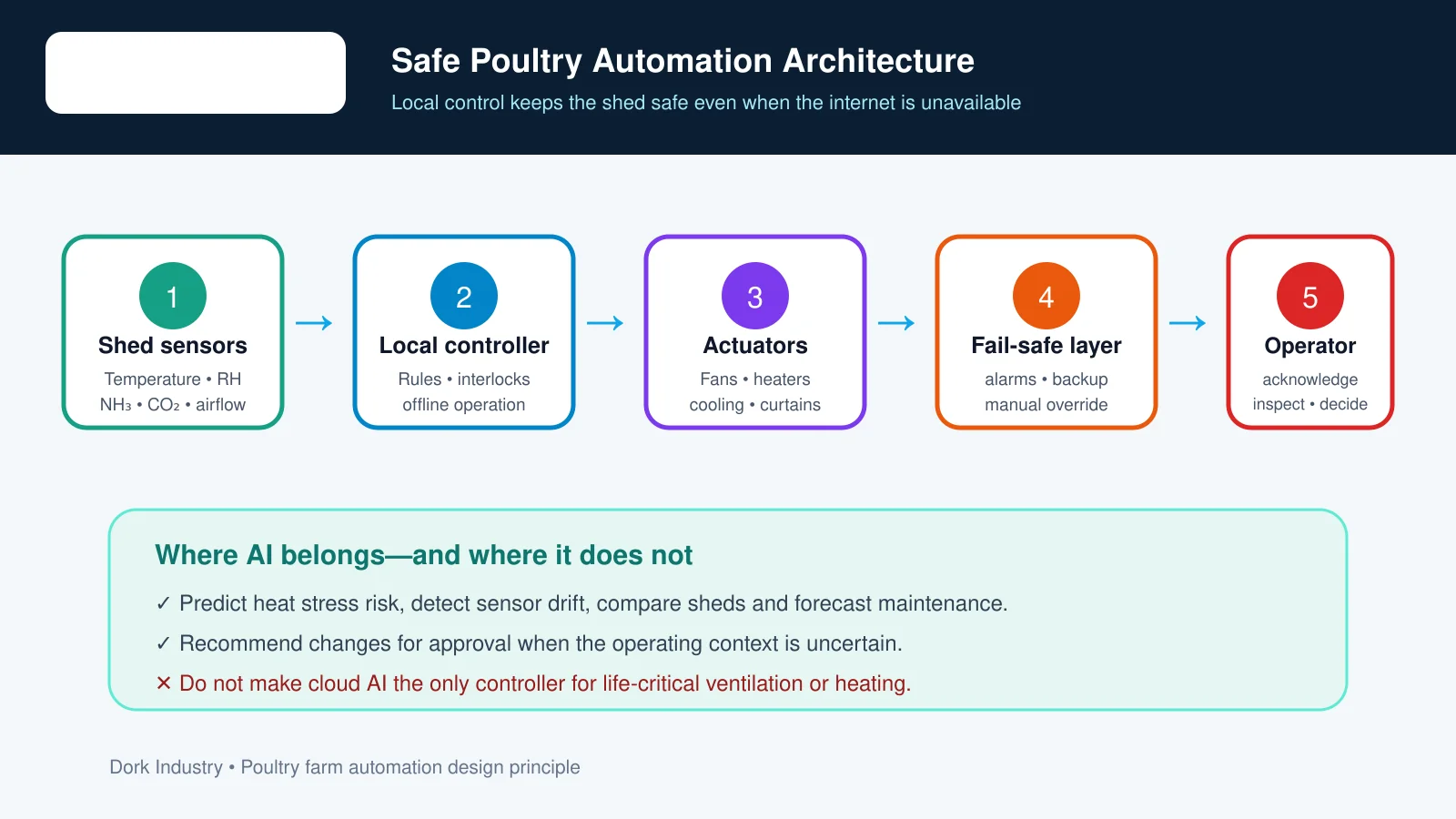
No—not as the only safety-critical controller. Critical heating and ventilation should continue through deterministic local logic with tested limits, interlocks, watchdogs and manual override. AI can improve prediction and diagnosis, but a cloud model should not become the single point of failure for the birds’ environment.
This is where semi-automation is commercially useful. The local controller performs approved, repeatable actions. AI and analytics work above that layer:
- forecast heat-stress risk from weather, shed conditions and equipment capacity;
- detect a drifting sensor by comparing it with neighbouring zones;
- identify a fan whose electrical signature is changing before a breakdown;
- compare houses or batches after accounting for bird age and operating context;
- recommend a set-point or maintenance change for a supervisor to approve;
- summarise overnight deviations and unresolved alarms for the morning review.
The boundary is simple: predictable, time-critical protection stays local; uncertain recommendations remain reviewable. This makes poultry farm automation useful without pretending that an AI model understands every biological or mechanical condition.
How should the automatic control loop work?
- Sample: read each required sensor and record device health.
- Validate: reject stale, impossible or contradictory values according to an approved rule.
- Evaluate: compare the validated state with the current age profile, operating band and equipment availability.
- Act: stage fans, heaters, inlets, cooling or curtains while respecting minimum run times and interlocks.
- Verify: confirm equipment feedback and check whether the environment responded within the allowed time.
- Escalate: alert a named operator if the deviation persists, equipment fails, or the controller enters a degraded mode.
- Record: preserve the reading, decision, command, feedback, acknowledgement and resolution.
A dashboard is only the visible layer. The value lies in the validated control loop and the response procedure behind it.
What happens when a sensor, fan, network or power supply fails?
Failure behaviour should be specified before automatic switching is enabled. The project team should conduct controlled tests rather than assume that hardware defaults are safe.
| Failure | Required detection | Planned response |
|---|---|---|
| Temperature sensor freezes or jumps | Stale-value timer, range check and cross-zone comparison | Enter degraded control, use approved fallback inputs and alert the operator |
| Fan command has no feedback | Contactor, current or rotation confirmation | Escalate another stage where approved; create critical equipment alarm |
| Internet connection fails | Gateway heartbeat and queued-message status | Continue local control and buffer records for later synchronisation |
| Controller restarts | Watchdog event and boot reason | Return to a documented safe state; never restore unsafe outputs blindly |
| Mains power fails | Power-quality input and backup-system state | Start the farm’s approved backup procedure and escalate if capacity is unavailable |
| Cloud account is compromised | Login alerts, audit logs and anomalous commands | Prevent cloud access from bypassing local safety limits; revoke credentials |
IoT security belongs inside the engineering scope. Each device should have a unique identity, controlled interfaces, secure configuration, update capability, protected data and observable cybersecurity state. These principles align with the NISTIR 8259A IoT device cybersecurity capability baseline. Remote access should use named accounts and least privilege; shared passwords and direct public exposure of controllers should be prohibited.
What can poultry farm automation do—and what should remain human-controlled?
| Usually appropriate for automation | Usually requires human approval or inspection |
|---|---|
| Routine staging of ventilation or heating inside approved limits | Changing biological targets or age profiles |
| Alerting, escalation and acknowledgement tracking | Interpreting unusual bird behaviour or possible illness |
| Equipment runtime and maintenance reminders | Returning failed equipment to service |
| Environmental and equipment-event logging | Overriding safety interlocks |
| Weather-linked risk forecasts | Decisions affecting flock health, medication or veterinary action |
Automation should shorten the time to a competent decision, not hide uncertainty from the person responsible for the farm.
Should a farm buy, configure or build its automation system?
The right choice depends less on company size than on workflow uniqueness, existing equipment and integration requirements.
Buy a complete system when
- the shed and equipment match a proven vendor design;
- local installation, spare parts and support are available;
- the standard controller covers required interlocks and manual operation;
- data export, ownership and integration terms are acceptable.
Configure and integrate when
- existing controllers are reliable but data is fragmented;
- the business needs multi-farm dashboards, alarm escalation or maintenance workflows;
- Modbus, MQTT, API or database connections are available;
- the project must connect operations with inventory, maintenance or management reporting.
Build selected components when
- the farm has unusual sheds, mixed equipment or a workflow that standard packages cannot represent;
- offline operation, multilingual mobile workflows or custom escalation are essential;
- the buyer needs ownership of specific software or integration logic;
- a controlled pilot can prove the requirement before a larger investment.
A custom build does not mean fabricating every sensor or controller. A sensible IoT solutions company combines appropriate industrial components with custom edge software, dashboards and integrations only where those additions create operational value. Dork Industry’s smart energy and monitoring services illustrate the same sensor-to-decision approach, while our guide to temperature-monitoring workflows explains why alarms, accountability and outage buffering matter beyond agriculture.
What data should the farm collect before requesting a quotation?
Use this worksheet to make vendor proposals comparable:
| Worksheet item | Your evidence |
|---|---|
| Shed dimensions, zones and bird-level layout | Drawings, photographs and current probe positions |
| Flock type, age profiles and approved environmental bands | Farm or breeder-management plan |
| Fans, heaters, cooling, curtains, inlets and controllers | Model, rating, interface, feedback contact and control-panel diagram |
| Internet, local network and mobile coverage | Availability test across normal and outage conditions |
| Power and backup arrangement | Generator, UPS, transfer logic and escalation owner |
| Three recent abnormal events | Timeline, readings, action taken and operational consequence |
| Required integrations | Maintenance, energy, inventory, ERP, WhatsApp, SMS or reporting systems |
| Acceptance tests | Sensor accuracy, alarm time, offline control, override and recovery tests |
How should a 30-day poultry farm automation pilot work?
The pilot should test one representative shed or control zone. It should not begin with automatic control across the entire farm.
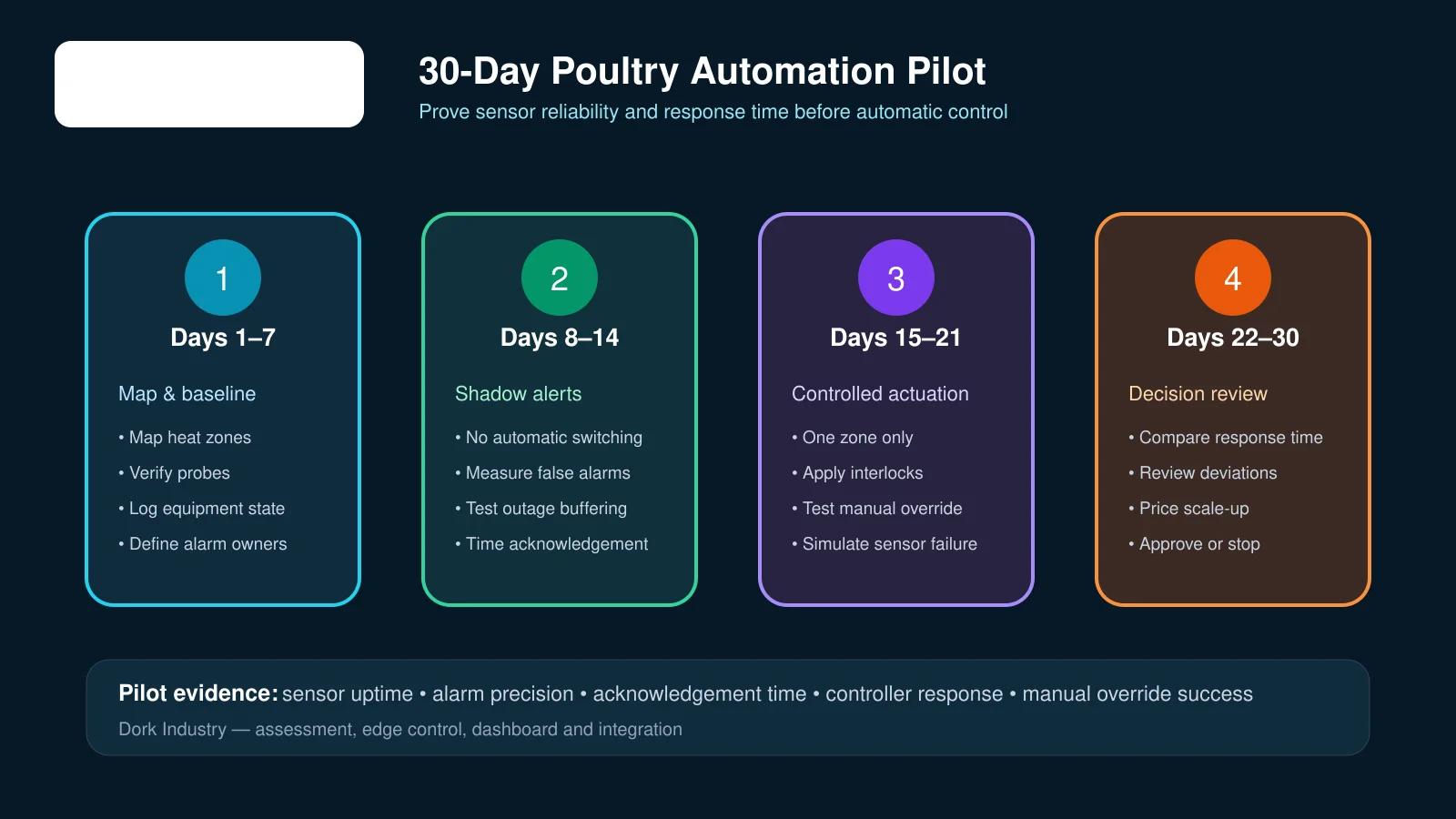
- Days 1–7—map and baseline: install calibrated temporary sensors, map zones, record equipment states and define alarm ownership. Do not automate switching.
- Days 8–14—run shadow alerts: notify the team while existing procedures remain active. Measure false alerts, missed events, acknowledgement time and data gaps.
- Days 15–21—enable limited control: automate one approved control sequence with interlocks. Test manual override, sensor failure, network loss and controller restart under supervised conditions.
- Days 22–30—review evidence: compare response time, environmental deviations, equipment feedback, staff workload and unresolved risks. Approve, redesign or stop before scaling.
What should count as pilot success?
Agree on measures before installation. Useful measures include sensor uptime, calibration deviation, percentage of actionable alarms, median acknowledgement time, command-to-feedback time, duration outside approved bands, successful manual-override tests and the percentage of records preserved during an internet outage. Do not claim feed, mortality or revenue improvement unless the pilot design can isolate and support that conclusion.
Is this approach suitable for farms in Punjab, Haryana and North India?
The architecture is applicable, but each farm needs local environmental and equipment design. North Indian operations can face substantial seasonal variation, so the pilot should cover representative hot, humid and cold conditions or use conservative simulations where waiting for a season is impractical. Punjab and Haryana are commercially relevant testing areas for Dork Industry because they are part of our target service region, but the article does not assume that one set-point, device count or control sequence fits every location.
What should an IoT assessment deliver before implementation?
A credible assessment should produce more than a product list. Ask for:
- a zone and sensor-placement map;
- a control narrative showing normal, degraded and emergency states;
- an I/O list covering sensors, commands and feedback signals;
- a network and offline-operation design;
- an alarm matrix with severity, owner and escalation time;
- manual-override and restart procedures;
- cybersecurity, access and update controls;
- integration boundaries and data ownership;
- a pilot plan with acceptance tests and measurable exit criteria;
- a scale-up estimate separated into hardware, installation, software, support and maintenance.
Plan a safe poultry automation pilot
Dork Industry can assess an existing shed, define the local control and fail-safe architecture, build the dashboard and integrations, and help your equipment partner test a measurable pilot. We do not replace veterinary, electrical or poultry-management specialists; we connect their approved requirements into a reliable digital workflow.
Frequently asked questions about poultry farm automation
Can poultry farm automation work without the internet?
Yes. Critical control should run on a local PLC, industrial controller or edge device. The cloud can support remote dashboards, analytics and notifications, but approved heating and ventilation rules should continue locally during an outage. The system should buffer records and synchronise them when connectivity returns.
Can an existing poultry shed be retrofitted?
Often, yes. A retrofit assessment must inspect the existing control panel, equipment interfaces, feedback signals, wiring, power backup and network conditions. Some farms may retain existing controllers and add monitoring or integration; others may require staged electrical and mechanical upgrades before software control is safe.
Is a mobile app enough to automate a poultry farm?
No. A mobile app is a user interface. Safe automation also requires representative sensors, local control logic, electrical interlocks, equipment feedback, alarms, manual override, cybersecurity and tested failure behaviour. Remote commands must never bypass local safety limits.
What is the difference between monitoring and automation?
Monitoring records and displays conditions. Automation evaluates validated conditions and operates equipment according to approved rules. A farm may begin with monitoring and shadow alerts, then introduce limited automatic control only after sensor accuracy, response procedures and failure modes have been tested.
How much does poultry farm automation cost?
Cost depends on shed count and size, sensor types, control panels, equipment interfaces, installation, backup power, connectivity, dashboards, integrations and support. The responsible first step is a site assessment and one-zone pilot; quoting a universal price without an I/O list and control narrative would be unreliable.
What should remain under human control?
People should approve changes to biological targets, handle unusual bird behaviour, investigate critical alarms, authorise equipment return to service and decide veterinary or welfare actions. The system should make those decisions faster and better informed—not conceal them.
Sources and methodology
- Aviagen, Ross Broiler Management Handbook, 2025.
- FAO, Poultry housing and management in developing countries.
- FAO, Management and housing—Gateway to poultry production and products.
- NISTIR 8259A, IoT Device Cybersecurity Capability Core Baseline.
Search-demand note (20 October 2026): Dork Industry compared current India keyword-planning data before selecting this topic. “Poultry farm automation” showed an estimated 170 average monthly searches, compared with 70 for “smart farming solutions” and 50 for “IoT solutions company.” All three showed commercial relevance, but the selected query expressed the clearest implementation problem. Figures are planning estimates, not guaranteed traffic.
Editorial note: This guide is an engineering and procurement framework, not veterinary advice or a universal set-point schedule. Environmental targets and operating procedures must be approved for the farm’s birds, housing and local conditions. No client result or financial outcome has been invented.