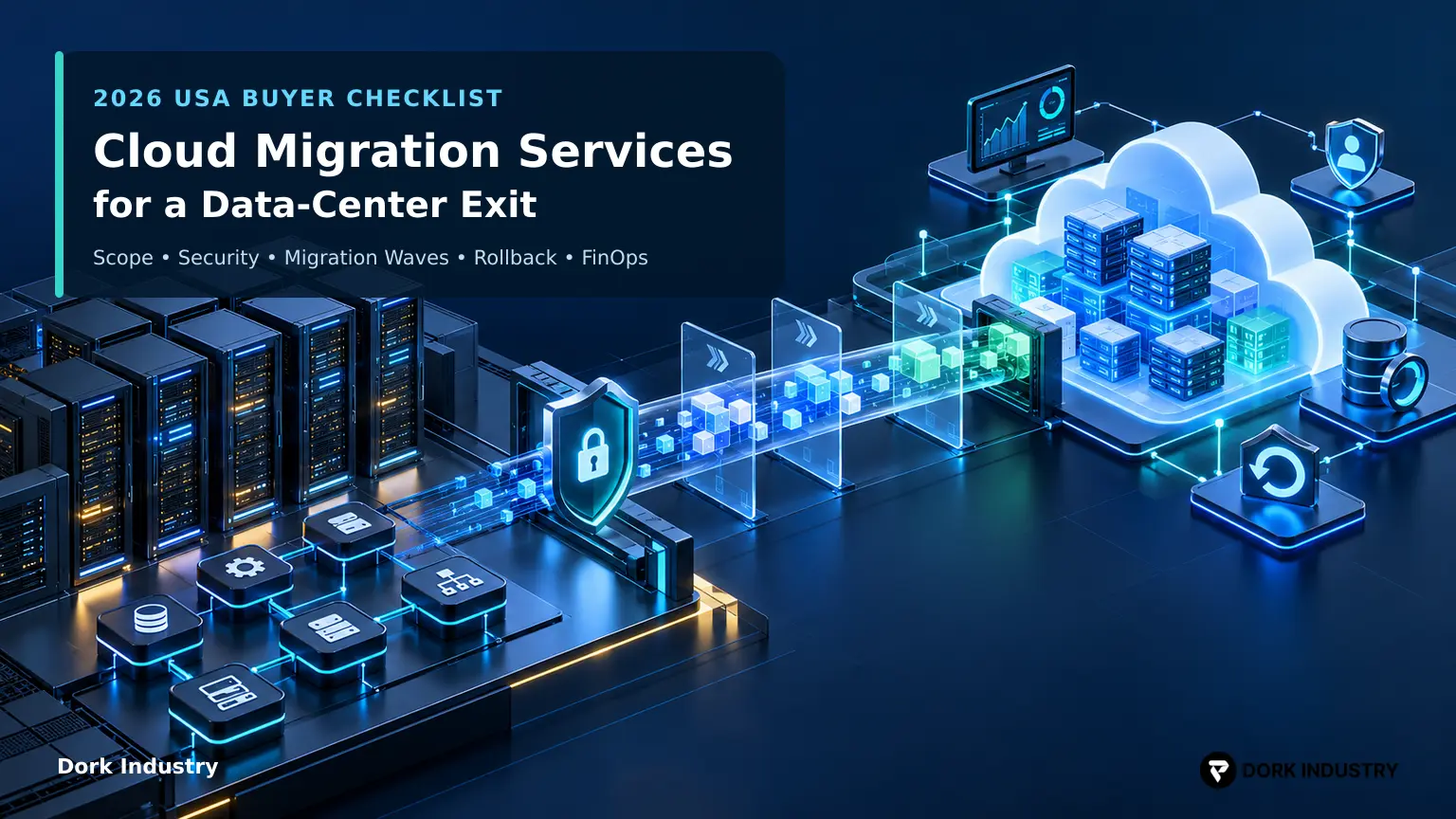
Cloud migration services for a data-center exit should convert a fixed deadline into a controlled sequence of workload decisions, dependency groups, tested cutovers and accountable operating ownership. The safest purchase is not the proposal with the fastest “move everything” promise. It is the plan that proves which systems should move, which should change, which should stay and how every critical workload can be restored.
By Nishant Singh, Founder of Dork Industry · Reviewed 17 October 2026. Nishant reviews cloud and software buyer guides for scope clarity, integration risk, security, migration governance, operational ownership and commercial decision quality.
Direct answer
Choose cloud migration services only after the provider inventories applications, maps technical and business dependencies, assigns a migration strategy to each workload, designs the landing zone, defines measurable acceptance tests and rehearses rollback. Price discovery, migration execution and post-cutover operation separately. Approve each migration wave only when business, security and operations owners accept the evidence.
What should a data-center-exit buyer remember?
- A deadline is not a strategy. Start with workload ownership, dependencies and business criticality.
- Do not rehost by default. Retire, retain, repurchase, relocate, replatform or refactor where evidence supports it.
- Separate migration cost from cloud run cost. Include parallel environments, data transfer, licensing, observability, backup, support and optimization.
- Make rollback testable. “We can roll back” is not evidence until recovery steps, decision authority and restoration time are rehearsed.
- Move dependency groups, not isolated servers. Applications, databases, identity, DNS, queues and external connections must work together.
Why target cloud migration services in the USA?
External demand research was completed before choosing an industry or content stream. Google Keyword Planner estimates collected on 17 October 2026 showed approximately 2,470 monthly searches for the exact phrase across eight researched markets. Our analysis showed that the USA and India each represented about 40.5% of this sample; together they accounted for approximately 81.0%. The US market was selected because it combined top-volume demand with the stronger advertiser-value signal for this commercial query.
| Market | Estimated monthly searches | Share of sample |
|---|---|---|
| United States | 1,000 | 40.5% |
| India | 1,000 | 40.5% |
| United Kingdom | 140 | 5.7% |
| Australia | 140 | 5.7% |
| Canada | 90 | 3.6% |
| Germany | 50 | 2.0% |
| Singapore | 30 | 1.2% |
| United Arab Emirates | 20 | 0.8% |
These are rounded Google Ads Keyword Planner estimates, not guaranteed organic visits or enquiries. Google Trends returned insufficient exact-query time-series data, so no trend claim is made.
What do the five current ranking competitors cover—and miss?
The competitor analysis reviewed 5 companies and platforms appearing in the current US results. Fluence and CloudEagle emphasize provider and tool comparisons. Google Cloud presents its migration products. Algoscale explains assessment, planning, deployment and modernization services. These pages help buyers build a shortlist, but they do not combine a fixed data-center-exit deadline with workload disposition, dependency-group evidence, rollback authority, dual-running cost and post-cutover ownership in one usable procurement framework.
| Ranking page | Useful coverage | Opportunity this guide addresses |
|---|---|---|
| Fluence provider comparison | Provider landscape and strategy overview | Workload-level acceptance and exit-deadline governance |
| CloudEagle migration tools | Migration-tool choices and downtime focus | Tool-independent decision gates and rollback evidence |
| Google Cloud products | First-party services and customer examples | Cross-cloud procurement and operating-accountability questions |
| Algoscale services | Assessment through modernization lifecycle | Cost worksheet, failure boundaries and evidence-based scoring |
| CloudEagle provider comparison | Vendor benefits and shortlist guidance | Migration-wave design, cutover authority and stabilization ownership |
What should cloud migration services include?
A complete engagement covers more than copying virtual machines. It should produce an application portfolio, dependency map, destination architecture, security baseline, migration factory, workload-specific test plan, cutover runbook, rollback plan, cloud-cost baseline and operating handover.
| Workstream | Required deliverable | Acceptance evidence |
|---|---|---|
| Discovery | Applications, owners, infrastructure, data, licenses and dependencies | Owners confirm inventory and unknowns |
| Disposition | Migration strategy and target state per workload | Business, architecture and cost rationale |
| Foundation | Accounts, identity, network, policy, logging, keys and backup | Landing-zone controls pass review |
| Migration factory | Repeatable build, replication, test, cutover and rollback runbooks | Pilot wave proves the pattern |
| Validation | Functional, performance, security, recovery and user tests | Named approvers sign measurable results |
| Operations | Monitoring, incident, backup, patching, cost and support ownership | Operations team accepts the service |
Is your data-center exit ready for provider pricing?
Give one point for every “yes.” A score of six or more supports detailed wave planning. A lower score means the first contract should be a bounded discovery and readiness assessment rather than a fixed migration commitment.
- Is there a named business and technical owner for every critical application?
- Do you have a current inventory of servers, databases, storage, integrations and licenses?
- Are upstream and downstream dependencies observed, not merely documented years ago?
- Is acceptable downtime defined for each workload?
- Are recovery-point and recovery-time objectives approved?
- Is data classified by sensitivity, residency and retention obligation?
- Can teams test with representative load and business transactions?
- Is there authority to retire unused systems and stop duplicate spend?
Need a defendable data-center-exit scope?
Dork Industry can map the portfolio, identify dependency groups, prepare workload dispositions and turn the deadline into priced migration waves with security and rollback acceptance criteria.
Book a cloud migration readiness assessment Discuss the exit plan on WhatsApp
How should each workload’s migration strategy be chosen?
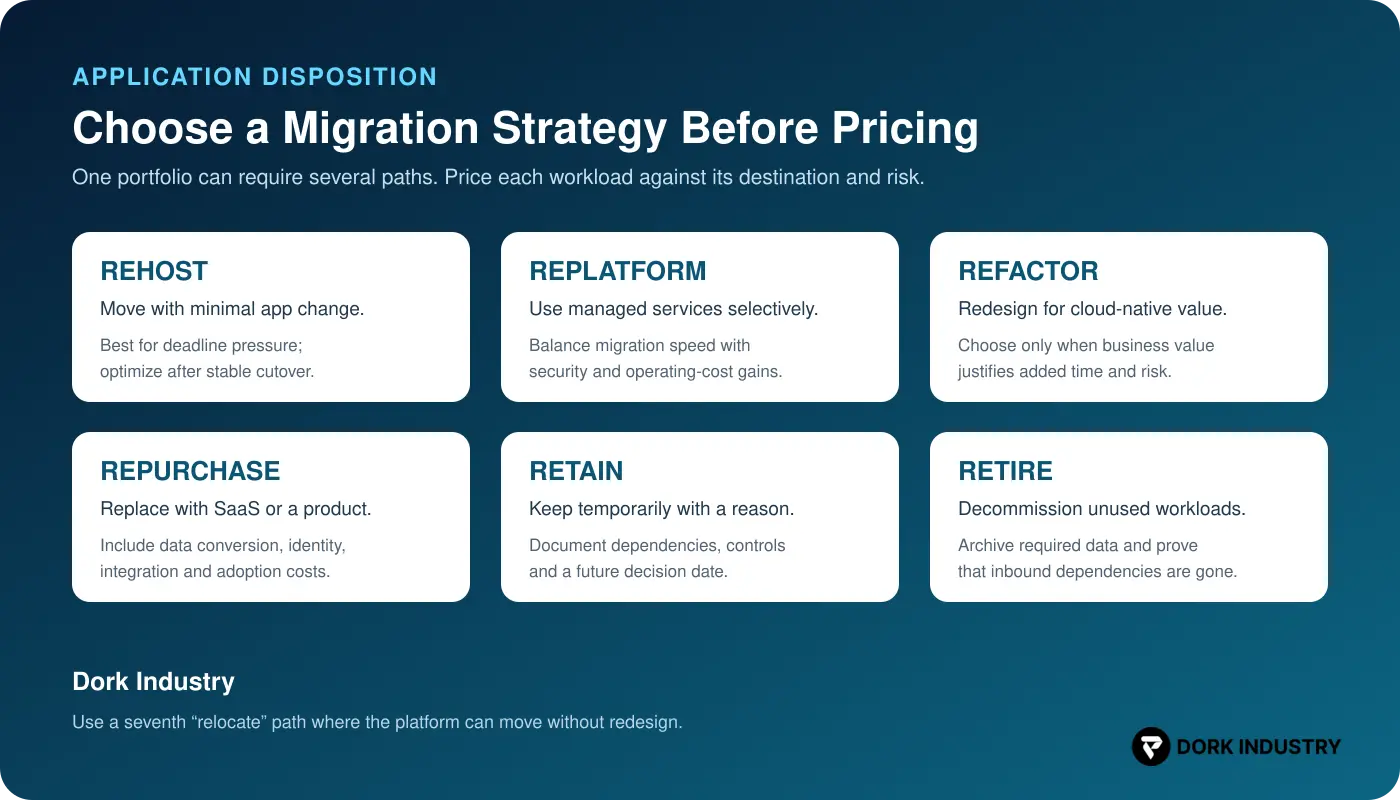
AWS Prescriptive Guidance describes seven migration strategies: retire, retain, rehost, relocate, repurchase, replatform and refactor. It also cautions that refactoring during a large migration is complex; where practical, a team can migrate first and modernize after stability. Treat these strategies as decision options, not vendor-specific requirements.
When should a workload be rehosted?
Rehost when the exit deadline is dominant, application change is too risky, and the target can run the current architecture safely. Record the post-migration optimization debt. A rehosted workload can preserve inefficient sizing, licensing and operational patterns if the modernization decision disappears after cutover.
When should a workload be replatformed?
Replatform when managed databases, container services, backup, identity or observability can reduce operational burden without redesigning the whole application. The proposal should identify every changed component, compatibility test, fallback path and recurring service cost.
When should a workload be retained, retired or repurchased?
Retain a workload only with a documented dependency, compliance reason or decision date. Retire it after proving required records are archived and inbound connections have ended. Repurchase when a SaaS or packaged product satisfies the business process—but include data conversion, identity, integration, training and exit costs.
How should cloud migration services be priced?
A credible price begins with workload facts. A per-server rate alone ignores application testing, database consistency, business approvals and the period when both environments run. Ask every provider to use the same cost model.
Total program cost = discovery + landing zone + connectivity + workload remediation + migration tooling + data transfer + testing + cutover + parallel operations + licenses + hypercare + decommissioning + contingency.
Which assumptions must appear beside the price?
- Number of applications, servers, databases, interfaces and dependency groups.
- Data volume, transfer path, change rate and available migration bandwidth.
- Downtime tolerance, replication duration and cutover-window restrictions.
- Operating systems, database versions, commercial licenses and support status.
- Required cloud accounts, regions, availability zones and disaster-recovery targets.
- Testing responsibility, business-user effort and performance baselines.
- Duration of parallel operation and who approves source-system shutdown.
- Expected cloud usage, support tier, observability, backup and security services.
The FinOps Foundation’s principles treat technology value and cost as a shared responsibility across engineering, finance and business teams. Apply that principle before migration: give every workload an owner, cost-allocation tags, a baseline and a unit metric such as cost per transaction, customer, shipment or report.
What security requirements belong in the migration contract?
Security is part of the landing zone and every wave—not a final penetration test. The NIST Cybersecurity Framework 2.0 organizes cybersecurity outcomes around governance and risk reduction. CISA’s Cloud Security Technical Reference Architecture addresses secure cloud transition, shared services, cloud security posture management, data protection, DevSecOps and zero-trust considerations.
Which technical controls should be acceptance criteria?
- Federated identity, multifactor authentication, least privilege and emergency access.
- Account or subscription separation for production, nonproduction and security tooling.
- Approved network segmentation, private connectivity, DNS and egress controls.
- Encryption in transit and at rest, managed keys, secrets rotation and certificate ownership.
- Central logs protected from workload administrators, plus actionable alerts.
- Image, dependency, configuration and vulnerability scanning in deployment pipelines.
- Backup isolation, immutable or protected copies where appropriate, and tested restoration.
- Data-location, retention, deletion and legal-hold controls matched to obligations.
- Cloud security posture monitoring and an incident process that names both parties.
- Evidence that source credentials, agents, routes and data are removed after decommissioning.
Who owns security after cutover?
The contract should distinguish the cloud provider’s responsibilities, the migration partner’s delivery responsibilities and the customer’s continuing responsibilities. Assign each control to a named role and operational process. A configured service without an owner, alert route or review schedule is not an operating control.
How should migration waves, cutover and rollback work?
Microsoft’s Cloud Adoption Framework guidance recommends sequencing workloads around dependencies, moving nonproduction before production, defining downtime requirements and establishing rollback criteria before migration. AWS wave-planning guidance similarly starts from portfolio data and detailed application assessment rather than an arbitrary server list.

What belongs in a migration wave?
Group components that must communicate within an accepted latency or consistency boundary. Include the application, database, identity path, certificates, DNS, queues, file shares, batch jobs, monitoring, backup, external integrations and business test owners. A server can move successfully while the business service still fails.
What should trigger rollback?
Define measurable thresholds before the change window: failed health checks, incorrect balances, lost messages, response-time regression, replication lag, security-control failure or inability to complete priority transactions. State who declares failure, the latest safe rollback time, data reconciliation steps and how users are informed.
When is a workload genuinely complete?
Completion requires stable monitoring, backup restoration evidence, security approval, business acceptance, cost visibility, support ownership and a source decommission decision. Keep the source only for a defined validation period. Indefinite dual running increases cost, attack surface and confusion about the system of record.
How should you compare cloud migration providers?
Score all proposals with the same evidence. Brand recognition or a large cloud resale practice does not replace workload-specific accountability.
- Discovery quality: Does the provider identify owners, dependencies and unknowns?
- Disposition discipline: Is every workload assigned a justified migration strategy?
- Landing-zone capability: Are identity, network, logging, keys, policy and backup designed first?
- Migration factory: Are runbooks, infrastructure-as-code, testing and repeatable patterns included?
- Data integrity: Are replication, reconciliation and system-of-record rules explicit?
- Downtime control: Does every critical workload have an agreed migration method and window?
- Rollback evidence: Is rollback rehearsed with business decision authority?
- Security: Are controls measurable and mapped to named owners?
- Cost transparency: Are migration, parallel-run and steady-state cloud costs separated?
- Operations: Who owns monitoring, incidents, patching, backup and optimization after hypercare?
- Knowledge transfer: Will the customer receive architecture, code, runbooks and training?
- Exit terms: Can the customer change providers without losing automation or documentation?
Red flags include fixed pricing before portfolio discovery, “zero downtime” without a replication and validation design, migration waves made only from server names, no business test owners, no rollback deadline, and savings claims without a comparable usage baseline.
What should your data-center-exit worksheet contain?
- Deadline: Which lease, support, acquisition, risk or regulatory event sets the date?
- Portfolio: How many applications, servers, databases, interfaces and data stores exist?
- Owners: Who owns business acceptance, architecture, security and operations?
- Criticality: What business process fails if the workload is unavailable?
- Dependencies: Which identity, DNS, network, APIs, queues, file transfers and vendors connect?
- Data: What sensitivity, residency, retention and recovery requirements apply?
- Disposition: Rehost, relocate, replatform, repurchase, refactor, retain or retire?
- Acceptance: Which functional, performance, security and recovery tests must pass?
- Rollback: What triggers it, who decides and how is changed data reconciled?
- Economics: What are migration, parallel-run, licensing and steady-state costs?
- Handover: Which team owns the service after hypercare?
Want an evidence-based migration-wave plan?
Dork Industry provides cloud discovery, AWS and Azure architecture, application and database migration, integration, security engineering, cutover planning and operational handover. Start with one portfolio workshop or a bounded pilot wave.
Email: support@dorkindustry.com
WhatsApp: +91 8210792477
What do buyers ask about cloud migration services?
What are cloud migration services?
Cloud migration services assess, design, move, test and stabilize applications, data and infrastructure in a cloud environment. A complete engagement also covers workload disposition, landing-zone controls, integration, cutover, rollback, cost visibility, decommissioning and operational handover.
How long does a data-center exit take?
Duration depends on portfolio size, dependency complexity, data volume, downtime constraints, remediation and business-test availability. A provider should estimate by migration waves and show assumptions. A single date without portfolio evidence is not a reliable plan.
Can every application be lifted and shifted?
No. Some workloads have unsupported operating systems, specialized hardware, licensing restrictions, latency-sensitive dependencies or regulatory constraints. Others should be retired or replaced. Use a workload-level disposition rather than applying one strategy to the whole portfolio.
How can downtime be reduced?
Reduce downtime through dependency mapping, continuous replication where suitable, rehearsed runbooks, production-like testing, controlled change freezes, clear data-validation steps and rapid rollback. Near-zero downtime adds complexity and should be reserved for workloads whose business criticality justifies it.
Should migration and modernization happen together?
Only when modernization is required to reach the destination or creates enough business value to justify schedule and delivery risk. Under a fixed exit deadline, rehost or replatform first and modernize after stabilization may be safer for many workloads.
Which cloud should a business choose?
Choose based on workload fit, existing skills, identity and data ecosystem, required managed services, residency, support model, commercial terms and exit risk. Dork Industry supports AWS services, Microsoft Azure and provider-neutral cloud migration planning.
Which sources and research method support this guide?
This guide combines external commercial-demand data, live inspection of five US ranking pages, primary cloud-provider migration guidance, US cybersecurity guidance and Dork Industry’s application-integration perspective. It does not promise savings, zero downtime or regulatory compliance without workload-specific evidence.
- AWS Prescriptive Guidance: migration strategies
- AWS Prescriptive Guidance: wave planning
- Microsoft Cloud Adoption Framework: plan your migration
- Google Cloud Architecture Center: migration framework
- NIST Cybersecurity Framework 2.0
- CISA Cloud Security Technical Reference Architecture
- FinOps Foundation principles
- Fluence cloud migration provider comparison
- CloudEagle cloud migration tools
- Google Cloud migration products and services
- Algoscale cloud migration services
- CloudEagle cloud migration provider comparison
Editorial responsibility: Dork Industry. This guide supports technology procurement and does not replace legal, regulatory, security or financial advice specific to your organization.
Discuss this for your business?
Book a free consultation — we scope the problem, outline the approach, and give you an honest verdict before any development is discussed.