
Data & BI solution
AI Data Platform Development
AI data platform development AI data platforms provide governed, discoverable and reusable data products for analytics, machine learning and generative AI. Dork Industry designs ingestion, lakehouse or warehouse layers, metadata, quality controls, access policies and serving patterns around specific AI use cases.
What are the key takeaways?
- AI data platform development should begin with one measurable workflow, a baseline and an accountable business owner.
- Architecture, data access, integrations, exceptions, security and human approvals should be written before implementation starts.
- A controlled pilot should include quality, latency, cost, failure handling, rollback and a documented scale decision.
What is AI data platforms and when does it create value?
AI data platforms is valuable when a defined workflow has a measurable delay, quality, risk or cost problem and the organisation can supply the data, system access and operational owner needed to change it. Buying technology before documenting the workflow usually shifts the bottleneck rather than removing it.
The desired result for this service is a governed platform that turns fragmented sources into discoverable, permission-aware data products for analytics and AI. A credible proposal should therefore describe the current process, exceptions, integration boundaries, human decisions, security controls, support model and acceptance test. It should not rely on a product demo or a list of tools.
Which organisations should consider this service?
- Teams with a repeatable workflow whose delay or error rate can be measured.
- Businesses that need integration across existing ERP, CRM, ecommerce, cloud, data or operational systems.
- Organisations with privacy, residency, audit, uptime or human-approval requirements.
- Buyers who want to validate value in a controlled pilot before a wider rollout.
How can you diagnose the requirement before requesting a proposal?
Use this ten-question diagnostic with the process owner, IT lead and security owner. A clear answer makes vendor estimates more comparable and prevents a technically impressive solution from missing the business need.
| Question | Evidence to collect |
|---|---|
| Which decision, handoff or task is failing? | Process map, queue, rework and escalation records |
| What is the financial or operational consequence? | Delay, labour, defect, outage, opportunity or compliance cost |
| Which systems and data are involved? | APIs, databases, files, devices, identities and owners |
| Which exceptions require a person? | Approval thresholds, risky actions and escalation routes |
| What would prove the pilot works? | Baseline, target, sample size, test window and sign-off owner |
If these answers are unavailable, begin with a discovery engagement. Development estimates made before discovery usually hide assumptions about data quality, access, exceptions and production support.
What happens when the underlying problem is left unresolved?
AI teams cannot find, trust, govern or reuse the enterprise data needed for reliable applications. The visible symptom may be slow service, manual re-entry, a growing cloud bill, missed defects or delayed decisions. The deeper cost includes unreliable reporting, weak audit evidence, staff workarounds and an inability to scale the process safely.
Measure the existing workflow for at least one representative cycle. Separate volume from value: a rare failure can matter more than thousands of successful transactions if it stops production, exposes data or affects a customer commitment.
What do our AI Data Platforms services include?
Dork Industry can deliver the complete lifecycle or a defined part of it. The scope is written around the workflow and acceptance evidence.
- data and AI readiness assessment
- source inventory and target architecture
- batch and streaming ingestion
- lakehouse, warehouse and vector data design
- catalogue, lineage and data contracts
- quality rules and ownership workflows
- retrieval, feature and semantic layers
- access, residency and retention controls
What will you receive?
- A current-state map, risk register and prioritised requirements.
- A target architecture showing data flows, trust boundaries and human approvals.
- A pilot backlog with measurable acceptance tests and rollback conditions.
- Implementation, integration, testing and deployment documentation.
- An operational runbook covering ownership, monitoring, incidents and change.
Which technology supports the solution?
The likely technical components include cloud or private lakehouse services, orchestration, data catalogues, vector search, feature stores, governance and BI tools. The final choice depends on existing licences, team skills, latency, scale, residency, support and total cost. We document why each component exists and how it can be replaced.
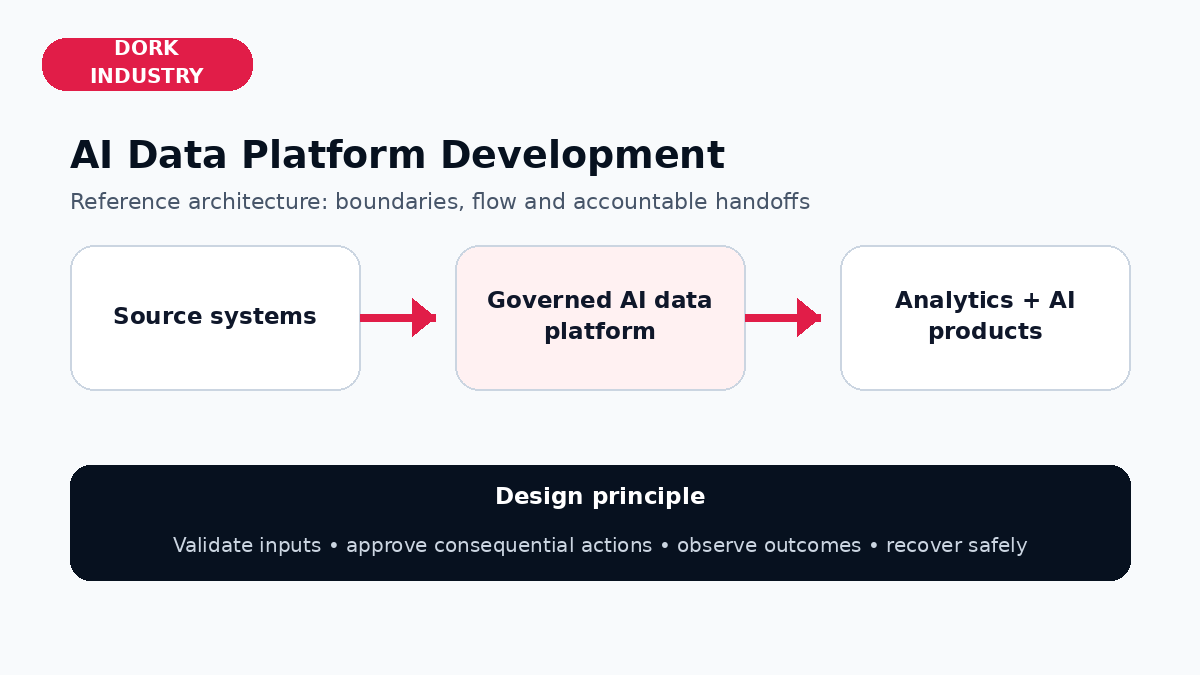
How should data move through the system?
- Capture: accept data only from identified sources and record its owner, purpose and quality constraints.
- Validate: reject malformed, unauthorised or incomplete input before it can trigger an action.
- Process: apply deterministic rules, AI models or both, with versioned configuration.
- Approve: route sensitive, uncertain or high-value decisions to the correct person.
- Act: write to the destination system with idempotency, permission and reconciliation controls.
- Observe: record latency, quality, cost, failures and changes without exposing protected data.
Should you build, configure, buy or integrate?
| Option | Best fit | Main trade-off to test |
|---|---|---|
| Configure a product | Common workflow with acceptable vendor features | Licensing, customisation limits, data access and lock-in |
| Integrate existing tools | Required capabilities already exist in separate systems | API limits, ownership, reconciliation and support boundaries |
| Build a custom solution | Differentiating workflow, unusual constraints or deep integration | Product ownership, maintenance, test coverage and roadmap |
| Hybrid approach | Commodity platform plus custom workflow or interface | Clear division of responsibility across components and vendors |
The decision should compare three-year cost, time to value, operational control, exit options and the cost of future change. A low initial quote is not economical if every workflow change requires a supplier or if data cannot be exported in a usable form.
Which security, privacy and operational controls are required?
- Identity: named users and services, least privilege, short-lived credentials and periodic access review.
- Data: classification, purpose limitation, encryption, retention, deletion and residency decisions.
- Application: input validation, dependency management, secret isolation and protected administrative functions.
- AI: model and prompt versioning, evaluation, unsafe-output handling and human review for consequential actions.
- Operations: logs, alerts, service levels, backups, rollback, incident response and accountable owners.
- Suppliers: documented sub-processors, model training terms, service limits, portability and termination plan.
Controls must match the consequence of failure. A recommendation can tolerate a different level of uncertainty than a system that releases payment, stops equipment or changes a customer record.
How can you test AI data platforms with a controlled pilot?
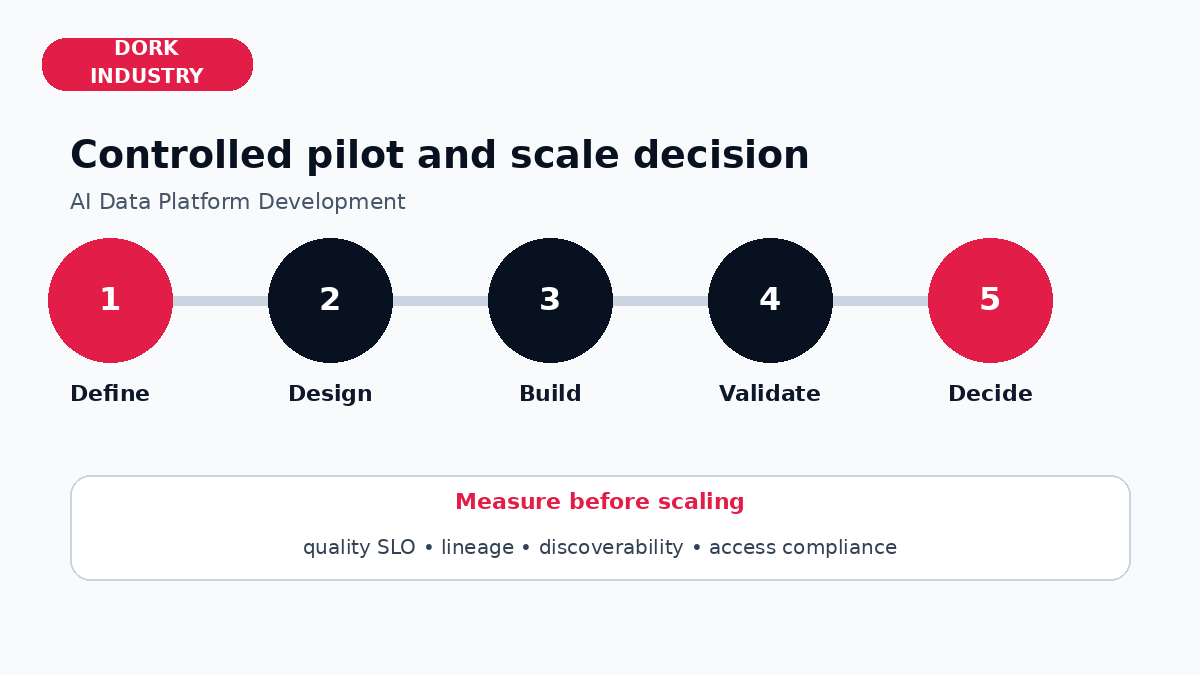
- Week 1 — define: select one workflow, owner, baseline, sample and exclusions.
- Week 2 — design: confirm architecture, access, risks, approvals and test cases.
- Weeks 3–5 — build: implement the smallest end-to-end path with logs and failure handling.
- Weeks 6–7 — validate: test normal, boundary, security, recovery and user scenarios.
- Week 8 — decide: compare results with the baseline and choose scale, revise or stop.
Which acceptance metrics should be written into the pilot?
| Metric | How to use it |
|---|---|
| critical-data quality pass rate | Record the present baseline, pilot target, data source and accountable owner before implementation. |
| freshness service levels | Record the present baseline, pilot target, data source and accountable owner before implementation. |
| lineage coverage | Record the present baseline, pilot target, data source and accountable owner before implementation. |
| time to provision approved data | Record the present baseline, pilot target, data source and accountable owner before implementation. |
| AI retrieval relevance | Record the present baseline, pilot target, data source and accountable owner before implementation. |
Targets should be agreed before the pilot starts. Report both averages and failure cases; a strong average can hide unacceptable behaviour for a particular defect type, language, location or transaction.
What should an AI Data Platforms proposal contain?
- The exact workflow, users, systems, assumptions and exclusions.
- Architecture, integration ownership and data-processing boundaries.
- Delivery milestones tied to demonstrations and acceptance evidence.
- Security, privacy, backup, recovery and support responsibilities.
- Itemised implementation, licence, cloud, model, device and maintenance costs.
- Source-code, configuration, data, documentation and exit rights.
- A change process for requirements discovered during the pilot.
Ask each supplier to respond to the same requirement pack. This makes capability, risk and total cost easier to compare than separate sales demonstrations.
Frequently asked questions about AI data platforms
How much does AI data platforms cost?
Cost depends on workflow scope, integrations, data readiness, security, infrastructure, licences, testing and support. A discovery phase should convert these variables into an itemised estimate and separate one-time build cost from recurring operating cost.
How long does implementation take?
A narrow assessment and pilot can often be planned in weeks, while multi-system or regulated deployments require staged delivery. The reliable schedule begins after access, data samples, owners, exceptions and acceptance tests are confirmed.
Can Dork Industry integrate the solution with existing ERP or CRM systems?
Yes, subject to the system’s supported APIs, database access, security controls and vendor terms. We first document the system of record, direction of data flow, reconciliation method and ownership of failures.
Can the solution run in a private cloud or on premises?
Where the workload and technology permit, Dork Industry can design private, on-premise or hybrid deployment. The assessment covers capacity, updates, identity, network boundaries, backups, monitoring and the operational skills required.
How do you prevent a proof of concept from becoming an unsupported production system?
The pilot includes ownership, source control, deployment, monitoring, rollback, documentation and a scale decision. Production is a separate approval based on test evidence and an agreed support model.
What information should we send for an initial assessment?
Send the workflow goal, current steps, systems, users, approximate volumes, known constraints and one or two representative samples without confidential data. Dork Industry can then propose the next discovery step.
Which references support this service framework?
The following primary or standards-based references inform the security, architecture and operational guidance on this page. Product choices still require customer-specific validation.
Where does Dork Industry deliver this service in India?
Dork Industry supports organisations across India through remote discovery, engineering and production support. For requirements connected to Delhi, Chandigarh or Himachal Pradesh, the engagement can assess whether workshops, infrastructure review or site work should be performed on location. Delivery scope, travel, access, data residency and local operational ownership are agreed before the project begins.