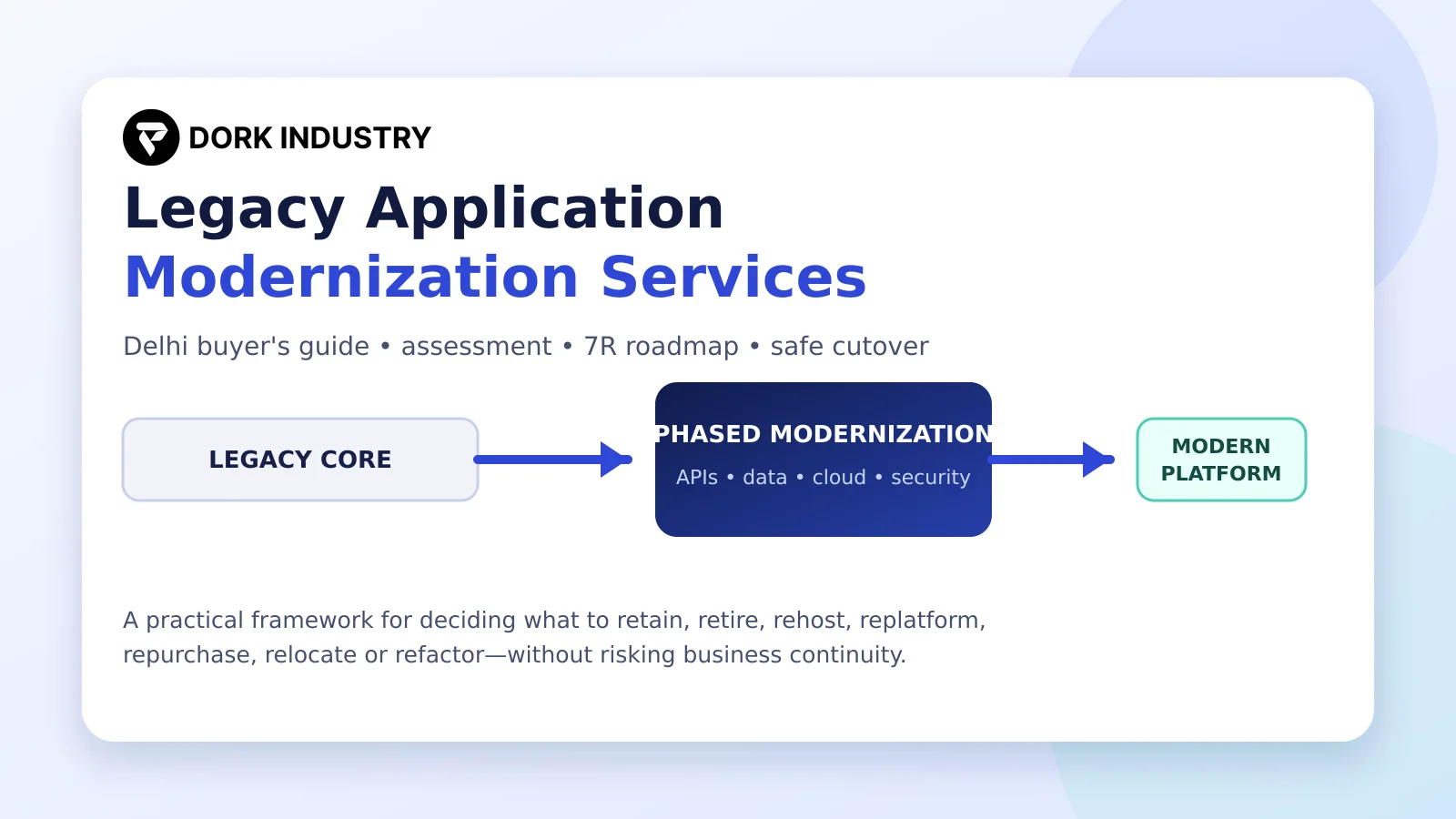
Legacy application modernization services help an organisation improve an ageing business system without blindly replacing everything at once. The work starts with application, data and dependency discovery; then each workload is retained, retired, rehosted, relocated, replatformed, repurchased or refactored. A safe programme protects business continuity with testing, reconciliation, rollback and measurable acceptance criteria.
For a Delhi business comparing vendors, the difficult question is not “Which cloud should we buy?” It is “Which parts of the current system still create value, which parts create risk, and what is the least disruptive route to a better operating model?” This buyer’s guide provides the diagnostic, decision framework, pilot plan and vendor checks needed before requesting a proposal.
Last reviewed 15 October 2026 by Nishant Singh, Dork Industry Editorial Team. Nishant writes about software development, cloud platforms, AI, IoT and business systems. His work focuses on process design, integration boundaries, operating risks, security controls and measurable pilot decisions. He develops practical procurement and implementation guidance for business and technical leaders assessing, building, migrating and supporting modern technology solutions.
Need an independent modernization assessment?
Dork Industry can map your applications, integrations, data risks and cutover options before you commit to a rebuild or migration.
Request a legacy system assessment · Discuss the system on WhatsApp · support@dorkindustry.com
What will this legacy modernization guide help you decide?
- Whether a system should be retained, retired, migrated, replaced or redesigned.
- Which business and technical evidence must be collected before estimating cost.
- How to compare legacy application modernization services without accepting a risky “rewrite everything” proposal.
- How to protect data, integrations, users and business continuity during the transition.
- How to run a small, reversible pilot before committing to a larger programme.
Do you actually need legacy application modernization services?
You probably need an assessment when the current application is still important but has become expensive, slow or difficult to change. Microsoft’s Cloud Adoption Framework recommends prioritising workloads by both business value and technical risk—not by age alone. That distinction prevents a team from modernising a low-value application while a revenue-critical system remains exposed.
How do you run this 15-minute diagnostic?
Give one point for every “yes.” The result is not a business case; it is a signal that deeper discovery is justified.
| Question | Evidence to collect |
|---|---|
| Does one change regularly break another function? | Release defects, rollbacks and emergency fixes |
| Are the operating system, framework, database or libraries out of support? | Vendor lifecycle dates and unpatched components |
| Does the system depend on one employee or supplier? | Support tickets, documentation and knowledge ownership |
| Are integrations built through files, manual re-entry or fragile scripts? | Interfaces, batch jobs, spreadsheets and failure logs |
| Do peak loads cause slow screens, failed jobs or downtime? | Response time, throughput, queues and incident records |
| Is reporting delayed because data sits in separate systems? | Sources, reconciliation steps and reporting latency |
| Does every release require a long outage? | Deployment procedure, maintenance window and recovery time |
| Are audit, privacy or access-control requirements hard to prove? | User roles, logs, retention rules and control evidence |
Interpretation: zero to two points usually supports monitoring and targeted maintenance. Three to five points supports a structured assessment. Six or more points indicates that business continuity, security and change capacity should be reviewed urgently. A critical end-of-support deadline or recurring outage can justify assessment even with a lower score.
What does an ageing application cost the business?
The most visible cost is maintenance, but the larger cost may be delayed change. A legacy system can slow pricing updates, customer onboarding, supplier integration, reporting, new branches, mobile access or ecommerce connections. The financial consequence should therefore be measured as a combination of support effort, incidents, lost staff time, delayed revenue and risk exposure.
Create a baseline for the previous 90 days:
- Hours spent on manual workarounds and repeated data entry.
- Incidents, downtime minutes, failed jobs and reconciliation errors.
- Average lead time from approved change to production release.
- Infrastructure, licence, support and specialist-contractor costs.
- Transactions or users affected by performance or reliability problems.
- Business requests postponed because the system could not support them.
These measures turn modernization from a technology preference into a business decision. They also become the acceptance criteria for the pilot.
What can—and cannot—be automated during modernization?
Discovery tools can inventory code, dependencies, database objects, API calls and infrastructure. Automated tests can compare old and new behaviour. Data pipelines can validate counts, checksums and exception records. Infrastructure-as-code can make environments repeatable. Observability can expose latency, errors and resource use.
Automation cannot decide which historical workarounds still represent valid business rules. It cannot approve a regulatory interpretation, resolve conflicting data ownership, decide acceptable downtime or replace user acceptance. Those decisions need application owners, operations teams, finance, security and real users. Treat AI-assisted code conversion as an accelerator that still requires review, tests and accountable human approval.
Which of the 7R modernization paths fits each workload?
AWS describes seven common migration strategies: retain, retire, rehost, relocate, replatform, repurchase and refactor or re-architect. The important buyer lesson is that one programme may use several paths. A payroll package may be repurchased as SaaS, a stable archive retained, an unused module retired and a differentiating order workflow refactored.
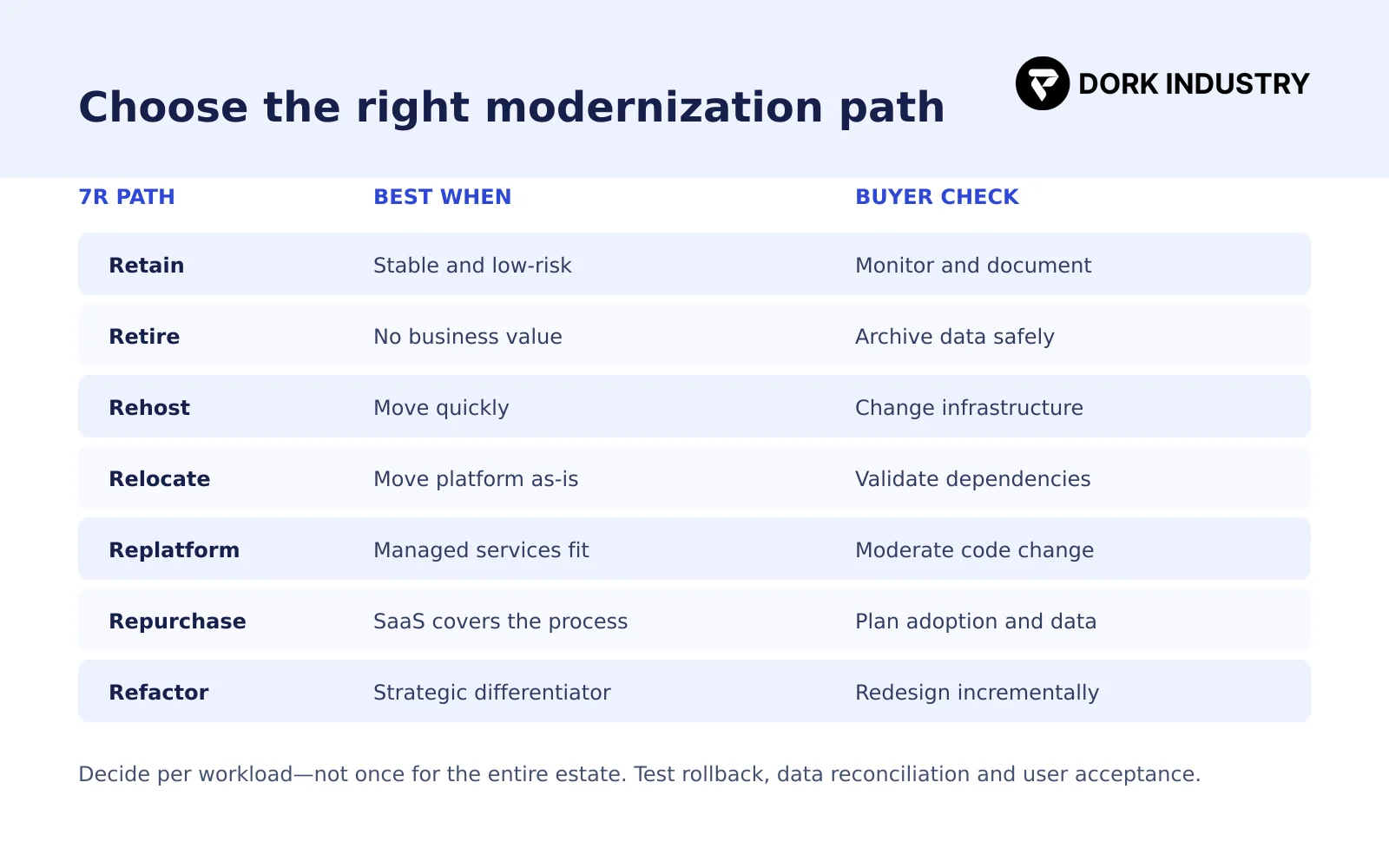
| Path | Choose it when | Main risk to test |
|---|---|---|
| Retain | The workload is stable, supported and not blocking change. | Hidden dependencies and future support deadlines |
| Retire | The function is unused, duplicated or no longer valuable. | Records, retention obligations and downstream reports |
| Rehost | A fast infrastructure move is needed with minimal application change. | Moving existing inefficiency without improving it |
| Relocate | A compatible platform can move largely as-is. | Licensing, networking and platform-specific dependencies |
| Replatform | Managed databases, containers or runtime services can reduce operations work. | Behaviour changes, performance and vendor constraints |
| Repurchase | A proven ERP, CRM or SaaS product fits the process better than custom code. | Process fit, data portability, adoption and recurring cost |
| Refactor | The application is strategically important and must change faster or scale differently. | Scope expansion, parity defects and long dual-running periods |
Do not assume cloud migration equals modernization. Rehosting can change the infrastructure while leaving the architecture and release process untouched. Conversely, an on-premise system can be modernised through APIs, modularisation, automated testing and a supported database without moving everything to a public cloud.
How should buyers estimate modernization cost?
A credible estimate depends on evidence, not only user count or code size. Before giving a fixed proposal, legacy application modernization services providers should identify the application portfolio, technology versions, dependency graph, data volume, integrations, test coverage, availability needs, security constraints and target operating model.
Which cost drivers change the proposal?
| Cost driver | Lower complexity | Higher complexity |
|---|---|---|
| Architecture | Documented modular application | Tightly coupled monolith with hidden jobs |
| Data | Clean schema and limited history | Duplicates, unknown rules and multiple masters |
| Integrations | Documented APIs | Files, desktop agents, direct database writes |
| Testing | Automated regression suite | Knowledge exists only with users |
| Availability | Planned maintenance window | Near-zero downtime and high transaction volume |
| Compliance | Standard business data | Regulated or sensitive records and evidence requirements |
| Change scope | Parity first | Modernization mixed with redesign and new features |
Ask for an estimate in phases: discovery, pilot, migration waves, cutover, stabilisation and support. Separate mandatory parity from optional new capability. This makes scope and commercial trade-offs visible and reduces the chance that hidden dependencies appear only after development begins.
What data, security and integration controls belong in the plan?
Modernization changes trust boundaries. An internal database may become an API; batch data may become event-driven; a single server may become several managed services. Security therefore has to be designed into discovery, architecture, migration and operations—not added after cutover.
What is the minimum control set?
- Data inventory: classify personal, financial, operational and confidential data; identify owners and retention rules.
- Identity and access: map current users and service accounts; apply least privilege; remove shared and dormant access.
- Secrets: move passwords, tokens and certificates out of code and scripts; establish rotation and expiry.
- Encryption: define encryption in transit and at rest, including backups and data-export paths.
- Auditability: preserve business and security logs with timestamps, actor identity and retention controls.
- Dependency risk: inventory unsupported libraries, operating systems, databases and external components.
- Recovery: agree recovery time and recovery point objectives; test backup restore and rollback.
- Data reconciliation: compare record counts, totals, checksums and exceptions before final cutover.
Integration discovery deserves its own workshop. Document every API, file exchange, message queue, scheduled job, report extract, email trigger, barcode device, payment service and direct database connection. For each interface, capture the owner, protocol, frequency, volume, authentication, retry behaviour and failure alert. Dork Industry’s cloud services, ERP solutions and application development capabilities can be combined when a modernization programme crosses these boundaries.
Should you build, configure or buy?
The answer should be decided per capability, not per company. Buy or configure commodity functions when a product fits the required process and data controls. Build when the workflow creates genuine differentiation, when integrations are unusually complex or when available products force unacceptable operational compromise.
| Decision | Use it when | Ask before approval |
|---|---|---|
| Buy SaaS | The process is standard and change management is manageable. | Can we export data, integrate safely and leave without lock-in? |
| Configure ERP/CRM | Core processes fit a platform with limited extensions. | Are customisations upgrade-safe and documented? |
| Build or refactor | The workflow is differentiating or a product gap is material. | Who owns the architecture, tests, code and support? |
| Hybrid | A product covers the core while custom APIs handle differentiating steps. | Where is the system of record, and who owns integration failures? |
Avoid rebuilding a poor process exactly as it exists. Also avoid forcing a unique operational advantage into a generic product merely to reduce initial development. The assessment should separate obsolete workaround, required control and differentiating workflow.
What should a 30-day assessment and 90-day pilot include?
Timelines vary by estate size, access and complexity. The following is a practical pilot structure, not a promise that every system can be completed within 90 days.
What happens during days 1–30?
- Confirm business outcomes, critical processes and decision owners.
- Inventory applications, infrastructure, data stores, interfaces and scheduled work.
- Record incidents, change lead time, manual effort and current costs.
- Classify each workload using the 7R model.
- Choose one bounded pilot with measurable value and reversible risk.
- Define target architecture, security controls, migration method and rollback.
- Approve acceptance criteria, responsibilities, budget range and decision gate.
What happens during days 31–60?
- Create non-production environments and repeatable deployment.
- Capture or automate critical regression tests.
- Modernize the selected component and integrate it behind a controlled boundary.
- Run data migration rehearsals and reconciliation reports.
- Test access control, logging, monitoring, backup, recovery and failure handling.
What happens during days 61–90?
- Run side-by-side or limited-user release where feasible.
- Measure performance, errors, user task time and support demand against baseline.
- Exercise rollback and operational runbooks.
- Collect user acceptance and unresolved exceptions.
- Approve, revise or stop the next migration wave based on evidence.
Start with a reversible pilot, not a blank-cheque rewrite.
Send Dork Industry the system purpose, current stack, key integrations and biggest operational problem. We will help define the discovery scope and the first measurable decision gate.
How should you compare legacy application modernization services providers?
Most competing service pages describe assessment, cloud migration, refactoring, databases and DevOps. Far fewer make the buyer’s evidence, stop conditions, reconciliation, rollback and operating ownership explicit. Use the following checklist to compare proposals on delivery safety—not only technology logos.
- Discovery evidence: Will you receive an application inventory, dependency map and 7R decision record?
- Business baseline: Are current incidents, change lead time, user effort and operational cost measured?
- Scope separation: Does the proposal separate parity, modernization and new features?
- Architecture: Are target components, interfaces, data ownership and non-functional requirements documented?
- Security: Are identity, secrets, encryption, logging, retention and dependency risk included?
- Testing: Is there a regression, performance, security, migration and user-acceptance plan?
- Data quality: Are rehearsal, reconciliation, exceptions and sign-off defined?
- Continuity: Are cutover, fallback, dual-running and operational support described?
- Ownership: Will you own the code, documentation, infrastructure definitions and data exports?
- Commercial gates: Can you stop after discovery or a pilot without committing to the full programme?
- Post-release support: Who monitors, fixes and improves the modernised application after stabilisation?
Why is Delhi the geographic focus?
Delhi is used as a natural service-area focus, not as a doorway keyword. External Google Keyword Planner research showed current exact-match demand for the selected keyword in Delhi and positive recent momentum, while several other target cities returned no measurable volume or declining demand. Dork Industry also has a Delhi contact location and supports clients remotely, so the article remains useful to buyers outside the city.
Research note (15 October 2026): Google Ads Keyword Planner reported an India-wide average of 390 monthly searches for “legacy application modernization services,” a 51.3% three-month increase, advertiser competition index 19, and a high top-of-page bid estimate of ₹553.85. A related city query, “legacy software modernization services,” showed 10 monthly searches and 100% three-month growth in Delhi; Gurugram and Noida returned zero, while Jaipur showed 10 searches with a 100% decline. These figures can change and should be rechecked before campaign spending.
For Delhi teams operating ERP, CRM, finance, ecommerce, warehouse, field-service or custom line-of-business systems, the same principle applies: modernize around the process and its evidence. Location affects stakeholder access, support and delivery coordination; it does not change the technical standards required for safe migration.
Frequently asked questions
What are legacy application modernization services?
Legacy application modernization services assess and improve ageing software, infrastructure, data and delivery practices. Depending on business value and risk, the provider may retain, retire, rehost, relocate, replatform, repurchase or refactor each workload. The work should include discovery, testing, data controls, cutover, rollback, documentation and operational handover.
Is modernization the same as cloud migration?
No. Cloud migration changes where a workload runs; modernization changes how it is built, delivered, operated or integrated. A rehost can move an unchanged application to cloud infrastructure. A modernization programme may instead refactor code, replace a database, introduce APIs or automate releases without moving every component to the cloud.
Should we rewrite the entire legacy application?
Usually not as the default. A full rewrite has high parity, scope and cutover risk. First classify components by value, technical risk and change need. Retain stable parts, retire unused functions and pilot the highest-value bounded component. Approve a broader rewrite only when incremental paths cannot meet the required outcome.
How long does legacy application modernization take?
Duration depends on dependencies, data, integrations, testing, availability and scope. A bounded assessment or pilot may take weeks, while a large portfolio can require multiple migration waves. Ask providers for phased estimates with explicit assumptions, decision gates and exit criteria rather than one unsupported completion date.
How do we reduce downtime during migration?
Use rehearsed cutovers, automated deployment, data replication where appropriate, reconciliation, feature flags, traffic controls and a tested rollback plan. Side-by-side running can reduce risk when the systems support it. The acceptable downtime, recovery time and recovery point must be agreed with business owners before design begins.
What should we send for a first assessment?
Provide the application’s business purpose, users, current stack, hosting, databases, integrations, known incidents, support constraints and the most important outcome. Sensitive credentials or production data are not needed for an initial scoping conversation. Dork Industry can then propose a discovery scope and evidence checklist.
Sources and further reading
- AWS Prescriptive Guidance glossary: modernization and the 7 Rs
- Microsoft Cloud Adoption Framework: prepare for cloud modernization
- Microsoft Cloud Adoption Framework: execute modernization
- OWASP Application Security Verification Standard
Get a legacy application modernization assessment
Share the system purpose, stack, integrations and biggest operational risk. Dork Industry can help you choose the right modernization path, define a pilot and prepare a practical implementation roadmap.
Request an assessment · WhatsApp +91 8210792477 · support@dorkindustry.com
Planning an app for this?
Book a free consultation — we scope the requirements, outline the approach, and give you an honest verdict before any development is discussed.