A custom software development company RFP is a buying specification that defines the business problem, users, scope boundaries, data and integrations, measurable quality requirements, delivery evidence, acceptance tests, intellectual-property ownership, support duties, and a vendor-exit package. Without these details, proposals may look comparable while pricing different products.
Key takeaways
- Describe the workflow and measurable outcome before naming a technology stack.
- Make every milestone produce reviewable evidence, not only a progress percentage.
- Define application security, privacy, accessibility, performance and recovery as testable requirements.
- Make repository access, documentation, deployment assets and exit assistance contractual deliverables.
Researched and reviewed by the Dork Industry Editorial Team on 17 October 2026. This guide is for founders, operations leaders, procurement teams and technology managers comparing software partners in India.
Why choose the custom software development company keyword—and why India?
We selected the commercial query custom software development company only after comparing external demand across eight markets, rather than choosing an industry first or copying an existing Dork Industry article. Google Keyword Planner data available through Dork Industry’s research environment estimated roughly 6,240 monthly searches across the reviewed markets. India produced the largest measured share at about 2,900 searches (46.5%), followed by the United States at about 2,400 (38.5%). The United Kingdom, Australia, Canada, the UAE, Germany and Singapore together represented the remaining 15%. These are rounded observations from the collected dataset.
| Reviewed market | Approximate monthly searches |
|---|---|
| India | 2,900 |
| United States | 2,400 |
| United Kingdom | 390 |
| Australia | 210 |
| Canada | 140 |
| United Arab Emirates | 110 |
| Germany | 50 |
| Singapore | 40 |
Research snapshot: the measured market values were India ≈2,900; United States ≈2,400; United Kingdom ≈390; Australia ≈210; Canada ≈140; United Arab Emirates ≈110; Germany ≈50; and Singapore ≈40 monthly searches. We used the same query and planning method across markets. See Google’s explanation of Keyword Planner forecasts and search-volume data when interpreting these estimates.
The query signals a buyer evaluating or preparing to hire a provider. Recent momentum was positive in the collected series, while top-of-page advertising bids confirmed commercial competition. India is therefore the primary geographic lens, but the RFP framework works for international buyers commissioning an India-based delivery team. These figures are directional planning inputs, not guaranteed traffic or sales forecasts.
What do the five leading results explain—and what do they miss?
We reviewed five prominent current pages serving this intent. Their strongest material explains capabilities, technologies, industries, cost factors and delivery processes. Their shared weakness is procurement detail: most do not give a buyer a complete, testable RFP that makes proposals genuinely comparable.
| Current result | Useful value | Buyer gap this guide closes |
|---|---|---|
| Webanix | Service scope and development capabilities | Evidence-linked milestones, ownership and exit package |
| OrangeMantra | Enterprise services and technology breadth | Comparable RFP response format and acceptance matrix |
| TriazineSoft | Vendor comparison by fit, cost and proof | Requirements a buyer must issue before scoring vendors |
| CodeMech Solutions | India-focused service explanation | Data migration, non-functional tests and vendor-exit controls |
| Levitation | Shortlist-style market overview | Practical discovery worksheet and payment evidence |
The better question is not merely “Which company ranks first?” It is “Which custom software development company can show, in writing and in working evidence, that it understands our workflow, delivery risks and usable handover?” The following twelve requirements turn that question into a buying process.

What should a custom software development company RFP include?
1. What business problem and baseline should you state?
Start with the current workflow, not a feature wish list. Document who performs each step, which spreadsheet or system holds the record, where re-entry occurs, who approves exceptions and how long the process takes. Add a baseline such as order-processing time, reconciliation hours, missed follow-ups, error rate or support volume. A custom software development company can then propose a measurable operational change instead of repackaging a generic application.
2. Which users, jobs and permission boundaries must be defined?
List every user group: customer, operator, supervisor, finance reviewer, administrator, external partner and auditor. For each group, specify the job they need to complete and the information they may view, create, edit, approve or export. Include peak user counts, concurrent usage and device conditions. This exposes hidden complexity before pricing.
3. What is in—and out—of the first release?
Separate launch requirements, later enhancements and explicit exclusions. Describe the critical user journeys from trigger to completed outcome. If an RFP says “inventory module” but does not define returns, adjustments, batch rules, multiple locations and approval exceptions, each vendor will price a different interpretation. Ask bidders to list assumptions and exclusions next to every estimate.
4. Which data, integrations and migration rules apply?
Name each source system, data owner, format, approximate volume, update frequency and interface method. Identify which system is authoritative when values disagree. Define duplicate handling, validation, reconciliation and cutover. For APIs, state rate limits, authentication, sandbox availability and error-retry expectations. A responsible custom software development company should flag unknown data quality before promising a fixed migration date.
5. How will quality requirements become measurable?
“Fast,” “scalable” and “user-friendly” cannot be accepted or rejected. Convert them into measurable targets: response time for key journeys, expected peak load, availability window, recovery-time and recovery-point objectives, browser/device coverage, accessibility level and audit-log retention. For public-facing interfaces, reference the W3C Web Content Accessibility Guidelines 2.2 where appropriate.
6. Why request an architecture decision record?
Do not prescribe a fashionable stack without a constraint. Ask the custom software development company to explain deployment model, major components, data stores, integrations, identity, observability, scaling approach and rejected alternatives. The architecture should connect to business needs such as offline operation, data residency, integration volume or rapid product experimentation. Require a simple diagram plus an architecture decision record for material choices.
7. What application security and privacy evidence is required?
Require the custom software development company to document secure-development responsibilities, dependency controls, code review, secret management, access control, event logging, vulnerability handling and an incident communication path. The NIST Secure Software Development Framework gives purchasers and suppliers a common vocabulary, while the OWASP Application Security Verification Standard can help define verifiable web-application controls.
For personal data, identify controller/processor-style responsibilities, purpose, retention, deletion, user requests, sub-processors and cross-border handling. India-based projects should obtain legal review for their obligations under the applicable Digital Personal Data Protection framework. The RFP should assign evidence and responsibilities; it should not substitute for legal advice.
8. How should milestones link to accepted evidence?
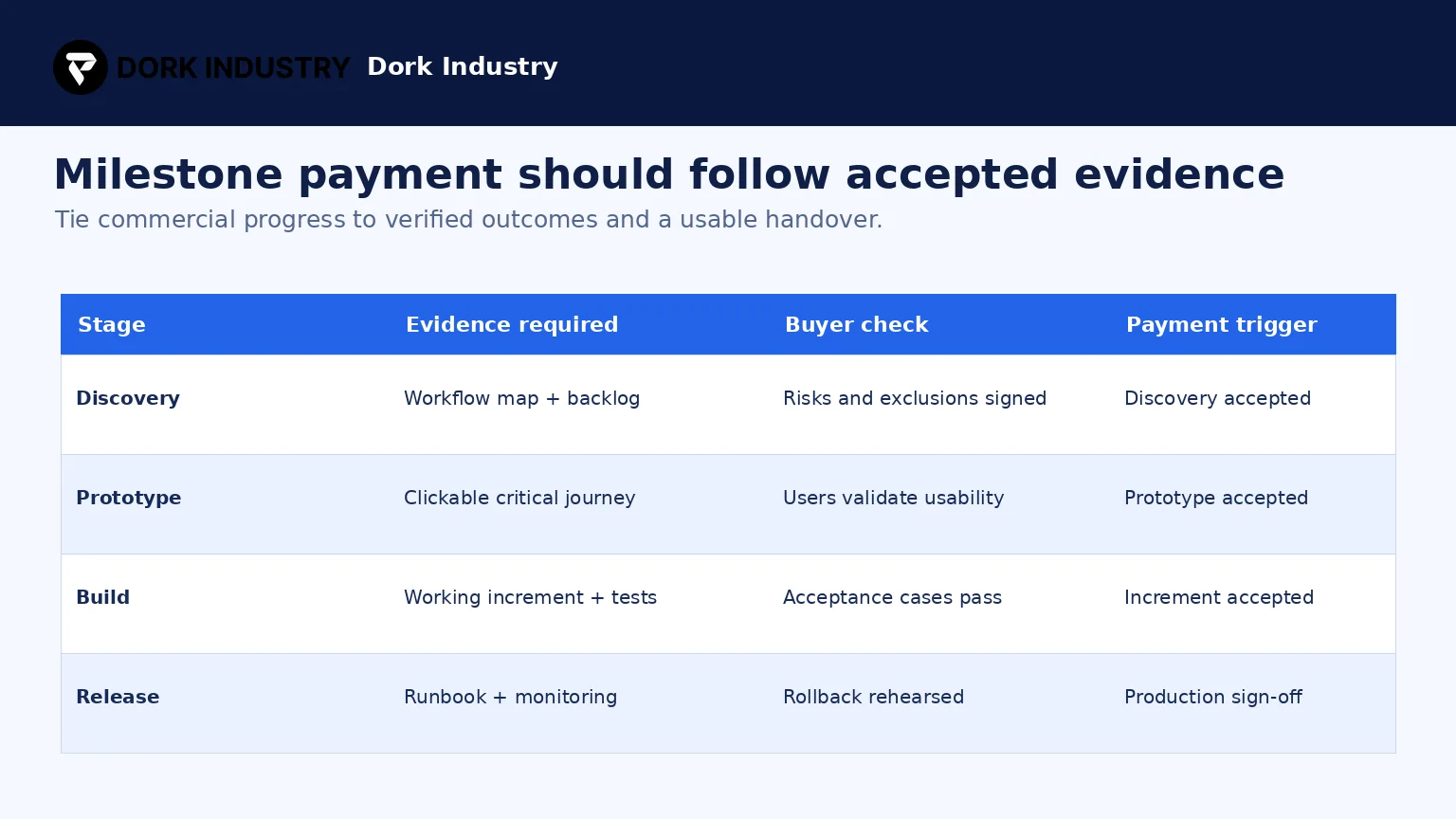
A calendar date alone is not a milestone. Each payment point should identify the deliverable, review method, acceptance owner, correction window and payment trigger. Discovery might require a signed workflow map and prioritized backlog. A custom software development company should support every build increment with a working demonstration, test report, updated documentation and accepted cases in a staging environment.
9. How should testing and acceptance be defined?
State who writes and approves acceptance cases, which test data may be used, which defects block release and how regression is demonstrated. Require the custom software development company to include functional, integration, migration, performance, accessibility and application-security checks as relevant. Define production readiness: monitoring, backups, rollback, runbook, support contacts and user training should be verified before launch.
10. How can changes be controlled without freezing learning?
Custom projects discover new information. The contract should explain how a change is raised, estimated, approved, scheduled and reflected in cost. Ask vendors to distinguish clarification, defect and scope change. Maintain a decision log and revised backlog. This protects the buyer without pretending every requirement can be known on day one.
11. Who owns the repository, IP and delivery assets?
Define ownership and licensing for source code, designs, documentation, data models, deployment scripts, test suites and third-party components. The buyer should have agreed repository visibility during delivery—not only a zip file after final payment. List open-source and commercial dependencies, their licences, renewal costs and replacement risks. Ask who owns reusable vendor accelerators and what the buyer can modify after handover.
12. What support and vendor-exit package is required?
Specify warranty scope, support hours, severity definitions, response and restoration targets, maintenance inclusions, hosting responsibilities and enhancement pricing. Then define exit deliverables: current repositories, build instructions, environment inventory, credentials transfer, data export, architecture records, runbooks, known issues and knowledge-transfer sessions. A credible custom software development company should plan for operational independence, even while aiming for a long partnership.
Need an implementation-ready software RFP?
Dork Industry can map your workflow, identify integration and data risks, define acceptance evidence and prepare a discovery or proof-of-concept plan before you commit to a full build.
Discuss custom software architecture WhatsApp +91 8210792477
Email: support@dorkindustry.com
Should you build, configure or buy?
| Option | Best fit | Main caution |
|---|---|---|
| Buy standard software | Your workflow is common and change is acceptable | Licence limits, export restrictions and process compromise |
| Configure a platform | Core capability exists but fields, rules and integrations differ | Extension limits, upgrade compatibility and partner dependency |
| Build custom software | The workflow differentiates the business or requires unusual integration/control | Ownership burden, product decisions and ongoing maintenance |
| Hybrid | A platform covers commodities while custom services handle differentiation | Integration ownership and fragmented observability |
Ask every vendor to recommend the lowest-complexity option that meets the outcome—even when that means less custom development. A good partner can explain why a standard product, configuration, custom build or hybrid is commercially justified.
What belongs in a practical custom software RFP worksheet?
Complete this one-page diagnostic before requesting proposals:
- Outcome: What measurable business result must improve?
- Baseline: What is the current time, error, cost or conversion measure?
- Users: Who completes, approves and audits the workflow?
- Critical journey: What end-to-end task must work at launch?
- Boundaries: What is explicitly excluded from release one?
- Data: Which system is authoritative and what must be migrated?
- Integrations: Which APIs, devices, ERP, CRM or payment systems are involved?
- Quality: What performance, availability, recovery and accessibility targets apply?
- Evidence: What demonstration or report releases each milestone payment?
- Ownership: Which code, documents, environments and licences transfer?
- Operations: Who monitors, supports, backs up and restores the service?
- Exit: What must another qualified team receive to operate the product?
How should you score a custom software development company?
Use a weighted matrix instead of choosing the lowest total price. Ask each bidder to respond in the same format and attach evidence.
| Criterion | Suggested weight | Evidence to request |
|---|---|---|
| Problem and workflow understanding | 20% | Restated process, assumptions and risks |
| Solution and architecture fit | 20% | Diagram, trade-offs and integration approach |
| Delivery method | 15% | Milestones, team roles and demo cadence |
| Quality, privacy and application security | 15% | Test strategy, controls and responsibility matrix |
| Relevant proof | 10% | Comparable outcomes, references or working demonstration |
| Ownership and handover | 10% | Repository, documentation and exit deliverables |
| Commercial clarity | 10% | Assumptions, rate card, change rules and recurring costs |
Adjust weights to your risks. A regulated workflow may allocate more to privacy, traceability and validation. A prototype may allocate more to learning speed. Record why each score was awarded so the selection can be reviewed later.
What are the warning signs?
- A fixed quote before the provider understands users, data and integrations.
- A proposal that lists a technology stack but not the workflow outcome.
- Milestones defined only as percentages or dates.
- No explicit assumptions, exclusions or recurring third-party costs.
- Source-code access only after the final payment, with no agreed repository process.
- “Testing included” without environments, cases, evidence or defect thresholds.
- No rollback, monitoring, backup restoration or operational handover plan.
- Unclear ownership of accounts, licences, deployment assets and data exports.
How does a low-risk 30-day discovery plan work?
Before awarding a large build, commission a bounded discovery or proof of concept:
- Week 1—diagnose: map the current workflow, baseline, users and failure points.
- Week 2—define: agree release-one boundaries, critical journeys, data and integrations.
- Week 3—prove: prototype the riskiest journey or integration and test it with real users using safe data.
- Week 4—decide: produce the architecture decision, backlog, estimates, delivery plan, risk register and acceptance matrix.
The output should let you stop, re-scope, buy a product or proceed to development without losing the learning. Dork Industry supports this process through custom application and integration services, as well as web application delivery.
Turn the worksheet into a qualified vendor brief
Send Dork Industry your workflow, current systems and target outcome. We can return a scoped assessment, proof-of-concept plan or developer-hiring recommendation.
Email: support@dorkindustry.com
WhatsApp: +91 8210792477
Contact: Request an assessment
Frequently asked questions
What should I send a custom software development company first?
Send a short workflow description, user groups, current systems, measurable problem, critical launch journey, data and integration list, constraints and target decision date. A useful provider should identify unknowns before asking you to approve a complete build estimate.
How detailed should a custom software RFP be?
It should be detailed enough for vendors to price the same boundaries and risks, but not so prescriptive that it forces an untested solution. Define outcomes, constraints and acceptance evidence; invite vendors to explain architecture trade-offs.
Can a custom software project have a fixed price?
Yes, when scope, dependencies, acceptance tests and change rules are sufficiently stable. For uncertain integrations or workflows, a fixed-price discovery followed by phased estimates is often more credible than a single early promise.
Who should own the source code?
The contract should clearly state ownership and licences for custom code, vendor accelerators, open-source components, designs, tests, documentation and deployment assets. Buyers should also define repository access and usable handover, not ownership wording alone.
How do I compare two software proposals?
Normalize each custom software development company proposal across assumptions, exclusions, team roles, recurring costs, milestones, acceptance evidence, support and exit deliverables. Score the same criteria with documented evidence. Do not compare only headline price or feature counts.
When should I choose configuration instead of custom development?
Choose configuration when a maintained platform already covers the core workflow and the business can adapt without losing an important advantage. Build custom capability when the workflow differentiates the business or requires controls and integrations a platform cannot support economically.
Which sources and methodology support this guide?
Demand and geographic selection used current Keyword Planner outputs available in Dork Industry’s research environment across India, the United States, the United Kingdom, Australia, Canada, the UAE, Germany and Singapore. Search intent and content gaps were reviewed against the five competitor pages listed above. Technical recommendations were checked against the NIST SSDF, OWASP ASVS and W3C WCAG 2.2. Traffic, enquiry and ranking outcomes are not guaranteed.
If you are shortlisting a partner for this kind of system, see our comparison of the best AI automation company in India, which covers eight providers on delivery, integrations and governance.
Discuss this for your business?
Book a free consultation — we scope the problem, outline the approach, and give you an honest verdict before any development is discussed.
About the author: The Dork Industry Editorial Team combines software architecture, application development, automation, cloud operations and integration experience. The team turns business workflows into practical assessment, proof-of-concept and delivery guidance for buyers evaluating technology investments.