
AI automation can connect your ad spend to store walk-ins: click IDs from Google Enhanced Conversions and Meta’s Conversions API are joined with in-store signals you already own — loyalty IDs, coupon codes, door-counter footfall and POS timestamps. An AI matching engine then estimates, per campaign, how many visits each campaign likely drove. Direct answer: yes, it can be measured — but only on consented first-party data, with probabilistic (never personal) matching and human approval of every budget move.
This article examines how much money a retail chain spends without knowing what worked, why ad platforms can’t give you the answer themselves, what data you already have, what an AI automation attribution system looks like in practice, what it must never do alone, when you should not build custom, how the options compare, and how to test the idea on a 30-day pilot.
Key takeaways
- Retail chains misallocate ad spend because each platform only reports its own clicks — the store-visit truth is missing.
- First-party data you already own (click IDs, loyalty scans, coupon codes, door counters, POS timestamps) is the foundation of walk-in attribution.
- An AI matching engine joins ad-side events to store-side evidence and outputs aggregate, probabilistic per-campaign walk-in ROAS with honest uncertainty bands.
- Hard boundaries: no individual shopper profiles, no automated budget moves, no employment use, consent-only data.
- A 30-day pilot (one campaign family, two stores, coupon codes as ground truth) validates the model before a full build is funded.
How much money is a retail chain spending without knowing what worked?
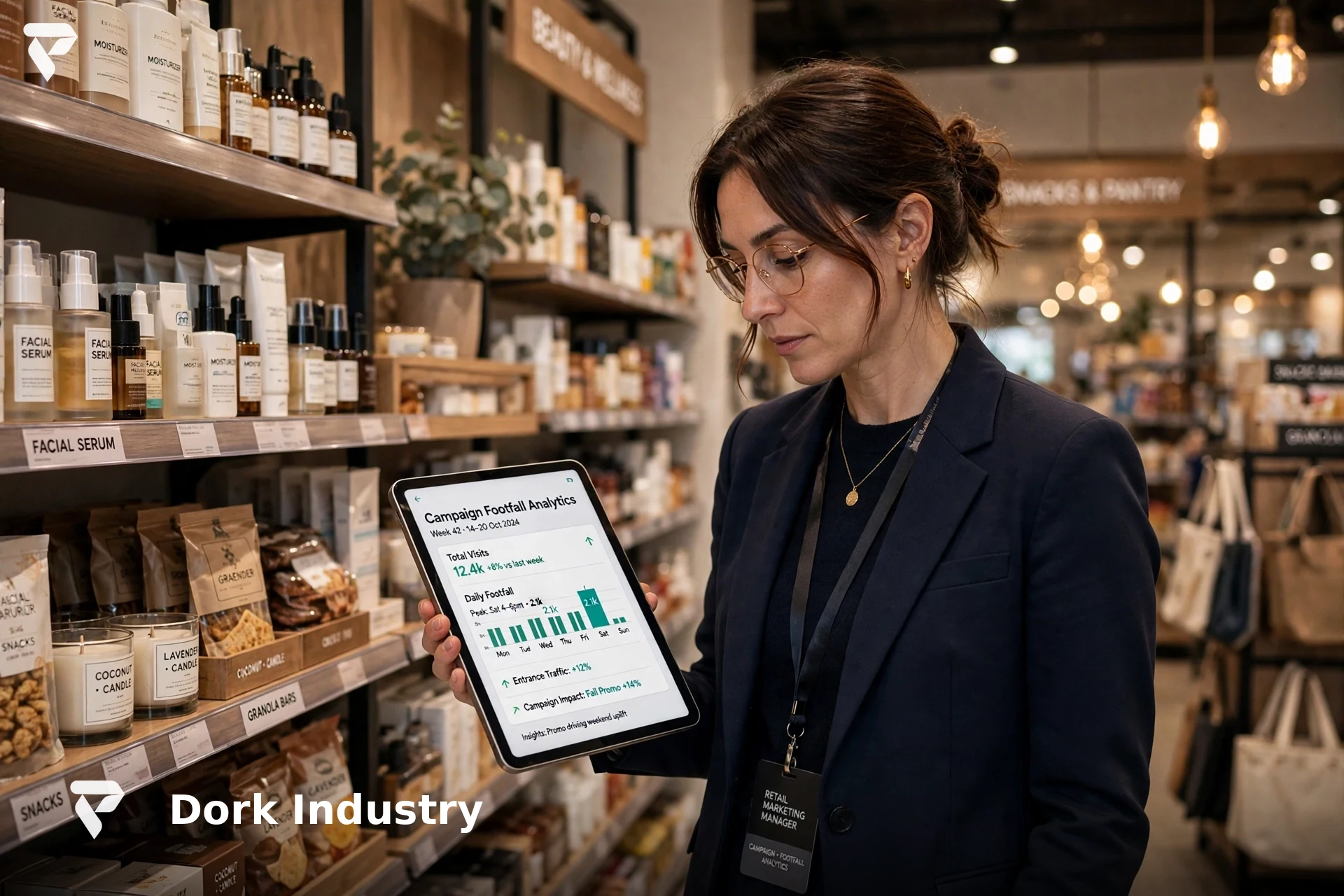
The expensive failure is not that the ads don’t work — it is that nobody can prove which ones do. A chain spending on Google, Meta, influencers and print usually optimizes each channel on its own dashboard: clicks here, impressions there. But when most revenue walks through the store door, the dashboard that matters — which campaign produced this week’s footfall — does not exist, so the campaign with the most clicks keeps its budget while the one that quietly fills stores on Saturdays gets cut.
Here is the math — an illustrative example with stated assumptions, not industry statistics:
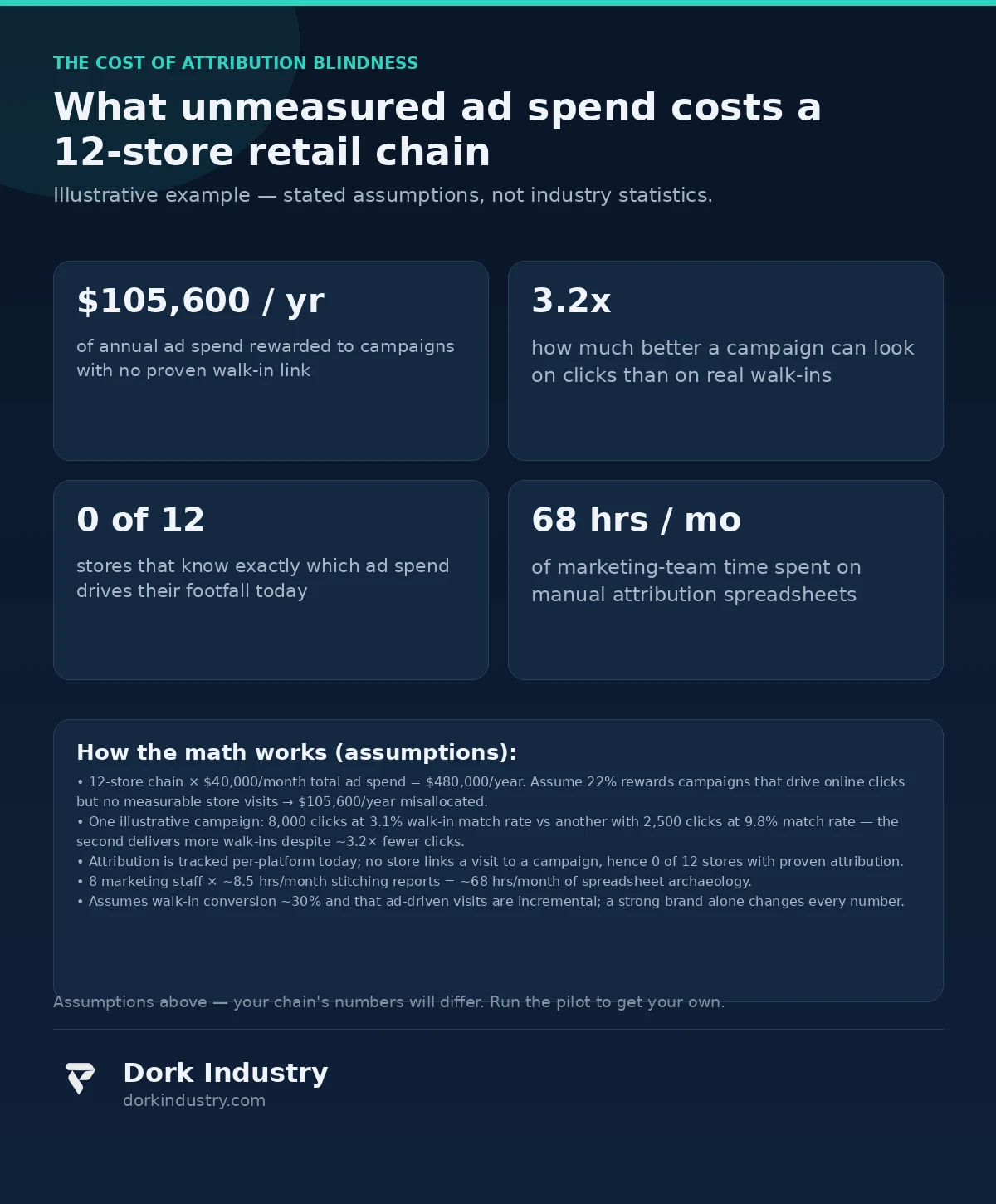
- $105,600 of annual ad spend rewarded to the wrong campaigns. Assume a 12-store chain spends $40,000/month ($480,000/year) across platforms. Assume 22% of it rewards campaigns that drive online clicks but no measurable store visits. That is $105,600 a year buying metrics, not customers.
- A 3.2× measurement illusion. Assume one campaign generates 8,000 clicks at a 3.1% walk-in match rate (248 walk-ins) while another generates 2,500 clicks at 9.8% (245 walk-ins). On clicks, the first looks 3.2× better; on walk-ins, they tie. The click-based budget decision is wrong.
- 68 hours a month of spreadsheet archaeology. Assume 8 marketing staff each spend ~8.5 hours a month stitching per-platform exports into one report that still can’t tie a visit to a campaign. That is ~816 hours a year producing evidence nobody fully trusts.
- Zero stores with proven attribution. In this illustrative chain, attribution is tracked per platform; no store links a visit to a campaign. Zero of twelve stores can answer “which ad spend drove yesterday’s footfall?”
According to Google’s documentation on Enhanced Conversions for Google Ads, the industry’s answer to measurement gaps is first-party data: advertisers send hashed first-party customer data (like email or phone) with conversion events so ad platforms can attribute outcomes they would otherwise miss. That same principle is the technical foundation of everything in this article.
Why can’t the ad platforms just tell you which campaign brought the customer in?
First, the platform sees clicks; the sale happens in your store. Google knows someone clicked. It does not know that the person walked into your Andheri outlet on Saturday and bought a ₹4,500 kurta set. Unless you send that outcome back, the platform’s attribution ends at the click.
Second, third-party cookies are dying and cross-app tracking is restricted. The identity signals that once connected a browser to a person are gone or opt-in, so platforms report on their own clicks — not on what happens on your sales floor.
Third, each platform only reports itself. Google credits itself; Meta credits itself. Both can claim the same store visit, and neither is built to answer your true question — which single campaign deserves the next rupee.
Fourth, offline conversion data is yours to send. Store-visit programs exist (Google’s store-visit conversions, for example), but they are modeled estimates — not a per-campaign ledger of your spend. That ledger needs your own pipeline: ad-side events joined to store-side evidence on your infrastructure.
What data do you already have that can connect a campaign to a walk-in?
More than you think — and it is all first-party, which is exactly what survives the privacy era:
- Click and ad-event IDs. gclid from Google, fbclid from Meta, and the event payloads their server-side APIs accept. If you run any server-side tagging, this data exists today.
- Loyalty and membership IDs. A loyalty scan at the till is a consented join key between a known customer and a store visit. Most chains have this data; almost none join it to campaigns.
- Campaign coupon and promo codes. A code unique to a campaign that gets redeemed at the POS is the cleanest attribution signal retail has — deterministic, consented, unambiguous.
- Click-to-call numbers and store-locator searches. Unique numbers per campaign turn “I saw the ad and called” into attributable evidence.
- Door-counter footfall and POS timestamps. The ground truth: how many people entered, and when each transaction happened.
- Wi-Fi opt-in and app location consent. Consented presence data can corroborate visits — never as an identifier, only as an aggregate footfall signal.
The foundation of the whole system is one rule: only consented, first-party data enters the pipeline. No purchased lists, no fingerprinting, no device graphs.
What does an AI automation attribution system actually look like?
Here is the concrete implementation — no buzzwords:
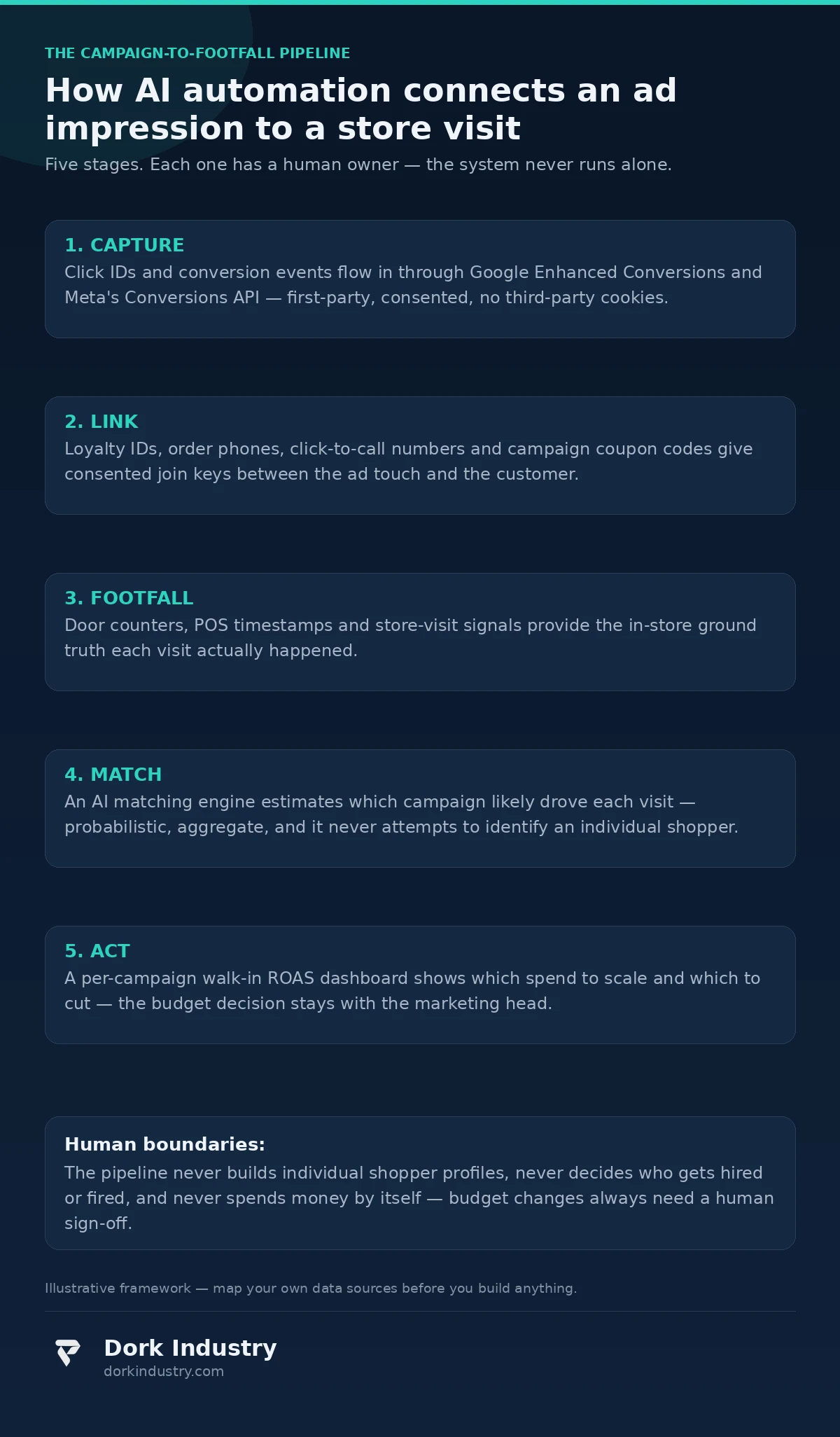
Capture layer: server-side events from both sides. Google’s Enhanced Conversions and Meta’s Conversions API receive hashed first-party data with each online event. On the store side, POS redemptions, loyalty scans and campaign coupon codes stream into the same warehouse. Nothing here tries to “identify” anyone — it moves events with consented identifiers.
Link layer: consented join keys. Loyalty ID, hashed phone, coupon code and click-to-call number connect an ad touch to a visit. Where no deterministic key exists — the majority of walk-ins — the match stays probabilistic rather than pretending to be exact.
Match layer: the AI matching engine. The engine learns the signature of an ad-driven visit per campaign: exposure time windows, geography (the ad ran in a 10-km radius of the store), creative relevance, day-part patterns, baselines. It outputs aggregate, probabilistic attribution — “Campaign A likely drove 180–230 visits this week, confidence band shown” — never “this person came because of that ad.” Uncertainty is displayed, not hidden.
Act layer: per-campaign walk-in ROAS. The dashboard shows each campaign’s estimated walk-ins against its spend — the “weak” campaign from the click dashboard may turn out to be the footfall leader. A reporting system, not an autopilot — which brings us to the boundaries.
According to Meta’s Conversions API documentation, server-side event sharing is designed to give advertisers more reliable measurement by sending events directly from their own servers — including offline events like in-store purchases — rather than relying on browser signals. The pipeline above is exactly that pattern, extended with your store’s own ground truth.
What must this system never do alone?
Attribution touches customer data, so these boundaries are part of the design:
- Never build individual shopper profiles. The engine reports aggregate campaign performance only — never “who visited because of which ad,” never merged cross-campaign profiles, never shopper scoring.
- Never move budget by itself. The system recommends; the marketing head approves. Probabilistic errors turn into real money when budget shifts are automated.
- Never touch employment decisions. Footfall data must never judge individual store staff or decide who gets fired — store-level and campaign-level reporting only.
- Never collect data the customer didn’t consent to. Loyalty scans, coupon redemptions and Wi-Fi opt-ins are consent events. Wi-Fi probe sniffing and facial matching stay out of the pipeline entirely.
- Never report a point estimate without its uncertainty. “Campaign A drove 204 visits” is a lie if the model knows ±35. Honest ranges keep trust when the pilot is audited.
When should you NOT build this?
Build-vs-buy honesty, because a custom attribution system is not always the right answer:
- If 90% of your revenue is online with in-house delivery, your existing e-commerce attribution already works — the store-visit problem doesn’t apply to you.
- If you run one or two stores and under $5,000/month in ads, campaign-unique coupon codes at the POS plus a monthly spreadsheet give you 80% of the answer for near-zero cost. Build nothing.
- If you have no loyalty program, no door counters and no coupon habit, there is not enough store-side ground truth to match against. Start with campaign-unique coupon codes — the cheapest ground truth available.
- If you cannot name one person who owns marketing data, the system will starve. The pipeline needs a marketing owner who can approve data flows and sign budget decisions.
- If your ad data lives across agencies that won’t share event logs, the capture layer has nothing to capture. Fix agency data access before building anything.
How do your attribution options compare?
| Approach | What you get | Honest limitation | Best for |
|---|---|---|---|
| Campaign-unique coupon codes at POS | Deterministic proof that a campaign drove a purchase | Misses ad-influenced visits where no coupon was used | 1–2 stores, small budgets |
| Platform dashboards (Google + Meta) | Clicks, impressions, modeled store visits | Each platform over-credits itself; no per-campaign walk-in truth | Online-first advertisers |
| Attribution SaaS platforms | Multi-touch modeling with a polished UI | Generic models, limited store-side ground truth, ongoing seat costs | Chains that need speed over precision |
| Custom AI automation pipeline | Your own per-campaign walk-in ROAS on your data, with honest uncertainty bands | Needs data hygiene and a marketing owner; real build cost | Multi-store chains with walk-in-led revenue |
The custom route wins when the answer is strategically valuable — when knowing which campaigns fill stores changes how you spend six or seven figures a year. A custom software development build also keeps your customer data on your own infrastructure.
What does a 30-day pilot look like?
The pilot is the proof — one campaign family, two stores, your data:
- Days 1–7: audit and instrumentation. Map every ad event you emit and every store-side signal (loyalty, coupons, door counters, POS exports). Issue campaign-unique coupon codes for one campaign family as the deterministic anchor.
- Days 8–14: capture layer live. Server-side events flow into a staging warehouse. No AI yet — just verify the data arrives complete and consented. Data-quality issues surface here, not later.
- Days 15–21: matching engine on historical data. Train on the last 90 days of campaigns. Produce the first per-campaign walk-in ROAS estimates with confidence bands. The gap between these and the click dashboards is the pilot’s headline finding.
- Days 22–30: validation against coupon ground truth. Check whether the engine’s estimates for the coupon-coded campaign track the deterministic coupon counts. If they correlate, the model earns trust; if not, you’ve learned the limit for the cost of a pilot, not a platform.
A pilot that reports its uncertainty honestly is a success even when match rates are modest — it tells you whether the full build is worth funding, with your numbers.
What drives the cost of the build?
Four cost drivers, in rough order of weight:
- Data plumbing (largest share). Connecting POS exports, loyalty systems, door-counter feeds and server-side ad APIs. The messier your existing systems, the more this costs — data work is typically half the build.
- Matching-engine calibration. The probabilistic model must be calibrated to your visit patterns, geography and campaign structure — not an off-the-shelf product.
- Dashboard and reporting. A per-campaign walk-in ROAS view the marketing head actually trusts, with uncertainty bands and drill-downs.
- Consent and governance. Consent records, data-retention policies and audit trails. Skipping this is how attribution systems become liability systems.
What does not drive the cost: the AI itself. The matching engine is mature technology; the expensive part is the data it stands on.
FAQ
How accurate is AI automation at connecting ad campaigns to store walk-ins?
Expect aggregate, probabilistic accuracy — strong enough to rank campaigns and reallocate budget, not to certify an exact visit count. The pilot validates against coupon redemptions so you see the error bands before funding the full build.
Does this require tracking individual shoppers?
No. It works on consented first-party events (clicks, loyalty scans, coupon redemptions) and reports aggregate campaign performance only. No individual identification, no personal profiles.
Can AI automation work if most walk-ins never click an ad?
Yes — that is the point. The matching engine estimates ad influence from exposure patterns (geography, timing, creative, historical baselines) against footfall ground truth, capturing walk-ins that never touched a click.
How long before we see usable attribution data?
The capture layer yields data within days; the engine needs ~90 days of history to calibrate. A 30-day pilot typically delivers the first credible per-campaign walk-in ranking, validated against the pilot campaign’s coupon codes.
Why not just use Google’s and Meta’s own store-visit reports?
They are modeled, aggregated estimates that each platform optimizes for its own spend — neither gives you a unified per-campaign walk-in ROAS on your own data. Your pipeline does, and the data stays on your infrastructure. For an honest evaluation of what fits your chain, see our AI automation services breakdown.
The bottom line
Retail chains don’t have an ad-performance problem — they have an attribution problem. Clicks dashboards reward the wrong campaigns while the real footfall drivers go unfunded. AI automation fixes this by joining consented first-party ad events with the store-side evidence you already own. The matching engine stays probabilistic, the boundaries stay human, and the budget decision stays with the marketing head.
The cheapest way to start is the 30-day pilot: one campaign family, two stores, coupon codes as ground truth — your own numbers, not a vendor’s slide deck.
Can’t tell which of your campaigns actually fill your stores?
Dork Industry builds AI automation that connects your ad spend to real store walk-ins — consented first-party data, a per-campaign walk-in ROAS dashboard, and a 30-day pilot you can verify against your own coupon redemptions before you fund the full build.
Request a free marketing attribution assessment WhatsApp +91 8210792477
About Dork Industry
Dork Industry is a software development company building custom web, mobile, AI and IoT systems for businesses that need technology to survive contact with the real world — factories, retailers, logistics firms and service companies. From sensor networks and evidence ledgers to AI agents and mobile apps, every build starts from the client’s existing process and is measured against a pilot before it is scaled. Learn more at dorkindustry.com.