Multi branch diagnostic lab sample tracking software should prove who handled every specimen, when it moved, what condition it arrived in, which analyser produced the result, who approved the report and how the originating branch is settled. A feature demonstration is not enough. Buyers should test the complete collection-centre-to-central-lab chain with representative exceptions before choosing a LIS, LIMS or custom enterprise platform.
Prepared by Dork Industry as an enterprise-software evaluation guide. All sample quantities, test events and acceptance thresholds below are illustrative recommendations—not client results, medical advice or accreditation certification.
Diagnostic lab software decision guide
Which growth problem should sample tracking software solve?
The commercial problem is not simply “finding samples.” A multi-branch laboratory can lose capacity and trust when collection centres, pickup teams, accessioning staff, analysers, pathologists, customer support and finance work from disconnected records. Teams then spend time calling branches, rebuilding custody history, correcting identifiers and explaining delayed reports instead of processing additional tests reliably.
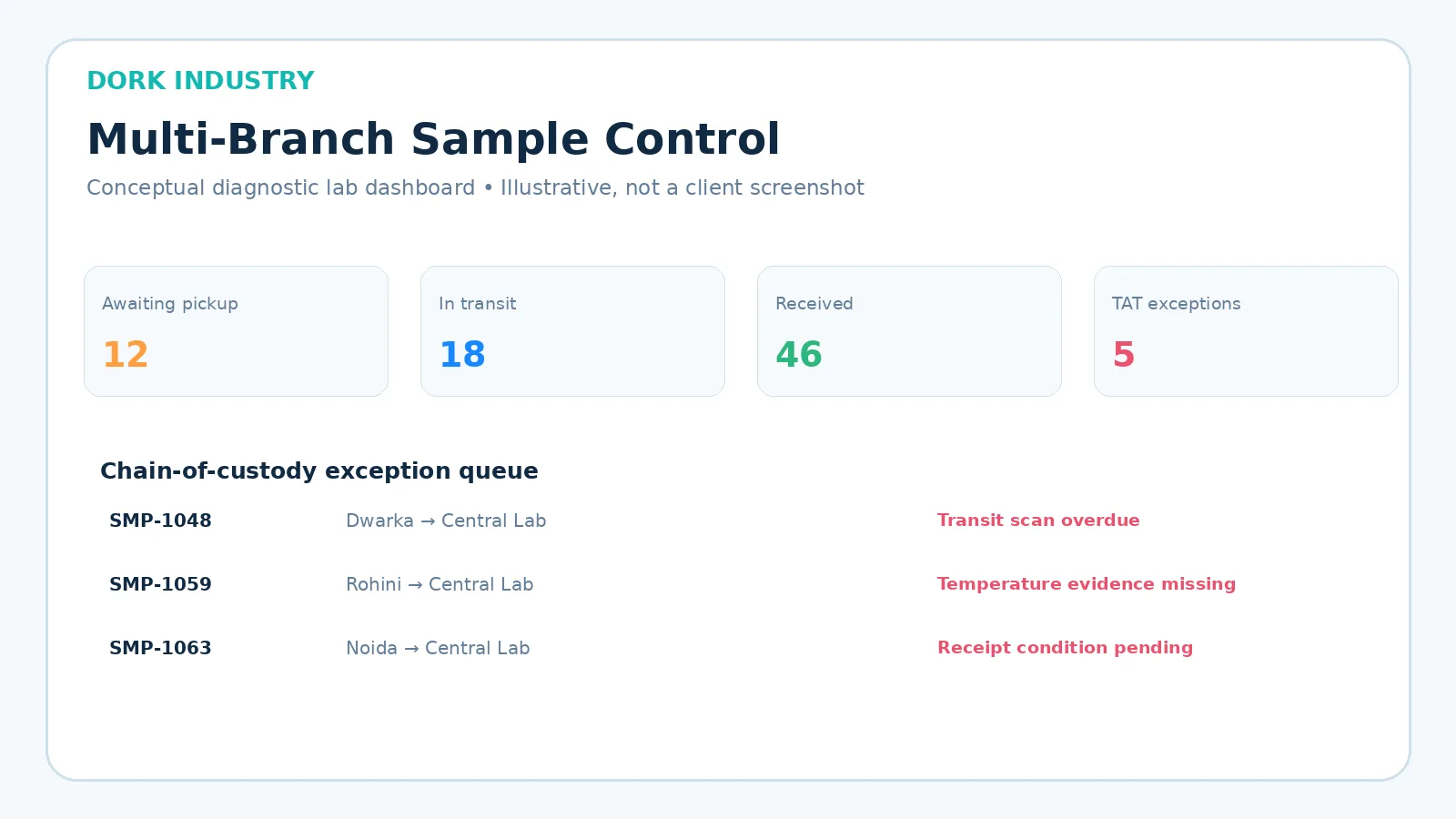
The buying case becomes stronger when the platform must support more collection centres without creating a proportional increase in manual coordination. The software should make each exception visible to the team that can resolve it and preserve the evidence behind that resolution.
| Growth or operating risk | Required control | Evidence to inspect |
|---|---|---|
| More branches create more hand-off gaps | Barcode events and named custody transitions | One timeline from collection through receipt |
| Delayed samples are noticed after TAT is missed | Route, pickup and elapsed-time alerts | Owned exception before the deadline |
| Duplicate or mismatched identifiers create rework | Unique accession rules and validation | Duplicate is blocked and recorded |
| Results fail between analyser and LIS | Message monitoring and controlled replay | Failure enters an exception queue; replay creates no duplicate |
| Branch revenue and referral settlement are disputed | Order-to-report-to-settlement linkage | Every charge traces to its source order and status |
The National Accreditation Board for Testing and Calibration Laboratories maintains current application, checklist and policy documents for medical testing laboratories. Buyers should review the applicable NABL documents and confirm their own quality, privacy and accreditation obligations with qualified specialists. Software supports a controlled process; it does not create accreditation by itself.
What must the sample chain connect?
The chain starts with the order and patient identity controls, then connects the requested tests, collection time, tube or container, printed barcode, collector, branch, pickup batch, courier handover, transit exception, central-lab receipt, condition assessment, accession, analyser mapping, result, technical review, authorised report, delivery and settlement.
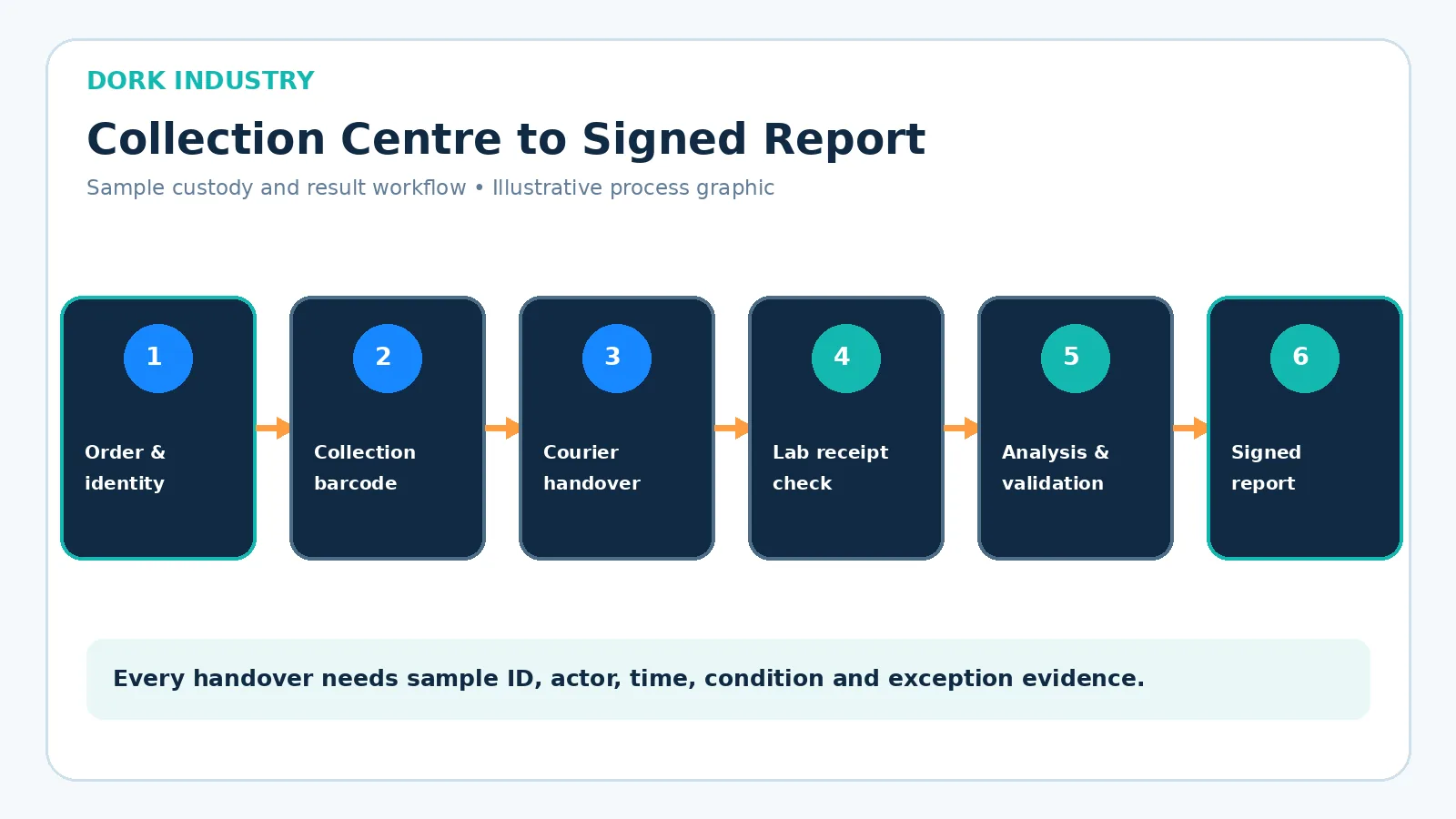
For example, a lab network might route pickups from collection centres in Rohini and Dwarka to one central processing facility. The example is illustrative, but the acceptance question is real: can an authorised user see the last confirmed custody event, expected next event, elapsed time and accountable team without calling each location?
Which multi branch diagnostic lab sample tracking software capabilities belong in a shortlist?
How should orders, barcodes and containers work?
Require one governed accession identity across order, specimen and report. The platform should validate test-to-container rules, print readable labels, prevent duplicate identifiers and retain reprint history. A correction must preserve the previous value, actor, timestamp and reason instead of silently replacing evidence.
How should pickups and receipt exceptions work?
Collection, ready-for-pickup, courier acceptance, departure and laboratory receipt should be separate events. Receipt needs condition, quantity and rejection-reason controls. Route and elapsed-time rules should create actionable exceptions for missing handovers, late arrival or unacceptable condition.
How should analyser and report interfaces behave?
Map specimen, test, unit, reference range, instrument and result status explicitly. The official HL7 FHIR Specimen resource describes data used for gathering, maintaining and processing a specimen, including where it originated. That makes origin and processing history useful integration concepts even when a buyer uses a different standard or interface. Test missing identifiers, duplicate messages, unavailable analysers and delayed acknowledgements. Failed messages should remain visible and replayable exactly once. Report release should require the configured review path and preserve amendments.
How should branch operations and finance connect?
Branch dashboards should separate collected, picked up, received, in process, held, approved and delivered orders. Finance should trace corporate, referral, branch or direct-patient charges to the originating order. Operational TAT and commercial settlement should use the same governed identities.
Dork Industry’s ERP and enterprise workflow services can connect orders, operations and settlement, while mobile application development can support controlled collection and pickup workflows where a browser-only process is impractical.
Which nine acceptance tests should buyers run?
Use authorised, anonymised records that represent actual tests, containers, branches, routes, analysers, approval roles and settlement rules. Record the expected result, actual result, evidence link, owner and severity for every test.
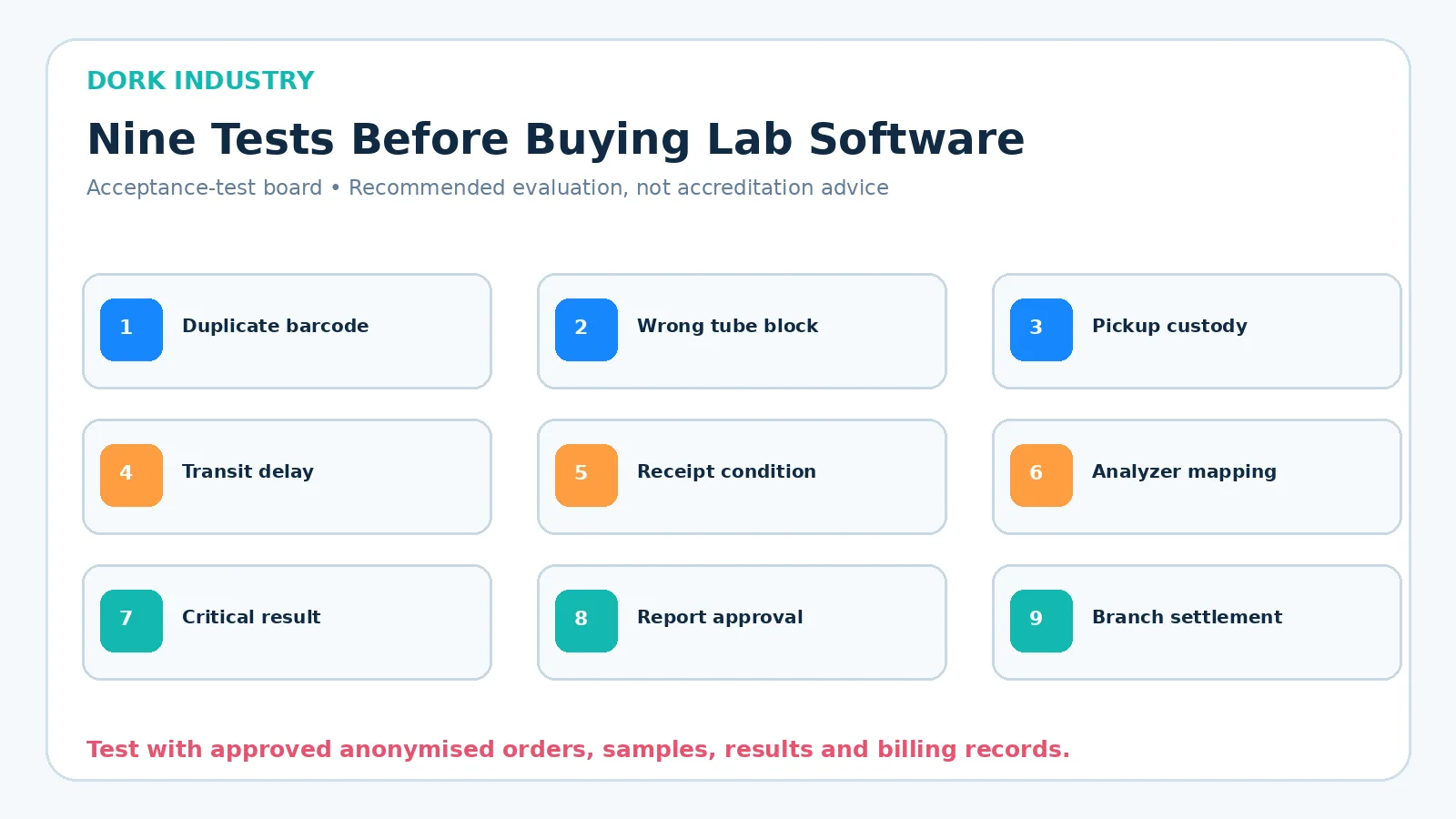
- Duplicate barcode: attempt to create or scan the same specimen identity twice and confirm the system blocks the conflict.
- Wrong container: request a test with an incompatible configured tube and verify collection cannot be completed without authorised resolution.
- Pickup custody: move a specimen from branch to courier and confirm actor, time, batch and next expected event remain visible.
- Transit delay: withhold the receipt event and verify the right team receives an owned elapsed-time exception.
- Receipt condition: record a damaged, insufficient or otherwise unacceptable specimen and confirm reason, disposition and recollection workflow.
- Analyser mapping: send an unmatched or invalid test code and verify it cannot silently attach to the wrong order.
- Critical result: trigger the configured escalation and confirm acknowledgement and follow-up evidence remain linked.
- Report approval: omit a required review and verify the report cannot be released or amended without the authorised path.
- Branch settlement: reconcile one order from booking through report and payment or referral settlement without an orphan transaction.
How should a sample-tracking pilot be scored?
This fictional pilot design makes a vendor comparison reproducible. It is not a customer result, demand statistic or universal accreditation threshold.
| Illustrative pilot item | Example scope | Acceptance question |
|---|---|---|
| Network | 3 collection centres + 1 central lab | Can every location see only the permitted data and actions? |
| Anonymised orders | 60 | Does each order retain a complete specimen-to-report timeline? |
| Pickup batches | 12 | Are handover, route and receipt events complete? |
| Condition events | 8 | Do exceptions preserve reason, owner and disposition? |
| Analyser messages | 6 | Are identities, units and statuses mapped correctly? |
| Deliberately failed integrations | 4 | Is every failure visible, owned and safely replayable? |
A practical pilot recommendation is 100% traceability for tested custody events, zero duplicate specimens after message replay, 100% failed messages visible in an owned exception queue, no report release with a missing configured approval, and full reconciliation of tested branch settlements. Adjust thresholds to the organisation’s documented risk assessment and operating model.
How should implementation risk be controlled?
- Define the system of record. Decide which platform owns patient, order, test, specimen, result, report, branch and payment identifiers.
- Map exception paths. Include recollection, rejected specimens, amended reports, analyser downtime, route delays and payment reversals.
- Design roles and evidence. Specify who may collect, hand over, receive, validate, approve, amend and settle—and what each action must retain.
- Test integrations before scale. Prove failure detection, recovery and idempotent replay across analysers, payments, messaging and external systems.
- Migrate with reconciliation. Count records, map identifiers, sample-check histories and document unresolved data-quality gaps.
- Release by workflow. Pilot one complete branch-to-report chain, review evidence, then expand only after acceptance issues are closed.
Dork Industry works on industry-specific enterprise software, integrations and operational automation. A useful discovery session starts with the hand-offs, exceptions and commercial records your teams cannot trust today—not a generic list of laboratory software features.
Need a multi-branch lab software evaluation plan?
Bring one representative collection-to-report workflow, your current system map and three recurring exception types. Dork Industry can help structure requirements, integrations and acceptance tests.
Frequently asked questions
What is multi branch diagnostic lab sample tracking software?
It is a laboratory operations platform that links orders, specimen barcodes, collection centres, pickup batches, custody events, central-lab receipt, analyser results, report approval and branch settlement. Its value comes from a complete, controlled workflow—not a tracking screen alone.
What is the difference between LIS, LIMS and sample tracking?
Product labels vary. An LIS commonly supports clinical laboratory orders, results and reporting; LIMS often emphasises sample and laboratory workflows. Sample tracking is one capability that may sit inside either platform. Buyers should evaluate required workflows and evidence rather than rely on the label.
Can barcode scanning prevent every sample error?
No. Barcodes reduce manual identification risk only when identity, container, workflow and exception rules are designed correctly. Buyers must also test reprints, duplicate scans, unreadable labels, wrong containers, offline events and authorised corrections.
What should a diagnostic lab software pilot include?
Include representative branches, orders, containers, pickup batches, receipt conditions, analyser messages, approvals, amendments and settlements. Deliberately test failures and retain evidence for the expected and actual result of every scenario.
How does sample tracking help a lab network scale?
It can replace branch-to-lab calls and spreadsheets with governed events, owned exceptions and shared operational status. That can make added collection centres easier to coordinate, but the result depends on process design, integrations, data quality, training and adoption.