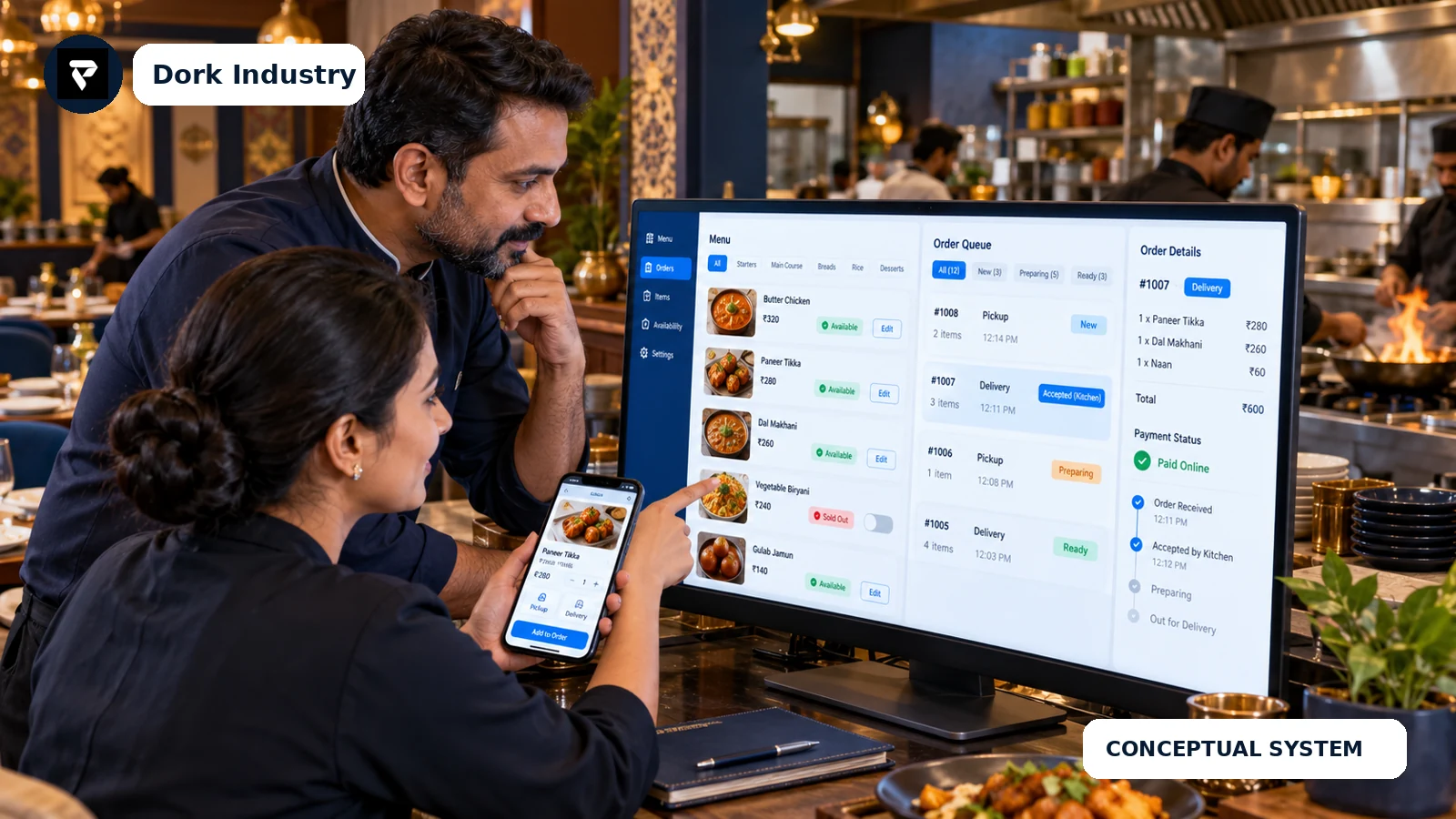
A restaurant direct ordering system can start as a mobile-friendly website rather than a costly app. The right first version lets customers choose a branch, view an accurate menu, select pickup or delivery, pay, and receive a confirmed kitchen status. An app becomes useful only when repeat ordering, loyalty, multi-branch operations or deeper integrations justify it.
Contents
Why does direct restaurant ordering fail after launch?
Many projects treat the menu page as the product. Operations then discover that a sold-out dish still accepts orders, a payment succeeds without kitchen confirmation, delivery addresses fall outside the service zone, different branches show the wrong price, or staff cannot pause ordering during a rush. The business problem is not simply “build an app”; it is to make every accepted order executable.
What should a restaurant direct ordering system check?
| Check | Evidence | Decision |
|---|---|---|
| 1. Branch selection | location, hours, service zone | route to one accountable kitchen |
| 2. Menu ownership | price, tax, variants, add-ons | define who can update each field |
| 3. Availability | sold-out and pause controls | prevent orders staff cannot fulfil |
| 4. Cart rules | minimum order, packaging, coupon | show totals before payment |
| 5. Payment state | success, failure, pending, refund | reconcile gateway and order status |
| 6. Kitchen acceptance | accept/reject and preparation time | do not promise before confirmation |
| 7. Fulfilment | pickup slot or delivery assignment | separate ordering from logistics |
| 8. Customer updates | confirmed status events | avoid unsupported arrival promises |
| 9. Recovery | failed payment, duplicate order, closure | assign a human exception owner |
How should a direct order move from customer to kitchen?
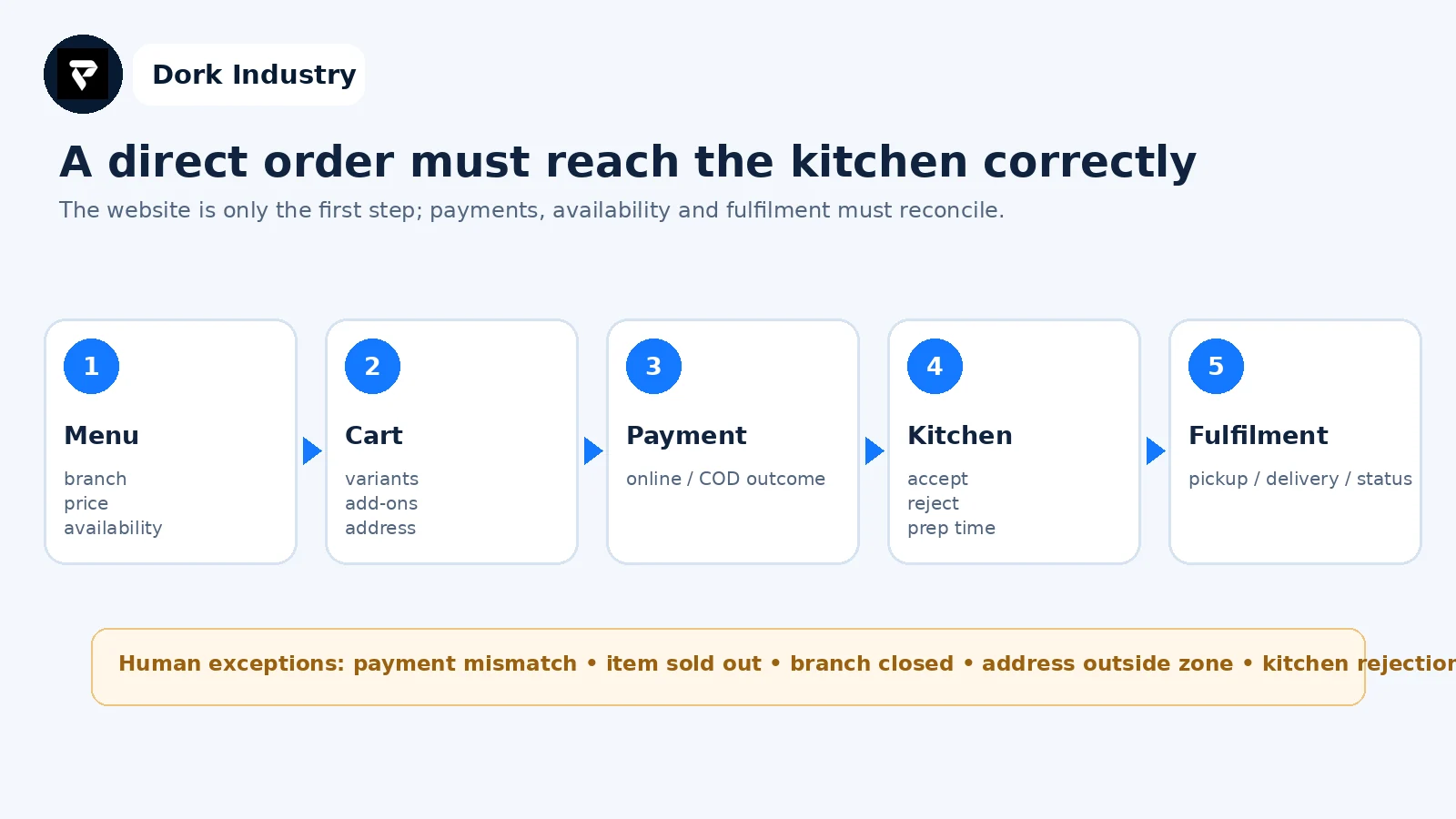
Automation should create an order, validate payment events, alert the selected kitchen and update the customer from confirmed operational states. It should not automatically accept an unavailable item, invent a delivery time, retry charges without rules or bypass a manager when a branch is closed.
Should the restaurant build a website, WooCommerce store or custom app?
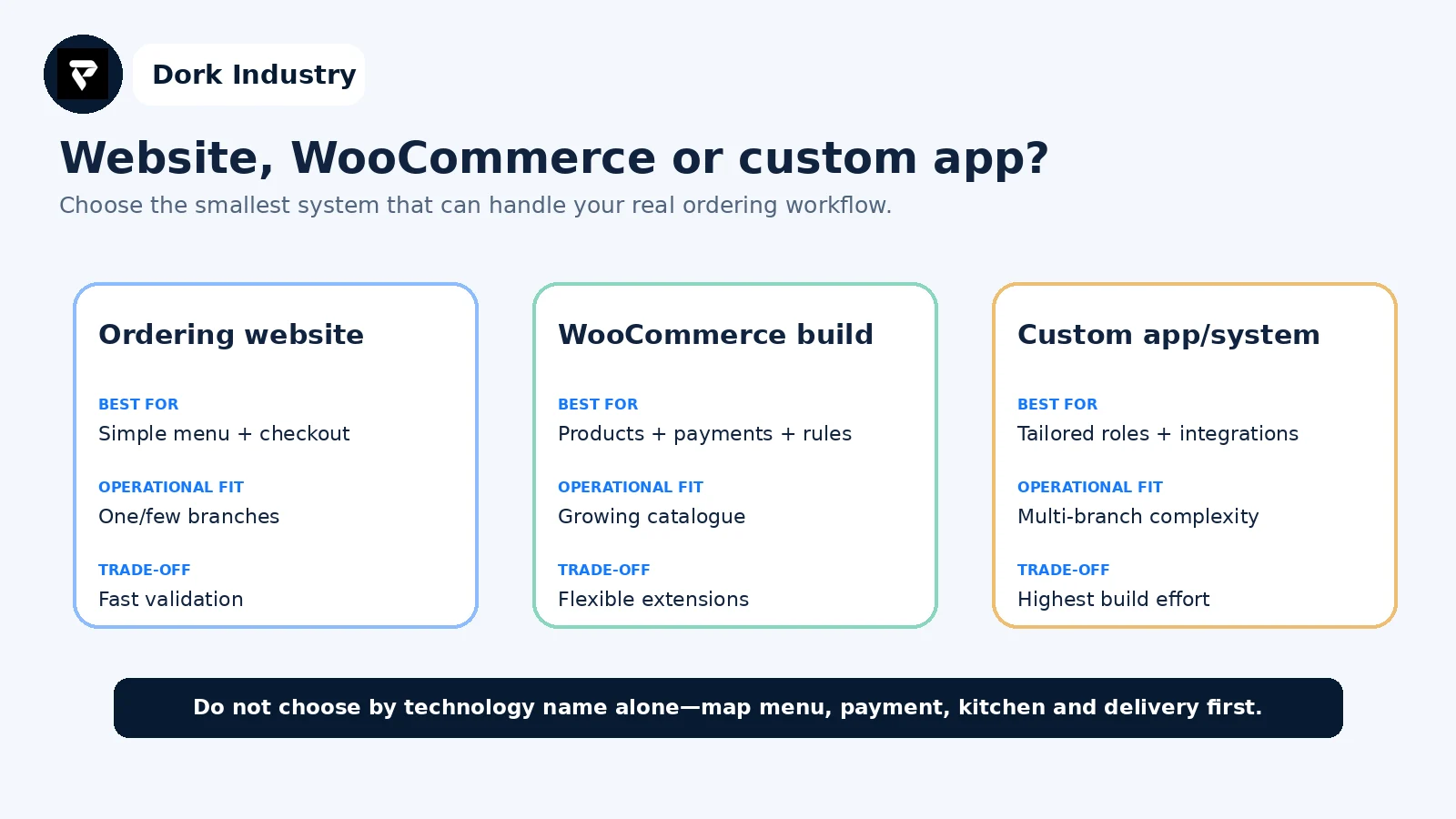
| Option | Good fit | Watch for |
|---|---|---|
| Ordering website | one/few branches, focused menu, quick validation | manual availability and fulfilment hand-off |
| WordPress + WooCommerce | structured catalogue, payments, coupons and configurable rules | extension conflicts and restaurant-specific workflows |
| Custom web/mobile system | multi-branch roles, POS/kitchen/delivery integrations | larger discovery, testing and maintenance scope |
| Network/marketplace connection | additional discovery channel | catalogue and order synchronisation across channels |
ONDC’s developer resources describe APIs and integrations for an open digital-commerce network. A restaurant may evaluate network participation separately from its own direct channel; these are not mutually exclusive decisions. Review the ONDC developer portal. According to the ONDC Developer FAQ, its resources cover APIs, integration documentation and hyperlocal, retail and logistics solutions; restaurants should confirm the exact participant and integration model before scoping development.
Which integrations may be required?
- Payment gateway callbacks and refund states.
- POS or kitchen display system for acceptance and preparation.
- Branch-specific menu and availability source.
- Delivery partner, in-house rider dispatch or pickup-slot logic.
- CRM or consented customer communication.
- Accounting, tax and order reconciliation where required.
- Analytics that separate visits, attempted checkouts, accepted orders and fulfilment failures.
A restaurant page can also expose structured facts such as its menu and reservation URL where appropriate. Schema.org documents the Restaurant type and properties including menu and reservations; structured data must reflect visible, accurate information. See Schema.org’s Restaurant reference.
What original demo test should a restaurant run?
Create a hypothetical dinner order containing one variant, one add-on and one item that becomes sold out after it enters the cart. Test online payment success, payment pending, branch rejection, address outside the delivery zone and customer cancellation. For each case, record what the customer sees, what the kitchen sees, who owns the exception and whether payment requires reconciliation.
How can Dork Industry help build the right ordering channel?
Dork Industry can map the ordering workflow, design a responsive restaurant website, configure or customise WordPress and WooCommerce, build a custom web or mobile application, integrate supported payment/POS/delivery systems, and create an operations dashboard. Scope depends on verified APIs and restaurant requirements. Review Dork Industry’s app development and industry solutions. A related guide explains how a grocery shop can start online ordering without an app.
Request a restaurant ordering assessment: share the number of branches, current menu process, payment method, kitchen/POS system, pickup or delivery model and recurring order problems. Dork Industry can recommend a focused website build, WooCommerce customisation, integration or custom application.
What do restaurant owners ask before building direct ordering?
Does every restaurant need a mobile app?
No. A responsive ordering website can validate direct demand without requiring an installation. Consider an app when repeat use, loyalty, push notifications, saved preferences or operational complexity justify the additional build and maintenance.
Can WooCommerce handle restaurant orders?
It can support products, variants, payments and checkout, but restaurant workflows may require custom availability, branch, time-slot, kitchen and fulfilment logic. Test those requirements before selecting extensions.
Should direct ordering replace marketplaces?
Not automatically. Marketplaces can remain discovery or delivery channels while the restaurant develops its owned website and customer journey. Catalogue, pricing, availability and order operations must remain consistent across channels.
What should be built first?
Start with one branch, a controlled menu, one payment flow and one fulfilment method. Prove kitchen acceptance, exception handling and reconciliation before expanding to loyalty, multiple branches or a customer app.
Discuss this for your business?
Book a free consultation — we scope the problem, outline the approach, and give you an honest verdict before any development is discussed.