Quotation software for wholesalers is software that helps a sales team turn an enquiry into a priced, reviewed and traceable offer using product records, customer terms and approval rules. Choose it by testing your difficult quotations—not by counting features. Start with reliable catalogue data and clear pricing ownership; automate drafting before allowing a system to send offers.

Why do wholesale quotations take too long?
The delay often begins before anyone opens a quotation template. A salesperson identifies an unfamiliar product description, asks which supplier price is current, checks stock, looks up a customer’s discount and waits for approval. A faster PDF generator will not remove these decisions if the underlying records are unreliable.
Consider a Delhi NCR electrical wholesaler receiving an Excel schedule with incomplete part numbers, or a Mumbai industrial supplier receiving a WhatsApp photo of a materials list. These are hypothetical examples, not client case studies. Both need product clarification before pricing; neither should accept an AI match as a confirmed order.
Review ten recent enquiries. Separate active preparation time from waiting time. A quote may take 15 minutes to assemble but wait two days for a supplier response. Record where work stops and who can resolve it. Buying a faster editor while leaving the same approval queue intact is unlikely to fix that delay.
| Where the quote stops | Likely cause | First useful change |
|---|---|---|
| Product identification | Aliases, incomplete specifications or unit confusion | Clean the catalogue and create a clarification queue |
| Pricing | Old supplier lists or undocumented customer terms | Assign owners and effective dates to price records |
| Approval | Every discount needs the owner | Define limits and an alternate approver |
| After sending | No owner, expiry date or next action | Track a specific follow-up task and quote version |
What does a delayed or incorrect quotation cost?
The operational consequences include repeated entry, avoidable revisions, inconsistent promises and reliance on one experienced employee. The financial consequence can be more serious: a small discount on an already narrow margin can make an apparently attractive order unprofitable. Faster response is useful only when the offer remains commercially acceptable.
Track the time spent preparing and correcting quotes, the reasons buyers decline, and discounts granted after a quote is sent. Do not assume every lost enquiry would have converted if you had replied sooner. Product availability, payment terms and buyer timing may explain the outcome.
What should quotation software for wholesalers actually control?
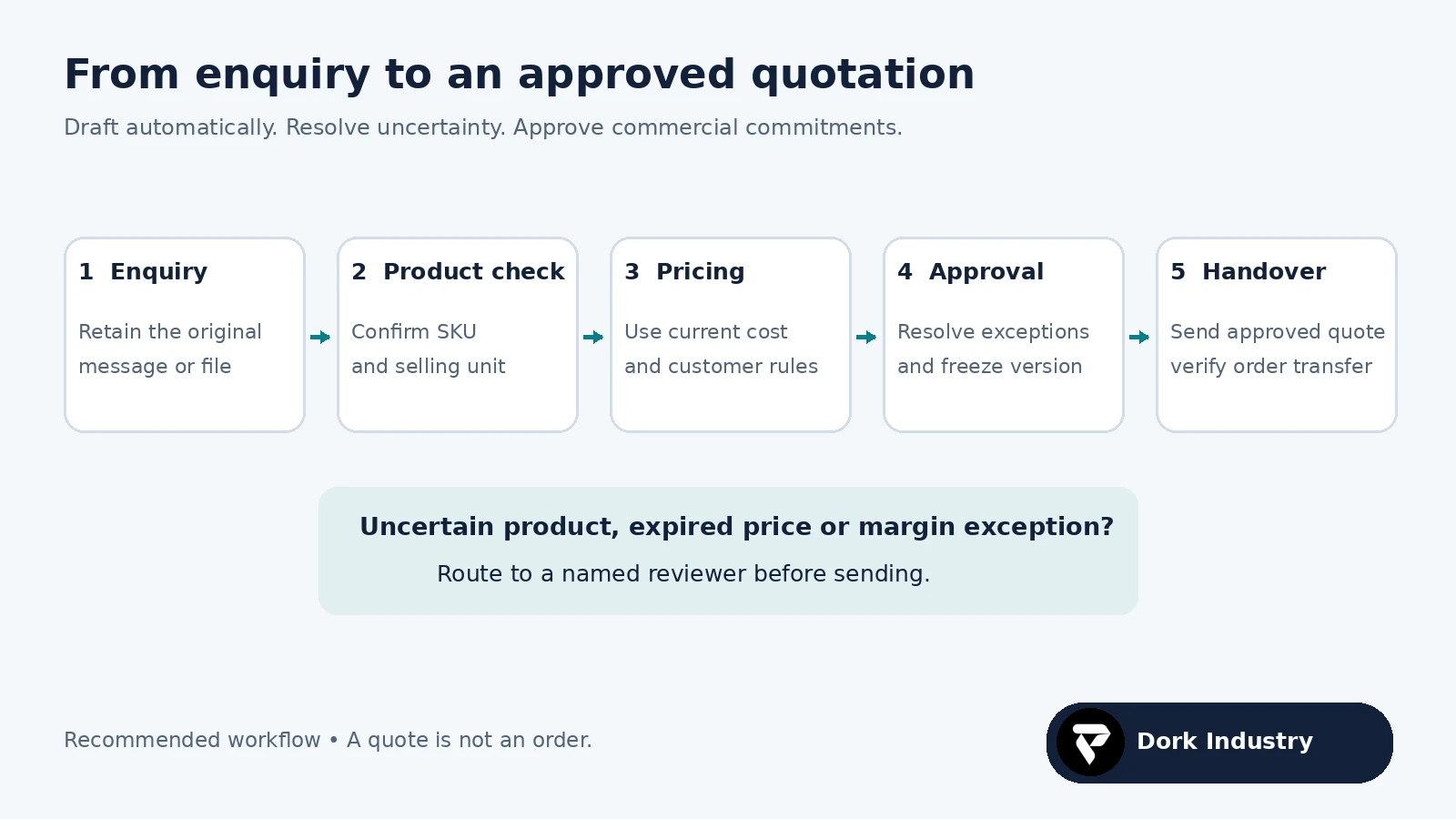
Test nine controls against real redacted enquiries: exact product matching, units, current costs, customer pricing, margin approvals, availability, quote versions, follow-up ownership and order handover. A system that produces an attractive document but cannot explain its prices is not ready for your sales team.
How does the system confirm an exact product match?
Retain your internal SKU, supplier part number, brand, specification and aliases. Similar product names can conceal different ratings, sizes or pack quantities. When a description has several plausible matches, show the alternatives and ask a person to decide. Record the selected item and the evidence behind the choice.
How are purchase and selling units kept separate?
A carton price is not a piece price. Store the purchase unit, sales unit and an approved conversion factor. Include minimum order quantities and rounding rules where relevant. Test requests containing mixed units, such as metres and rolls, before importing an entire supplier catalogue.
How are price effective dates and sources recorded?
Record the source price list, import time, effective period and responsible owner. Flag expired or unexpectedly changed costs. Freeze the cost basis and rules used when a quote is approved so a later supplier update cannot silently rewrite the history of an offer already sent.
How are customer pricing terms applied?
Choose an explicit precedence order for contract prices, quantity breaks and standard discounts. Decide whether discounts can stack. Show the price source to authorised staff while keeping internal costs and other customers’ terms out of buyer-facing PDFs. According to Odoo’s official pricelist documentation, configurable pricing rules and validity periods are supported. The right configuration still depends on your agreements.
Who approves discounts and margin exceptions?
Specify who can override a discount or margin limit, the evidence required and a backup approver. Keep the decision, timestamp and quote version. Avoid a blanket rule that every enquiry needs the owner’s approval; reserve that step for genuine exceptions and audit permitted routine quotes.
How are stock checks separated from delivery promises?
Display the stock source and time checked. Separate physical stock from available-to-promise quantities and existing reservations. If a supplier lead time is unconfirmed, mark it provisional. Agree whether stock is reserved at quotation, buyer acceptance or order confirmation; do not let those events merge accidentally.
How are quotation revisions identified?
Give each quote a stable identifier and each revision a version. Mark superseded versions clearly. Ask the buyer to accept a specific revision, including quantities, delivery terms and validity. Recheck the applicable conditions when acceptance arrives after expiry rather than assuming the original offer still stands.
Who owns follow-up after a quotation is sent?
Track sent, clarification needed, revised, accepted, declined and expired states. A PDF download or link view is an engagement signal, not an order. Choose a follow-up owner and a relevant next action. Respect customer messaging preferences; repeated automated nudges can damage a useful relationship.
How does an accepted quote reach the ERP exactly once?
Map the accepted quote version to the sales order in your ERP or accounting workflow. Use stable identifiers so retries do not create duplicate orders. If a connection fails, show an exception with an owner, not a green success label. Reconcile quote, order and downstream status before staff rely on the handover.
How can a small discount change the margin?
Worked example—not a customer result: assume a wholesaler sells 100 identical units. Cost is ₹800 per unit and the quoted selling price is ₹1,000 per unit. These figures exclude taxes and other costs for simplicity. Gross margin is calculated on selling price, whereas markup is calculated on cost.
| Measure | Before discount | After 5% selling-price discount |
|---|---|---|
| Revenue | ₹100,000 | ₹95,000 |
| Product cost | ₹80,000 | ₹80,000 |
| Gross profit | ₹20,000 | ₹15,000 |
| Gross margin | 20% | 15.79% |
In this example, a 5% revenue discount reduces gross profit by 25%. That is a calculation under the stated assumptions, not a predicted outcome for your business. Freight, handling, credit costs and returns can change the economics further.
The basic formula is gross margin = (selling price − cost) ÷ selling price × 100. According to Odoo’s official margin documentation, margins can be displayed on quotations and sales orders. Choose which costs your finance owner wants included; a margin field is only as useful as its cost basis.
What can AI automate, and what should people decide?
AI can assist with extracting enquiry lines, suggesting catalogue matches and drafting a clarification message. Deterministic rules should calculate approved prices, totals and thresholds. People should resolve uncertain product identity, approve substitutions and exceptions, and confirm commercial commitments that require judgement.
Preserve the original enquiry alongside extracted data. Show unresolved lines rather than silently dropping them. Compare original quantities with generated quantities before approval. An enquiry is untrusted input: text inside a PDF or message must never be allowed to override pricing policy or authorise access to another customer’s data.
Should you buy software, configure your ERP or build a custom system?
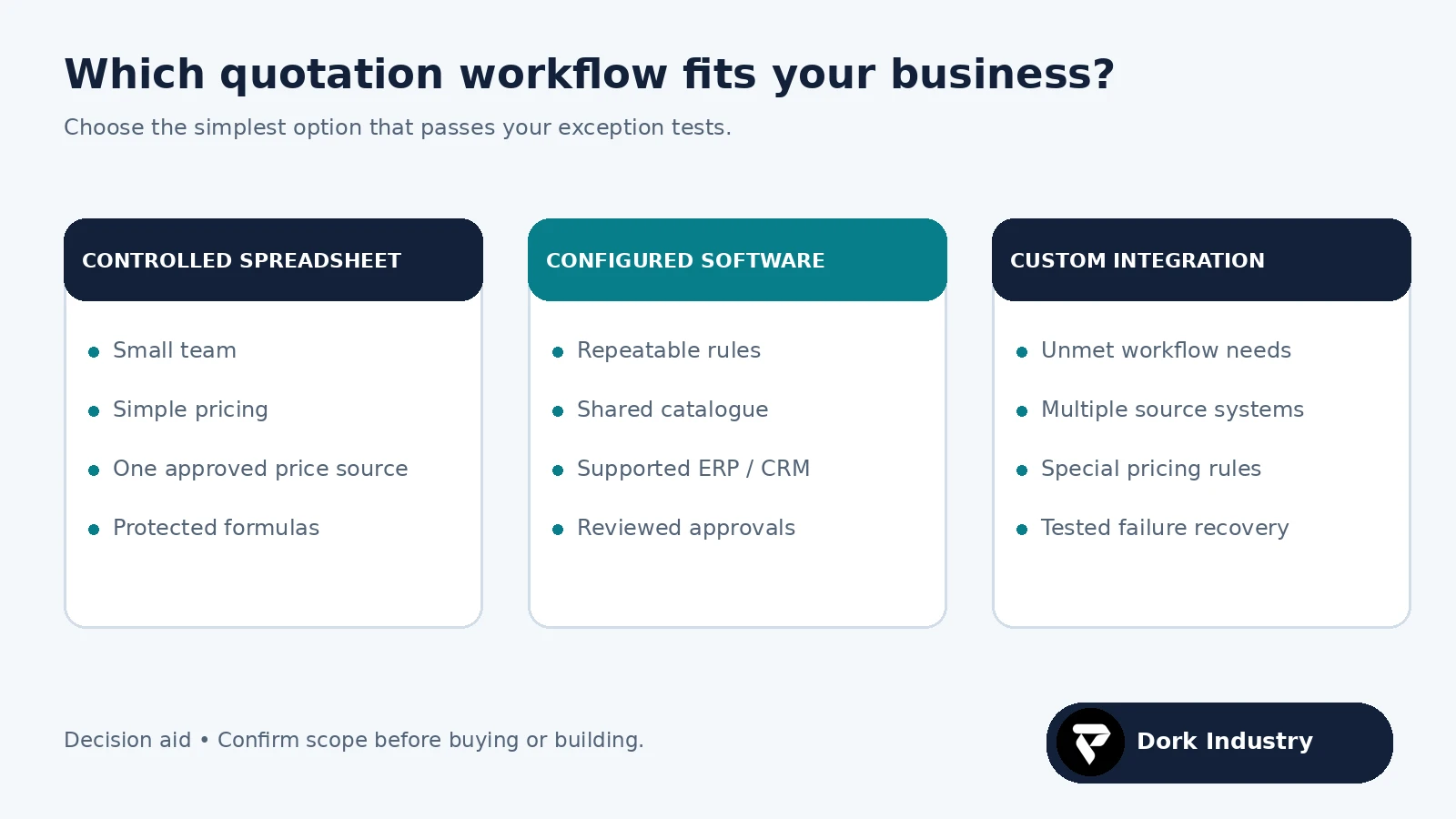
Use the least complex option that passes your workflow tests. A controlled spreadsheet can be enough for a small catalogue and a single approver. Configure an existing ERP or CRM when its quoting features fit. Buy dedicated software for repeatable needs; build custom components when important rules or integrations cannot be represented reliably.
| Option | Suitable when | What to verify |
|---|---|---|
| Controlled spreadsheet | Few users, simple price rules and manageable enquiry volume | Locked formulas, one approved price source, revision history and backup |
| Configure existing ERP/CRM | Products and customer records already live in a supported system | Units, pricing, approvals and order conversion in your actual edition |
| Dedicated quotation software | Most needs fit a repeatable product workflow | Catalogue import, export ownership, integrations, usage limits and support |
| Custom quotation integration | Multiple systems or specialised rules create material gaps | Scope, API access, exception recovery, testing and ongoing maintenance |
Ask vendors to demonstrate your difficult cases instead of a clean sample catalogue. Compare total ownership cost: subscriptions, data cleanup, connectors, training, messaging charges, support and future exports. Faster quoting does not justify replacing a stable ERP when a smaller integration will solve the problem.
Dork Industry’s ERP solutions and business automation services can support an assessment of configuration versus custom integration. The scope and feasibility should follow discovery, not a promise that every tool can connect automatically.
What data and integration requirements should you prepare?
Start with a small approved product master: internal SKU, supplier code, description, purchase and sales units, conversion factor, cost source, valid selling price and availability source. Add customer identifiers, authorised pricing agreements, quote validity and approver roles. Have your finance owner confirm the tax fields and rules appropriate to the business.
Specify which system owns products, prices, customers, stock and orders. Define read and write permissions, synchronisation frequency and recovery after a failed update. Begin with a reviewed export if live API access is uncertain. Separate costs and margins from customer-visible data; test that a PDF export does not reveal internal notes.
Use role-based access, tenant separation where relevant, encrypted transport, backups and a retention policy. Before using an AI provider, review its processing, storage and training terms with the responsible business owner. For discovery, share redacted samples rather than customer lists, private supplier agreements, credentials or production database exports.
How should Delhi NCR and Mumbai teams adapt the workflow?
Location matters where it changes delivery, branch ownership or supplier availability. A Delhi NCR team serving several delivery zones may need destination-specific freight approval. A Mumbai team quoting from more than one stock location may need branch-level availability and dispatch coordination. These are planning scenarios, not claims about every wholesaler in either city.
Capture delivery destination, supply branch, customer billing details, responsible salesperson and any confirmed lead time. Test inter-branch enquiries and alternative suppliers before promising a dispatch date. Keep these requirements in the quote record rather than in an employee’s WhatsApp memory. City names alone do not require separate software or duplicate articles.
How can you test quotation software with a 20-enquiry pilot?
Choose 20 representative redacted enquiries, including troublesome cases. Compare the current process with a proposed workflow using the same catalogue and approved pricing rules. Run in shadow mode: the team reviews generated drafts, and no automatic customer messages or production orders are created during the initial test.
- Define the baseline. Record preparation minutes, waiting time, correction count and unresolved items for each enquiry.
- Clean a limited catalogue. Choose one product family, confirm units and price owners, and retain the source records.
- Agree approval rules. Set margin limits, exception owners and backup coverage before configuring software.
- Replay difficult enquiries. Include incomplete descriptions, quantity breaks, expired prices and unclear substitutions.
- Test revisions and handover. Re-send an integration request and accept an old quote version to check failure handling.
- Make a go/no-go decision. Compare results against targets agreed before the pilot; fix critical errors before expanding.
Copy this pilot worksheet
Create one row per enquiry in a spreadsheet. Use the columns below; do not combine active work with elapsed waiting time.
| Worksheet field | What to record |
|---|---|
| Enquiry ID and channel | A redacted reference; email, WhatsApp, PDF or Excel |
| Product and unit exceptions | Unmatched items, ambiguous descriptions and conversions requiring review |
| Price source and version | Effective date, customer rule and approved cost basis |
| Time and corrections | Active minutes, waiting hours, corrections and their causes |
| Approval and handover | Approver, accepted version, downstream record ID and recovery outcome |
| Final decision | Pass, needs correction or blocked, with a responsible owner |
Include at least these exception tests: a carton-versus-piece mismatch; an expired cost list; a discount below the agreed margin floor; an unavailable item; an ambiguous product; an acceptance after expiry; a superseded PDF; a duplicate handover; and a failed connection. Require critical price, product and permission errors to be resolved before customer-facing automation.
When is the investment commercially justified?
Estimate monthly capacity released as monthly quote count × minutes saved per quote ÷ 60. For example, 300 quotes saving eight minutes each release 40 staff hours. This is a hypothetical capacity calculation, not a guaranteed cash saving: its value depends on how the team uses the time.
Compare that capacity, avoidable correction work and measured margin protection with the full operating cost. Track quote-to-order outcomes, but do not attribute every change to the software. If catalogue cleanup delivers most of the benefit, stop there until a further investment has a clear reason.
Need a quotation-workflow assessment in Delhi NCR or Mumbai?
Dork Industry can help assess the bottleneck, choose a suitable ERP/CRM configuration or quotation integration, and scope a practical pilot. Bring your current tools, product-family size, approximate monthly quote count and two or three redacted difficult enquiries. Tell us where work stops and who currently approves exceptions.
The next step is to discuss requirements and agree the assessment scope. Implementation cost, schedule and supported integrations depend on the systems and rules involved; this guide is not a fixed-price offer.
Request a quotation-workflow assessment →
Prefer email? Email support@dorkindustry.com with your city, existing software and main quotation problem. Please do not send passwords or unredacted customer information. You can also start an assessment enquiry on WhatsApp.
Frequently asked questions about quotation software for wholesalers
What is quotation software for wholesalers?
It is software that prepares customer offers using product records, quantities, agreed pricing and commercial terms. A useful wholesale workflow also controls approvals, revisions and handover to an order system. It should make uncertain items visible rather than silently inventing a match or price.
Can a wholesaler keep using Excel?
Yes. A controlled spreadsheet can be appropriate for a small team with simple pricing and limited revisions. Use one approved price source, protected formulas, backup and version control. Consider software when repeated exceptions, multiple users or integrations make that process difficult to maintain.
Does quotation software need AI?
No. Catalogue search, approved pricing rules, totals and approval routing can work without AI. AI assistance is useful when enquiries arrive in inconsistent descriptions or documents, but suggested matches must be reviewable. Start with the workflow requirement rather than making AI a purchase condition.
Can quotations arrive through WhatsApp and email?
Those channels can feed a shared enquiry process through manual intake or a supported integration. Preserve the original message, confirm the customer and resolve missing product details. Sending automated messages requires appropriate channel configuration and customer preferences; reading an enquiry does not authorise every follow-up.
Should the software replace our ERP?
Not necessarily. If your ERP already owns products, stock and customer records, quoting may be a configuration or integration project. Verify which system owns each field and demonstrate the approved quote-to-order handover before agreeing to a replacement.
How much does quotation software cost?
There is no single price for all wholesalers. Compare licence or subscription fees, data preparation, integration, training, support and export costs. Obtain a scoped quotation after providers have reviewed your workflow and demonstrated the important exception cases.
Does sending a quotation reserve stock?
Only if your workflow explicitly does so. A quote, stock reservation and confirmed sales order are different events. Agree the reservation trigger and expiry rule, display the availability check time and revalidate when a buyer accepts an old or revised offer.
Can Dork Industry help wholesalers in Delhi NCR and Mumbai?
Dork Industry offers business automation and ERP-related solutions. An assessment can determine whether your quotation process needs data cleanup, configuration or custom integration. Share your city, current tools and redacted examples so the team can discuss delivery requirements and a suitable scope.
Your next step: take one slow quotation and identify every decision made between enquiry and approval. That map will tell you what to automate—and what still needs a person.
If you are shortlisting a partner for this kind of system, see our comparison of best AI automation companies in India, which covers eight providers on delivery, integrations and governance.
Discuss this for your business?
Book a free consultation — we scope the problem, outline the approach, and give you an honest verdict before any development is discussed.