Marble slab measurement software converts a calibrated image of a slab or remnant into a reviewable outline, dimensions and area that can support inventory and quotation work. It should not be treated as a magic camera calculator: reliable results depend on calibration, controlled capture, edge review, reference measurements and an approval workflow.
Written by Nishant Singh for Dork Industry · Updated 8 October 2026 · For marble processors, slab-yard owners, commercial teams and operations managers.

Why do slab measurements create quotation disputes?
Natural-stone slabs are not identical rectangles. Edges may taper, corners may be broken, resin repairs or fissures may affect use, and remnants may have complex outlines. A yard worker may record maximum length and width, a salesperson may quote a rectangular area, and a customer may expect only usable material. Each method can produce a different number without anyone intentionally making an error.
The problem becomes harder when the photo, physical slab, measurement sheet, lot, finish, thickness, rack location and quotation are not tied to one stable identity. A salesperson may send an attractive image while the yard measures a different piece from the same bundle. A remnant can exist physically but remain commercially invisible because nobody can prove its dimensions or condition quickly.
Ten-minute diagnostic
Select one irregular slab and one remnant. Ask two trained people to measure and calculate the quote area independently. Then ask sales to identify the exact photographed piece, defects, location and measurement method. If results differ without a documented tolerance and approval rule, technology should begin with a controlled measurement definition.
What should the business decide before selecting software?
Write down the commercial quantity being calculated. It may be gross rectangular area, traced physical area, saleable area after approved exclusions, invoiced area under a contractual rule, or an estimate used only for planning. These numbers are not interchangeable. Software should display the method and version rather than presenting one unexplained “area.”
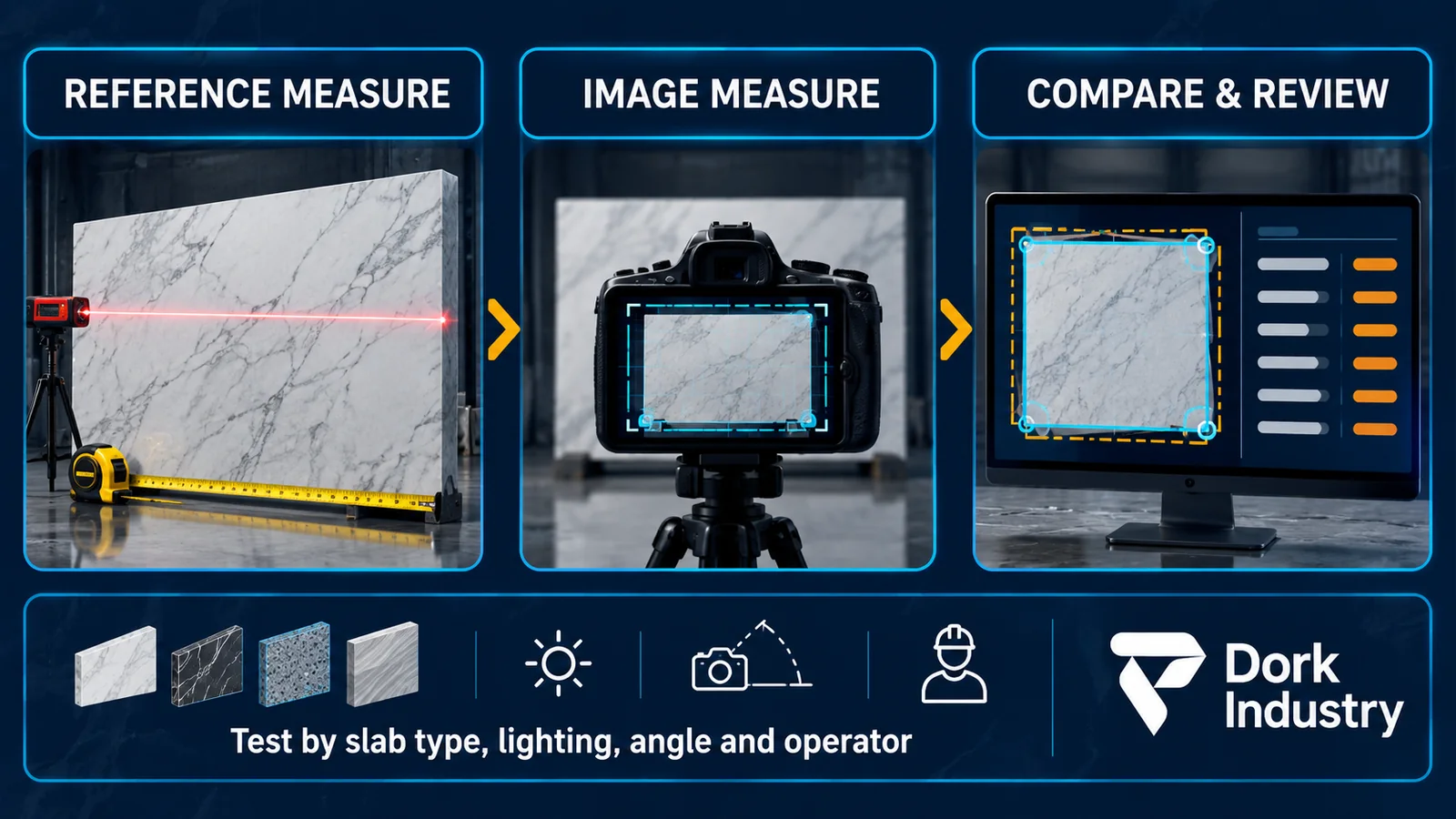
Define the reference process used to check the image result, acceptable tolerance by use case, who may alter an edge, how defects are classified, and who approves a measurement for quotation. A system can automate geometry, but it cannot decide a commercial convention that management has never agreed.
How should marble slab measurement software work?
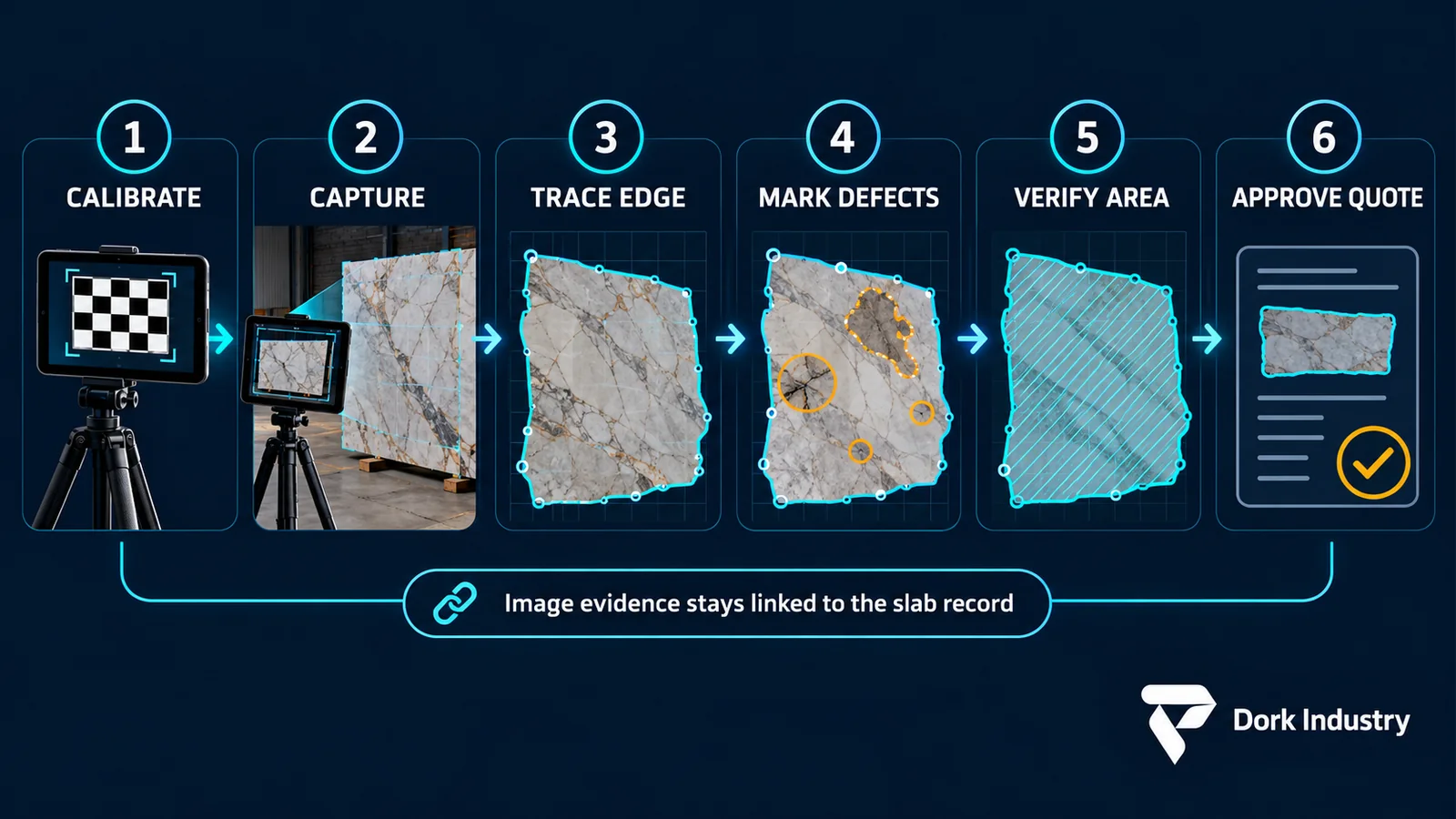
A defensible workflow keeps six stages connected:
- Calibrate: verify the camera, lens, distance and reference target for the capture station.
- Capture: photograph the full slab under controlled lighting with a stable identity marker.
- Trace: detect the boundary and allow an operator to correct unclear edges.
- Annotate: mark cracks, chips, resin areas, stains, holes or customer-specific exclusions without deleting the original image.
- Verify: compare calculated results with the approved reference process and route material variances for review.
- Approve: lock the measurement version used by inventory, catalogue and quotation documents.
Why are calibration and camera position essential?
A photograph contains pixels, not millimetres. Converting image points into physical dimensions requires a known geometric relationship between the camera and the slab plane. OpenCV’s camera-calibration documentation describes the camera matrix, lens distortion and projective transformation between world coordinates and image coordinates. In practical terms, lens distortion, camera angle, distance or an incorrectly positioned reference target can change the calculated outline.
NIST’s work on quantitative information from images emphasizes calibration and the accuracy of dimensional results. NIST also discusses metrological traceability for 3D imaging data. A commercial slab system need not become a metrology laboratory, but it should behave like a measurement process: document equipment, reference artefacts, conditions, test results and change control.
| Capture variable | Possible effect | Control to test |
|---|---|---|
| Camera angle | Perspective changes apparent edge lengths | Fixed mount, alignment check and perspective correction |
| Lens distortion | Straight edges appear curved near the frame | Camera-specific calibration and scheduled verification |
| Reference target | Wrong scale converts pixels incorrectly | Known target size, flat placement and target-detection check |
| Lighting and contrast | White marble, shadows or busy veins confuse edge detection | Controlled illumination and operator edge review |
| Slab plane | Leaning or warped material violates the assumed geometry | Defined capture fixture and reject condition |
| Camera replacement | New lens or sensor invalidates prior calibration | Versioned device profiles and revalidation |
Do not hide these conditions behind an “AI measured” label. Computer vision may locate the slab boundary and suggest defects, but the system should expose confidence, support correction and retain both the original and reviewed geometry.
How should irregular slabs and remnants be calculated?
For a clean planar image, software can convert the reviewed boundary into a polygon and calculate its physical area after calibration and perspective correction. Holes and excluded defect regions require explicit treatment. Maximum width multiplied by maximum height produces a bounding rectangle, not necessarily the traced slab area.
Saleable area is a business decision layered on top of geometry. A defect may be acceptable for one customer’s cutting plan and unacceptable for another. Preserve the physical outline and defect annotations separately from a quotation-specific usable-area decision. Otherwise, a sales correction can silently rewrite the inventory truth.
Which numbers should appear together?
- Maximum length and width with measurement method.
- Traced gross area and calibration version.
- Excluded regions with reason and approver.
- Approved quotation area and commercial rule.
- Reference-check result, variance and reviewer.
- Original image, processed overlay and revision history.
What can—and cannot—be automated?
Software can detect a calibration target, correct perspective, propose an edge, calculate polygon area, copy approved dimensions into a catalogue, flag missing data and compare the image result with a reference measurement. It can also generate a visual overlay that allows the customer or salesperson to see which outline and exclusions were used.
It should not automatically declare a vein to be a crack, decide whether a repaired corner is saleable, infer contract terms, or approve a disputed measurement without human authority. Surface appearance varies widely across white marble, dark granite, translucent stone, wet material and polished reflections. A safe design routes ambiguous results to review.
How should measurements connect with inventory and quotations?
The measurement record should reference a unique block, slab or remnant ID. It can enrich inventory with dimensions, images and status, but movement control remains a separate process. When a slab is reserved, transferred, cut or split, the system should create a new event and, where necessary, new child-piece identities rather than overwriting history.
A quotation should copy an approved measurement version and display the commercial calculation. If someone later retraces the edge, an existing quote should not silently change. Revisions need a reason, approver and link to affected documents.
| Integration | Information exchanged | Failure control |
|---|---|---|
| Inventory | Piece ID, lot, location, dimensions, images and status | Reject unknown or duplicate identities |
| Quoting | Approved area version, exclusions, rate rule and validity | Freeze the version used in the customer document |
| Digital catalogue | Approved image, finish, thickness, availability and dimensions | Publish only eligible pieces and expire reservations |
| Production | Selected slab, cut plan, resulting remnants and consumed area | Create traceable child pieces after cutting |
| Accounts | Approved invoice values and stable source references | Prevent accounting imports from changing physical measurements |
Test one slab route before buying a full platform
Dork Industry can map capture conditions, build a calibrated measurement proof of concept and connect approved results to your inventory or quotation workflow.
What data, security and operating controls are required?
Slab images can reveal stock, supplier marks, prices, customer selections and yard layout. Apply role-based access, protect exports, encrypt data in transit and at rest, and log changes to measurements and quotations. External support access should be time-bound. Backups must include original images, overlays, calibration profiles and document links—not only the latest numeric result.
Keep capture devices synchronized and monitor storage growth. Define retention for rejected images and duplicate captures. When a customer’s project name or contact information is linked to reservations, treat that information under the organization’s applicable privacy obligations.
Should a marble business buy, configure or build?
| Approach | Best fit | Buyer test |
|---|---|---|
| Buy an imaging platform | Standard station and workflows match the operation | Test representative slab surfaces, exports, revisions and support |
| Configure stone ERP | Inventory and quoting are primary; measurement can be integrated | Confirm piece identity, remnants and measurement versioning |
| Build an integration | Existing ERP remains but camera results must flow into it | Define ownership, retries, duplicate prevention and offline recovery |
| Build custom computer vision | Capture geometry or commercial workflow is genuinely distinct | Budget for datasets, calibration, validation, correction UI and maintenance |
Competitor pages show useful parts of the market: SlabSmith emphasizes calibrated digital slab images; IDStone focuses on barcode recognition from slab images; BACA connects scanners with inventory; Stonify emphasizes barcode-level slab and remnant history; and MarbleTrack positions AI-assisted inventory for Indian dealers. The missing buyer question is whether the measurement process remains accurate and explainable under the operator’s actual capture conditions.
How can a processor run a 30-day accuracy pilot?
- Days 1–4: define the quantity. Agree the reference measurement, quote-area rule, tolerances, defect categories and approval roles.
- Days 5–8: establish the station. Fix camera position, lighting, reference target, device profile and slab identity method.
- Days 9–15: create a representative test set. Include light, dark, reflective, strongly veined, chipped, rectangular and irregular material plus remnants.
- Days 16–21: repeat measurements. Compare operators, days, camera angles and approved reference values. Record failures rather than deleting them.
- Days 22–25: test workflow exceptions. Simulate a wrong slab ID, missing target, blurred image, changed camera, ambiguous edge and quotation revision.
- Days 26–28: connect one commercial route. Move approved measurements into a controlled quote and verify that later edits do not alter issued documents.
- Days 29–30: decide. Review accuracy by slab condition, correction workload, cycle time, unresolved risks and total operating effort.
What should the pilot worksheet contain?
| Field | Record |
|---|---|
| Piece identity | Block/slab/remnant ID, lot, material, finish and thickness |
| Capture | Station, camera profile, distance, angle, lighting and target |
| Reference | Approved method, operator and measurement result |
| Image result | Proposed edge, corrected edge, area and defect annotations |
| Comparison | Variance, tolerance, pass/review decision and approver |
| Commercial test | Quote version, calculation rule and document link |
How should Kishangarh and Delhi operators adapt the pilot?
Kishangarh is commercially relevant because the target-market research identifies it as a major marble and granite processing and trading cluster with gangsaw cutting, resin treatment, imported stone and multi-yard inventory needs. Delhi’s Mangolpuri cluster adds processors and traders closer to a large buyer market. Location belongs in the implementation plan—not as a forced keyword in every heading.
A high-throughput processing unit may need an inline or fixed imaging station, while a trading yard may prioritize mobile capture and customer catalogues. Standardize the identity, calibration evidence and quote-version rules across sites, then adapt hardware and roles to each yard.
Frequently asked questions
What is marble slab measurement software?
Marble slab measurement software uses calibrated images or scanner data to calculate dimensions and area for a slab or remnant. A reliable system preserves the original image, reviewed boundary, calibration profile, reference-check result and approved measurement version.
Can a phone camera measure marble slabs accurately?
A phone may support some controlled workflows, but accuracy cannot be assumed. Camera calibration, lens, angle, distance, reference target, lighting and slab plane affect results. Validate the exact device and process against an approved reference before using measurements commercially.
Can AI automatically identify cracks and defects?
Computer vision can propose defect regions when trained and tested on relevant material. Marble veins, reflections, resin and shadows can resemble defects, so operators should review suggestions. Preserve annotations separately from the physical outline and quotation decision.
Does image area equal invoice area?
Not necessarily. Image processing can calculate geometric area, while invoice area may follow an agreed commercial convention. The software should display both the physical calculation and the approved quotation rule so customers and staff can understand the difference.
When is custom development justified?
Custom development is justified when capture conditions, measurement rules or integrations cannot be supported safely by available products. Begin with a proof of concept and representative validation set before committing to a full application.
What should you bring to a measurement assessment?
Bring sample slabs and remnants, existing measurement sheets, quotation rules, camera or scanner details, yard layout, defect terminology, five disputed examples and the software that currently holds inventory and quotes. Redact customer and commercially sensitive information.
Email support@dorkindustry.com or start an enquiry on WhatsApp. Dork Industry can develop the calibrated capture proof of concept, operator review interface and custom web application integration.
Prove measurement reliability before scaling
Start with representative slabs, an approved reference process and measurable acceptance criteria.
Sources and technical references
- OpenCV: Camera Calibration
- NIST: Quantitative Information from Images
- NIST: Dimensional Measurement Traceability of 3D Imaging Data
- ISO/CD 17850: Digital Imaging — Geometric Distortion Measurements
- RIICO: Kishangarh approved industrial applications
Editorial note: This article provides workflow and technology-planning information. It does not certify measurement accuracy or replace contractual, legal or metrology advice.
Stuck with this issue?
Send us the error and the setup — we diagnose the cause, fix it, and show you how to prevent it from coming back.