Carpet weaver piece-rate payment becomes reliable when every settlement can be explained from one accepted job record: the agreed rate version, loom and artisan assignment, completed work, quality decision, approved rework, advances and final authorization. Software should make that evidence visible to the exporter and artisan; it should not convert an unclear deduction into an automatic one.
By Dork Industry Editorial Team · Reviewed for workflow design, mobile evidence capture and payment transparency · Updated October 2026

Why do carpet piece-rate payments become disputed?
The calculation is usually not the hardest part. The dispute begins because the records supporting it live in different places. The export order and design sit in an office file; yarn issue is written in a register; loom progress arrives through calls or messages; an inspector records faults separately; advances sit with accounts; and the final amount is reconstructed after completion.
- The rate changed after the loom started.
- Several artisans worked on one carpet, but their shares were not recorded.
- Completed area or accepted work differs from the production note.
- A quality deduction has no defect category, photograph or acknowledgement.
- Rework was completed but the earlier deduction was not reversed.
- An advance was deducted twice or carried from another job incorrectly.
- The artisan receives only a net amount, not an explainable statement.
What is a carpet weaver piece-rate payment record?
A carpet weaver piece-rate payment record connects a specific contracted job with the rate basis, responsible artisans, accepted production, quality decisions, adjustments, advances and payment status. It is more than payroll: it is a job-cost and evidence chain that should remain understandable after the carpet has moved to washing, finishing or dispatch.
Can you diagnose the workflow in 20 minutes?
- Select one recently settled carpet job.
- Find the rate that was accepted before work began.
- Identify every artisan who worked on it and the agreed share.
- Reconcile loom assignment, progress milestones and completion.
- Locate each inspection, defect, rework and acceptance decision.
- Reconcile advances, deductions, reversals and final payment.
- Ask whether the artisan can understand the same evidence.
If the answer depends on one coordinator’s memory or private messages, the business needs an agreed record model before it needs a large ERP.
What should the rate agreement contain?
| Field | Why it matters |
|---|---|
| Job and design ID | Prevents the rate from being applied to the wrong size, construction or design. |
| Measurement basis | Defines whether payment is by accepted piece, area, knot, stage or another agreed unit. |
| Rate and effective version | Preserves the amount that applied when the job started. |
| Artisan shares | Explains payment when more than one person works on the job. |
| Quality and rework process | Defines who inspects, what evidence is needed and when a decision can be challenged. |
| Advance treatment | States how advances are recorded, recovered, reversed and carried. |
| Approvals | Shows who accepted the commercial terms and any later change. |
How should the settlement workflow operate?
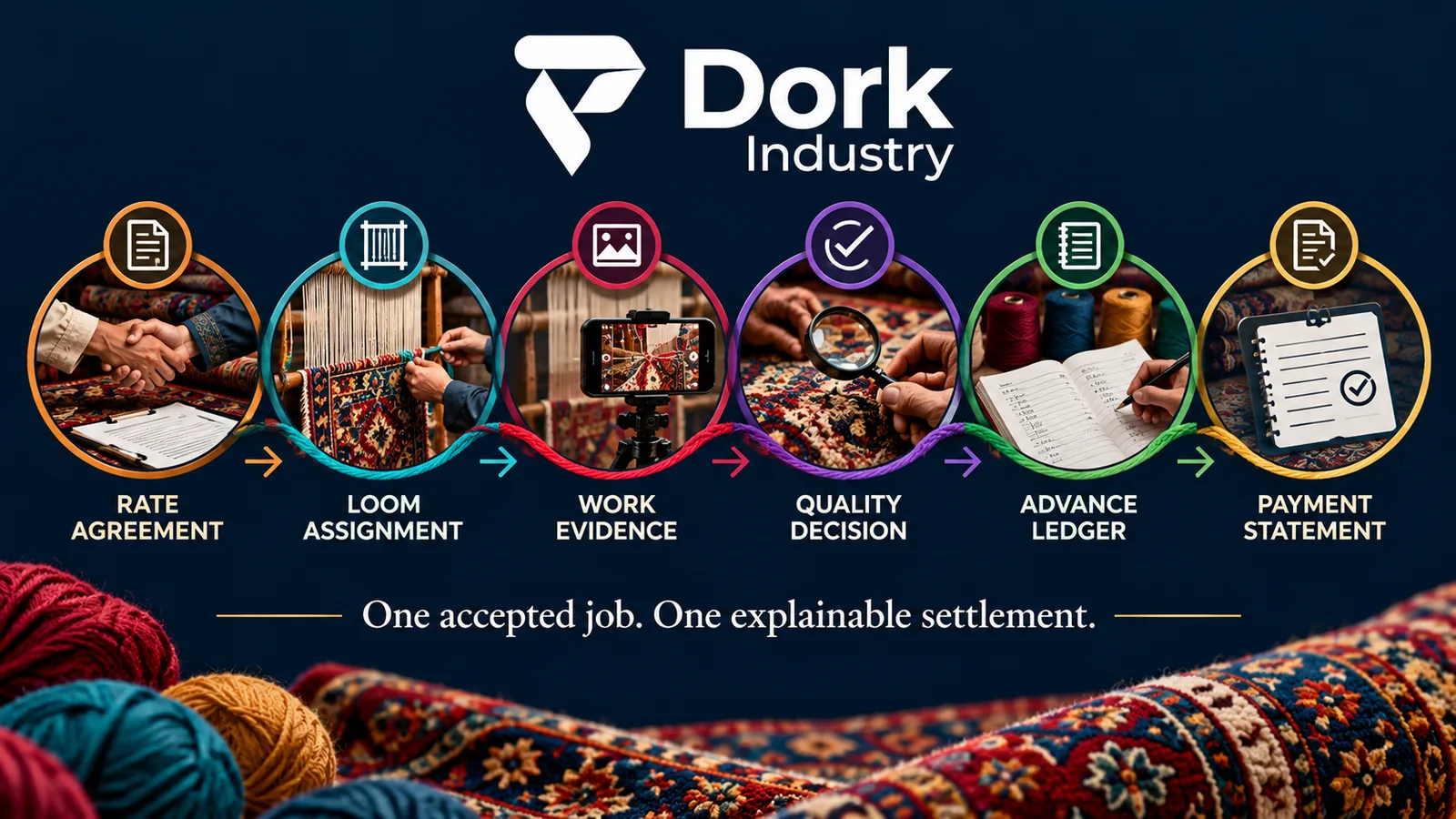
- Freeze the job: link buyer order, design, size, construction and delivery date.
- Assign responsibility: record loom, location, coordinator, artisans and work shares.
- Capture milestones: use a lightweight mobile form for start, progress, pause, reassignment and completion.
- Inspect consistently: record defect category, location, severity, evidence and decision.
- Manage rework: create a rework task and close it with a second decision rather than overwriting history.
- Reconcile advances: post every advance and recovery as a ledger transaction with reversal support.
- Issue a statement: show gross amount, additions, approved deductions, advances, reversals, net amount and payment reference.
Which quality deductions should be automated?
Software can calculate an approved rule, but it should not invent the rule or decide whether workmanship is acceptable. Quality evaluation can be subjective, especially where handmade variation and buyer specification must be distinguished. Require a named inspector, defined defect class, evidence and approval. Allow the artisan or coordinator to raise a review before settlement is locked.
| Safe to automate | Requires human decision |
|---|---|
| Applying a frozen rate to an accepted quantity | Whether a visible variation is a defect |
| Splitting an approved amount by recorded shares | Who is responsible for shared or upstream causes |
| Recovering an agreed advance instalment | Whether exceptional hardship or correction changes recovery |
| Generating the statement and payment batch | Approving a deduction, waiver or dispute outcome |
Map one disputed settlement
Dork Industry can map the evidence from rate agreement to payment and design a small mobile workflow for production, inspection and accounts.
Request a settlement workflow assessment support@dorkindustry.com
What data and privacy controls are required?
- Use named accounts and role-based access for coordinators, inspectors and accounts staff.
- Collect only necessary identity, bank and work information.
- Keep rate changes, deductions and reversals in an audit trail.
- Do not expose one artisan’s personal or payment data to unrelated users.
- Encrypt backups and test restoration.
- Define retention and correction procedures.
- Provide an offline capture and later-sync plan for weak-connectivity loom locations.
How should software integrate with production and accounts?
The workflow application should own the accepted job evidence. ERP or accounting should remain the system of record for invoices, financial ledgers and payment posting. A clean integration sends an approved payable with artisan, job, amount and statement reference; the accounting system returns payment status and transaction reference. Reconciliation must flag rejected, duplicate or changed transactions.
Should you buy, configure or build?
Buy when carpet-specific software already supports dispersed looms, artisan vendors and your settlement rules. Configure an ERP when production, quality and accounts are already centralized. Build a focused mobile workflow when the principal gap is outside-factory evidence, local terminology, multilingual use or integration with an existing accounting platform.
FocusApp emphasizes loom-level tracking and artisan control; Solyn includes handloom production and piece-rate registers; Fistreet describes artisan-wise automatic piece-rate calculation with quality-linked deductions; Fyond joins loom production, yarn and piece-rate wages; CENTRIO connects outsourced job work, loom tracking and export dispatch. The purchase decision should turn on explainable settlement, not the length of a module list.
What should a 30-day pilot test?
- Week 1: select one design family and document rate, assignment, inspection and advance rules.
- Week 2: capture five to ten live jobs with mobile milestones and evidence.
- Week 3: complete inspection, rework and advance reconciliation without deleting earlier decisions.
- Week 4: issue parallel digital statements, compare them with current settlements and resolve every mismatch.
Use this acceptance checklist
- The applicable rate can be proven.
- Every contributing artisan and share is recorded.
- Accepted work and inspection evidence are linked.
- Rework closes or reverses the correct adjustment.
- Advance balances reconcile to transactions.
- The artisan-facing statement explains the net amount.
- Accounts cannot post the same payable twice.
- Offline records synchronize without duplicate jobs.
Why is Bhadohi commercially relevant?
The target-market brief identifies Bhadohi, Mirzapur and Varanasi as a major carpet and handloom cluster, with artisan contractor payment records and production tools among relevant software needs. The location belongs in the operational context because dispersed artisan work, loom-level progress and export deadlines shape the workflow; it should not be repeated as a doorway keyword.
Create an explainable artisan settlement
Dork Industry builds custom web applications, field apps, ERP integrations and workflow automation. Start with one design family and prove that every settlement line can be explained.
Discuss the pilot on WhatsApp Email support@dorkindustry.com
Explore our custom application service.
Frequently asked questions
Can the rate change after weaving begins?
A change may be necessary, but it should create a new approved version with an effective date and reason. The original rate must remain visible so completed work is not silently recalculated.
How should shared work be paid?
Record the contributors and agreed shares before settlement. If responsibility changes, preserve the earlier assignment and approve the revised split. Do not let accounts guess from attendance or messages.
Should inspection photos determine deductions automatically?
No. Photos support a decision but may not show construction, cause or severity reliably. A qualified reviewer should apply the defined defect and rework process, with an appeal route.
Can the system work in rural loom locations?
Yes, if forms are lightweight and support offline capture, queued media, conflict handling and later synchronization. Pilot real connectivity conditions before rollout.
What is the first success metric?
Measure how many pilot settlements are completed without unexplained lines, duplicate advances or manual reconstruction. Also track dispute resolution time and statement acknowledgement.
Sources and methodology
Competitor research reviewed FocusApp, Solyn Handloom MIS, Fistreet, Fyond and CENTRIO. The workflow also reflects accounting guidance that piece-rate payment requires agreed rates applied to attributable production and quality-related procurement or acceptance evidence.
- FocusApp carpet production tracking
- Solyn Handloom MIS
- Fistreet handicraft manufacturing ERP
- Fyond textile management
- CENTRIO carpet ERP
- Textile industry accounting guidance
Important: This article is workflow and technology guidance, not labour, tax or legal advice. Obtain qualified advice for applicable wage, deduction, contractor, tax and data-protection requirements.
Discuss this for your business?
Book a free consultation — we scope the problem, outline the approach, and give you an honest verdict before any development is discussed.