
Direct answer: Weighbridge automation software connects vehicle identification, weight capture, position evidence, gate control and ERP posting in one controlled transaction. It can reduce re-entry and make exceptions traceable, but it cannot correct an unverified scale, decide whether unusual material is acceptable or replace accountable human approval. Start with the workflow, not the hardware catalogue.
Written and prepared by the Dork Industry Technology Editorial Team • Reviewed 8 October 2026
What is weighbridge automation software?
Weighbridge automation software is the transaction layer that links a weighing indicator with vehicle identity, material or order data, supporting evidence, approvals and downstream business records. A useful system records how a gross, tare and net weight became an accepted dispatch or receipt—not merely the number shown by the scale.
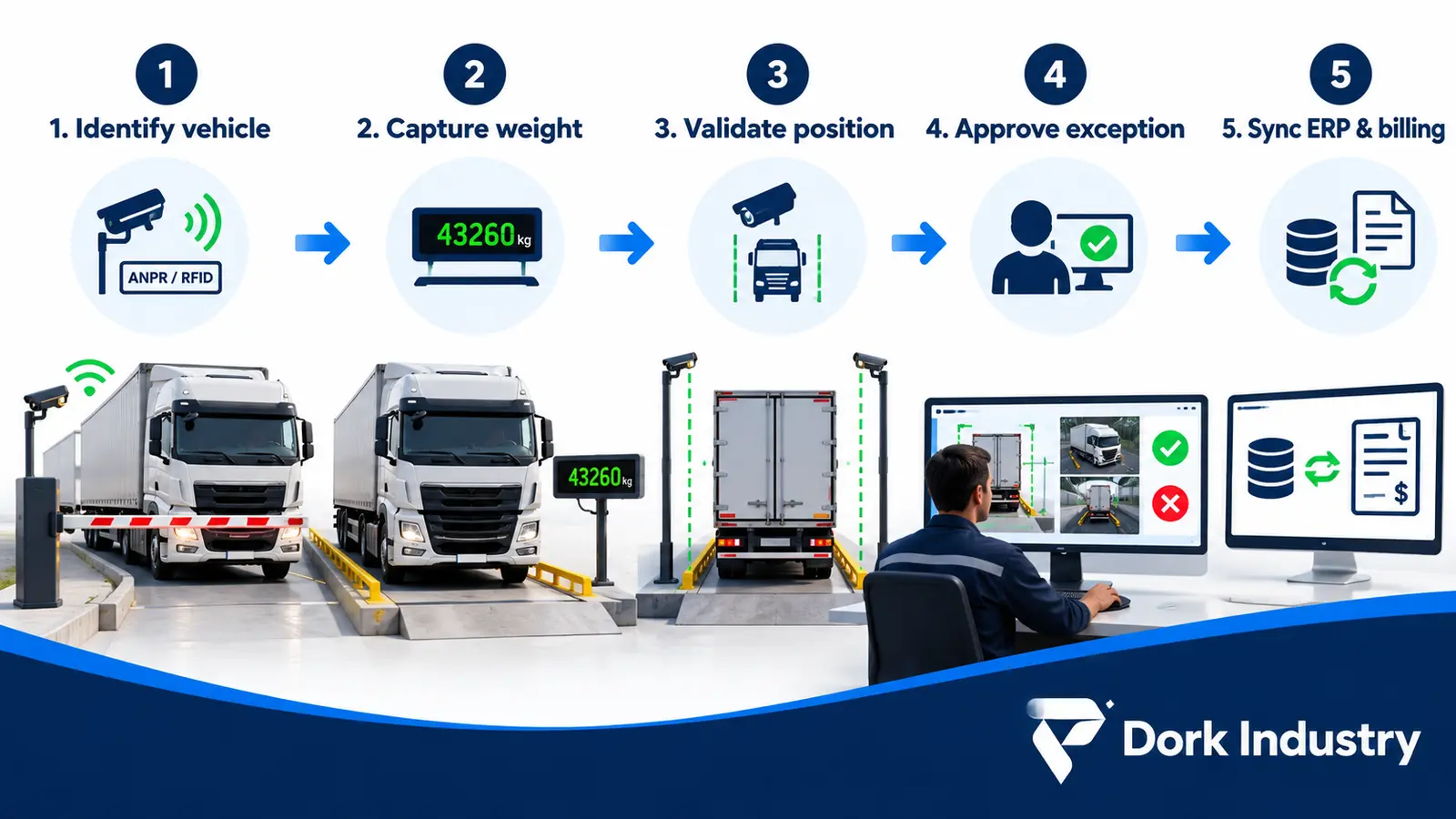
The complete workflow may include RFID, automatic number-plate recognition (ANPR), cameras, position sensors, traffic lights, boom barriers, printers, a local operator screen, offline storage, a central dashboard and integration with an ERP, accounting system, warehouse system or approved government interface. The right combination depends on the operating risk and traffic pattern.
The Avery Weigh-Tronix ERP integration overview illustrates that integrations can use APIs, staging tables, secure file exchange or web services and can connect to platforms such as SAP, Microsoft Dynamics, Oracle and Odoo. That range is important: “ERP integration” is not one universal connector.
Where do weighbridge errors become operational or financial problems?
A weighing error rarely stays at the gate. It can change received inventory, supplier settlement, production consumption, dispatch quantity, customer billing, transporter payment or the evidence available during a dispute. A valid reading may still become an invalid business transaction when the wrong vehicle, order, material, unit or timestamp is attached to it.
- Duplicate entry: the operator records the same weighment twice after a timeout or ERP retry.
- Wrong vehicle or order: a remembered registration or manually selected order is attached to another truck.
- Partial positioning: a wheel is outside the intended platform position, yet the reading is accepted without evidence.
- Unstable weight: software captures a value before the indicator reports the approved stable state.
- Tare misuse: an old tare is reused even though the vehicle body, fuel, attachments or operating rule changed.
- Master-data drift: the weighbridge, ERP and billing system disagree about material, supplier, customer or unit.
- Offline ambiguity: the local lane keeps operating, but queued transactions later sync twice or in the wrong order.
- Weak exception control: corrections overwrite the original instead of recording who changed what, why and when.
The business question is therefore not “Can the indicator send a number to a computer?” It is “Can every accepted transaction be reconstructed from identity, measurement, evidence, rules, approval and downstream acknowledgement?”
Map one real transaction before requesting a quotation
Bring one inward and one outward weighment, the related order and invoice, the correction process, current devices and one recent dispute. Dork Industry can turn them into an integration map and pilot scope.
Request a weighbridge workflow assessment WhatsApp +91 8210792477
What should you check before selecting weighbridge automation software?
Use these 12 checks on the current process. A “no,” “unknown” or “sometimes” identifies a requirement that should enter the pilot and acceptance tests.
- Transaction identity: Does every attempt receive a unique, immutable transaction ID before it reaches the ERP?
- Vehicle identity: Is the registration or RFID identity verified against the assigned job rather than accepted blindly?
- Stable capture: Does the interface capture only the approved stability state from the indicator?
- Position evidence: Can the system detect or document whether the vehicle was correctly positioned?
- Gross/tare pairing: Are the two readings linked to the same authorised vehicle, order and material?
- Master validation: Are supplier, customer, vehicle, transporter, material and unit values controlled by an agreed source?
- Duplicate protection: Can a retry return the existing result instead of creating another receipt or invoice input?
- Exception approval: Are overweight, stale tare, manual identity and correction cases routed to named roles?
- Evidence retention: Are images, indicator data, timestamps and approval records retained according to a defined policy?
- Offline recovery: Can the lane continue safely, show queued status and reconcile after reconnection?
- Downstream acknowledgement: Does the lane know whether the ERP accepted, rejected or has not yet processed the record?
- Audit export: Can an authorised reviewer reconstruct the transaction without editing the source record?
What quick test can an owner perform today?
Select ten recent transactions: two normal receipts, two dispatches, two corrections, one rejected vehicle, one network interruption, one duplicate attempt and one disputed record. Ask the operator, stores team, finance team and IT team to trace the same ten IDs. If they produce different counts or cannot connect weight to order and invoice, the first requirement is transaction reconciliation—not more sensors.
What can—and cannot—be automated?
| Workflow decision | Good automation candidate | Human or regulated responsibility |
|---|---|---|
| Vehicle identification | Read RFID/ANPR, compare with assignment, flag mismatch | Resolve unreadable, cloned, shared or disputed identity |
| Weight capture | Read supported indicator protocol and stability state | Maintain, verify and use the weighing instrument under applicable requirements |
| Position control | Use sensors or images to flag a suspect position | Inspect unusual loads and authorise a safe reweigh |
| Order validation | Check vehicle, material, supplier/customer, remaining quantity and status | Approve commercial exceptions or master-data corrections |
| ERP posting | Send an idempotent record and retain acknowledgement | Resolve business-rule rejection and financial impact |
| Compliance evidence | Retain signed or controlled records, images and audit events | Determine the applicable legal, tax and retention obligations |
Automation should narrow routine choices and expose exceptions. It should not hide uncertainty behind a green check mark. For example, ANPR can suggest a vehicle number, but handwritten, dirty or non-standard plates can still challenge recognition. An Indian commercial-truck plate research dataset describes this practical difficulty; treat recognition confidence and operator review as design inputs, not guarantees.
Which level of weighbridge automation is appropriate?
| Level | Suitable starting condition | Typical scope | Main risk to test |
|---|---|---|---|
| Level 1: controlled operator lane | Moderate traffic; operator remains essential | Indicator connection, master selection, tickets, audit log and reports | Manual identity and exception consistency |
| Level 2: assisted automation | Repeated traffic and established vehicle/order masters | RFID or ANPR, cameras, position checks, ERP validation and barrier control | False matches, device outages and safe fallback |
| Level 3: unattended lane | Stable rules, high volume, controlled site and remote support | Self-service guidance, automated sequence, exception queue and central monitoring | Safety, recovery, fraud scenarios and remote exception ownership |
Do not choose Level 3 simply because it sounds modern. A semi-automated lane with clear ownership can be safer and more auditable than an unattended lane with weak exception handling. Calculate the operational case from vehicle volume, queue pattern, correction effort, dispute frequency, staffing, integration maintenance and downtime tolerance. Do not use a generic savings percentage.
How should a defensible weighbridge transaction work?
- Create or retrieve the job. Start from an approved inward, outward, transfer or service workflow. Assign a transaction ID and expected master data.
- Identify the vehicle. Read RFID or ANPR where appropriate, then compare it with assignment, transporter and validity rules.
- Check lane readiness. Confirm indicator, camera, position sensors, network or local service, printer and barrier status. A failed device must be visible.
- Capture evidence. Store the raw reading, stability signal, device/time context and approved images without allowing the operator to rewrite source evidence.
- Apply business rules. Evaluate duplicate ID, order status, remaining quantity, gross/tare logic, thresholds and required documents.
- Route exceptions. Send mismatches to a named role with reason codes. Preserve rejected and superseded attempts.
- Post idempotently. Send one verified business event to ERP/WMS/accounting. Repeated delivery of the same key must not create another transaction.
- Confirm completion. Release the barrier or issue the final document only when the approved completion condition is met. Record the ERP acknowledgement.
What failures are commonly missed during demonstrations?
- The RFID reader returns a valid tag belonging to a different assigned vehicle.
- ANPR reads the plate but confuses a character; the operator accepts it without comparison.
- The indicator connection drops after displaying a value but before the record is committed.
- The local application saves successfully while ERP rejects an inactive material or closed order.
- The ERP times out after accepting the message, causing the lane to resend it.
- A camera is offline, yet the workflow silently completes without the required evidence.
- A user edits the vehicle or tare after weighing and the audit trail stores only the final state.
- The network returns and two offline queues post the same event.
What data, privacy and integration controls are required?
Define a data contract before development. It should state the owner, source, format and validation rule for each field: transaction ID, lane, device, vehicle, RFID, order, material, party, transporter, gross, tare, net, units, timestamps, images, operator, approver, exception, document and downstream acknowledgement.
Keep measurement evidence separate from derived commercial values. The raw reading and source context should remain traceable even if the ERP later calculates quantity, rate, tax or payable value. Use role-based access, change history, time synchronization, encrypted transport where appropriate, backup and tested recovery. Separate operational monitoring from production administration.
Vehicle numbers, driver details and images may relate to identifiable people. The Ministry of Electronics and Information Technology publishes the Digital Personal Data Protection Act materials and the Digital Personal Data Protection Rules, 2025. Obtain legal advice for the actual deployment; document purpose, access, notice, retention and deletion rather than collecting every available camera field indefinitely.
How should e-invoice or e-way bill integration be approached?
Use the authorised integration route and current API contract; do not scrape a government portal or treat weighment as the invoice itself. The GSTN-authorised IRIS Invoice Registration Portal describes core APIs for generating or cancelling e-invoices and generating or retrieving e-way bills, with encrypted payload requirements and consent for certain data APIs. Confirm taxpayer eligibility, GSP/IRP route, credentials, validation, error handling and reconciliation with the finance team.
Likewise, legal-metrology compliance cannot be replaced by application logic. The Department of Consumer Affairs maintains the Legal Metrology Act and rules collection, including general rules and amendments concerning weighing instruments. The Bureau of Indian Standards provides a Know Your Standard portal. Confirm the applicable instrument, state process and verification obligations with competent advisers and authorities.
Should you buy, configure or build?
| Approach | Choose it when | Due diligence |
|---|---|---|
| Buy a standard product | One or a few lanes follow a common flow and supported hardware | Protocol support, offline behaviour, reports, licensing, updates, exports and vendor response |
| Configure and integrate | A product covers lane operations but ERP, WMS, masters or approvals are specific | API ownership, mapping, idempotency, error queue, test environment and change management |
| Build a custom layer | Multiple sites, unusual workflows, legacy devices or differentiated controls cannot be handled safely by configuration | Long-term ownership, security, device abstraction, observability, support, documentation and exit plan |
Ask every vendor to demonstrate your exception cases, not only the happy path. Product pages reviewed for this guide emphasize RFID, ANPR, CCTV, dashboards, multi-site visibility and ERP integration. Those are useful capabilities. The buyer still needs evidence for duplicate prevention, offline reconciliation, master ownership, corrections, device-health failure, approval and acceptance testing.
What did the current competitor sample reveal?
Dork Industry reviewed five relevant Indian search results on 8 October 2026: Avery Weigh-Tronix, Convexicon, Eagle Weigh, Rapidsoft Technologies and iCeipts. All 5 of 5 were commercial vendor pages; at least 4 of 5 explicitly described ERP or business-system integration; and at least 3 of 5 prominently described RFID or ANPR. This is a dated editorial sample of the first relevant results returned during research—not a market-share study or monthly search-volume estimate. The common gap was buyer-side testing of duplicate events, offline reconciliation, exception ownership and acceptance evidence.
Dork Industry can work as an integration and product-engineering partner around an existing weighbridge product, or build a custom transaction layer when a verified gap exists. Review the company’s automation services, IoT automation capabilities, ERP solutions and manufacturing technology services.
Need integration—not another disconnected application?
We can assess indicator and device protocols, map ERP/WMS/accounting fields, design exception controls and define a testable API contract. Email support@dorkindustry.com with your indicator model, ERP name, number of lanes and one sample transaction.
How can you test weighbridge automation in 30 days?
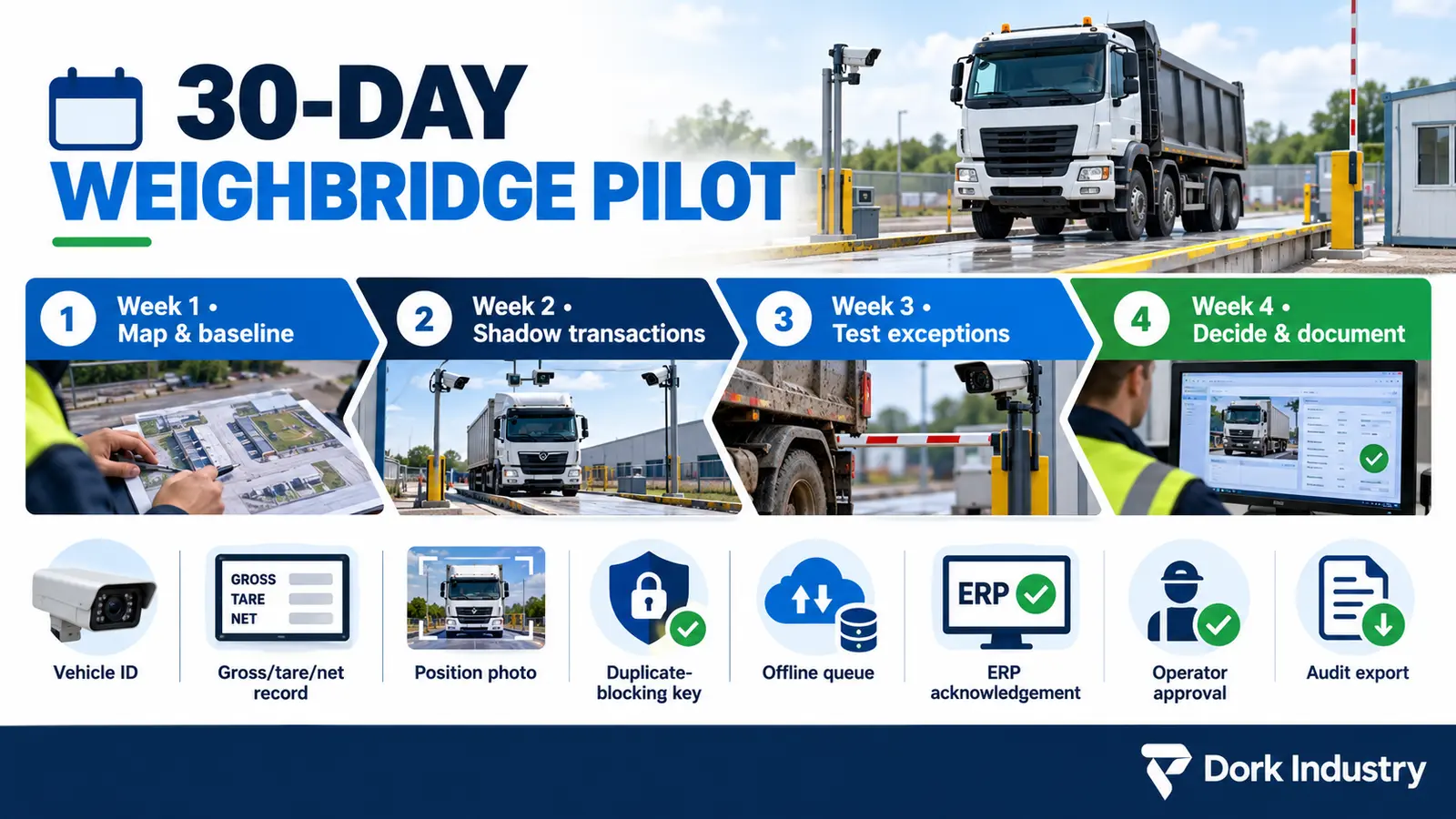
A pilot should prove control and recoverability before a full rollout. Run it in shadow mode where practical: compare automated records with the authorised current process without allowing the pilot to release vehicles or post financial records until approval.
- Week 1—map and baseline. Document lane sequence, roles, devices, masters, exceptions, documents and interfaces. Select a representative set of transactions; do not publish an improvement claim from an unrepresentative week.
- Week 2—shadow transactions. Capture identification, stable weight, evidence and validation while the approved process remains authoritative. Reconcile every pilot record by transaction ID.
- Week 3—test exceptions. Simulate reader outage, camera outage, partial position, wrong vehicle, closed order, stale tare, network failure, ERP rejection, ERP timeout, duplicate retry and authorised correction.
- Week 4—decide and document. Review missing data, false matches, unresolved events, recovery time, operator workload and support readiness. Approve, revise or stop against criteria agreed before the pilot.
What should the pilot worksheet record?
| Worksheet field | Record for every test |
|---|---|
| Scenario | Normal, mismatch, device failure, offline, duplicate, rejection or correction |
| Expected state | Blocked, queued, review required, accepted or completed |
| Evidence | Transaction ID, raw reading, stability, identity source, images and timestamps |
| Business link | Order, material, party, vehicle, gross/tare pair and downstream document |
| Decision | Rule triggered, person approving, reason code and time |
| Integration result | Request ID, acknowledgement, rejection, retry and final ERP record |
| Recovery | What failed, how detected, safe fallback, restoration and reconciliation |
| Outcome | Pass, fail, conditional pass, owner and corrective action |
This worksheet is an original decision framework, not a claim based on Dork Industry client performance. Set thresholds for data completeness, duplicate count, unresolved exceptions, device-health detection, reconciliation and recovery before testing. A pilot passes only when critical failures are closed or formally accepted by accountable owners.
How should Delhi NCR and North India facilities adapt the design?
Location is relevant when it changes the operating environment—not as a keyword inserted into an otherwise identical page. Delhi’s Wazirpur metal cluster may connect scrap intake, coil or batch tracking and dispatch billing. Bawana or Narela facilities may combine manufacturing, packaging, commodities or cold-chain traffic. Mayapuri operators may handle scrap grades and job work, while Ghaziabad–Sahibabad and Kundli–Sonipat sites may require multi-site dispatch or warehouse integration.
Those workflows differ in material masters, queue peaks, evidence, approval and billing. A useful site survey checks lane geometry, vehicle mix, indicator and communication protocol, camera placement, power conditioning, network coverage, dust and weather exposure, local service access, ERP location design and shift ownership. Multi-site operators should standardise transaction IDs and audit fields while allowing controlled local exceptions.
What should you bring to a discovery session?
- A lane sketch and list of devices, models and communication ports.
- One inward and one outward transaction from arrival through invoice or receipt.
- Current vehicle, material, supplier/customer and order master ownership.
- Three recent corrections or disputes with confidential fields redacted.
- ERP/WMS/accounting system, integration options and test-environment access.
- Network and power failure expectations, operating hours and support contacts.
- Applicable legal-metrology, tax, safety, privacy and record-retention advice.
- The decision that a 30-day pilot must support.
Plan a controlled weighbridge pilot
Dork Industry provides workflow assessment, custom software, IoT/device integration, ERP/API integration, dashboards and pilot engineering. We will first establish whether a standard product, configuration or custom build is justified.
Email support@dorkindustry.com or WhatsApp +91 8210792477.
Frequently asked questions
Can weighbridge automation software work with an existing weighbridge?
Often, yes, if the indicator exposes a documented and supportable communication method and the existing instrument is suitable for continued use. Confirm protocol, stability signal, device ownership, electrical isolation, warranty, verification status and safe fallback before promising compatibility.
What is the difference between RFID and ANPR at a weighbridge?
RFID reads an assigned tag; ANPR estimates a visible registration from an image. RFID depends on controlled tag issuance, while ANPR depends on plate visibility and recognition quality. Either can be wrong in a business context, so compare the identity with the assigned job and retain an exception path.
Can a weighbridge run when the internet is unavailable?
A correctly designed local lane may continue for approved workflows, but “offline” needs explicit rules. It should preserve transactions durably, show queued status, prevent duplicate IDs, restrict risky master changes and reconcile acknowledgements when connectivity returns.
How does weighbridge software integrate with an ERP?
The software validates a weighment transaction and exchanges controlled master or business records through a supported API, staging table, file or service. The integration must define field ownership, idempotency, authentication, rejection handling, retry and reconciliation.
Does automation remove the weighbridge operator?
Not necessarily. It can reduce routine entry, but someone must own safety, unusual loads, identity mismatches, device failures and commercial exceptions. Choose unattended operation only after those cases are controlled and support responsibilities are explicit.
What information should a weighment ticket contain?
The required content depends on the transaction and applicable rules. Operationally, teams usually need a unique transaction reference, vehicle and party context, material, gross/tare/net values, units, relevant timestamps and authorised status. Obtain specific legal and tax advice rather than copying a generic template.
How do you prevent duplicate ERP postings?
Assign a unique idempotency key to the business event, persist its state and require the receiving system to return the existing result when the same key is retried. Reconcile uncertain timeouts before creating a replacement event.
How much does weighbridge automation software cost?
Cost depends on lanes, existing indicators, RFID/ANPR and sensors, cameras, barriers, offline requirements, ERP integrations, dashboards, site work, support and compliance testing. A workflow assessment should separate reusable hardware, product licensing, configuration, custom engineering and ongoing support.
If you are comparing providers to build this, see our guide on how to compare AI automation providers in India, which rates eight providers on delivery, integrations, governance and pricing.
Want this automated for your business?
Book a free assessment — we map the workflow, check data readiness, and outline a pilot you can measure.
About the author
Dork Industry Technology Editorial Team researches and prepares practical guides for owners and operations teams evaluating IT, IoT, automation, ERP integration and custom software. The team separates verified sources, original editorial frameworks and recommendations from unverified product claims. Dork Industry is the technology-services brand associated with Lumetrix Mediatech LLP. This guide is educational and does not replace legal, tax, safety, metrology or privacy advice. Review the company profile, follow @dorkindustry on X, or contact support@dorkindustry.com.
[…] Theme code rarely controls the core hosted payment-method list, but custom carts, checkout extensions, payment customizations and apps can influence the journey or eligibility. If the cart itself is broken, use the Shopify Add to Cart repair guide. If a promotion changes the outcome, compare the Shopify discount diagnosis. […]