Quick answer: Microsoft Dynamics 365 services are implementation, migration, integration, security, testing, training and support capabilities that help a business operate the right CRM or ERP applications. Delhi businesses should compare providers against measurable workflows, evidence and ownership—not a long feature list.
Original framework data: Dork Industry grouped the 12 checks in this guide into three decision areas. Five checks (41.7%) test delivery controls such as data, integration, security, failure testing and handover. Four checks (33.3%) test scope and governance. Three checks (25%) test adoption and commercial continuity. The figures are an original classification of the framework below, not an industry-wide performance claim.
| Decision area | Checks | Share of framework |
|---|---|---|
| Delivery controls | 5 of 12 | 41.7% |
| Scope and governance | 4 of 12 | 33.3% |
| Adoption and continuity | 3 of 12 | 25.0% |
Source and method: Dork Industry original analysis of the 12 checks in this article. Product boundaries were cross-checked against the Microsoft Dynamics 365 documentation. Percentages are descriptive of this framework only.
Methodology: In October 2026, Dork Industry analysed a defined sample of 12 buyer-side controls (n=12). Our analysis found that delivery controls form the largest group at 41.7%, followed by scope and governance at 33.3%, and adoption and continuity at 25.0%. The difference between the largest and smallest groups is 16.7 percentage points. These reproducible calculations describe this checklist; they do not estimate project-success rates.
How should external benefit studies be interpreted? Microsoft reported that a commissioned Forrester study modelled $42.65 million in three-year benefits against a $9.5 million investment for a composite Field Service organisation, producing a 346% modelled ROI and payback in under six months. Those figures are scenario-specific—not a promise for a Delhi implementation. Use them as a prompt to build your own baseline and benefit case. Review Microsoft’s summary of the Forrester study.
Reviewed on 9 October 2026. Written by Nishant Singh for Dork Industry.
What should decision-makers know first?
- Choose modules only after mapping the workflows, users, data and controls that must change.
- Compare Microsoft Dynamics 365 services using the same discovery, migration, integration, testing and support scope.
- Separate licensing decisions from implementation effort and third-party integration costs.
- Use a controlled pilot with acceptance criteria before committing every department.
- Require documentation, administrator training and a clear exit or handover plan.
What do Microsoft Dynamics 365 services include?
Microsoft Dynamics 365 services cover the work required to assess, configure, integrate, migrate, test, deploy and support Dynamics 365 business applications. Depending on the problem, that may involve Sales, Customer Service, Customer Insights, Field Service, Finance, Supply Chain Management, Commerce, Project Operations or Business Central.
The software subscription is only one part of the decision. Implementation quality depends on process ownership, data readiness, integration boundaries, security roles, reporting definitions and user adoption. A partner should explain which requirements can be configured, which need extensions and which should remain in an existing system.
Why should the workflow be diagnosed before choosing a module?
A product-led discussion can encourage a business to buy applications before defining the operational problem. Start with the current workflow: who creates a record, who approves it, which system owns it, where delays occur and how success will be measured. Only then should Microsoft Dynamics 365 services be scoped.
Which problems justify a Dynamics 365 assessment?
- Sales teams maintain different lead, quotation and follow-up records.
- Finance and operations reconcile orders manually between CRM, ERP and spreadsheets.
- Customer-service requests arrive through email, phone and WhatsApp without one queue.
- Management reports require repeated exports and manual corrections.
- Legacy systems cannot support required integrations, controls or audit trails.
- Multiple branches use inconsistent customer, product or vendor data.
These symptoms do not automatically mean every process belongs in Dynamics 365. The assessment should identify whether the right action is to configure an existing application, integrate two systems, replace a legacy platform or redesign a process first.
How should a Delhi business select Dynamics 365 applications?
Delhi and NCR businesses often coordinate teams, suppliers, warehouses, service operations and customers across several locations. Geography supports workshops and stakeholder access, but module selection must follow the operating model. Avoid buying overlapping capabilities simply because several product demonstrations look useful.
| Business need | Application to assess | Questions before selection |
|---|---|---|
| Lead and opportunity control | Dynamics 365 Sales | How are leads assigned, qualified, quoted and forecast? |
| Case and service management | Customer Service | What channels, queues, entitlements and escalation rules exist? |
| Finance and supply-chain operations | Finance / Supply Chain Management | Which entities, approvals, inventory rules and statutory processes are required? |
| SMB financial and operational management | Business Central | Will standard processes fit, and which local integrations are necessary? |
| On-site service | Field Service | How are work orders, skills, inventory, schedules and mobile updates handled? |
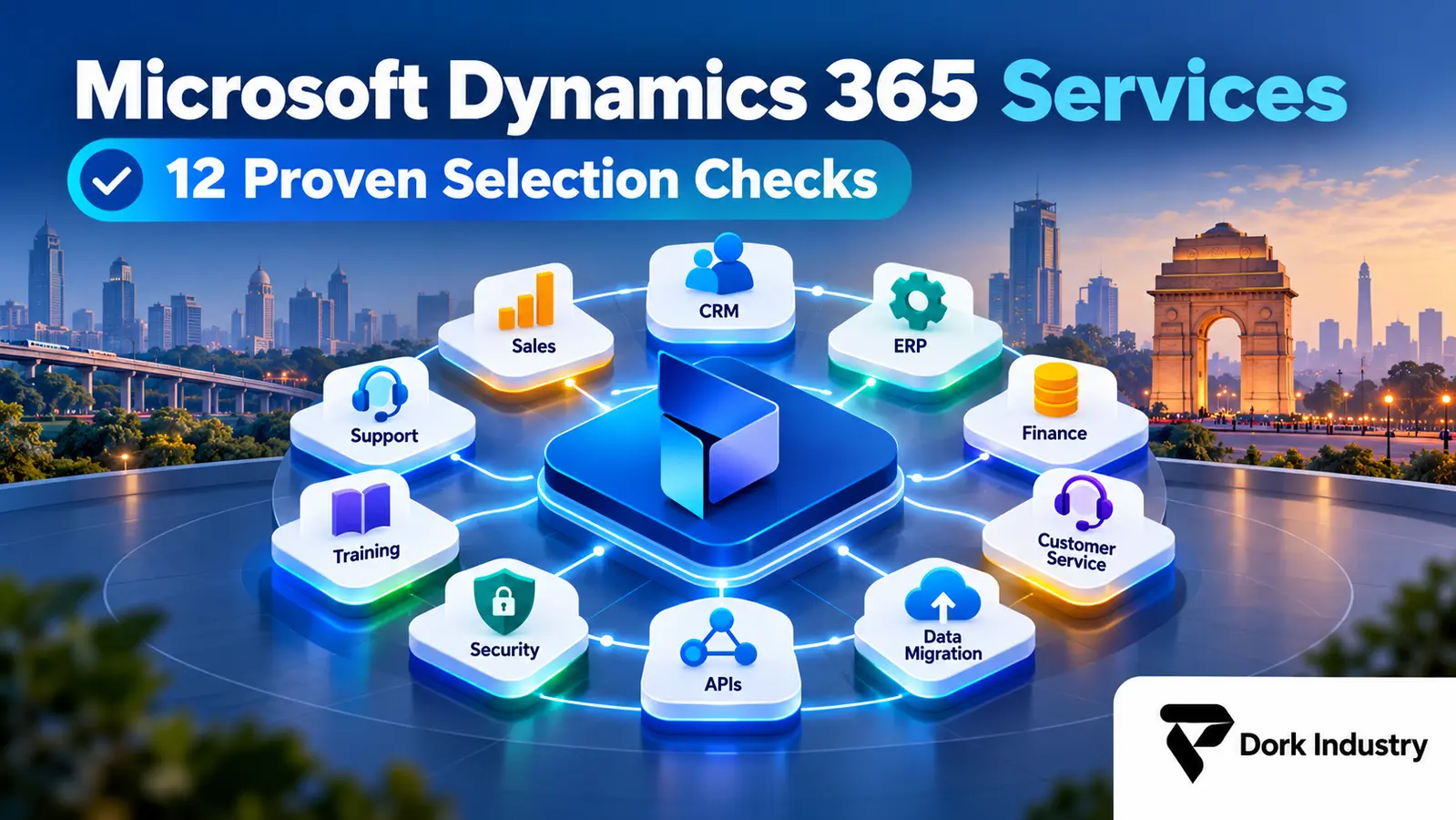
Which 12 checks should you apply to Microsoft Dynamics 365 services?
1. Is discovery tied to measurable business outcomes?
A strong engagement defines baseline measures such as lead-response time, case backlog, order-entry errors, reconciliation effort or approval delay. Microsoft Dynamics 365 services should connect configuration decisions to these measures. Avoid generic promises such as “digital transformation” without an operational definition.
2. Does the proposal separate configuration, customization and integration?
Configuration uses supported application capabilities. Customization changes behaviour or introduces extensions. Integration exchanges data with another system. Each has a different maintenance burden. The proposal should state which category every major requirement belongs to and why.
3. Are licensing assumptions documented?
Microsoft licensing changes over time and depends on applications, user types, capacity and contract terms. Ask the provider to document assumptions and direct you to current Microsoft licensing sources. Do not treat an old online price table as a final commercial quote.
4. Is data migration treated as a controlled workstream?
Migration should include profiling, ownership, cleansing, mapping, transformation, validation, reconciliation and rollback. Ask how duplicates, inactive records, missing identifiers and attachments will be handled. A successful import is not enough; users must trust the migrated data.
5. Are integrations designed around system ownership?
Each customer, product, order, invoice and support record needs an authoritative system. Microsoft Dynamics 365 services should document data direction, trigger conditions, retry behaviour, duplicate prevention, monitoring and failure ownership for every important integration.
6. Are security roles designed before user acceptance testing?
Security should follow job responsibility, least privilege and separation of duties. Define business units, teams, roles, field-level restrictions and administrative access before testing. Sensitive finance, employee and customer information should not be exposed merely to simplify implementation.
7. Is the solution maintainable after updates?
Ask how extensions, Power Platform components, connectors and third-party applications will be tested against platform changes. Supported patterns, environment separation and documented dependencies reduce the risk that one update interrupts a critical workflow.
8. Are reports based on agreed definitions?
A dashboard is only reliable when teams agree on what a lead, active customer, open case, booked order or overdue task means. Microsoft Dynamics 365 services should include data definitions, ownership and reconciliation—not only visual report construction.
9. Does testing include exceptions and failure scenarios?
User acceptance testing should cover normal flows, missing data, duplicates, rejected approvals, unavailable integrations, incorrect permissions and recovery steps. Require named test owners and evidence. A demonstration where every step succeeds is not production testing.
10. Is training role-specific?
Sales representatives, service agents, finance users, managers and administrators need different training. Use realistic data and daily tasks. Include administrator handover, support procedures and short reference guides so adoption does not depend on the implementation team remaining present.
11. Are support responsibilities measurable?
The proposal should define support hours, severity levels, response targets, escalation, monitoring and ownership of Microsoft or third-party tickets. Clarify whether ongoing optimization, new reports and process changes are included or separately estimated.
12. Can the business exit or change providers safely?
Confirm ownership of configurations, custom code, documentation, environments and credentials. Require deployment records and an exportable backlog. Good Microsoft Dynamics 365 services reduce dependency by leaving the client with understandable systems and controlled access.
Request a Dynamics 365 implementation assessment
Dork Industry can map one priority workflow, assess application fit, identify migration and integration risks, and define a practical pilot for your decision team.
Explore Dynamics 365 services Request assessment on WhatsApp
How should data migration and integration be planned?
Plan migration and integration as business-control work, not background technical tasks. Begin with an inventory of systems, entities, owners, volumes, retention rules and quality problems. Decide which data moves, which remains accessible in an archive and which should be deleted under an approved policy.
- Profile source data and agree quality thresholds.
- Define authoritative systems and integration direction.
- Create mapping and transformation specifications.
- Run trial migrations with reconciliation reports.
- Test interfaces under failures, duplicates and rate limits.
- Approve cutover, rollback and post-launch validation.
For Microsoft Dynamics 365 services involving Power Platform, Azure, ecommerce, telephony, ERP or custom applications, require an interface register. It should name the owner, authentication method, data exchanged, frequency, error route and monitoring approach.
What security and governance questions matter?
Ask where data is stored, which environments exist, who can administer them, how privileged access is reviewed and how audit information is retained. The solution should apply least privilege, multifactor authentication, approved service accounts and controlled deployment procedures.
AI and Copilot features require an additional review of permitted data, grounding sources, output validation and human approval. Do not allow a model to approve payments, alter contractual information or send sensitive customer messages without appropriate controls.
How can you run a decision-ready pilot?
A pilot should test one valuable end-to-end workflow with representative users, data and integrations. It should not be a disconnected demonstration. Use the worksheet below before accepting a proposal for Microsoft Dynamics 365 services.
| Pilot item | Decision to document |
|---|---|
| Workflow | One process from trigger to measurable outcome |
| Users | Named roles, approvers and administrator |
| Data | Representative records, exceptions and quality thresholds |
| Integration | One production-relevant interface and failure test |
| Success | Baseline, target, measurement method and owner |
| Exit | Go, revise or stop criteria plus handover materials |
Should you configure, customize or buy another application?
Configure Dynamics 365 when standard processes can meet the requirement. Customize only when the business value justifies ownership and regression testing. Keep a specialist application when it already performs a critical vertical function well, and integrate it where the interface is supportable.
A good provider may recommend doing less. The aim is not to move every spreadsheet and legacy rule into Dynamics 365. The aim is to create a controlled operating model that users can maintain and management can measure.
Frequently asked questions
What are Microsoft Dynamics 365 services?
Microsoft Dynamics 365 services include assessment, application selection, configuration, customization, data migration, integration, security design, testing, training, deployment and support for Microsoft’s CRM and ERP applications.
How long does a Dynamics 365 implementation take?
Duration depends on applications, users, data, integrations, customization and rollout strategy. A focused pilot is faster than an enterprise rollout, but it still needs representative data, security, testing and measurable acceptance criteria.
Can Dynamics 365 integrate with an existing ERP or website?
Often yes, when the systems provide supported APIs, connectors, events or database interfaces. The design must define system ownership, authentication, data mapping, duplicate prevention, monitoring and recovery.
Is Dynamics 365 only for large enterprises?
No. Microsoft offers applications for different operating models, including Business Central for many small and midsize organisations. Suitability depends on workflow complexity, users, controls, integration needs and total ownership cost.
What should be included in a Dynamics 365 proposal?
The proposal should state scope, applications, users, assumptions, configuration, extensions, integrations, migration, environments, security, testing, training, deployment, support, exclusions, responsibilities and acceptance criteria.
Does Dork Industry provide Microsoft Dynamics 365 services outside Delhi?
Yes. Dork Industry can deliver assessment, integration and implementation support remotely while arranging workshops according to the project’s stakeholder and operating requirements.
Define the right Dynamics 365 scope before you buy
Send one workflow, the current systems and the business result you need. Dork Industry will help structure an assessment, pilot or integration plan.
How was this guide researched?
Dork Industry reviewed the five ranking results returned for the target query on 9 October 2026: Microsoft’s Dynamics 365 overview, Microsoft’s “What is Dynamics 365?” guide, the Customer Service implementation overview, Dynamics 365 documentation and the Experience Dynamics portal. These pages explain products and documentation well but do not provide one buyer-side checklist covering vendor scope, data ownership, migration acceptance, integration recovery, adoption and handover.