
Quick answer: Kubernetes development services help a business assess application readiness, containerize suitable workloads, design clusters, automate delivery, secure runtime access, add observability and support production operations. A buyer should approve Kubernetes only when the expected reliability, release speed or portability benefit exceeds the added platform complexity.
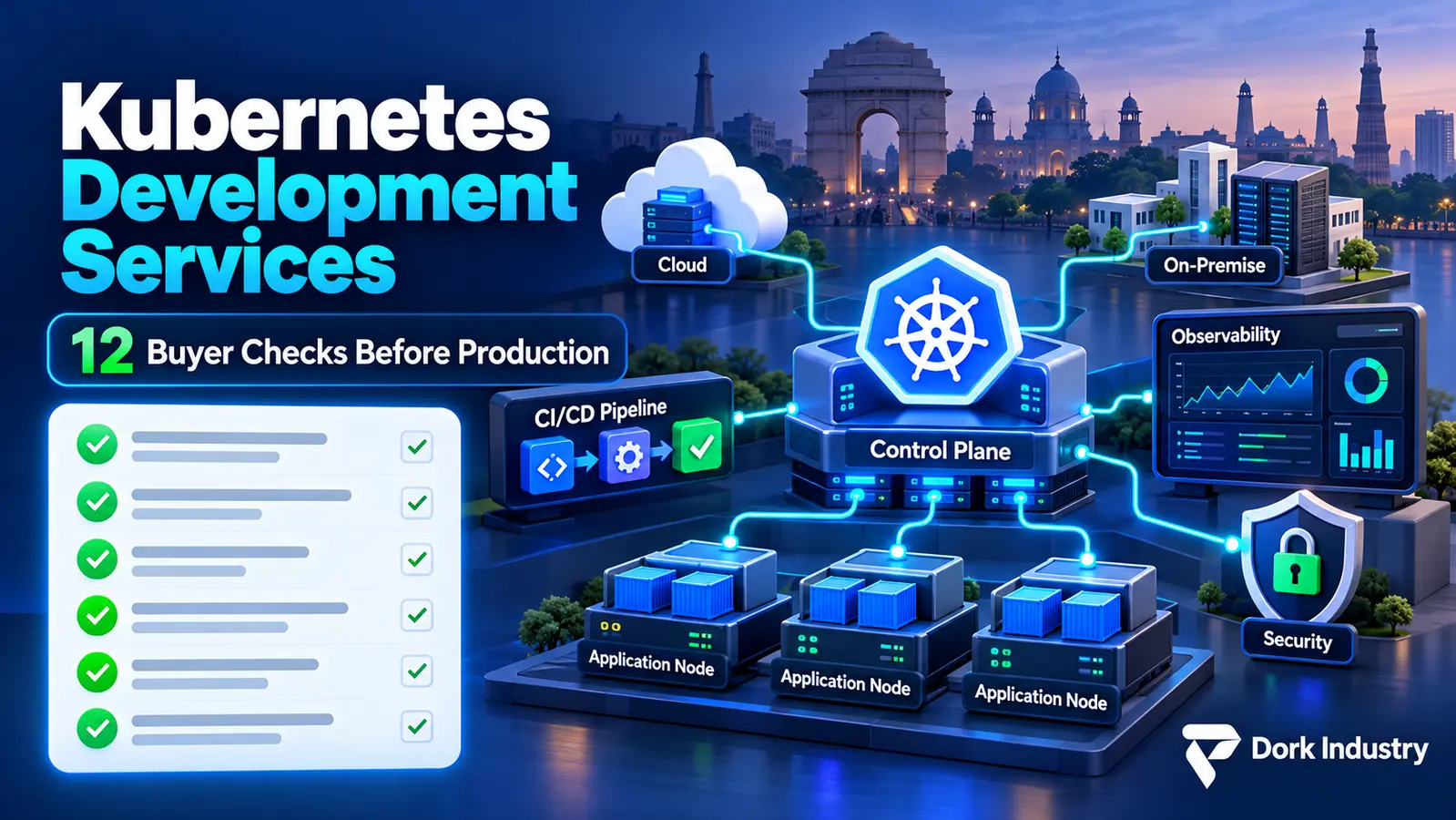
Original framework data: Dork Industry classified the 12 checks in this guide into three buyer-control areas. Five checks (41.7%) test platform safety and operations. Four checks (33.3%) test application delivery and reliability. Three checks (25.0%) test commercial governance and handover. These figures describe this framework, not an industry-wide success rate.
| Buyer-control area | Checks | Share |
|---|---|---|
| Platform safety and operations | 5 of 12 | 41.7% |
| Application delivery and reliability | 4 of 12 | 33.3% |
| Commercial governance and handover | 3 of 12 | 25.0% |
Methodology: In October 2026, Dork Industry analysed a defined sample of 12 buyer controls (n=12). The largest and smallest control groups differ by 16.7 percentage points. The calculation is reproducible from the numbered checks below and is intended to make the framework’s priorities transparent.
Reviewed 9 October 2026. Written by Nishant Singh for Dork Industry.
What should buyers know first?
- Kubernetes is not automatically the right destination for every application.
- Readiness depends on workload architecture, deployment frequency, operational ownership, security and recovery requirements.
- Compare Kubernetes development services using identical deliverables and acceptance evidence.
- Require a production-like pilot before moving a critical workload.
- Keep cloud charges, platform engineering effort and application remediation visible as separate cost lines.
What are Kubernetes development services?
Kubernetes development services are professional services for assessing, building, migrating, securing, automating and operating applications on Kubernetes. The scope can include container engineering, cluster design, infrastructure as code, CI/CD, secrets, policy controls, observability, cost controls, disaster recovery and platform support.
The service is not merely “installing Kubernetes.” Production responsibility crosses application code, container images, registries, networking, identity, storage, cloud infrastructure and incident response. A useful proposal names the owner and evidence for every layer.
CNCF reported that 82% of container users ran Kubernetes in production during 2025, up from 66% in 2023. That adoption signal demonstrates maturity, but it does not prove that Kubernetes is economical for every workload. Review the CNCF survey announcement.
A separate CNCF 2024 survey summary reported that 80% of responding organizations ran Kubernetes in production, 60% used CI/CD for most or all applications, 57% used automated vulnerability-detection tools, and 77% had adopted GitOps principles. These community-survey figures describe respondents rather than a guaranteed outcome for a buyer. They reinforce why delivery automation and security evidence belong in a vendor assessment. Read the CNCF research summary.
According to CNCF’s State of Cloud Native Development research, the study drew on a survey reaching more than 10,000 developers. CNCF later reported 15.6 million developers using cloud-native technologies, with 77% of backend developers using at least one such technology; hybrid-cloud use reached 32% and multi-cloud use 26% among developers. These figures describe ecosystem adoption, not project ROI. Read the CNCF research methodology.
How can a business diagnose Kubernetes readiness?
Start with the delivery and operating problem. Do releases fail because environments differ? Does demand vary enough to justify automated scaling? Is one application blocking independent releases? Do regulated workloads need stronger isolation and auditable controls? Kubernetes development services should translate those symptoms into testable requirements.
Which conditions indicate a reasonable fit?
- Several containerized services need repeatable deployment and independent scaling.
- Teams already use automated builds, tests and versioned configuration.
- The business has defined availability, recovery and security objectives.
- Operations personnel can own alerts, upgrades, capacity and incident response.
- Portability or hybrid deployment has a measurable business reason.
When might Kubernetes be unnecessary?
A stable monolith with low traffic, infrequent releases and a small operating team may be cheaper on a managed application platform or virtual machine. Kubernetes can add control-plane, networking, policy and skills overhead. The right provider should be willing to recommend a simpler option when it meets the requirement.
Which 12 checks should buyers apply to Kubernetes development services?
1. Does discovery begin with measurable outcomes?
Define the current release lead time, deployment failure rate, recovery time, availability target and infrastructure effort. The proposal should state which measure the platform will change. “Modernization” is not an acceptance criterion.
2. Is each workload assessed before containerization?
Inventory runtime dependencies, state, storage, scheduled jobs, external services, session handling and licensing restrictions. Record what must change and what can remain unchanged. Avoid converting an application into microservices solely to satisfy a platform decision.
3. Is the cluster model justified?
Ask why the design uses a managed or self-managed control plane, how many clusters and environments are needed, and where isolation boundaries sit. Multiple clusters can improve separation but increase upgrades, policies and observability work.
4. Are deployment and rollback automated?
Every production change should be traceable to versioned configuration and a controlled pipeline. Require deployment strategies, approvals, health checks and rollback evidence. A successful first deployment does not demonstrate a safe operating system.
5. Are security controls mapped to threats?
Review identity, RBAC, service accounts, secrets, image provenance, network policies, admission controls, audit logs and node hardening. Kubernetes describes its official security checklist as a baseline rather than an exhaustive guarantee, so the provider must adapt it to the workload. Consult the Kubernetes security checklist.
6. Does observability support decisions?
Logs, metrics and traces should help teams detect user impact, isolate a failing dependency and measure service objectives. Ask which alerts require action, who receives them, and how noise is controlled. Dashboard quantity is not the same as operational visibility.
7. Are stateful services treated separately?
Databases and queues need documented storage classes, consistency assumptions, backup verification, restore testing and failure-domain design. Kubernetes orchestration does not replace database resilience. Buyers should see a recovery demonstration using representative data.
8. Are resource requests and limits evidence-based?
CPU and memory settings influence scheduling, stability and cost. Require measurements from realistic load tests, not copied defaults. The team should explain autoscaling signals, capacity headroom and how it will detect throttling or out-of-memory failures.
9. Is platform cost measured end to end?
Include compute, storage, network egress, load balancers, security tools, observability retention, backups and engineering support. Separate one-time migration cost from recurring platform cost. Compare the total with a simpler hosting model using the same reliability target.
10. Is failure recovery rehearsed?
Test failed deployments, unavailable nodes, exhausted capacity, expired certificates, registry outages and lost credentials. Document detection, escalation, rollback and business communication. Recovery time should be observed during the pilot rather than promised in a slide.
11. Are upgrades and lifecycle ownership explicit?
Kubernetes, node images, add-ons, controllers and application dependencies change independently. The contract should identify supported versions, upgrade cadence, compatibility testing, maintenance windows and responsibility for deprecated APIs.
12. Can another team operate the result?
Require architecture decisions, repositories, runbooks, inventory, access records, pipeline documentation and administrator training. Good Kubernetes development services reduce provider dependency by leaving an understandable and supportable platform.
Request a Kubernetes readiness assessment
Dork Industry can assess one application, identify remediation and platform risks, and design a production-like pilot with measurable acceptance criteria.
What architecture and operating model should the proposal show?
A credible design connects business objectives to technical ownership. It should show traffic entry, identity, cluster boundaries, namespaces, workloads, data stores, registries, delivery pipelines, secrets, policies, telemetry and recovery services. It should also show what remains outside Kubernetes.
| Control | Required evidence | Named owner |
|---|---|---|
| Delivery | Versioned pipeline and demonstrated rollback | Application/platform team |
| Security | Access matrix, policy tests and audit records | Security owner |
| Reliability | Service objectives, alerts and recovery drill | Operations owner |
| Data | Backup, restore and reconciliation results | Data owner |
| Cost | Tagged baseline and monthly variance review | FinOps/business owner |
How should this framework be used? Treat the 12 checks as a procurement and pilot worksheet. Adapt their weight to the workload’s risk, regulatory obligations and operating model rather than treating every Kubernetes project as identical.
What should a Kubernetes pilot prove?
Use one representative but non-critical application. A useful pilot proves the delivery and operating model, not merely that a container starts. Agree the worksheet before implementation.
- Business objective: Name the release, reliability or portability problem.
- Baseline: Record current deployment time, failure rate, recovery time and monthly cost.
- Scope: List included services, data, integrations and environments.
- Security gates: Define identity, image, secrets and policy requirements.
- Load test: Use representative traffic and failure conditions.
- Recovery test: Demonstrate rollback, node loss and data restoration.
- Operations test: Let the client team respond using the runbook.
- Decision: Compare observed results with the baseline and stop criteria.
Should you build, configure or buy the platform capability?
Use managed services when they satisfy the required control and reduce undifferentiated operations. Configure standard tooling when the process is common. Build custom components only when a verified requirement cannot be met safely by supported options.
A Delhi business should also decide whether it needs a project team, an embedded platform engineer or ongoing managed support. Kubernetes development services are suitable for a defined modernization or platform build. Managed support is more appropriate when upgrades, monitoring, incidents and capacity need continuous ownership.
Frequently asked questions
How much do Kubernetes development services cost?
Cost depends on application remediation, cluster count, cloud model, security controls, data services, delivery automation, observability and support coverage. Request separate estimates for assessment, pilot, migration and recurring operations. A responsible provider needs workload and reliability requirements before offering a defensible estimate.
How long does a Kubernetes migration take?
A limited pilot may take weeks, while a portfolio migration can require several phases. Timing depends on container readiness, stateful data, integrations, testing and organizational approvals. Estimate after a workload inventory, then use the pilot to replace assumptions with observed effort.
Is managed Kubernetes always better?
No. Managed control planes reduce some infrastructure responsibility, but the client still owns workload configuration, access, policies, data protection, observability and incident response. Compare the provider’s responsibility model against the capabilities your team can reliably operate.
Can Kubernetes run on-premises and in the cloud?
Yes, but common orchestration does not make every environment identical. Networking, storage, identity, load balancing and support models differ. Use hybrid or multi-cloud only when a clear regulatory, resilience, latency or commercial requirement justifies the additional engineering.
What security evidence should a vendor provide?
Ask for an access matrix, image and dependency controls, network policies, secrets handling, admission policies, audit logging, vulnerability remediation workflow and recovery evidence. The official Kubernetes application security checklist provides useful baseline guidance for developers. Review the application checklist.
What should happen after the pilot?
Review measured outcomes, unresolved risks, operating effort and total cost. Approve expansion only if acceptance criteria passed. Otherwise remediate the application, simplify the architecture or select a different hosting model. A pilot is valuable even when the correct decision is not to proceed.
Turn the checklist into a scoped pilot
Email support@dorkindustry.com or contact Dork Industry on WhatsApp at +91 8210792477. Bring one application diagram, current deployment process and reliability requirement. We will help define a practical readiness assessment, architecture or engineering engagement.
Methodology and sources
This guide was prepared after reviewing the five organic results returned for “Kubernetes development services” in India on 9 October 2026. The analysis compared page intent, depth, architecture coverage, operational controls and commercial journey. Dork Industry added buyer controls that were absent or inconsistent across those pages. Product and security statements were cross-checked against:
Original SERP analysis: Dork Industry inspected 5 ranking pages (n=5). Extractable page lengths were 0, 719, 2,835, 1,169 and 620 words; the median extractable length was 719 words. Three of five results (60%) were classified as shallow, one (20%) as moderate and one (20%) as deep. All five lacked a complete combination of production rollback, failure recovery and measurable acceptance evidence. The 0-word result was blocked from full extraction, so only its verified search snippet and visible structured signals were assessed.
- Kubernetes Security Checklist
- Kubernetes Application Security Checklist
- Kubernetes: Securing a Cluster
- CNCF Annual Cloud Native Survey
Discuss this for your business?
Book a free consultation — we scope the problem, outline the approach, and give you an honest verdict before any development is discussed.
About the author: Nishant Singh writes for Dork Industry about software development, cloud platforms, AI, IoT and business systems. His work focuses on practical evaluation methods, integration boundaries, operating risks and measurable pilot decisions for organizations selecting technology services. He reviews technical implementation choices from a buyer’s perspective, connecting architecture, security, delivery evidence, support ownership and commercial outcomes without presenting vendor claims as guaranteed results.
[…] Theme code rarely controls the core hosted payment-method list, but custom carts, checkout extensions, payment customizations and apps can influence the journey or eligibility. If the cart itself is broken, use the Shopify Add to Cart repair guide. If a promotion changes the outcome, compare the Shopify discount diagnosis. […]