
Reviewed by Nishant Singh, Founder of Dork Industry. This buyer guide combines external search-demand research with practical CRM, integration, migration and software-delivery controls.
A Salesforce implementation partner helps a business translate sales, service and reporting requirements into a configured, integrated and usable Salesforce system. The right partner should prove how it will handle data migration, permissions, integrations, testing, adoption and post-launch ownership—not simply demonstrate attractive screens or list certifications.
For a Delhi business, choosing a Salesforce implementation partner is a commercial-risk decision as much as a technology decision. A weak discovery process can reproduce broken workflows inside a new CRM. A strong process starts with measurable business outcomes, tests assumptions with real users and makes cutover, rollback and support responsibilities explicit.
Dork Industry research note: Google Ads Keyword Planner data retrieved on 16 October 2026 recorded approximately 590 average monthly searches in India for “salesforce implementation partner,” 69.5% three-month growth, a high top-of-page advertiser bid of ₹570.33, and approximately 70 monthly searches in Delhi for the partner variant. These are planning signals, not guaranteed traffic forecasts. Source: Google Ads Keyword Planner via the Dork MCP research connection.
The buying context is also changing. Salesforce reports that 89% of respondents consider AI strategy and capabilities when selecting a CRM vendor. Its 2026 India sales research says 91% of Indian sales leaders who deployed agents consider them critical, while its connectivity research reports that 96% of IT leaders say agent success depends on integration across systems. These figures strengthen the case for evaluating data readiness and integration ownership—not merely licence configuration. Sources: Salesforce CRM implementation guide, State of Sales in India 2026, and Salesforce Connectivity Report 2026.
Need an implementation scope before comparing proposals?
Dork Industry can assess your lead flow, customer data, integrations, security requirements and adoption risks, then prepare a practical Salesforce implementation roadmap.
Request an assessment on WhatsApp Email support@dorkindustry.com
What should a Salesforce implementation partner actually deliver?
A capable implementation partner should deliver an agreed operating model, not just a configured Salesforce org. The work normally includes requirements discovery, process mapping, solution architecture, configuration, carefully governed customisation, data preparation and migration, integration design, permission modelling, testing, user training, cutover and support.
Salesforce’s own partner-selection guidance recommends matching selection criteria to project size, complexity and risk, then checking ratings, completed projects, certified professionals and demonstrated cloud expertise. It also recommends deciding who will evaluate partners before the selection process begins. See the official Salesforce implementation partner selection guidance.
Why do Salesforce projects fail even when the software works?
The system can be technically available while the implementation still fails commercially. Common causes include undefined ownership, copying inefficient legacy processes, migrating duplicate records, excessive customisation, unclear integration boundaries, weak acceptance tests and poor user adoption. These problems create unreliable forecasts, shadow spreadsheets and low confidence in CRM data.
Before contacting any provider, run this quick diagnostic:
- Can sales, service and management agree on the three outcomes the CRM must improve?
- Do you know which system owns customer, product, pricing and invoice data?
- Can you identify duplicate accounts, incomplete contacts and obsolete fields?
- Are approval rules and exceptions documented, or do they exist only in employee knowledge?
- Do teams agree on definitions for a qualified lead, opportunity stage and closed deal?
- Can business users describe the reports required on launch day?
- Is there a named product owner who can accept or reject scope decisions?
If several answers are “no,” begin with a discovery and data-readiness phase. Purchasing licences or starting configuration immediately will not solve missing governance.
How should you choose a Salesforce implementation partner in Delhi?
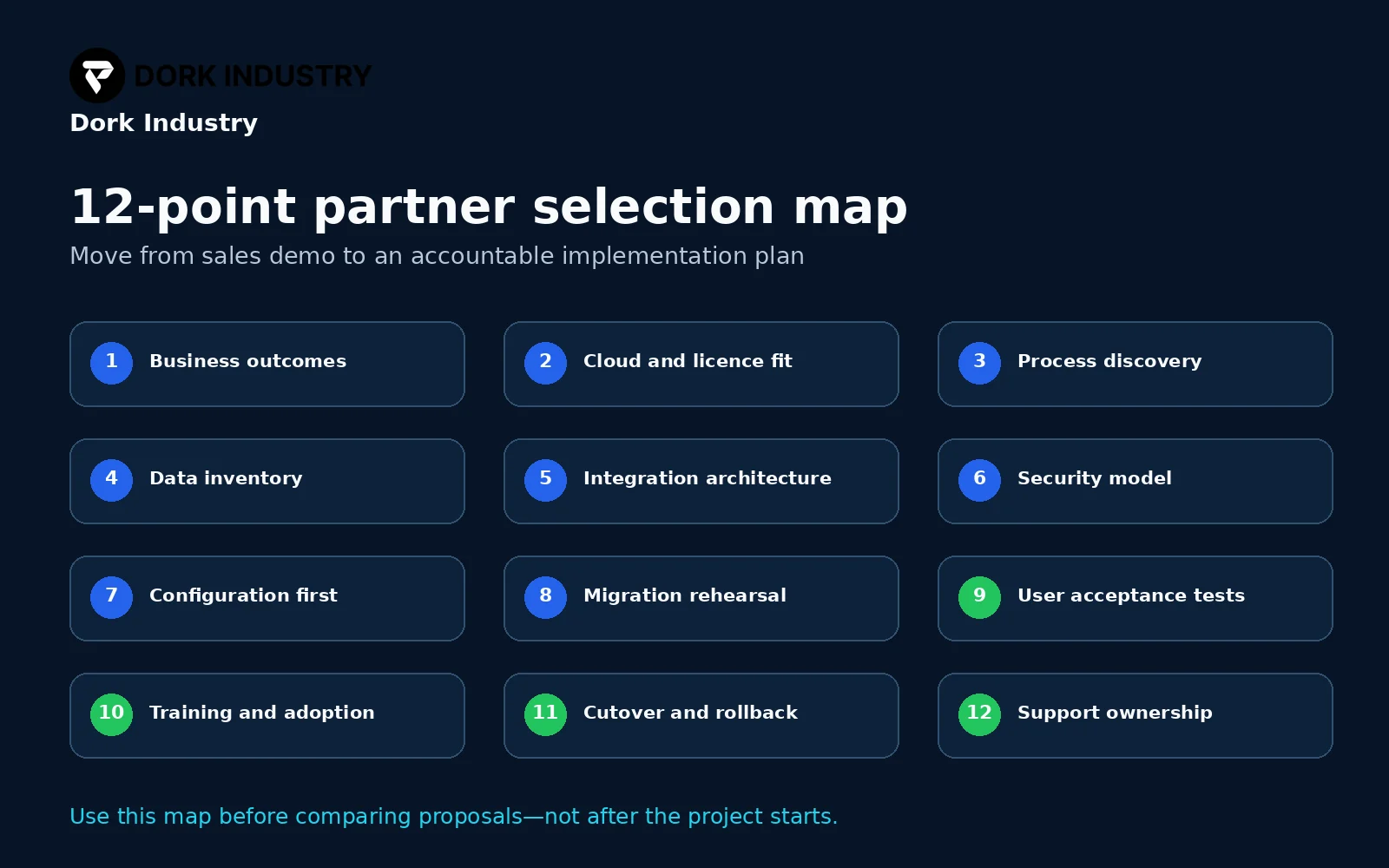
Use the following 12 checks to compare partners on evidence, delivery controls and accountability. Score each proposal against the same requirements instead of allowing every vendor to define a different scope.
1. What measurable business outcomes should be agreed?
Ask the partner to convert objectives into measurable acceptance criteria. “Improve sales visibility” is not testable. “Show pipeline value by region, owner and stage from approved opportunity data with daily refresh” is testable. Outcomes should cover revenue operations, service quality, management reporting, compliance or cycle-time reduction.
2. Which Salesforce cloud and licences actually fit?
The proposal should explain why Sales Cloud, Service Cloud, Experience Cloud, Data Cloud or another product is required. It should separate Salesforce subscription costs from implementation costs and identify assumptions about editions, sandboxes, API limits, storage and add-ons. Never accept a licence recommendation that is disconnected from users, processes and integration volume.
3. How will process discovery happen before configuration?
A discovery workshop should trace the current workflow from trigger to outcome: lead capture, qualification, quotation, approval, order handoff, service request or renewal. It should record exceptions, role handoffs, decision rules and the information each user needs. The partner must identify what should be simplified before it is automated.
4. What must the field-level data inventory include?
A migration plan should state which objects, fields, files, activities and relationships will move; what will be archived; how duplicates will be resolved; and how totals will be reconciled. Salesforce recommends loading objects in dependency order and preserving legacy identifiers to maintain relationships and support validation. Review the official Salesforce data migration practices.
5. How should the integration architecture be reviewed?
List every connected system: website forms, WhatsApp, telephony, ERP, ecommerce, marketing tools, payment services, accounting software, support systems and data warehouses. For each connection, document the source of truth, direction, frequency, expected volume, duplicate controls, authentication, retry behaviour, failure alerts and reconciliation owner.
The Salesforce Architects integration guide describes multiple patterns and recommends choosing them according to the scenario rather than forcing every exchange through one method. See the official Salesforce integration patterns and selection guidance.
6. How will the security and permission model be tested?
The partner should design access from job responsibilities, data sensitivity and separation-of-duty requirements. Ask for profiles or permission sets, role hierarchy, sharing rules, field-level security, integration-user controls, audit requirements and an offboarding procedure. Salesforce’s shared-responsibility model states that customers remain responsible for configuration, access controls, custom code and data governance on the platform. Consult the Salesforce Well-Architected trust guidance.
7. When should configuration be preferred over custom code?
Custom code is appropriate when a verified requirement cannot be met safely and maintainably through standard configuration. Ask the partner to label every proposed component as standard, configured, third-party or custom. For custom components, require the business reason, testing approach, deployment method, ownership and likely maintenance impact.
8. What should a migration rehearsal prove?
A rehearsal should use representative data in a non-production environment. Measure rejected records, duplicates, missing relationships, transformed values and load duration. Reconcile record counts and important financial or operational totals. The final cutover plan should incorporate the evidence from this rehearsal.
9. Which user acceptance tests must pass?
User acceptance tests should mirror real work. Examples include converting a web enquiry into a qualified opportunity, applying a discount approval, synchronising an order to ERP, reopening a service case and producing a management forecast. Each test needs an owner, input data, expected outcome and pass/fail result.
10. How will user adoption be designed and measured?
Training alone does not create adoption. Involve representative users during discovery and prototype reviews. Remove unnecessary fields and clicks. Define role-based dashboards and identify team champions. Salesforce’s CRM adoption guidance emphasises cross-team alignment, user feedback, data integrity and training as part of implementation—not as an afterthought. See the official CRM adoption guide.
11. What are the cutover, rollback and continuity controls?
The go-live plan should specify data freeze windows, final loads, validation, user activation, integration switching, communication and escalation. It should also define the conditions that trigger rollback, who decides, how changes made during the window are protected and how operations continue if a critical dependency fails.
12. Who owns the system after launch?
Agree who handles defects, enhancement requests, release reviews, user administration, security audits, failed integrations and data-quality monitoring. Separate warranty work from new scope. The support agreement should state response targets, channels, included hours, exclusions, knowledge-transfer deliverables and exit arrangements.
What affects Salesforce implementation cost in Delhi?
Implementation cost is driven by scope and risk—not simply user count. A proposal becomes more expensive when it includes multiple clouds, complex approval paths, poor-quality legacy data, historical activities or files, high-volume integrations, advanced security, custom development, extensive reports, multi-company structures or a compressed cutover window.
| Cost driver | Question to ask | Evidence required |
|---|---|---|
| Process scope | How many distinct workflows, roles and exceptions are included? | Approved process maps and scope matrix |
| Data migration | Which objects, years, files and relationships will move? | Field inventory, sample extract and reconciliation plan |
| Integrations | Which systems exchange which data and how often? | Interface register and failure-handling design |
| Customisation | What cannot be handled through standard configuration? | Decision log and maintainability assessment |
| Security | Which data needs restricted access, audit or retention controls? | Access matrix and security test cases |
| Adoption | Which teams require prototypes, training and support? | Role-based adoption plan |
Ask every shortlisted provider to price the same work-breakdown structure: discovery, architecture, configuration, custom development, integrations, data migration, testing, training, cutover and support. Record assumptions, exclusions and change-control rules. This makes proposals comparable and exposes a low quote that has omitted essential work.
Should you configure, build or buy Salesforce functionality?
| Approach | Use it when | Main risk to control |
|---|---|---|
| Configure Salesforce | The requirement fits standard objects, flows, reports and security controls. | Overcomplicating configuration without governance |
| Buy an AppExchange product | A proven specialist capability already exists and fits the workflow. | Recurring cost, vendor dependency and data-access scope |
| Build custom functionality | The requirement differentiates the business or cannot be met safely otherwise. | Technical debt, test coverage and long-term ownership |
| Integrate an existing system | Another platform should remain the source of truth. | Failures, duplicate updates, latency and reconciliation |
The correct answer may combine all four approaches. The Salesforce Well-Architected Framework evaluates quality through trust, reliability, operational excellence, resource and cost optimisation, and fairness. Use these principles to challenge short-term customisation that creates long-term risk. Review the official Salesforce Well-Architected Framework.
What should a Salesforce implementation proposal contain?
- Business objectives and measurable success indicators
- In-scope and out-of-scope processes, users and business units
- Proposed Salesforce products, editions and licence assumptions
- Solution architecture and integration boundaries
- Data-migration objects, volumes, cleansing and reconciliation
- Security roles, permissions and compliance responsibilities
- Configuration, AppExchange and custom-development decisions
- Delivery phases, milestones, dependencies and client responsibilities
- Testing, acceptance, cutover and rollback plans
- Training, adoption and change-management activities
- Support, warranty, documentation and knowledge transfer
- Commercial model, assumptions, exclusions and change control
Get a proposal-ready Salesforce requirements worksheet
Send Dork Industry your current lead sources, user roles, existing CRM or spreadsheets, required reports and connected systems. We will convert them into a discovery checklist you can use to compare implementation proposals.
How can you test a Salesforce partner before committing to the full project?
Use a short paid discovery or proof-of-concept with a defined exit. Give the partner one representative workflow, a small anonymised data sample and one important integration boundary. Require a process map, solution options, risks, acceptance tests and a delivery estimate. Do not request a disposable demo that hides migration, security and ownership questions.
What does a practical 30-day validation plan include?
- Week 1: confirm outcomes, stakeholders, process boundaries and success measures.
- Week 2: profile sample data, review integrations and design permissions.
- Week 3: configure a representative workflow and prepare acceptance tests.
- Week 4: run user tests, document gaps and produce the phased implementation roadmap.
At the end, judge the partner on clarity, evidence, risk disclosure, documentation and responsiveness—not on how many features were placed in the prototype.
Questions to ask during a Salesforce partner interview
- Which requirements would you challenge or simplify before configuration?
- How will you demonstrate traceability from requirements to test cases?
- What is your approach to duplicate detection and migration reconciliation?
- How are integration failures detected, retried and assigned?
- Which security decisions remain our responsibility?
- What custom code do you expect, and why is configuration insufficient?
- How will you measure adoption after launch?
- What documentation and source assets do we receive?
- How does change control affect schedule and cost?
- What happens if we change support providers later?
Frequently asked questions
What is a Salesforce implementation partner?
A Salesforce implementation partner analyses business requirements and helps configure, integrate, migrate, test and deploy Salesforce. Depending on scope, the provider may also deliver custom development, user training, adoption support and managed services. Official Salesforce consulting-partner status and certifications should be verified independently through Salesforce or AppExchange.
How long does Salesforce implementation take?
Duration depends on process scope, data quality, integrations, customisation, stakeholder availability and testing. A controlled implementation should publish milestones and dependencies after discovery instead of promising a universal timeline before examining the workflow and data.
What should be completed before Salesforce configuration starts?
Confirm business outcomes, process owners, scope, user roles, data sources, integration boundaries, required reports and acceptance criteria. Also appoint a product owner who can resolve priority and scope decisions quickly.
How do we avoid over-customising Salesforce?
Require every custom component to include a documented business reason, standard configuration alternatives, maintenance impact, test plan and owner. Prefer configuration where it meets the requirement without creating a fragile or confusing user experience.
How do we verify a Salesforce implementation partner?
Check the provider’s relevant cloud experience, named delivery team, certifications, references, completed projects and AppExchange profile where applicable. Validate the proposed architecture and delivery controls; a badge alone does not prove the team understands your workflow, data and integration risks.
Can Dork Industry help if we already use Salesforce?
Yes. Dork Industry can assess workflows, CRM integrations, data-quality problems, reporting gaps, automation requirements and custom-development needs. The outcome can be a remediation plan, integration project, phased enhancement roadmap or dedicated developer engagement.
Choose the partner by evidence, not presentation
The best Salesforce implementation partner in Delhi for your organisation is the one that can make scope, architecture, data, security, testing and ownership visible before the largest spending begins. A persuasive demonstration is useful, but a testable delivery plan protects the investment.
Dork Industry provides CRM assessment, Salesforce implementation support, API integration, data migration planning, automation and custom software development. To discuss your project, contact support@dorkindustry.com or message +91 8210792477 on WhatsApp.
Reviewed for practical implementation, integration, security and buyer-decision completeness by Dork Industry. Last updated: October 2026.
Before you sign a quote, see our comparison of best AI automation companies in India.
Discuss this for your business?
Book a free consultation — we scope the problem, outline the approach, and give you an honest verdict before any development is discussed.
[…] Theme code rarely controls the core hosted payment-method list, but custom carts, checkout extensions, payment customizations and apps can influence the journey or eligibility. If the cart itself is broken, use the Shopify Add to Cart repair guide. If a promotion changes the outcome, compare the Shopify discount diagnosis. […]