
Azure cost optimization is the continuous process of reducing unnecessary cloud spend while preserving the workload’s required performance, reliability, security and delivery speed. A safe program begins with cost ownership and a stable baseline, removes obvious waste, rightsizes with workload evidence, and only then evaluates reservations, savings plans or architectural changes.
Quick answer
Do not start Azure cost optimization by buying a commitment. First allocate spend, remove idle resources, validate rightsizing against service-level guardrails, and rebuild the usage baseline. Commit only the stable demand that remains, then verify savings against actual—not forecast—cost.
This guide is for CFOs, CTOs, cloud platform leads, FinOps practitioners and IT operations teams facing an Azure budget overrun, renewal, post-migration cost spike or planned capacity purchase. It provides a 30-day assessment plan, a risk-adjusted savings method and the evidence to request from an internal team or external cloud partner.
What are the key Azure cost optimization takeaways?
- Separate genuine business growth from waste before setting a reduction target.
- Assign every material cost to a workload owner, environment and business outcome.
- Remove waste and rightsize before purchasing reservations or savings plans.
- Evaluate each change against reliability, performance, recovery and delivery guardrails.
- Record forecast savings, realized savings and avoided costs separately.
- Turn one-time cleanup into budgets, alerts, policy and a monthly optimization cadence.
Is your Azure bill rising faster than workload value?
Dork Industry can build a workload-level baseline, prioritize low-risk savings and prepare an implementation backlog before you buy more capacity or make a long-term commitment.
Why is Azure cost optimization a commercial opportunity now?
External Google Ads Keyword Planner research performed for this article measured an average 110 monthly searches for the exact query azure cost optimization in the United States and 90 in India. The three-month change was +240% in the United States and +27.3% in India at the time of research. These are directional advertising-platform estimates, not guaranteed organic traffic, but the pattern shows increasing demand around a problem with immediate financial consequences.
The United States is the primary geographic context because it had the largest measured exact-query demand and the strongest recent momentum. The method remains relevant to Azure customers globally; the article does not create a doorway page or assume that every workload should be hosted in one country.
What do the top five results cover—and what do buyers still need?
The current leading results include Microsoft’s Azure Advisor Cost Optimization workbook, the nOps 2026 guide, Microsoft’s Cost Management recommendations tutorial, FinOps Forge’s 12-strategy guide and CloudZero’s complete guide. Together they explain visibility, unused resources, rightsizing, reservations, savings plans, storage, databases and governance.
The missing layer is decision evidence. A buyer needs to know which baseline to use, who accepts performance risk, how forecast savings are adjusted for engineering effort, when a recommendation should be rejected, and how realized savings are verified after the change. This article focuses on that operational and purchasing gap.
What problem are you actually trying to solve?
A larger invoice does not automatically mean waste. Spend may rise because customer demand, data volume, availability requirements or a successful migration increased. The correct question is: which costs are not producing proportionate business or operational value?
Can you complete this ten-minute diagnostic?
- Can at least 80% of material Azure spend be assigned to a product, workload, environment and owner?
- Can finance distinguish metered cost, amortized commitment cost, credits and shared charges?
- Which five services caused the largest month-over-month variance?
- Did usage, unit price, architecture or data retention cause each variance?
- Which service-level objective could be harmed by reducing each cost?
- Which commitments are underused, expiring or based on an obsolete baseline?
If several answers are unknown, the first deliverable is not a savings promise. It is an allocation and measurement plan.
What should happen during a 30-day Azure cost optimization assessment?
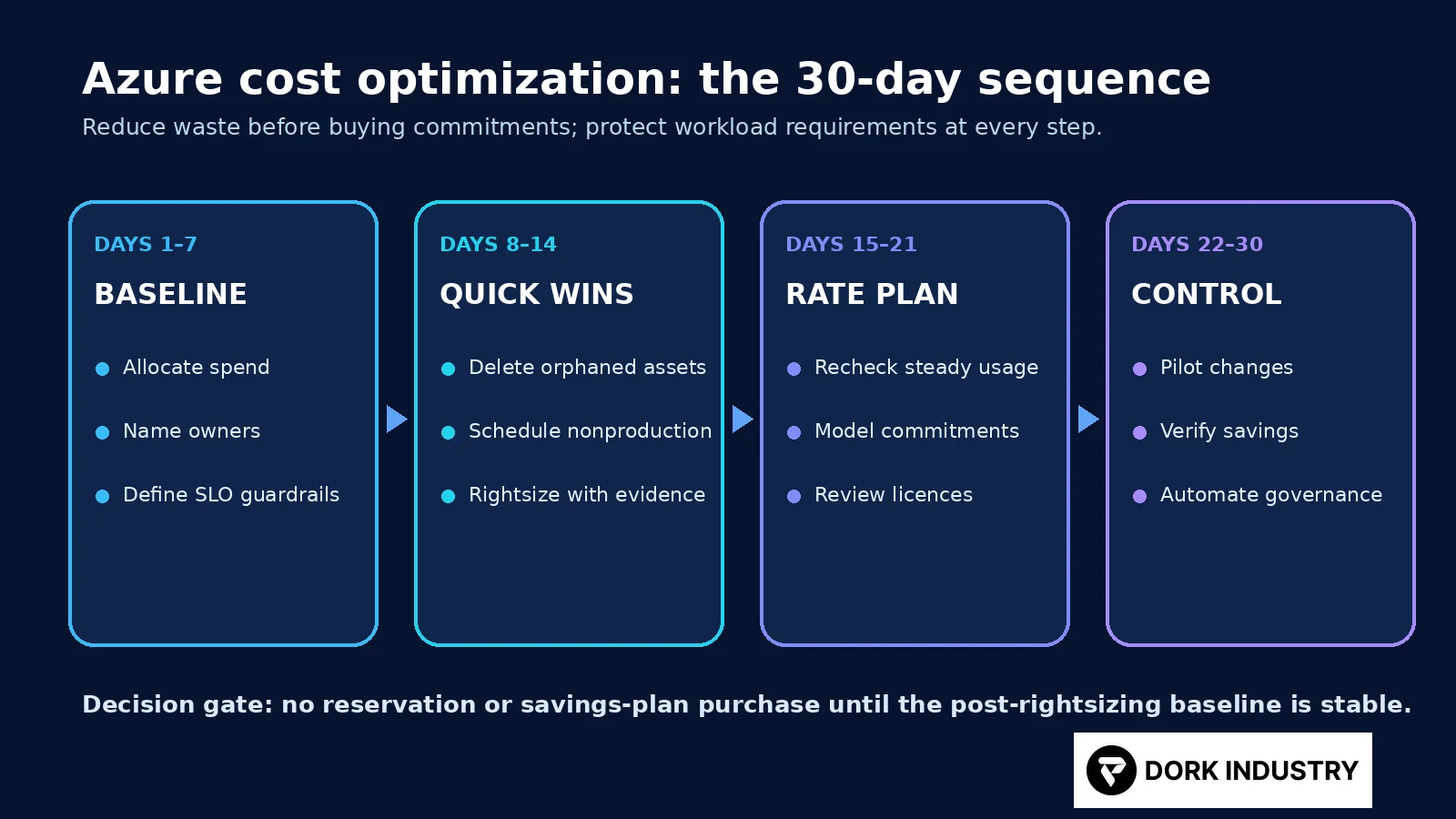
Days 1–7: How do you build a trustworthy baseline?
Export cost and usage data for a representative period and map subscriptions, resource groups and resources to owners, environments and applications. Separate production from nonproduction, shared from direct costs, and one-time migration activity from recurring run rate.
Define guardrails before ranking opportunities. Examples include latency, throughput, availability, recovery targets, deployment windows and data-retention obligations. Microsoft’s Azure Well-Architected Cost Optimization checklist frames cost optimization as balancing cost with business value and functional and nonfunctional requirements.
Deliverable: a normalized baseline, ownership map, cost-driver list and approved guardrails.
Days 8–14: Which low-risk waste should be removed first?
Start with resources that provide no current business value: unattached disks, unused public IP addresses, abandoned snapshots, idle development systems and obsolete test environments. Schedule nonproduction resources around actual working windows where appropriate.
Rightsize compute, databases and platform tiers only after reviewing utilization, peaks, seasonality and scale behavior. A recommendation becomes implementable when it names the owner, expected savings, operational risk, rollback path and verification period.
Deliverable: an approved quick-win backlog with change tickets and rollback criteria.
Days 15–21: When should you evaluate reservations or savings plans?
Commitment analysis should use the demand that remains after waste removal and rightsizing. Microsoft’s guidance on calculating Azure Advisor savings recommends sequencing rightsizing or shutdown before reservations and savings-plan purchases because each step changes the following recommendation.
Model coverage, utilization, term, scope, currency, growth scenarios and exit constraints. Do not commit variable or short-lived usage merely to improve a forecast. Review Azure Hybrid Benefit and licensing eligibility with the organization’s licensing specialist.
Deliverable: a commitment decision memo with assumptions, scenarios and accountable approval.
Days 22–30: How do you verify savings and prevent regression?
Pilot changes in a controlled group. Compare post-change cost and service behavior with the baseline, accounting for demand changes. Record realized savings only after the observation period; track forecast savings and avoided future cost separately.
Create budgets, anomaly alerts, tag policies, deployment guardrails and a monthly owner review. Optimization becomes durable when teams see unit cost and receive feedback near the engineering decision—not only when finance reviews the invoice.
Deliverable: a verified savings report, prioritized 90-day backlog and governance schedule.
Which Azure costs can be optimized automatically?
Automation works well for evidence collection, known schedules and policy enforcement. It can identify unattached assets, stop approved nonproduction resources, enforce required tags, trigger budget alerts and open tickets from Advisor recommendations.
Automation should not independently approve a workload resize, delete uncertain data, change recovery coverage or purchase a long-term commitment. Those decisions require workload context, an authorized owner and a rollback or exit plan.
| Activity | Automate? | Required human decision |
|---|---|---|
| Detect untagged resources | Yes | Confirm owner and allocation rule |
| Schedule approved dev/test systems | Yes | Approve access window and exception |
| Delete unattached storage | Partly | Confirm retention and rollback evidence |
| Rightsize a production database | Recommend only | Accept performance and recovery risk |
| Purchase a reservation | No | Approve forecast, term, scope and flexibility |
How should you calculate risk-adjusted Azure savings?
Gross forecast savings can mislead when a change requires engineering effort, creates transition cost or increases service risk. Use a simple decision model:
Risk-adjusted benefit = forecast savings − implementation cost − ongoing tool or support cost − expected risk cost.
Expected risk cost can be approximated as the probability of an adverse event multiplied by its financial impact. The purpose is not artificial precision; it is to make tradeoffs explicit and comparable.
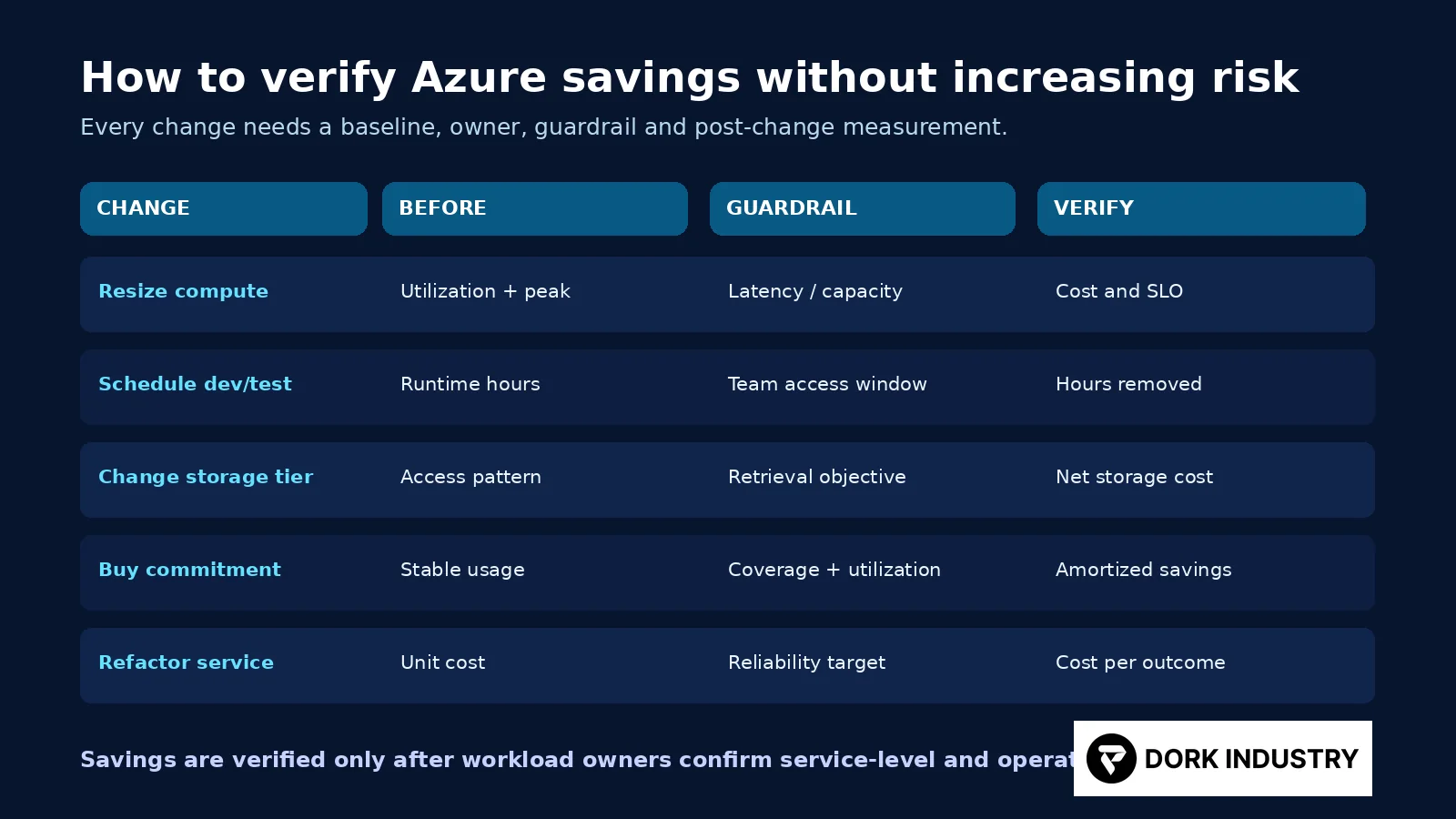
Which Azure cost optimization levers deserve investigation?
How can cost allocation improve the decision?
Use management groups, subscriptions, resource groups, naming standards and tags to assign spend. Shared platforms need an agreed allocation method. The FinOps Framework treats reliable cost data and allocation as foundations for informed cloud decisions.
Where do compute and container costs hide?
Review VM size and runtime, autoscaling bounds, dev/test schedules, orphaned scale sets, Kubernetes requests and limits, unused nodes and licence choices. For containers, optimize the application request profile and scheduling behavior rather than only shrinking the node pool.
How should storage and backup costs be reviewed?
Map access patterns, retention, redundancy, replication, snapshots and recovery requirements. Tiering cold data may reduce storage charges while increasing retrieval expense or time. Deleting a backup without a validated retention decision is not optimization.
Can database and platform services be optimized safely?
Examine tier, compute model, storage growth, high availability, replicas, backup retention and query behavior. Sometimes code or indexing work provides better unit economics than a smaller tier. Measure workload outcomes before and after the change.
When do architectural changes make sense?
Serverless, managed services, caching, asynchronous processing and regional redesign can improve cost, but they also change engineering effort, lock-in, failure behavior and support requirements. Treat them as investment cases with a pilot—not quick wins.
Should you configure tools, build automation or hire a partner?
| Approach | Best when | Main limitation |
|---|---|---|
| Use native Azure tooling | Small or moderately complex estate with capable owners | Recommendations still need business context and action |
| Buy a FinOps platform | Large multi-account or multi-cloud estate needing allocation and workflow | Licence cost and implementation do not guarantee adoption |
| Build targeted automation | Repeated controls are unique and stable | Requires engineering ownership and maintenance |
| Hire an optimization partner | Skills, independence or implementation capacity is missing | Scope must require evidence and knowledge transfer |
If Azure costs increased after a migration, review the original assumptions and operating model alongside Dork Industry’s guide to buying cloud migration services for a data-center exit. A migration is not financially complete until the legacy footprint is retired and the cloud environment is governed.
What should an Azure cost optimization partner deliver?
- A baseline that finance and engineering can reproduce.
- A cost-allocation and ownership coverage report.
- An opportunity backlog with assumptions, risk, effort and expected benefit.
- Service-level guardrails and rollback plans for material changes.
- A commitment analysis based on post-rightsizing demand.
- Change implementation and post-change verification evidence.
- Budgets, alerts, policy and a continuing review cadence.
- Knowledge transfer, documentation and access ownership.
Request a decision-ready Azure optimization backlog
Dork Industry can assess cost allocation, utilization, commitments, architecture and governance, then help implement approved changes with measurable guardrails.
Email: support@dorkindustry.com | WhatsApp: +91 8210792477
Frequently asked questions about Azure cost optimization
What is Azure cost optimization?
Azure cost optimization aligns cloud spend with workload value while protecting required performance, reliability, security and delivery speed. It combines allocation, waste removal, rightsizing, rate optimization, architectural improvement and ongoing governance.
Should we buy Azure reservations before rightsizing?
Usually no. Remove waste and rightsize first because those actions change the stable demand used for commitment recommendations. Then model reservations or savings plans against the new baseline, coverage goals and flexibility needs.
How quickly can Azure cost optimization produce savings?
Approved idle-resource cleanup and nonproduction scheduling may affect the next billing period. Rightsizing, licensing, commitments and architectural changes need longer observation and approval. Report realized savings only after usage and service outcomes are verified.
Does Azure Advisor implement every recommendation automatically?
No. Advisor identifies recommendations, but workload owners must confirm context, operational risk and timing. Some actions can be automated after approval; production resizing, data deletion and commitment purchases should retain human authorization.
How do we know whether savings are real?
Compare normalized post-change cost with a documented baseline, adjust for demand changes, and confirm that agreed service-level guardrails were preserved. Keep forecast savings, realized savings and avoided future costs as separate measures.
Can Dork Industry implement the approved recommendations?
Yes. Dork Industry can assess the Azure estate, prepare the evidence-backed backlog, implement approved infrastructure or application changes, configure governance and transfer documentation. Scope depends on access, workload risk and the organization’s change process.
What should you do next?
Begin with one representative billing period, the five largest cost variances and the workload owners responsible for them. Establish the baseline and guardrails before changing resources. If the team cannot reproduce the numbers or agree who accepts risk, fix that foundation first.
For a 30-day Azure cost optimization assessment, contact support@dorkindustry.com or message Dork Industry on WhatsApp.
About the author: The Dork Industry Editorial Team creates implementation-focused guidance with input from software, cloud, integration and automation practitioners. Dork Industry helps businesses assess, build, migrate and operate practical technology solutions. Recommendations are grounded in current primary sources and operational review.
Research note: Keyword and competitor research was completed on 18 October 2026. Keyword Planner figures are directional averages and can change by location, date and match behavior. Primary technical sources include Microsoft Learn’s Azure Well-Architected Framework, Azure Advisor and the FinOps Framework.